
3D Printing
News Videos Newsletter Contact us
Home / Construction / 3D Printing Glass Fixtures for Facades

3D Printing Glass Fixtures for Facades

October 14, 2020

Building glass facades help to create a smooth aesthetic for buildings, often concealing structure underneath to create something more visually fitting for the city where the building is being constructed.

But facades are not easy to mount on buildings. They often require mounting holes to be machined into the glass plate, and the holes can act as stress concentrators and can crack over time.

The other traditional ways of fixing facade glass into frames require some form of adhesive which can deteriorate under environmental conditions, such as UV light from the sun.

Either scenario can require replacement of panels as the fastenings deteriorate. If only there was some method of joining similar pieces of glass together additively…

Glass on Glass

The Glass Competence Center (ISM+D and MPA IfW) at the Technical University of Darmstadt, Germany has come up with a method of printing 3D glass features on float glass.

Float glass is made by floating molten glass on top of a pool of molten metal, traditionally tin or lead. This provides an incredibly smooth and flat glass surface which is used in a variety of applications, including windows and even flat panel TVs.

The team wanted to know if a joint of a similar material could be joined to the glass plate, minimizing brittle areas, ensuring the bond takes hold, and enabling the loads from the glass pane to be transferred predictably via the joint and into the mounting points on the building.

Naturally, this joining requires an application of heat to the glass bracket and also the joining faces of the pane itself. In order to join properly, the glass needs to be heated far above its transformation temperature. Heating it below that temperature will result in a poor bond (or no bond at all). Heating it too much can cause localized distortions and warping. Finding that sweet spot which preserves the join, the mechanical qualities of the system and the aesthetic finish, were therefore the main goals of this research. And you can see the results of one of these experiments in the image below.
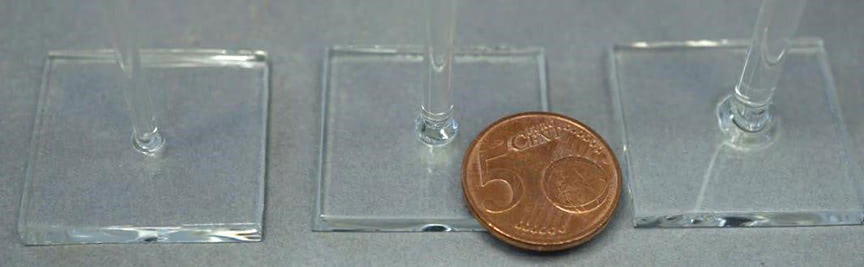
3d printing glass

The team experimented with a variety of glasses including soda-lime glass and also borosilicate-based glasses, and used some form of extrusion-based printer system, with a heated nozzle extruding tracks of molten glass onto the target, as seen in the example of the printed glass columns in the image above.

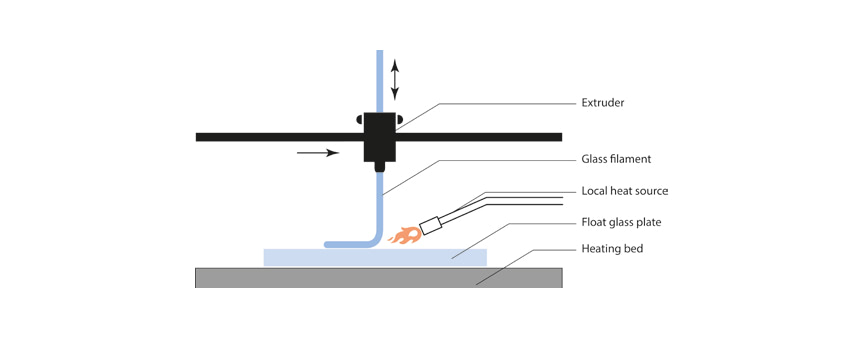
The university has stated that it is an FDM type process however, so one imagines a print gantry suspended over the vat of molten metal, depositing material onto the floating glass surface. While there are no images on the TU Darmstadt website, a quick Google search shows that the Darmstadt team have been working with TU Delft on this topic.

The image below is from another paper published jointly by Delft and Darmstadt, and seems to confirm this process. Note the heat source is separate from the print head, in opposition to traditional filament printing methods which hold the heater in the printer nozzle.
Other Glass Printing Methods

Glass printing is not a new phenomenon… researchers have been printing glass for at least 25 years. They seem to still be searching for that killer app though. Will it come in the form of printed fasteners? Maybe. They certainly offer cost savings, if the process is automated.

And that is the next step for the team: automation and repeatability. Now that the team has demonstrated that the process works, now it is a case of optimising the process and that will require automation.

And of course, simply automating a process does not mean the end of development…it may just be the beginning in fact. Glass used in architectural applications must not only be repeatable and homogeneous, but they must be tested for thermal shock and post-break behavior too.

But the foundation of the process has been demonstrated, and the research teams have some big names behind them (including Schott AG), so it seems only a matter of time before we see this technology hit the main stage (the glacial pace of AEC product certification processes notwithstanding).


Press Release
Share:
WhatsApp Twitter Facebook LinkedIn Buffer Reddit E-mail
About the author | Phillip Keane
Phillip is an aerospace engineer from UK. He is a graduate of Coventry University (UK), International Space University (France) and Nanyang Technological University (Singapore), where he studied Advanced Manufacturing at the Singapore Centre for 3D Printing.
Join our newsletter

Our newsletter is free & you can unsubscribe any time.

Latest posts

University of Utah Develops Holographic 3D Printer That Completes Prints in 20 Seconds

University of Utah engineers have built a holographic 3D printer that produces complete shapes in a single exposure rather than building them layer... read more »

News

Inside Vietnam’s First Connected Surgical Ecosystem, and the Role 3D Printing Plays Within It

When Vinmec switched on a nationwide robotic surgery network, the real advance was the connective tissue around it: preoperative 3D reconstruction, surgical simulation,... read more »

Medical

Best Castable Resin 2026: Clean-Burnout Picks for Jewelry Casting

Castable resin exists for one moment: the burnout. A printed pattern goes into investment plaster, the kiln takes it to several hundred degrees,... read more »

Resin

Best Water-Washable Resin 2026: Easy Cleanup Without the IPA

The messiest part of resin printing has never been the printing; it is the tub of isopropyl alcohol waiting afterwards. Water-washable resin removes... read more »

Resin

Best Flexible Resin 2026: Rubber-Like Picks by Shore Hardness

Flexible resin is the category where the material is the function. Nobody prints a gasket for its looks: the part exists to bend,... read more »

Resin

Best Tough and ABS-Like Resin 2026: Impact-Resistant Picks for Functional Parts

Standard resin has one famous weakness: it shatters. Drop a bracket, flex a clip, or over-tighten a printed thread and the part gives... read more »

Resin

Revopoint Trackit SR: Marker-Free, Wireless 3D Scanning Built for Industrial Metrology

An intelligent optical tracking, high-accuracy, marker-free wireless laser 3D scanner for metrology, reverse engineering, and quality inspection, with no reflective markers and no... read more »

News

Best Resin for Miniatures 2026: Sharp Detail That Survives Play

Miniatures are the hardest test you can set a resin. A 28 mm figure carries sub-millimetre detail, spear shafts thinner than a toothpick,... read more »

Resin

3D-Printed Piezoelectric Tooth Implant Restores Chewing Sensation in 90% of Trial Patients

Scientists in China have developed a 3D-printed tooth implant that restores the sense of chewing — a capability that conventional dental implants don't... read more »

Dental
3D-Printed Piezoelectric Tooth Implant Restores Chewing Sensation in 90% of Trial Patients

Nikon SLM Solutions and Bosch 3D Print Complete V8 Engine Block as a Single Piece

Nikon SLM Solutions and Bosch Industry Consulting have produced a complete V8 engine block as a single printed part, using the NXG XII... read more »

Automotive
Nikon SLM Solutions and Bosch 3D Print Complete V8 Engine Block as a Single Piece

Social

  • Facebook Facebook 3D Printing
  • Linkedin Linkedin 3D Printing
Join our newsletter

Our newsletter is free & you can unsubscribe any time.

Featured Industries

  • Automotive
  • Aerospace
  • Construction
  • Dental
  • Environmental
  • Electronics
  • Fashion
  • Medical
  • Military
  • Flashforge Guider 3 Ultra

    • - Print size: 330 x 330 x 600 mm
    • - dual extruder system
    More details »
    $2,999.00 Flashforge
    Buy Now
  • Flashforge AD5X

    • - Print size: 220 x 220 x 220 mm
    • - dual extrusion system
    More details »
    $399.00 Flashforge
    Buy Now
  • Qidi Q2

    • - Print size: 270 x 270 x 256 mm
    • - enclosed heated chamber up to 65°C
    More details »
    $580.00 Qidi
    Buy Now
  • Snapmaker U1

    • - Print size: 270 x 270 x 270 mm
    • - multi-color printing with SnapSwap
    More details »
    $849.00 Snapmaker
    Buy Now
  • Flashforge Adventurer 5M

    • - Print size: 220 x 220 x 220 mm
    • - 600mm/s travel speed
    More details »
    $299.00 Flashforge
    Buy Now
  • Anycubic Kobra S1 Combo

    • - Print size: 250 x 250 x 250 mm
    • - budget multicolor printing
    More details »
    $429.00 Anycubic
    Buy Now
  • Creality Hi Combo

    • - Print size: 260 x 260 x 300 mm
    • - up to 16-color printing
    More details »
    $399.00 Creality
    Buy Now
  • Qidi Max 4

    • - Print size: 390 x 390 x 340 mm
    • - active cooling air control
    More details »
    $1,219.00 Qidi
    Buy Now
  • Creality K2 Plus

    • - Print size: 350 x 350 x 350 mm
    • - multi-color printing
    More details »
    $1,199.00 Creality
    Buy Now
  • Anycubic Photon Mono M7

    • - Print size: 223 x 126 x 230 mm
    • - 10.1 inch 14K screen
    More details »
    $279.00 Anycubic
    Buy Now

Company Information

  • What is 3D Printing?
  • Contact us
  • Join our mailing list
  • Advertise with us
  • Media Kit
  • Nederland 3D Printing

Blog

  • Latest News
  • Use Cases
  • Reviews
  • 3D Printers
  • 3D Printing Metal

Featured Reviews

  • Anycubic Photon Mono M5s
  • Creality Ender 5 S1
  • The Mole 3D Scanner
  • Flashforge Creator 3 Pro

Featured Industries

  • Automotive
  • Aerospace
  • Construction
  • Dental
  • Environmental
  • Electronics
  • Medical
  • Military
  • Fashion
  • Art
2026 — Strikwerda en Dehue
  • Home
  • Join our mailing list
  • Contact us
Blog
  • Latest News
  • Use Cases
  • Reviews
  • 3D Printers
  • 3D Printing Metal
Featured Industries
  • Automotive
  • Aerospace
  • Construction
  • Dental
  • Environmental
  • Electronics
  • Medical
  • Military
  • Fashion
  • Art
Company Information
  • What is 3D Printing?
  • Contact us
  • Join our mailing list
  • Advertise with us
  • Media Kit
  • Nederland 3D Printing