
3D Printing
News Back to school deals Contact us
Home / News / 3D Printed Amino Acid Glass Can Dissolve in the Body
qidi

3D Printed Amino Acid Glass Can Dissolve in the Body

March 18, 2023

Researchers from the Chinese Academy of Sciences in Beijing have devised a means of 3D printing glass made from amino acids that can dissolve within the human body. This revolutionary material promises significant applications in the healthcare sector and beyond.

Amino Acid Glass

Traditional glass is a versatile material with numerous applications; however, it possesses certain drawbacks, such as brittleness and incompatibility with the human body.

To overcome these limitations, researchers have developed a unique glass material derived from amino acids, the building blocks of proteins, and peptides.
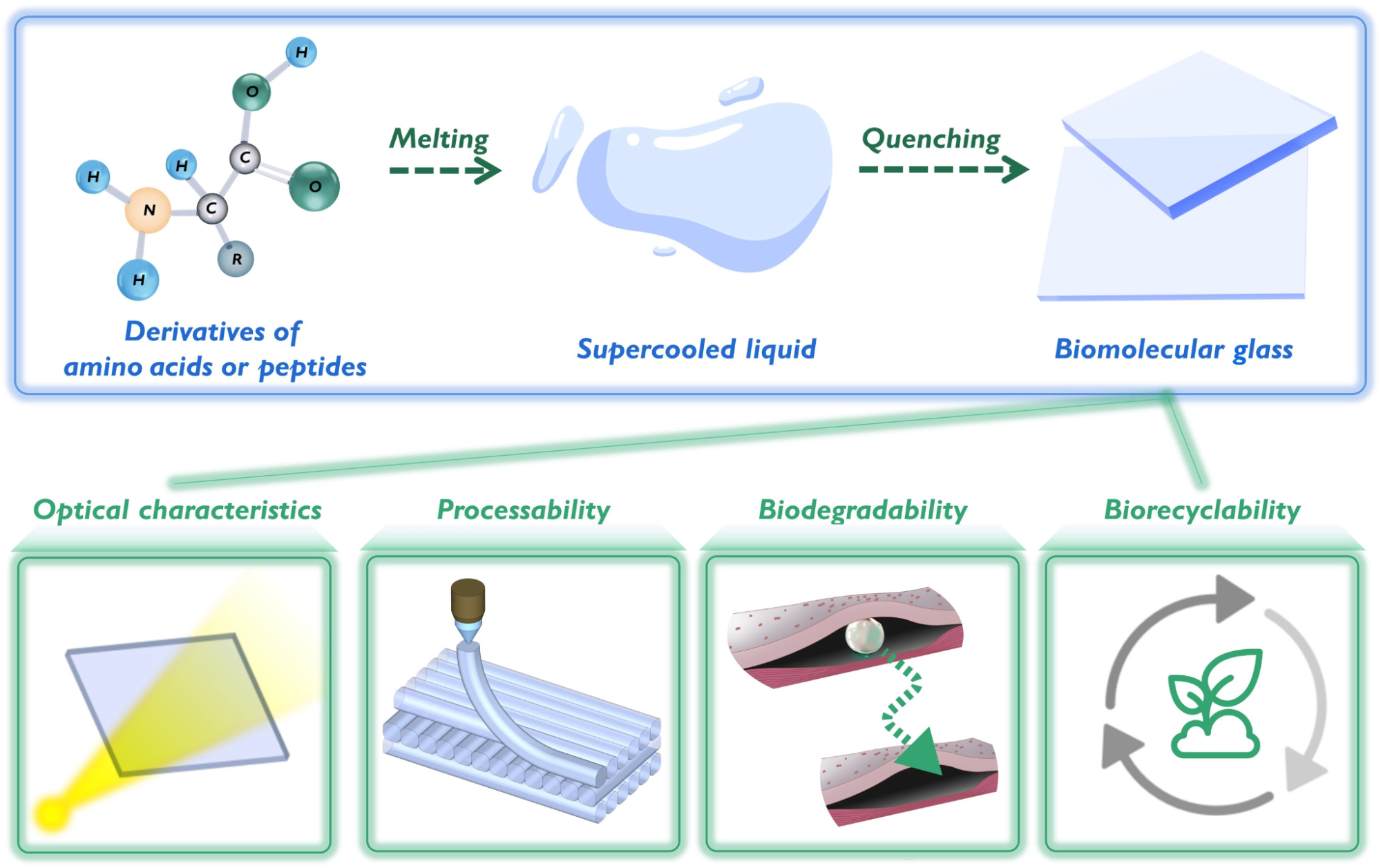
The fabrication process
The fabrication process. (Image credit: Chinese Academy of Sciences)

The method of making the glasses involved the heating of the chemically modified amino acids and peptides in an inert gas atmosphere until they reached their decomposition temperature. The resulting supercooled liquid was then quenched to produce the glass while preventing crystallization.

The team used this glass in casting methods and 3D printing to achieve the final shape of the parts, making use of a commercial biological 3D printer with a temperature-controlled barrel.

The novel glass combines the best qualities of both glass and amino acids, resulting in a material that is strong, flexible, and biocompatible, meaning it can be used for a range of medical devices.

Applications

Amino acid glass can be used for multiple scenarios such as the development of new drug delivery systems, which can release medication gradually over time. This approach can enhance the effectiveness of treatments and reduce side effects.

Additionally, new bioresorbable implants made from amino acid glass can provide temporary structural support to the body while healing, eventually dissolving to eliminate the need for additional surgeries to remove the implant.
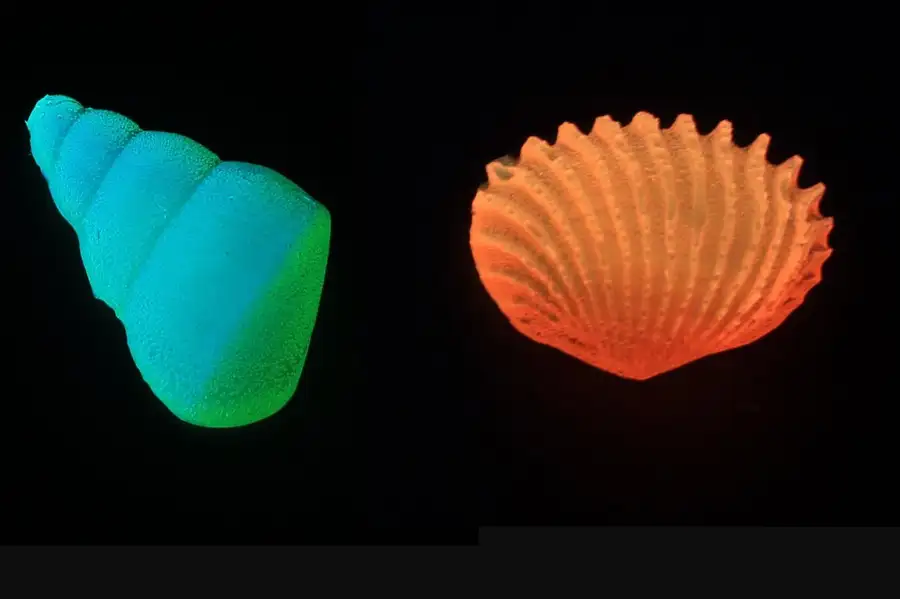
Amino acid glass can also be made to fluoresce
Amino acid glass can also be made to fluoresce, which may have applications in medical imaging. (Image credit: Chinese Academy of Sciences)

In the domain of tissue engineering, amino acid glass scaffolds can support the growth of cells, enabling the creation of functional tissue for regenerative medicine applications.

Another example given in the research is for wound healing. The biocompatible and dissolvable nature of amino acid glass makes it an ideal candidate for developing advanced wound dressings that promote healing and minimize the risk of infection.

Challenges and Future Research

The researchers have tested the degradation of different types of amino acid glass in simulated bodily fluids (specifically proteinase K solution, simulated gastric fluid (SGF[sp]), and simulated intestinal fluid (SIF[sp]), and soil, finding that one type dissolved in a week while another took several months. The reason for testing in soil is to ensure that the glass can be disposed of in compost, ensuring that the materials can be disposed of sustainably outside of the body.
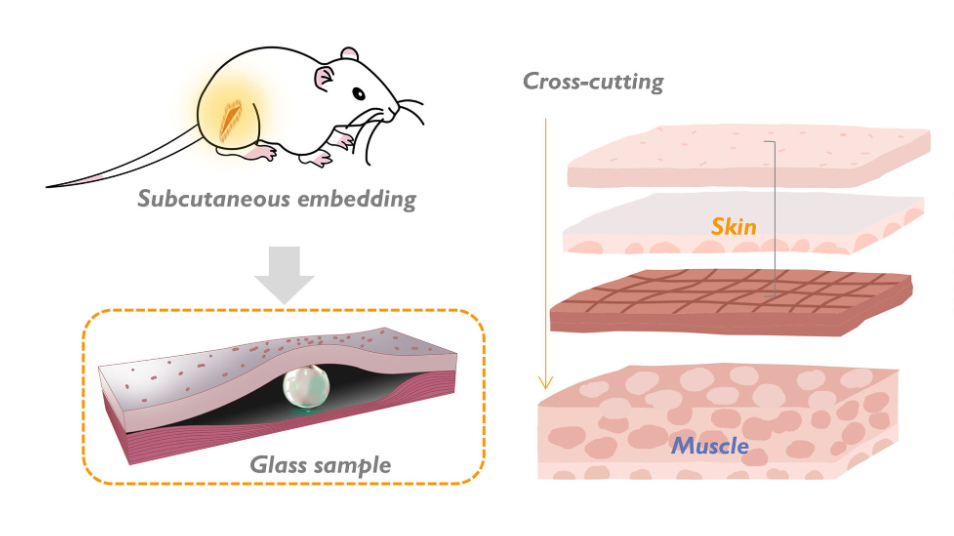
mice
Researchers: always with the mice… (Image credit: Chinese Academy of Sciences)

In a further experiment with mice, the fastest-degrading glass bead was completely absorbed in 12 days, causing temporary muscle degradation, although it was shown to heal after some time.

While the development of amino acid glass is a significant breakthrough, further research is needed to optimize its properties and identify the most effective applications.

Challenges include enhancing the material’s mechanical strength, fine-tuning its dissolution rate, and exploring its compatibility with various cell types. Additionally, long-term studies are required to ensure the material’s safety and efficacy in real-world medical applications.

Come and let us know your thoughts on our Facebook, Twitter, and LinkedIn pages, and don’t forget to sign up for our weekly additive manufacturing newsletter to get all the latest stories delivered right to your inbox.

Share:
WhatsApp Twitter Facebook LinkedIn Buffer Reddit E-mail
About the author | Phillip Keane
Phillip is an aerospace engineer from UK. He is a graduate of Coventry University (UK), International Space University (France) and Nanyang Technological University (Singapore), where he studied Advanced Manufacturing at the Singapore Centre for 3D Printing.
Join our newsletter

Our newsletter is free & you can unsubscribe any time.

Latest posts

ORNL and Boeing 3D-Print a Nearly Two-Ton Mold for Aircraft Parts

Oak Ridge National Laboratory and Boeing 3D-printed a nearly two-ton steel mold for stamping thermoplastic composite aircraft parts.

3D Printing Metal

Meshy 7 Review: From a Designer’s Drawings to Four-Color Board Game Pawns, With No Modelling Skills

Game designer Sonja Uittenboogaard (swurls.nl) draws her own characters. I took three of them, a dragon, an owl and a wizard, and tried... read more »

News

Creality Pika: The Pocket AI 3D Scanner That Wants Scanning to Feel Like Taking a Photo

Creality has shrunk a dual-mode 3D scanner to the size of a compact camera, given it a touchscreen and two swappable batteries, and... read more »

News

How to 3D Scan With Your Phone in 2026: Apps, Technique, and Limits

Yes, you can 3D scan with your phone, and the results are better than the price of admission suggests, which is zero. A... read more »

Scanners

LLNL Researchers Inspect Direct-Ink Prints Layer by Layer With Cameras

Lawrence Livermore mounted cameras on a direct-ink printer so software can measure filament diameter and flag broken strands before a part leaves the... read more »

News
LLNL Researchers Inspect Direct-Ink Prints Layer by Layer With Cameras

CMU Researchers Turn a Single Photo Into Snap-Fit 3D Printed Parts

Carnegie Mellon software takes a photo, splits the object into 3D parts, and adds peg-and-socket joints so the pieces print and snap together... read more »

News
CMU Researchers Turn a Single Photo Into Snap-Fit 3D Printed Parts

Artec Neo: Artec 3D Launches a Tolerance-Driven Handheld Metrology Scanner

Artec 3D says its new handheld blue-light scanner delivers 0.025 mm accuracy at target-anchored features only, while capturing the whole part in color... read more »

News

MIT Spinout 3D Prints Building Trusses From Recycled Plastic

Atlas Building Composites, a spinout of MIT mechanical engineering research, 3D prints structural trusses from shredded single-use plastic fused with fiberglass, including a... read more »

Construction
MIT Spinout 3D Prints Building Trusses From Recycled Plastic

MIT Researchers Let Users Repair AI-Generated 3D Models Before Printing

MIT CSAIL, with Google and Northeastern, built software that generates 3D models from prompts and lets users fix printability defects with language and... read more »

News
MIT Researchers Let Users Repair AI-Generated 3D Models Before Printing

Elegoo Day Sale 2026: The Four Best Prices, And How The Rest Compare

Elegoo Day runs to September 29 with up to 54% off. Four prices are the lowest we have on record, the material tiers... read more »

News

Social

  • Facebook Facebook 3D Printing
  • Linkedin Linkedin 3D Printing
Join our newsletter

Our newsletter is free & you can unsubscribe any time.

banner
banner
  • Flashforge Adventurer 5M

    • - Print size: 220 x 220 x 220 mm
    • - 600mm/s travel speed
    More details »
    $299.00 Flashforge
    Buy Now
  • Anycubic Photon Mono M7

    • - Print size: 223 x 126 x 230 mm
    • - 10.1 inch 14K screen
    More details »
    $279.00 Anycubic
    Buy Now
  • Creality Hi Combo

    • - Print size: 260 x 260 x 300 mm
    • - up to 16-color printing
    More details »
    $399.00 Creality
    Buy Now
  • Qidi Q2

    • - Print size: 270 x 270 x 256 mm
    • - enclosed heated chamber up to 65°C
    More details »
    $580.00 Qidi
    Buy Now
  • Qidi Max 4

    • - Print size: 390 x 390 x 340 mm
    • - active cooling air control
    More details »
    $1,219.00 Qidi
    Buy Now
  • Anycubic Kobra S1 Combo

    • - Print size: 250 x 250 x 250 mm
    • - budget multicolor printing
    More details »
    $429.00 Anycubic
    Buy Now
  • Flashforge Guider 3 Ultra

    • - Print size: 330 x 330 x 600 mm
    • - dual extruder system
    More details »
    $2,999.00 Flashforge
    Buy Now
  • Snapmaker U1

    • - Print size: 270 x 270 x 270 mm
    • - multi-color printing with SnapSwap
    More details »
    $849.00 Snapmaker
    Buy Now
  • Creality K2 Plus

    • - Print size: 350 x 350 x 350 mm
    • - multi-color printing
    More details »
    $1,199.00 Creality
    Buy Now
  • Flashforge AD5X

    • - Print size: 220 x 220 x 220 mm
    • - dual extrusion system
    More details »
    $399.00 Flashforge
    Buy Now

Company Information

  • What is 3D Printing?
  • Contact us
  • Join our mailing list
  • Advertise with us
  • Media Kit
  • Nederland 3D Printing

Blog

  • Latest News
  • Use Cases
  • Reviews
  • 3D Printers
  • 3D Printing Metal

Featured Reviews

  • Anycubic Photon Mono M5s
  • Creality Ender 5 S1
  • The Mole 3D Scanner
  • Flashforge Creator 3 Pro

Featured Industries

  • Automotive
  • Aerospace
  • Construction
  • Dental
  • Environmental
  • Electronics
  • Medical
  • Military
  • Fashion
  • Art
2026 — Strikwerda en Dehue
  • Home
  • Join our mailing list
  • Contact us
Blog
  • Latest News
  • Use Cases
  • Reviews
  • 3D Printers
  • 3D Printing Metal
Featured Industries
  • Automotive
  • Aerospace
  • Construction
  • Dental
  • Environmental
  • Electronics
  • Medical
  • Military
  • Fashion
  • Art
Company Information
  • What is 3D Printing?
  • Contact us
  • Join our mailing list
  • Advertise with us
  • Media Kit
  • Nederland 3D Printing