
3D Printing
News Deals Contact us
Home / News / Calgary University Researchers Turn Fecal Matter Into 3D Printable Material
qidi

Calgary University Researchers Turn Fecal Matter Into 3D Printable Material

April 12, 2018

An award-winning research project has just revealed the possibility of 3D printing human waste for use during space flight. The research team outlined a means of turning fecal matter into bio-plastic, allowing for astronauts to have a handy and replenish-able source of materials for tools, repair or radiation shielding on-board their ship. The team went head to head with other competitors at the International Genetically Engineered Machine (iGEM) Foundation’s Giant Jamboree.

The team undertook the project with the advice of Canadian astronaut and ISS commander Chris Hadfield. When they began, the team took a trip to Calgary’s wastewater treatment plant. With a basic idea, they developed a means for recycling waste. Eventually, they arrived at a version where they would use genetically engineered E. Coli to process the waste.

Related Story
New Research Shows How Urine Can be Turned Into a 3D Printable Material During Space Voyages

The method is a landmark achievement for space travel, as it allows the formation of a crucial material from a recyclable form of waste. It can grow the materials on board and prevent storage problems while also making disposal more efficient. The process can be of aid outside of aerospace as well, considering how ubiquitous waste disposal issues are one Earth.

From Fecal Matter to 3D Printable Bio-Plastics
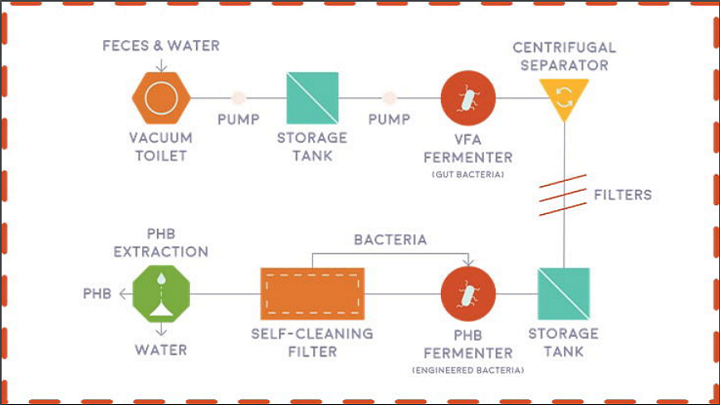
3DP Waste into Bio Plastic

Since the team were reluctant to test the process on actual feces, the initial tests used a NASA-approved simulation mixture. The synthetic mixture comprised cellulose, miso paste, peanut oil, and yeast, which were all proven to be processable. Alina Kunitskaya, a 4th year student and co-author, stated: “We actually tried to pursue the route of using the real thing, but no one wanted to have it inside the lab.”

It takes quite a few days to convert the matter into polyhydroxybutyrate plastic. The waste remains untouched for a few days so its volatile fatty acid levels can rise. The VFAs eventually need to be separated via application of centrifugal force. Finally, the remaining substance is ready for exposure to the E. Coli. After this period the by-product plastic is ready for Selective Laser Sintering.

The full research paper is available here.

Share:
WhatsApp Twitter Facebook LinkedIn Buffer Reddit E-mail
Join our newsletter

Our newsletter is free & you can unsubscribe any time.

Latest posts

Revopoint RANGE 3 Series Opens for Pre-Order as MIRACO 2 Heads to Kickstarter

Revopoint launches two scanner lines on October 22: the RANGE 3 Series, two lightweight wide-field scanners from $369 now on pre-order, and MIRACO... read more »

News

Milan Researchers Turn Soybean Waste Into 3D Printable Skin Repair Material

Milan researchers blended peptides from okara, a soybean by-product, into biodegradable polycaprolactone, and the blend kept its healing activity once printed.

Materials

CNC Kitchen’s Free ScanRuler Lets AI Agents Turn 3D Scans Into Parametric CAD

CNC Kitchen YouTuber Stefan Hermann's free ScanRuler tool now lets an artificial intelligence agent rebuild 3D scans as editable, parametric design models.

News

Additive Industries and Materialise Launch Faster MetalFab Build Processor

The Next-Generation Build Processor for MetalFab metal printers brings MetalFab 420K scan controls and multiprocessing, and is available to customers now.

3D Printing Metal

LAIKA Picks PrismSlicer to Preview Its Full-Color 3D Prints

LAIKA, the stop-motion studio behind Coraline and Kubo and the Two Strings, has agreed to add PrismSlicer, a photorealistic preview tool from Prague... read more »

News

TCT Shenzhen 2026 Draws 34,347 Visitors, Up 85 Percent on Its Last Edition

TCT Shenzhen 2026 closed on October 16 with 34,347 unique visitors over three days, up 85 percent on the previous edition, according to... read more »

Events

RMIT Prints Architectural Forms With Coffee Waste Filament

RMIT researchers turned spent Melbourne coffee grounds into a stronger, biodegradable printing material and a full-scale demonstrator for Melbourne Design Week.

Materials

De Montfort University Fellowship Backs 3D Printed Artificial Muscles for Soft Robots

A Royal Academy of Engineering fellowship gives De Montfort University's Meisam Abdi up to a year to print piezoelectric muscles for safer soft... read more »

News

Metal 3D Printed Propellers Make Powerboat World Championship Debut in UIM F2

Steel Developments and Caleb Jelf ran two five-bladed stainless steel propellers, 3D printed with direct metal laser sintering, in UIM F2 World Championship... read more »

3D Printing Metal

Snapmaker Opens Snapmaker Space and Backs Full Spectrum Color Printing With a Four-Filament Bundle

Snapmaker has opened the beta of Snapmaker Space, a model platform built around its U1 toolchanger. It launches with more than 2,500 models... read more »

3D Printers

Social

  • Facebook Facebook 3D Printing
  • Linkedin Linkedin 3D Printing
Join our newsletter

Our newsletter is free & you can unsubscribe any time.

  • Qidi Q2

    • - Print size: 270 x 270 x 256 mm
    • - enclosed heated chamber up to 65°C
    More details »
    $580.00 Qidi
    Buy Now
  • Anycubic Kobra S1 Combo

    • - Print size: 250 x 250 x 250 mm
    • - budget multicolor printing
    More details »
    $429.00 Anycubic
    Buy Now
  • Qidi Max 4

    • - Print size: 390 x 390 x 340 mm
    • - active cooling air control
    More details »
    $1,219.00 Qidi
    Buy Now
  • Snapmaker U1

    • - Print size: 270 x 270 x 270 mm
    • - multi-color printing with SnapSwap
    More details »
    $849.00 Snapmaker
    Buy Now
  • Anycubic Photon Mono M7

    • - Print size: 223 x 126 x 230 mm
    • - 10.1 inch 14K screen
    More details »
    $279.00 Anycubic
    Buy Now
  • Flashforge AD5X

    • - Print size: 220 x 220 x 220 mm
    • - dual extrusion system
    More details »
    $399.00 Flashforge
    Buy Now
  • Creality Hi Combo

    • - Print size: 260 x 260 x 300 mm
    • - up to 16-color printing
    More details »
    $399.00 Creality
    Buy Now
  • Flashforge Adventurer 5M

    • - Print size: 220 x 220 x 220 mm
    • - 600mm/s travel speed
    More details »
    $299.00 Flashforge
    Buy Now
  • Flashforge Guider 3 Ultra

    • - Print size: 330 x 330 x 600 mm
    • - dual extruder system
    More details »
    $2,999.00 Flashforge
    Buy Now
  • Creality K2 Plus

    • - Print size: 350 x 350 x 350 mm
    • - multi-color printing
    More details »
    $1,199.00 Creality
    Buy Now

Company Information

  • What is 3D Printing?
  • Contact us
  • Join our mailing list
  • Advertise with us
  • Media Kit
  • Nederland 3D Printing

Blog

  • Latest News
  • Use Cases
  • Reviews
  • 3D Printers
  • 3D Printing Metal

Featured Reviews

  • Anycubic Photon Mono M5s
  • Creality Ender 5 S1
  • The Mole 3D Scanner
  • Flashforge Creator 3 Pro

Featured Industries

  • Automotive
  • Aerospace
  • Construction
  • Dental
  • Environmental
  • Electronics
  • Medical
  • Military
  • Fashion
  • Art
2026 — Strikwerda en Dehue
  • Home
  • Join our mailing list
  • Contact us
Blog
  • Latest News
  • Use Cases
  • Reviews
  • 3D Printers
  • 3D Printing Metal
Featured Industries
  • Automotive
  • Aerospace
  • Construction
  • Dental
  • Environmental
  • Electronics
  • Medical
  • Military
  • Fashion
  • Art
Company Information
  • What is 3D Printing?
  • Contact us
  • Join our mailing list
  • Advertise with us
  • Media Kit
  • Nederland 3D Printing