
3D Printing
News Videos Newsletter Contact us
Home / News / Johns Hopkins Prints Worm-like Gel Robots
qidi

Johns Hopkins Prints Worm-like Gel Robots

January 10, 2023

Engineers at Johns Hopkins university have demonstrated the printing of worm-like gel bots, and have published their findings in a paper. The robotic worms are capable of uni-directional locomotion thanks to the expansion and contraction of their gel-bodies during thermal cycling.

Read on to know more about the printed gel bots.

Soft Robots

The worms are inspired by inch-worms in the way their movement appears to undulate, pushing the creature along. Hydrogel structures have previously been printed that demonstrate the ability to expand and contract when undergoing thermal cycling.

The Johns Hopkins team has applied this principle to the small robots, and this enables the robots to move in one direction across a flat plane. You can see the robot moving in the clip below.

gel bot
Undulating gel bot. (Image credit: Johns Hopkins University)

The gel bot is a type of soft robot, and in this case, a very soft robot. Soft robotics is a rapidly growing field that involves the design and development of robots that are made primarily from flexible materials. These robots can take on a wide range of shapes, sizes, and forms, and are capable of performing a variety of tasks, from simple grasping and manipulation to more complex tasks such as swimming, flying and crawling, as you can see with the gel bot.

Soft robots have many advantages over traditional hard robots, including greater flexibility, adaptability, and the ability to safely interact with their environment. They are being researched and developed for use in a wide range of applications, from manufacturing and healthcare to search and rescue and even space exploration.

Untethered

The gel soft robot differs from many soft robot examples, as the robot has no power supply, and so can operate untethered, receiving its energy to move from the temperature of the fluid environment in which it sits.

By fluctuating the surrounding temperature between 30 and 60 degrees Celsius, the robot moves thanks to the geometry of the hydrogel structure.

The robot consists of hydrogel layers, namely an active thermoresponsive poly(N-isopropylacrylamide) (pNIPAM) and passive polyacrylamide (pAAM) bilayers with suspended linkers.

The motion was simulated using finite element analysis, and confirmed by use of finite element simulations, and experiments were performed where parameters such as linker stiffness and the number of bilayer segments were varied. The experiments were monitored visually using motion cameras.

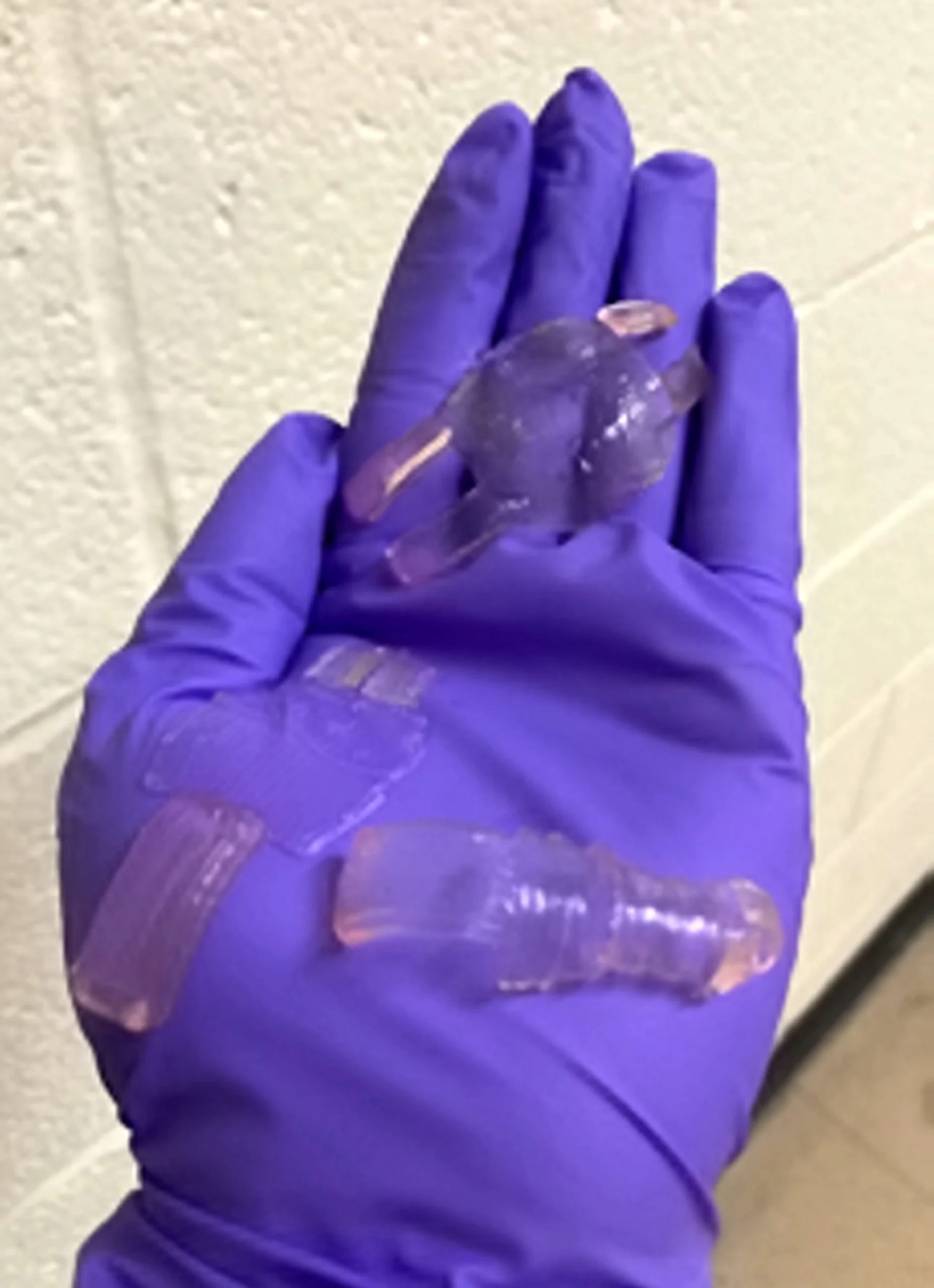
You can see the gel bots in the image below for scale.
gel
(Image credit: Johns Hopkins University)

It is hoped that the robots can find application in biomedical domains, where the robots could be used to deliver drugs to targeted sites within the human body, where their motion could potentially be controlled with human biomarkers and biochemicals.

“It seems very simplistic but this is an object moving without batteries, without wiring, without an external power supply of any kind—just on the swelling and shrinking of gel,” said David Gracias, researcher and professor at Johns Hopkins University.

“Our study shows how the manipulation of shape, dimensions and patterning of gels can tune morphology to embody a kind of intelligence for locomotion.”

Moving forward, the researchers plan to print the gel bots in different geometries, and add cameras and other sensors to the body, although it is not stated how these devices will be powered.

The research paper, titled “Untethered unidirectionally crawling gels driven by asymmetry in contact forces” is available for your perusal in the Science Robotics journal at this link.


Share:
WhatsApp Twitter Facebook LinkedIn Buffer Reddit E-mail
About the author | Phillip Keane
Phillip is an aerospace engineer from UK. He is a graduate of Coventry University (UK), International Space University (France) and Nanyang Technological University (Singapore), where he studied Advanced Manufacturing at the Singapore Centre for 3D Printing.
Join our newsletter

Our newsletter is free & you can unsubscribe any time.

Latest posts

OU and Oak Ridge Lab Win $8.8M to Speed 3D-Printed Parts Approval for Air Force Aircraft

The University of Oklahoma has been awarded $8.8 million to launch Phase II of a metal 3D printing research program aimed at cutting... read more »

3D Printing Metal

BASF Starts Up World’s First Industrial-Scale 3D Printed Catalyst Plant in Ludwigshafen

BASF commissioned the world's first production plant for 3D-printed catalysts, bringing its proprietary X3D technology to full industrial scale at its Ludwigshafen site.... read more »

Materials
BASF Starts Up World's First Industrial-Scale 3D Printed Catalyst Plant in Ludwigshafen

Sound Particles 3D Prints Its Employees’ Ears to Perfect Spatial Audio

A 17-person audio software company in Lisbon has 3D-printed replicas of every employee's ears, heads, and torsos to test acoustic realism, part of... read more »

News
Sound Particles 3D Prints Its Employees' Ears to Perfect Spatial Audio

BENTU Design 3D Prints Street Furniture From Demolished Urban Village Waste

Chinese design studio BENTU Design has developed a method for turning construction rubble from demolished urban villages into 3D printed public furniture, with... read more »

News

Developer Creates 3D Printer That Uses Bitcoin Mining Heat for Bed Temperature Control

A developer known as PizzAndy has created a prototype 3D printer that uses heat generated from Bitcoin mining chips to control the printer... read more »

3D Printers
Developer Creates 3D Printer That Uses Bitcoin Mining Heat for Bed Temperature Control

Formula 1 Teams Use 3D Printing to Navigate New Engine Compression Ratio Rules

Mercedes and Red Bull have reportedly found a way to work around Formula 1's new compression ratio regulations for the 2026 season. The... read more »

Automotive
Formula 1 Teams Use 3D Printing to Navigate New Engine Compression Ratio Rules

European Researchers 3D Print Glass-like Metallic Components for More Efficient Electric Motors

Researchers at Saarland University are developing new metallic glass alloys that could reduce energy losses in electric motors used in devices like drones... read more »

News
European Researchers 3D Print Glass-like Metallic Components for More Efficient Electric Motors

Researchers Develop 3D Printed Foam Composite That Absorbs 10 Times More Energy Than Standard Padding

Researchers at Texas A&M University and the DEVCOM Army Research Laboratory have created a hybrid foam material that can absorb up to 10... read more »

News

Corpus Christi Army Depot Uses 3D Printing to Manufacture UH-60 Black Hawk Fuel System Components

The Corpus Christi Army Depot (CCAD) in Texas has begun using 3D printing technology to manufacture replacement tail fins for the UH-60 Black... read more »

Military
Corpus Christi Army Depot Uses 3D Printing to Manufacture UH-60 Black Hawk Fuel System Components

German Company rpm Develops 3D Printed Padding System for Explosive Ordnance Disposal Helmets

German manufacturing company rpm has developed a 3D-printed padding system for explosive ordnance disposal (EOD) helmets that replaces traditional foam materials with a... read more »

News

Social

  • Facebook Facebook 3D Printing
  • Linkedin Linkedin 3D Printing
banner
Join our newsletter

Our newsletter is free & you can unsubscribe any time.

Featured Industries

  • Automotive
  • Aerospace
  • Construction
  • Dental
  • Environmental
  • Electronics
  • Fashion
  • Medical
  • Military
  • Creality K2 Plus

    • - Print size: 350 x 350 x 350 mm
    • - multi-color printing
    More details »
    $1,199.00 Creality
    Buy Now
  • Qidi Q2

    • - Print size: 270 x 270 x 256 mm
    • - enclosed heated chamber up to 65°C
    More details »
    $580.00 Qidi
    Buy Now
  • Flashforge Adventurer 5M

    • - Print size: 220 x 220 x 220 mm
    • - 600mm/s travel speed
    More details »
    $299.00 Flashforge
    Buy Now
  • Qidi Max 4

    • - Print size: 390 x 390 x 340 mm
    • - active cooling air control
    More details »
    $1,219.00 Qidi
    Buy Now
  • Creality Hi Combo

    • - Print size: 260 x 260 x 300 mm
    • - up to 16-color printing
    More details »
    $399.00 Creality
    Buy Now
  • Snapmaker U1

    • - Print size: 270 x 270 x 270 mm
    • - multi-color printing with SnapSwap
    More details »
    $849.00 Snapmaker
    Buy Now
  • Flashforge AD5X

    • - Print size: 220 x 220 x 220 mm
    • - dual extrusion system
    More details »
    $399.00 Flashforge
    Buy Now
  • Anycubic Photon Mono M7

    • - Print size: 223 x 126 x 230 mm
    • - 10.1 inch 14K screen
    More details »
    $279.00 Anycubic
    Buy Now
  • Flashforge Guider 3 Ultra

    • - Print size: 330 x 330 x 600 mm
    • - dual extruder system
    More details »
    $2,999.00 Flashforge
    Buy Now
  • Anycubic Kobra S1 Combo

    • - Print size: 250 x 250 x 250 mm
    • - budget multicolor printing
    More details »
    $429.00 Anycubic
    Buy Now

Company Information

  • What is 3D Printing?
  • Contact us
  • Join our mailing list
  • Advertise with us
  • Media Kit
  • Nederland 3D Printing

Blog

  • Latest News
  • Use Cases
  • Reviews
  • 3D Printers
  • 3D Printing Metal

Featured Reviews

  • Anycubic Photon Mono M5s
  • Creality Ender 5 S1
  • The Mole 3D Scanner
  • Flashforge Creator 3 Pro

Featured Industries

  • Automotive
  • Aerospace
  • Construction
  • Dental
  • Environmental
  • Electronics
  • Medical
  • Military
  • Fashion
  • Art
2026 — Strikwerda en Dehue
  • Home
  • Join our mailing list
  • Contact us
Blog
  • Latest News
  • Use Cases
  • Reviews
  • 3D Printers
  • 3D Printing Metal
Featured Industries
  • Automotive
  • Aerospace
  • Construction
  • Dental
  • Environmental
  • Electronics
  • Medical
  • Military
  • Fashion
  • Art
Company Information
  • What is 3D Printing?
  • Contact us
  • Join our mailing list
  • Advertise with us
  • Media Kit
  • Nederland 3D Printing