
Researchers at Lawrence Livermore National Laboratory have developed 3D-printed microscale helix structures that function as optical materials for Terahertz (THz) frequencies. The printed helixes create circularly polarized beams in the THz range and can be arranged in arrays to form a new type of QR code for encryption applications. Their findings, published in Advanced Science, represent the first complete parametric analysis of helical structures for THz frequencies.
The team used two-photon polymerization (2PP), a high-resolution 3D printing technique, to create optimized helix structures that function as quarter waveplates. These components address a technology gap in the THz frequency range, which is important for 5G/6G telecommunications and has potential applications in non-destructive evaluation and chemical sensing. “At around 300 µm, the wavelength of the THz frequency is a sweet spot [for 2PP], so we can create any geometries in that length scale comfortably and control it very nicely,” said Materials Engineering Division staff engineer Xiaoxing Xia.
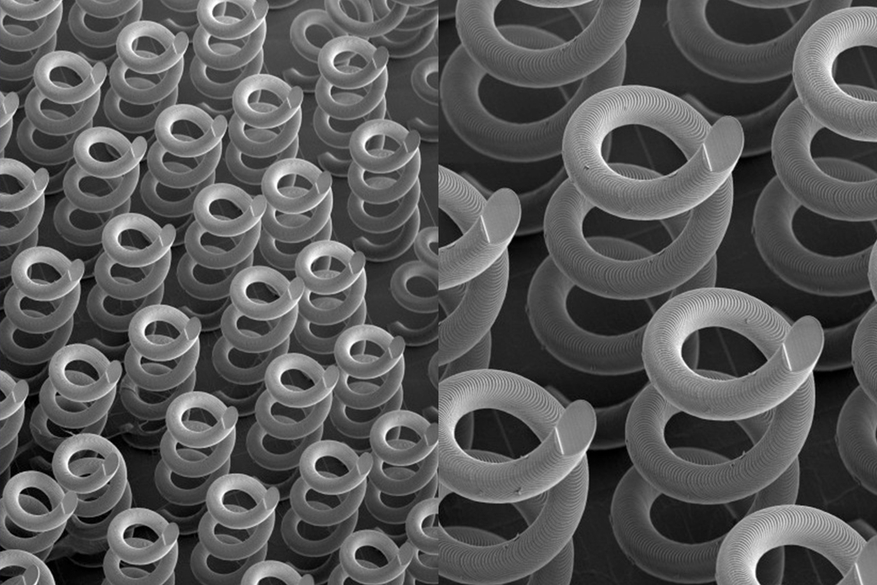
The printed helixes demonstrated strong broadband activity and reliably created circularly polarized beams with distinct left-handed or right-handed signals. When arranged in arrays, the structures showed enhanced coupling effects that improved both polarization types. This discovery led the team to develop what they call a “chiral QR code” using left-handed and right-handed helixes as pixels.
The chiral QR code encodes information using polarization rotation rather than traditional brightness variations, requiring specialized filters and correct electromagnetic frequency for access. “For hospitals or banks or military purposes, sometimes we might need to add encryption while maintaining the convenience of the rapid scan,” said Materials Science Division scientist Wonjin Choi, who led the project. The research demonstrates potential applications in molecular sensing, telecommunications filtering, and various detection systems across medicine, biology, and astronomy.
Source: llnl.gov