

NASA has recently validated the data from hot fire tests on their 3D printed aerospike engine at their test facility in Marshall Space Flight Center, Huntsville, Alabama. The validation confirms that the engine is viable, and behaved as predicted, and as a result, NASA engineers have been given the green light to develop a larger version.
And not only is it an aerospike engine, but it is also a rotating detonation rocket engine (RDRE).
Why is this so great? Read on to find out.
Aerospike
In a traditional bell-shaped rocket nozzle the rocket exhaust over-expands as the ambient pressure drops while the rocket’s altitude increases. Basically, instead of shooting straight out of the rocket and pushing the rocket upwards, the over-expanded gasses kinda just flop around all over the place. This is inefficient.
In contrast, an aerospike engine fires the exhaust along the outside edge of a wedge-shaped protrusion called the “spike.” The spike forms one side of a “virtual” bell, with the other side being formed by the outside air. At low altitude, ambient pressure compresses the exhaust against the spike, creating a balance of pressure that gives no overall thrust but also doesn’t lose thrust by forming a partial vacuum. As the vehicle climbs to higher altitudes, the air pressure holding the exhaust against the spike decreases, and the recirculation zone at the base of the spike maintains a higher pressure, giving extra thrust as altitude increases.
This is more efficient.
But they do get very hot, and cooling them incurs a huge mass penalty. But thanks to 3D printing, lighter weight aerospike can be manufactured, allowing the fabrication of functional, lighter weight aerospike engines. And that’s what NASA has been working on here, as you can see in the image below.
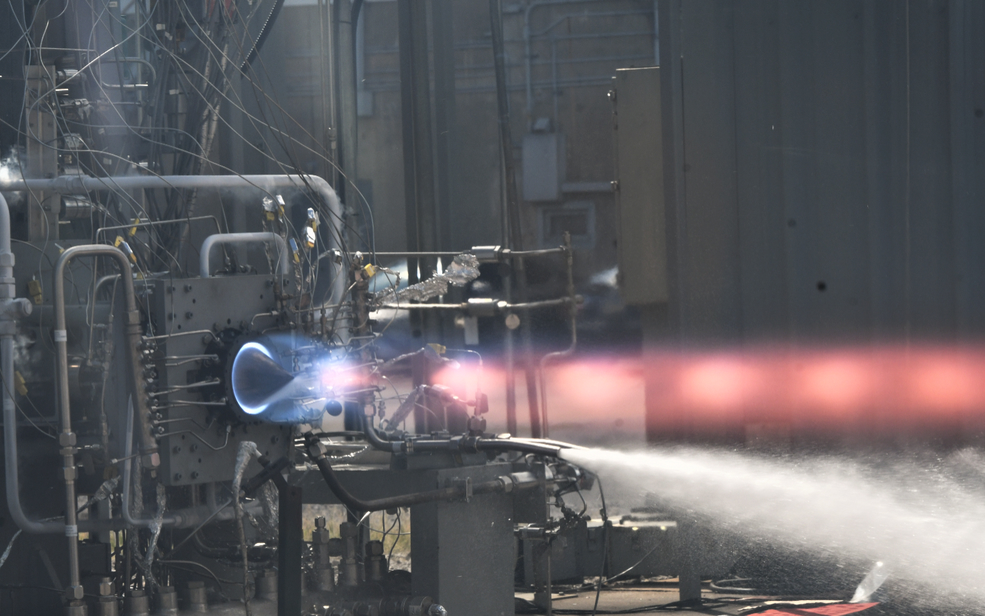
The RDRE aerospike engine was printed with an LPBF process, using GRCop-42, a copper alloy developed by NASA, which is valued for its thermal properties.
The engine was fired over a dozen times in 2022 at Marshall’s East Test Area, totaling nearly 10 minutes in duration.
RDRE
Normal rockets use a single continuous burn to generate thrust, much like a huge firework.
A RDRE differs because it uses a series of small controlled explosions, or detonations, to generate thrust. Fuel and an oxidizer are injected into the combustion chamber, where they ignite and create a wave-like pattern of detonations that travel around the circumference of the chamber. This creates a continuous thrust, propelling the rocket forward.
The detonation process converts more of the fuel’s energy into thrust, and it can operate with a wider range of fuels and oxidizers. Plus, it can handle higher combustion pressures and temperatures than traditional rocket engines.
They not only use their fuels more efficiently, but they also have a higher thrust-to-weight ratio, and so they are of great interest to space engineers.
“Additive manufacturing certainly allows for very complex designs, but this novelty propagates and enables other new technologies such as advanced propulsion,” said Paul Gradl, Principal Engineer at NASA.
“Our NASA team completed hot-fire testing of an aerospike rotating detonation rocket engine (RDRE) enabled by Laser Powder Bed Fusion GRCop-42. The longest continuous duration operated with this hardware was greater than 130 seconds at 622 psi and accumulated over 10 minutes of total time. This is a huge step forward for RDRE.”
The RDRE tests were successful in proving their ability to operate for long durations while withstanding the extreme heat and pressure environments generated by detonations. The tests also demonstrated deep throttling and internal ignition bringing the technology closer to being used with future flight vehicles.
As a result of the test validations, a 10,000-pound class RDRE will be developed to compare the benefits against traditional liquid-fuelled rockets.