

3D Printing
News Back to school deals Contact us
Home / News / New Tech Enables Compositionally Graded Alloys for Extreme Environments
qidi

New Tech Enables Compositionally Graded Alloys for Extreme Environments

July 24, 2023

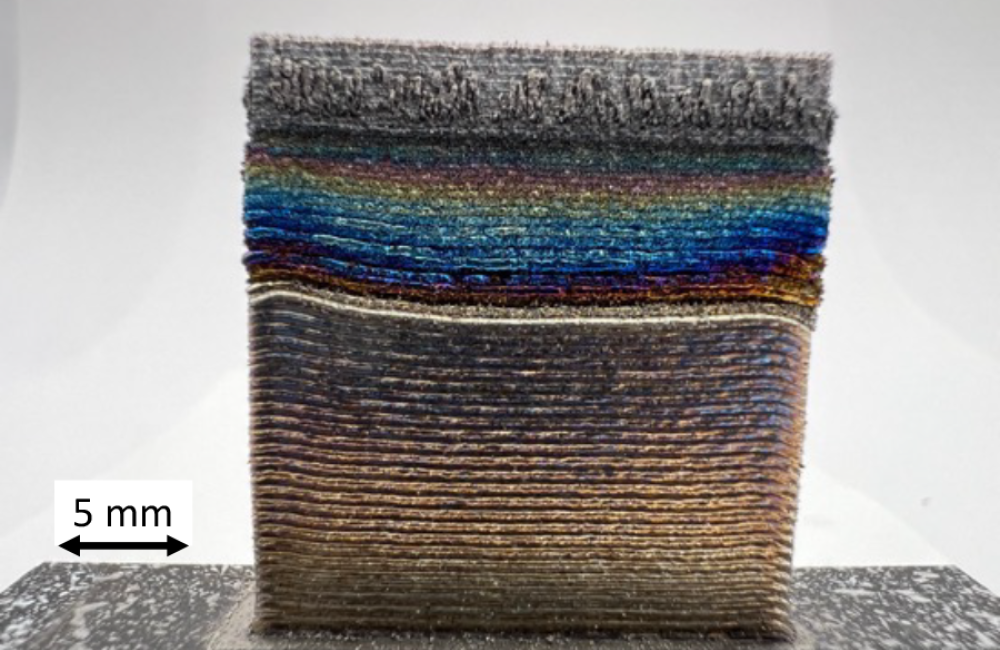
Researchers at the Department of Energy’s Oak Ridge National Laboratory (ORNL) have developed a new technology for additive manufacturing of composite metal parts. The new technique allows for the design of compositionally graded composite parts that transition seamlessly from high-strength superalloys to refractory alloys capable of withstanding extreme temperatures, eliminating the need for welding.
New Tech Enables Compositionally Graded Alloys for Extreme Environments
Additively manufactured thin-walled, functionally graded builds. (Image Credit: Brian Jordan, Soumya Nag, ORNL/U.S. Dept. of Energy)

The key to this process lies in the “secret sauce” – a powder composed of a third transition alloy with lightweight or high-temperature characteristics. Using directed energy deposition, researchers deposit different powder compositions in an inert argon environment while adjusting the deposition rate along the way.

“It’s like cooking- you basically have different ingredients,” said lead researcher, Soumya Nag.

“So, if you have more pasta on one side and more risotto on the other side, how do you continuously change from a pasta to a risotto? You change the ingredients as you move along from one end to another, and that’s exactly what we do,” Nag said.

Traditionally, structural applications involve using a single alloy composition for fabricating components in harsh environments, which can be expensive and compromise performance. Alternatively, welded parts made from dissimilar materials are used for components requiring varied properties, leading to abrupt interfaces and reduced performance.

In this research, scientists successfully joined non-weldable superalloys with refractory alloys by creating a non-linear gradient pathway using computational thermodynamics and experimental data. The team validated their computational alloy design by analyzing stress states with neutron diffraction-based studies.

The potential applications for this technology are vast, including rocket engines for space, aerospace manufacturing, fusion and fission reactor fabrication, marine-related uses, and renewable energy systems – essentially any field where extreme environments exist.

Come and let us know your thoughts on our Facebook, Twitter, and LinkedIn pages, and don’t forget to sign up for our weekly additive manufacturing newsletter to get all the latest stories delivered right to your inbox.

Share:
WhatsApp Twitter Facebook LinkedIn Buffer Reddit E-mail
About the author | Phillip Keane
Phillip is an aerospace engineer from UK. He is a graduate of Coventry University (UK), International Space University (France) and Nanyang Technological University (Singapore), where he studied Advanced Manufacturing at the Singapore Centre for 3D Printing.
Join our newsletter

Our newsletter is free & you can unsubscribe any time.

Latest posts

Harbin Researchers 3D-Print Cement That Stores Electricity

Harbin Institute of Technology researchers 3D-printed a cement supercapacitor whose interlocking electrodes store a charge while the piece still carries a structural load.

News

NTU Researchers 3D Print a Bone Scaffold Timed to How Injuries Heal

NTU researchers 3D-printed a gel bone scaffold that releases copper and an antibiotic quickly at first, then more slowly, so one implant can... read more »

Medical

Hands-On Review: Revopoint MetroY Pro 3D Scanner

Hands-on with the wireless Revopoint MetroY Pro, tested against the MetroX for speed, laser lines, structured light, and color textures.

News

Bambu Lab 3D Printer Comparison 2026: Which Bambu Should You Buy?

Bambu Lab sells nine printers, and every one of them prints fast, takes an AMS and undercuts the model above it. That has... read more »

3D Printers

Glasgow Engineers Map Damage Inside 3D Printed Lattices in Real Time

University of Glasgow engineers, with colleagues at the University of Sydney, used a hospital imaging method to map cracks in 3D-printed lattice parts... read more »

News

Cranfield 3D-Prints Natural Rubber Gloves Without a Dipping Line

Cranfield University researchers 3D-printed natural rubber gloves by spraying latex onto a mould, a process meant to replace the dipping lines glove factories... read more »

News

Prototal Group: Industrial 3D Printing, Molding and Casting Under One Roof

Prototal Group describes itself as Europe's leading manufacturing service provider for industrial 3D printing, injection molding and vacuum casting. With nine facilities in... read more »

News

California AB 2047 Explained: What the New 3D Printer Gun Blocking Law Requires

The bill that started the year as a DOJ-certified detection mandate with criminal penalties was signed into law on September 26 as something... read more »

Industry

SHINING 3D Launches ShiningSpace, a Browser Platform for Real-World 3D Scans

SHINING 3D has launched ShiningSpace, a browser-based platform for storing, viewing, editing and sharing 3D scan data. The company says it accepts models... read more »

News

LLNL 3D-Prints a Bioreactor That Turns Waste Methane Into a Useful Chemical

Lawrence Livermore National Laboratory 3D-printed a bioreactor that uses bacteria in thin lattice walls to turn waste methane into succinate.

News

Social

  • Facebook Facebook 3D Printing
  • Linkedin Linkedin 3D Printing
Join our newsletter

Our newsletter is free & you can unsubscribe any time.

banner
banner
  • Anycubic Photon Mono M7

    • - Print size: 223 x 126 x 230 mm
    • - 10.1 inch 14K screen
    More details »
    $279.00 Anycubic
    Buy Now
  • Snapmaker U1

    • - Print size: 270 x 270 x 270 mm
    • - multi-color printing with SnapSwap
    More details »
    $849.00 Snapmaker
    Buy Now
  • Flashforge Adventurer 5M

    • - Print size: 220 x 220 x 220 mm
    • - 600mm/s travel speed
    More details »
    $299.00 Flashforge
    Buy Now
  • Flashforge AD5X

    • - Print size: 220 x 220 x 220 mm
    • - dual extrusion system
    More details »
    $399.00 Flashforge
    Buy Now
  • Qidi Max 4

    • - Print size: 390 x 390 x 340 mm
    • - active cooling air control
    More details »
    $1,219.00 Qidi
    Buy Now
  • Creality Hi Combo

    • - Print size: 260 x 260 x 300 mm
    • - up to 16-color printing
    More details »
    $399.00 Creality
    Buy Now
  • Qidi Q2

    • - Print size: 270 x 270 x 256 mm
    • - enclosed heated chamber up to 65°C
    More details »
    $580.00 Qidi
    Buy Now
  • Flashforge Guider 3 Ultra

    • - Print size: 330 x 330 x 600 mm
    • - dual extruder system
    More details »
    $2,999.00 Flashforge
    Buy Now
  • Anycubic Kobra S1 Combo

    • - Print size: 250 x 250 x 250 mm
    • - budget multicolor printing
    More details »
    $429.00 Anycubic
    Buy Now
  • Creality K2 Plus

    • - Print size: 350 x 350 x 350 mm
    • - multi-color printing
    More details »
    $1,199.00 Creality
    Buy Now

Company Information

  • What is 3D Printing?
  • Contact us
  • Join our mailing list
  • Advertise with us
  • Media Kit
  • Nederland 3D Printing

Blog

  • Latest News
  • Use Cases
  • Reviews
  • 3D Printers
  • 3D Printing Metal

Featured Reviews

  • Anycubic Photon Mono M5s
  • Creality Ender 5 S1
  • The Mole 3D Scanner
  • Flashforge Creator 3 Pro

Featured Industries

  • Automotive
  • Aerospace
  • Construction
  • Dental
  • Environmental
  • Electronics
  • Medical
  • Military
  • Fashion
  • Art
2026 — Strikwerda en Dehue
  • Home
  • Join our mailing list
  • Contact us
Blog
  • Latest News
  • Use Cases
  • Reviews
  • 3D Printers
  • 3D Printing Metal
Featured Industries
  • Automotive
  • Aerospace
  • Construction
  • Dental
  • Environmental
  • Electronics
  • Medical
  • Military
  • Fashion
  • Art
Company Information
  • What is 3D Printing?
  • Contact us
  • Join our mailing list
  • Advertise with us
  • Media Kit
  • Nederland 3D Printing