
3D Printing
News Videos Newsletter Contact us
Home / News / PENN State Researchers Use New Method of Creating Improved PDMS Constructs
qidi

PENN State Researchers Use New Method of Creating Improved PDMS Constructs

January 24, 2018

Researchers at PENN State have just discovered a new method of creating improved PDMS constructs. The new approach involves the amalgamation of PDMS elastomers Sylgard 184 and SE 1700 to greatly enhance the strength and cell adhesion of the material. It also allowed the researchers to print more complex geometries which would have previously required molding, casting, and spin coating.
3d-printed-silicone-hd-featured-600
Related Story
An Overview Of Silicone 3D Printing

PDMS, aka silicone rubber, has several applications. It is widely prevalent in medical devices such as point of care devices and biological machines. It is also effective for the production of tissue/organ-on-a-chip devices. Previously, creating simple structures required far more complex forms of manufacturing. The newer method is quite similar to FFF/ FDM but requires material preparation before entry into the nozzle.

Optimising PDMS Fabrication
PDMS PENN State Silicone Rubber

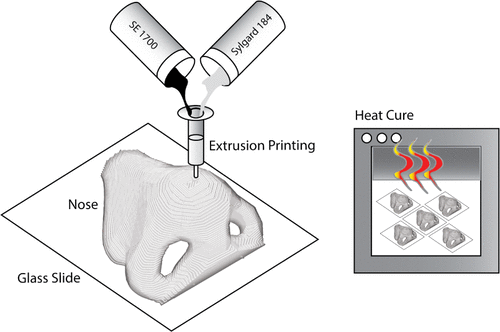
The main crux of the new discovery is the mixture of Sylgard 184 and SE 1700. This required a bit of fine-tuning when considering the properties of the individual materials. One of the issues with using Sylgard 184 is its viscosity. Sylgard 184 does not have a significant thickness so it puddles rather than adhering. However, when the researchers mixed it with SE 1700, it was significantly more suitable for printing.

Adjusting the ratio of the two materials allowed them to adjust the viscosity as needed. Another advantage of optimising the two materials in a mixture was a factor called shear thinning, where a material behaves like a solid when still, but like a liquid when force is applied. This is immensely helpful for 3D printing for obvious reasons. They also adjusted cell adherence by adding various coatings.

Related Story
3D Printing Respirator Tubes Cuts Production Costs 10X

As part of their first test the researchers printed a nose. After consulting with the National Institute of Health, they decided the human nose would be ideal because of all its complex geometries and the varying densities in its many parts. The material managed a great job at capturing the complex cavities without support materials. They even compared this to casted PDMS with imaging technology (image above) and were happy to report many improvements in tensile strength.

PDMS has many applications within medicine and many more outside of it. It can offer new possibilities in single-piece electronics with the use of conductive inks, for example. It’s easy to see why, the researchers are very optimistic about what this research presents.

The full paper is available here.

Share:
WhatsApp Twitter Facebook LinkedIn Buffer Reddit E-mail
Join our newsletter

Our newsletter is free & you can unsubscribe any time.

Social

  • Facebook Facebook 3D Printing
  • Linkedin Linkedin 3D Printing
banner
banner
Join our newsletter

Our newsletter is free & you can unsubscribe any time.

Featured Industries

  • Automotive
  • Aerospace
  • Construction
  • Dental
  • Environmental
  • Electronics
  • Fashion
  • Medical
  • Military
  • Creality K2 Plus

    • - Print size: 350 x 350 x 350 mm
    • - multi-color printing
    More details »
    $1,199.00 Creality
    Buy Now
  • Qidi Max 4

    • - Print size: 390 x 390 x 340 mm
    • - active cooling air control
    More details »
    $1,219.00 Qidi
    Buy Now
  • Flashforge AD5X

    • - Print size: 220 x 220 x 220 mm
    • - dual extrusion system
    More details »
    $399.00 Flashforge
    Buy Now
  • Anycubic Photon Mono M7

    • - Print size: 223 x 126 x 230 mm
    • - 10.1 inch 14K screen
    More details »
    $279.00 Anycubic
    Buy Now
  • Creality Hi Combo

    • - Print size: 260 x 260 x 300 mm
    • - up to 16-color printing
    More details »
    $399.00 Creality
    Buy Now
  • Flashforge Guider 3 Ultra

    • - Print size: 330 x 330 x 600 mm
    • - dual extruder system
    More details »
    $2,999.00 Flashforge
    Buy Now
  • Qidi Q2

    • - Print size: 270 x 270 x 256 mm
    • - enclosed heated chamber up to 65°C
    More details »
    $580.00 Qidi
    Buy Now
  • Snapmaker U1

    • - Print size: 270 x 270 x 270 mm
    • - multi-color printing with SnapSwap
    More details »
    $849.00 Snapmaker
    Buy Now
  • Anycubic Kobra S1 Combo

    • - Print size: 250 x 250 x 250 mm
    • - budget multicolor printing
    More details »
    $429.00 Anycubic
    Buy Now
  • Flashforge Adventurer 5M

    • - Print size: 220 x 220 x 220 mm
    • - 600mm/s travel speed
    More details »
    $299.00 Flashforge
    Buy Now

Company Information

  • What is 3D Printing?
  • Contact us
  • Join our mailing list
  • Advertise with us
  • Media Kit
  • Nederland 3D Printing

Blog

  • Latest News
  • Use Cases
  • Reviews
  • 3D Printers
  • 3D Printing Metal

Featured Reviews

  • Anycubic Photon Mono M5s
  • Creality Ender 5 S1
  • The Mole 3D Scanner
  • Flashforge Creator 3 Pro

Featured Industries

  • Automotive
  • Aerospace
  • Construction
  • Dental
  • Environmental
  • Electronics
  • Medical
  • Military
  • Fashion
  • Art
2025 — Strikwerda en Dehue
  • Home
  • Join our mailing list
  • Contact us
Blog
  • Latest News
  • Use Cases
  • Reviews
  • 3D Printers
  • 3D Printing Metal
Featured Industries
  • Automotive
  • Aerospace
  • Construction
  • Dental
  • Environmental
  • Electronics
  • Medical
  • Military
  • Fashion
  • Art
Company Information
  • What is 3D Printing?
  • Contact us
  • Join our mailing list
  • Advertise with us
  • Media Kit
  • Nederland 3D Printing