
3D Printing
News Videos Newsletter Contact us
Home / News / Bioprinting Technique Could Create Artificial Blood Vessels
qidi

Bioprinting Technique Could Create Artificial Blood Vessels

October 31, 2018

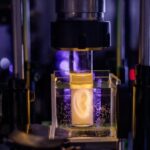
One of the core problems with fixing complex cardiac tissues and vessels is that of getting replacement parts to behave like the real thing. Take heart disease for example: hardening blood vessels present an issue that makes them hard to replace. That’s why a team of researchers at Colorado University Boulder is using 3D printing as a means of producing artificial blood vessels with programmable rigidity control. As a result, they’ve been able to accurately mimic the blood and oxygen flow present in the human body.

The research uses a fine-grained, programmable control over rigidity achieved via elaborate layering. Through the method, the researchers can print objects with the same shape, size and materials while displaying variable rigidities. The researchers printing these items with a high-resolution desktop printer (the biomaterials were as small as 10 microns). The key is to control oxygen migration, while simultaneously managing flexibility and size.

Researchers Bioprint Vessel Replacement Structures
Related Story
Researchers Bioprint Vessel Replacement Structures

“This is a profound development and an encouraging first step toward our goal of creating structures that function like a healthy cell should function,” said Xiaobo Yin, CU mechanical engineering associate professor and the study’s senior author. “The idea was to add independent mechanical properties to 3D structures that can mimic the body’s natural tissue.”

Medical Applications
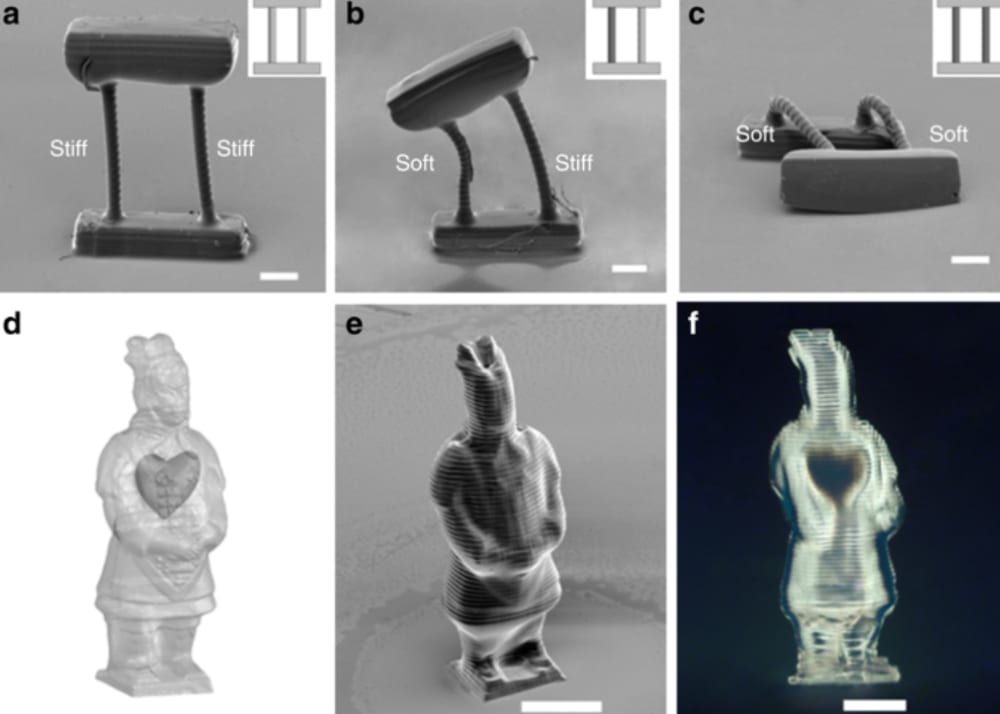
Prints With Programmable Rigidity Control Present Medical Applications

This technology allows researchers to create customisable microstructures for any patient’s disease models.   The researchers demonstrated this by printing various models with programmable rigidity control. The level of control comes courtesy of varying up the rod rigidity as shown in the image above. This creates items that display a level of flexibility without altering their other properties. The prints come in 3 combinations: soft/soft, hard/soft and hard/hard (from left to right in the picture).

“The challenge is to create an even finer scale for the chemical reactions,” Yin said. “But we see tremendous opportunity ahead for this technology and the potential for artificial tissue fabrication.”

The research could lead to many potential improvements in cardiology. It has a particular potential in solving the issues associated with hypertension and hardening vessels. As with many other forms of medical 3D printing, the greatest benefit is the patient specific care it provides. Doctors could alter the process, size and rigidity for each different patient. While the research is still young, it has immense potential in creating medical bio-structures as well. Perhaps it may also prove useful for simplistic nanomachines in the future.

Featured image courtesy of Colorado University.

Share:
WhatsApp Twitter Facebook LinkedIn Buffer Reddit E-mail
Join our newsletter

Our newsletter is free & you can unsubscribe any time.

Social

  • Facebook Facebook 3D Printing
  • Linkedin Linkedin 3D Printing
banner
banner
Join our newsletter

Our newsletter is free & you can unsubscribe any time.

Featured Industries

  • Automotive
  • Aerospace
  • Construction
  • Dental
  • Environmental
  • Electronics
  • Fashion
  • Medical
  • Military
  • Flashforge Adventurer 5M

    • - Print size: 220 x 220 x 220 mm
    • - 600mm/s travel speed
    More details »
    $299.00 Flashforge
    Buy Now
  • Flashforge Guider 3 Ultra

    • - Print size: 330 x 330 x 600 mm
    • - dual extruder system
    More details »
    $2,999.00 Flashforge
    Buy Now
  • Qidi Q2

    • - Print size: 270 x 270 x 256 mm
    • - enclosed heated chamber up to 65°C
    More details »
    $580.00 Qidi
    Buy Now
  • Snapmaker U1

    • - Print size: 270 x 270 x 270 mm
    • - multi-color printing with SnapSwap
    More details »
    $849.00 Snapmaker
    Buy Now
  • Creality Hi Combo

    • - Print size: 260 x 260 x 300 mm
    • - up to 16-color printing
    More details »
    $399.00 Creality
    Buy Now
  • Flashforge AD5X

    • - Print size: 220 x 220 x 220 mm
    • - dual extrusion system
    More details »
    $399.00 Flashforge
    Buy Now
  • Qidi Max 4

    • - Print size: 390 x 390 x 340 mm
    • - active cooling air control
    More details »
    $1,219.00 Qidi
    Buy Now
  • Creality K2 Plus

    • - Print size: 350 x 350 x 350 mm
    • - multi-color printing
    More details »
    $1,199.00 Creality
    Buy Now
  • Anycubic Kobra S1 Combo

    • - Print size: 250 x 250 x 250 mm
    • - budget multicolor printing
    More details »
    $429.00 Anycubic
    Buy Now
  • Anycubic Photon Mono M7

    • - Print size: 223 x 126 x 230 mm
    • - 10.1 inch 14K screen
    More details »
    $279.00 Anycubic
    Buy Now

Company Information

  • What is 3D Printing?
  • Contact us
  • Join our mailing list
  • Advertise with us
  • Media Kit
  • Nederland 3D Printing

Blog

  • Latest News
  • Use Cases
  • Reviews
  • 3D Printers
  • 3D Printing Metal

Featured Reviews

  • Anycubic Photon Mono M5s
  • Creality Ender 5 S1
  • The Mole 3D Scanner
  • Flashforge Creator 3 Pro

Featured Industries

  • Automotive
  • Aerospace
  • Construction
  • Dental
  • Environmental
  • Electronics
  • Medical
  • Military
  • Fashion
  • Art
2026 — Strikwerda en Dehue
  • Home
  • Join our mailing list
  • Contact us
Blog
  • Latest News
  • Use Cases
  • Reviews
  • 3D Printers
  • 3D Printing Metal
Featured Industries
  • Automotive
  • Aerospace
  • Construction
  • Dental
  • Environmental
  • Electronics
  • Medical
  • Military
  • Fashion
  • Art
Company Information
  • What is 3D Printing?
  • Contact us
  • Join our mailing list
  • Advertise with us
  • Media Kit
  • Nederland 3D Printing