
3D Printing
News Videos Newsletter Contact us
Home / News / Researchers 3D Print Liquid-Filled Defect-Detecting Objects
qidi

Researchers 3D Print Liquid-Filled Defect-Detecting Objects

December 21, 2020

The market for microfluidic chambers is still small, mostly because the technology to create them effectively hasn’t been around that long. 3D printing microfluidic circuits has the potential to rapidly advance a number of industries, including medical, robotics, and cooling. To further automate the process of getting liquids into printed objects, a team of researchers in Germany recently developed a printing process that deposits liquids into objects as they’re being printed.

The research project was led by Professor Wolfgang Binder and researcher Harald Rupp at Germany’s Martin Luther University Halle-Wittenberg. “The future lies in more complex methods that combine several production steps. That is why we were looking for a way to integrate liquids directly into the material during the printing process,” said Professor Binder. That certainly would save a lot of time, especially considering that their test capsules were only a few hundred microns wide.

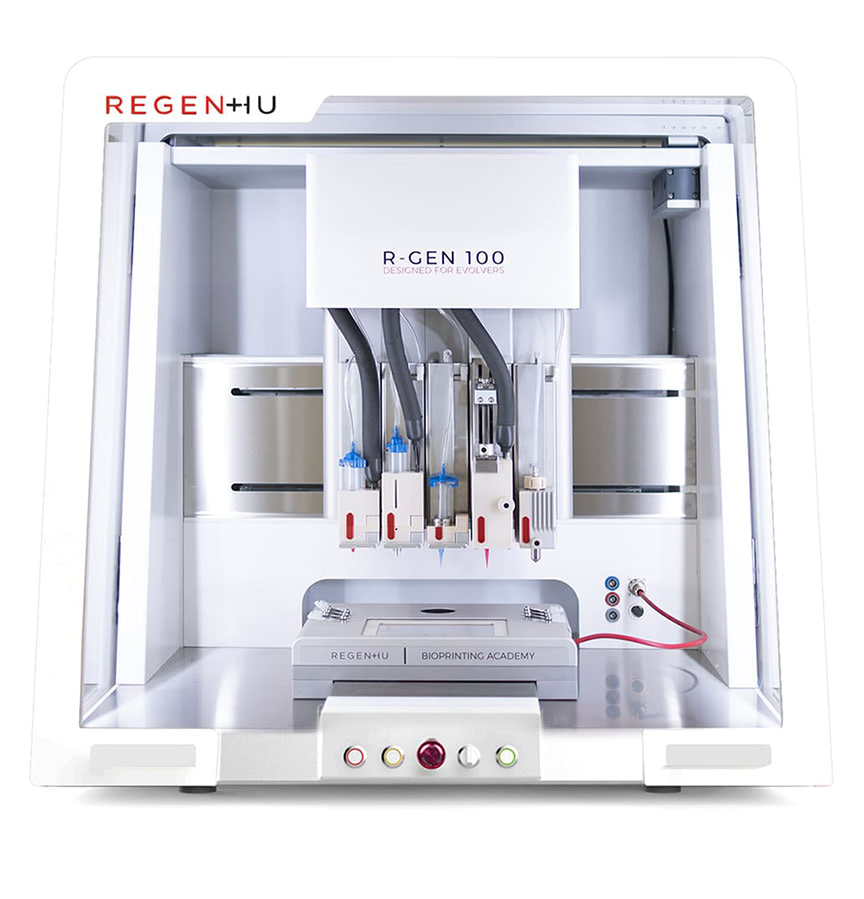
Using a REGENHU bioprinter that’s equipped with multiple types of print heads, the team used one head to extrude a 5mm x 5mm shell matrix of the biodegradable polymer polycaprolactone (PCL). The matrix had voids in it ranging from 100 to 800 microns, and another head on the printer deposited liquid oil into the voids. After the voids were filled with oil, the extrusion head capped the top with more PCL, making an array of nanocapsules. That level of precision and automation paves the way to truly personalized medicine that’s actually accessible.

To run that point home, their final “reactive capsule composites were containing two different liquids for a fluorogenic CuAAC “click” reaction (copper(I)‐catalyzed alkyne azide cycloaddition), catalyzed by a heterogeneous catalyst: thermally reduced graphene oxide containing Cu(I)‐nanoparticles (TRGO).” To put that in normal-speak, they deposited two reactive liquids in different voids within the same matrix so that when the object is damaged, the liquids mix and cause a fluorogenic reaction, meaning it glows where the damage occurred. Automatic defect detection could be used in all sorts of applications, from infrastructure to medical.
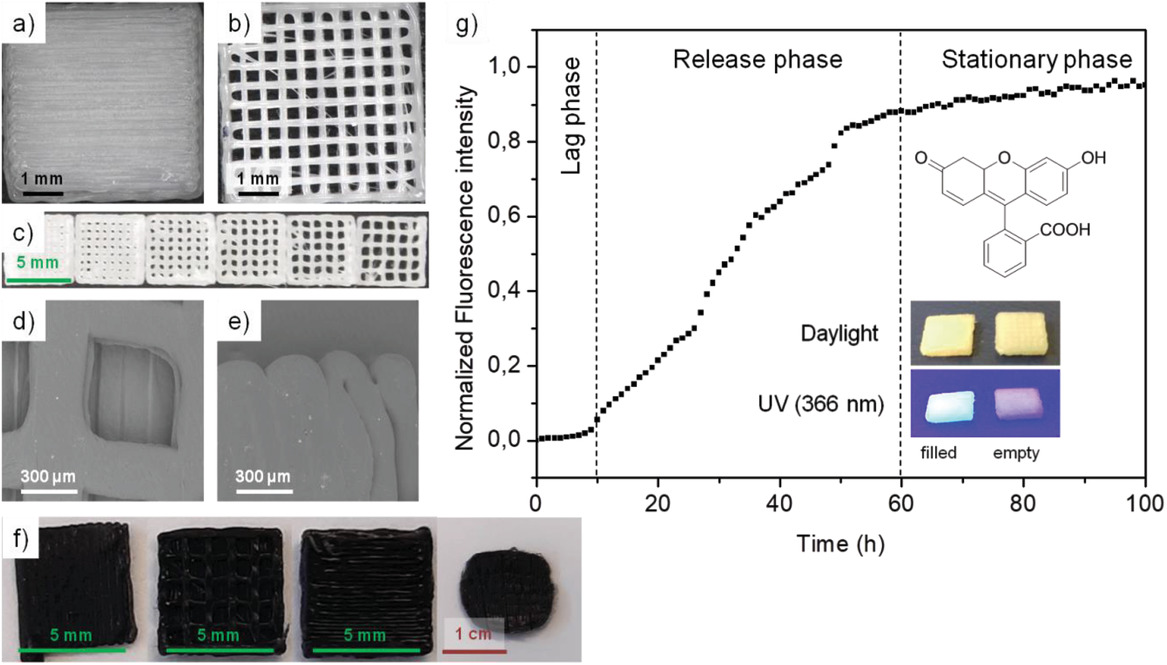
a) Microscopic image of the printed top layer (5 mm × 5 mm) to enclose the core–shell capsule system, b) the inner grid structure forming the capsule system, and c) different grid sizes with gaps from 100 to 800 µm. SEM images of d) one capsule void, e) the top layer, and f) pictures of different layers of the composite 10 during printing as well as a compressed/damaged sample. g) Diffusion test of printed core–shell capsule systems with fluorescein saturated farnesol solution as capsule filling. The release of the solution in ethanol was analyzed by fluorescence measurements.

The glowing effect was actually included to demonstrate the potential for self-healing composites, because if you can mix two liquids that glow when they mix on demand, you can do the same with liquids that cure into solids when they mix. Self-patching tires and auto-healing pipes are right around the corner.
regenhu

Share:
WhatsApp Twitter Facebook LinkedIn Buffer Reddit E-mail
About the author | Cameron Naramore
Cameron is a 3D printer and CNC operator. He's fond of cooking, traveling, and science fiction.
Join our newsletter

Our newsletter is free & you can unsubscribe any time.

Latest posts

Best 3D Printers 2026 – Buyers Guide

This overview contains basic product specs & prices for our pick of the best consumer-grade 3D printers of 2024. We'll cover FDM printers... read more »

3D Printers

Spanish Hospital Cuts Therapy Equipment Costs by 97.6% With 3D Printing

La Candelaria University Hospital in Tenerife is producing custom hand rehabilitation tools for €56 per batch using a 3D printer, down from €2,316... read more »

Medical
Spanish Hospital Cuts Therapy Equipment Costs by 97.6% With 3D Printing

Adidas Debuts 3D Printed Basketball Shoe

Adidas has introduced a 3D-printed basketball shoe, debuted by Kansas Jayhawks guard Darryn Peterson. The 19-year-old, who'd been projected as the top pick... read more »

News
Adidas Debuts 3D Printed Basketball Shoe

OU and Oak Ridge Lab Win $8.8M to Speed 3D-Printed Parts Approval for Air Force Aircraft

The University of Oklahoma has been awarded $8.8 million to launch Phase II of a metal 3D printing research program aimed at cutting... read more »

3D Printing Metal

BASF Starts Up World’s First Industrial-Scale 3D Printed Catalyst Plant in Ludwigshafen

BASF commissioned the world's first production plant for 3D-printed catalysts, bringing its proprietary X3D technology to full industrial scale at its Ludwigshafen site.... read more »

Materials
BASF Starts Up World's First Industrial-Scale 3D Printed Catalyst Plant in Ludwigshafen

Sound Particles 3D Prints Its Employees’ Ears to Perfect Spatial Audio

A 17-person audio software company in Lisbon has 3D-printed replicas of every employee's ears, heads, and torsos to test acoustic realism, part of... read more »

News
Sound Particles 3D Prints Its Employees' Ears to Perfect Spatial Audio

BENTU Design 3D Prints Street Furniture From Demolished Urban Village Waste

Chinese design studio BENTU Design has developed a method for turning construction rubble from demolished urban villages into 3D printed public furniture, with... read more »

News

Developer Creates 3D Printer That Uses Bitcoin Mining Heat for Bed Temperature Control

A developer known as PizzAndy has created a prototype 3D printer that uses heat generated from Bitcoin mining chips to control the printer... read more »

3D Printers
Developer Creates 3D Printer That Uses Bitcoin Mining Heat for Bed Temperature Control

Formula 1 Teams Use 3D Printing to Navigate New Engine Compression Ratio Rules

Mercedes and Red Bull have reportedly found a way to work around Formula 1's new compression ratio regulations for the 2026 season. The... read more »

Automotive
Formula 1 Teams Use 3D Printing to Navigate New Engine Compression Ratio Rules

European Researchers 3D Print Glass-like Metallic Components for More Efficient Electric Motors

Researchers at Saarland University are developing new metallic glass alloys that could reduce energy losses in electric motors used in devices like drones... read more »

News
European Researchers 3D Print Glass-like Metallic Components for More Efficient Electric Motors

Social

  • Facebook Facebook 3D Printing
  • Linkedin Linkedin 3D Printing
banner
Join our newsletter

Our newsletter is free & you can unsubscribe any time.

Featured Industries

  • Automotive
  • Aerospace
  • Construction
  • Dental
  • Environmental
  • Electronics
  • Fashion
  • Medical
  • Military
  • Flashforge Adventurer 5M

    • - Print size: 220 x 220 x 220 mm
    • - 600mm/s travel speed
    More details »
    $299.00 Flashforge
    Buy Now
  • Creality K2 Plus

    • - Print size: 350 x 350 x 350 mm
    • - multi-color printing
    More details »
    $1,199.00 Creality
    Buy Now
  • Qidi Q2

    • - Print size: 270 x 270 x 256 mm
    • - enclosed heated chamber up to 65°C
    More details »
    $580.00 Qidi
    Buy Now
  • Anycubic Kobra S1 Combo

    • - Print size: 250 x 250 x 250 mm
    • - budget multicolor printing
    More details »
    $429.00 Anycubic
    Buy Now
  • Anycubic Photon Mono M7

    • - Print size: 223 x 126 x 230 mm
    • - 10.1 inch 14K screen
    More details »
    $279.00 Anycubic
    Buy Now
  • Flashforge Guider 3 Ultra

    • - Print size: 330 x 330 x 600 mm
    • - dual extruder system
    More details »
    $2,999.00 Flashforge
    Buy Now
  • Snapmaker U1

    • - Print size: 270 x 270 x 270 mm
    • - multi-color printing with SnapSwap
    More details »
    $849.00 Snapmaker
    Buy Now
  • Creality Hi Combo

    • - Print size: 260 x 260 x 300 mm
    • - up to 16-color printing
    More details »
    $399.00 Creality
    Buy Now
  • Flashforge AD5X

    • - Print size: 220 x 220 x 220 mm
    • - dual extrusion system
    More details »
    $399.00 Flashforge
    Buy Now
  • Qidi Max 4

    • - Print size: 390 x 390 x 340 mm
    • - active cooling air control
    More details »
    $1,219.00 Qidi
    Buy Now

Company Information

  • What is 3D Printing?
  • Contact us
  • Join our mailing list
  • Advertise with us
  • Media Kit
  • Nederland 3D Printing

Blog

  • Latest News
  • Use Cases
  • Reviews
  • 3D Printers
  • 3D Printing Metal

Featured Reviews

  • Anycubic Photon Mono M5s
  • Creality Ender 5 S1
  • The Mole 3D Scanner
  • Flashforge Creator 3 Pro

Featured Industries

  • Automotive
  • Aerospace
  • Construction
  • Dental
  • Environmental
  • Electronics
  • Medical
  • Military
  • Fashion
  • Art
2026 — Strikwerda en Dehue
  • Home
  • Join our mailing list
  • Contact us
Blog
  • Latest News
  • Use Cases
  • Reviews
  • 3D Printers
  • 3D Printing Metal
Featured Industries
  • Automotive
  • Aerospace
  • Construction
  • Dental
  • Environmental
  • Electronics
  • Medical
  • Military
  • Fashion
  • Art
Company Information
  • What is 3D Printing?
  • Contact us
  • Join our mailing list
  • Advertise with us
  • Media Kit
  • Nederland 3D Printing