Researchers from IMDEA Materials Institute and the Technical University of Madrid have developed a design-focused approach to improve the performance of 3D-printed nitinol structures. Their study, published in Virtual and Physical Prototyping, demonstrates how woven, fabric-like architectures can enhance the deformability of nickel-titanium alloys manufactured through additive processes.
Traditional 3D printing of nitinol has faced significant limitations compared to conventional manufacturing methods. Previous studies have shown that 3D-printed nitinol samples exhibit roughly half the deformability rate of industrially produced nitinol, with the additive manufacturing process creating more brittle materials.
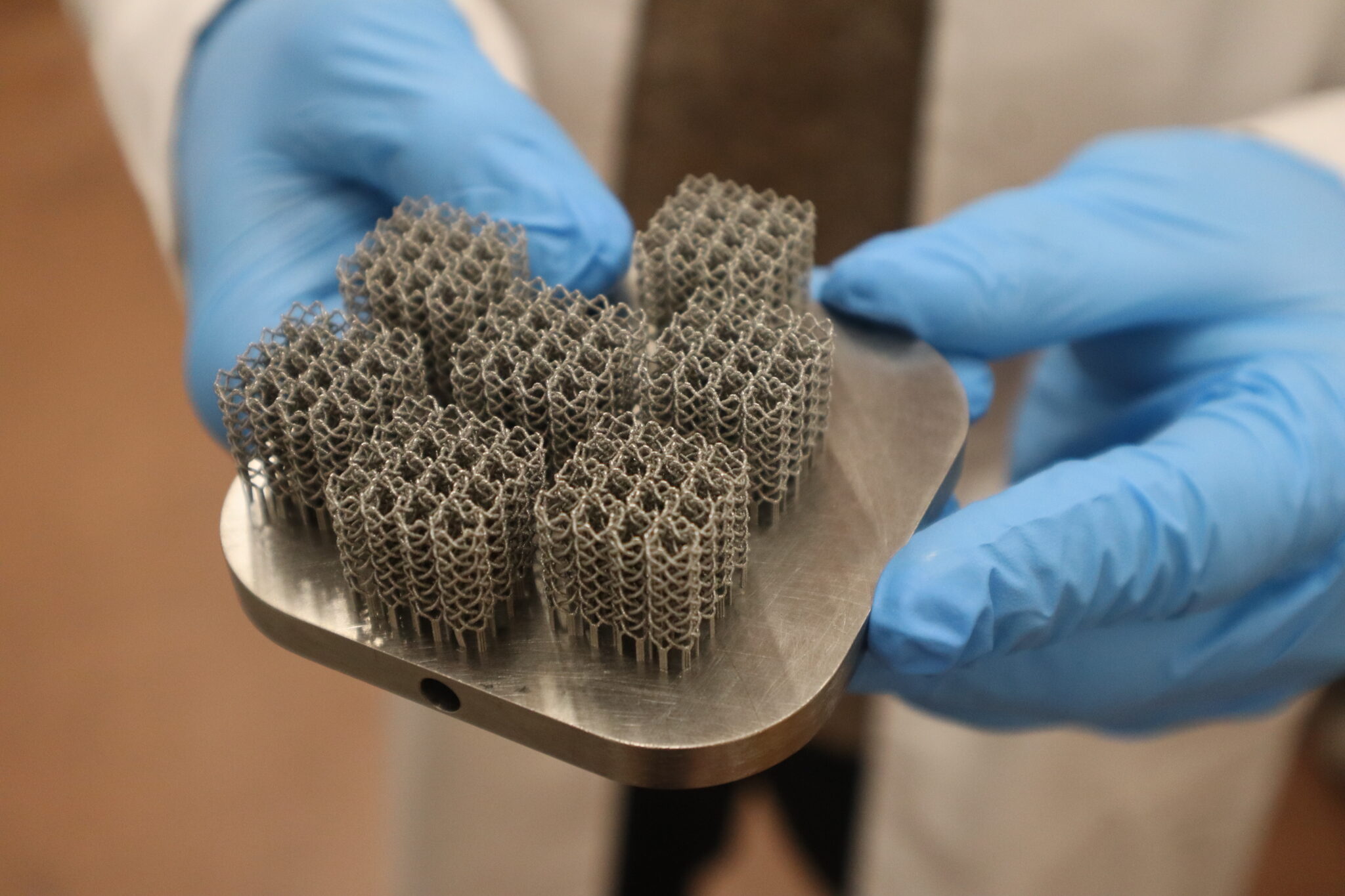
The research team addressed this challenge by shifting focus from material optimization to architectural design that amplifies mechanical performance through geometry. They created complex woven structures including meshes, spheres, and rings using laser powder bed fusion techniques. “These were some of the most complex-shaped woven nitinol structures ever created,” explains Prof. Andrés Díaz Lantada from UPM and IMDEA Materials Institute.
The study introduced an algorithm-based design framework specifically tailored for additive manufacturing of nitinol. Two main families of structures were developed: tubular lattices and cylindrical woven architectures. Mechanical testing revealed that the stiffness, load-bearing capacity, energy absorption, and toughness of these structures can be adjusted across several orders of magnitude through design alone.
The research team used computed tomography to compare printed samples with digital models, validating the accuracy of their manufacturing process. This approach confirms the methodology’s effectiveness for creating complex, customizable architectures. The work was supported by the ‘iMPLANTS-CM’ project funded by Comunidad Autónoma de Madrid.
Source: materials.imdea.org