
3D Printing
News Videos Newsletter Contact us
Home / News / Researchers Develop New Material for More Lifelike Wearables
qidi

Researchers Develop New Material for More Lifelike Wearables

September 22, 2023

Engineers and chemists at Lawrence Livermore National Laboratory (LLNL) and Meta have collaborated to develop a 3D printed material that emulates the properties of biological tissues. This advancement has the potential to significantly impact the field of wearable technology and enhance the concept of “augmented humanity.”

Published in the journal Matter, their research introduces a unique 3D printable resin that utilizes light to create smooth stiffness gradients, replicating natural transitions found in biological structures, such as the junction between bone and muscle. This addresses a significant challenge in creating more realistic wearables: the mechanical disparity between soft tissues and rigid electronic components.
Researchers Develop New Material for More Lifelike Wearables
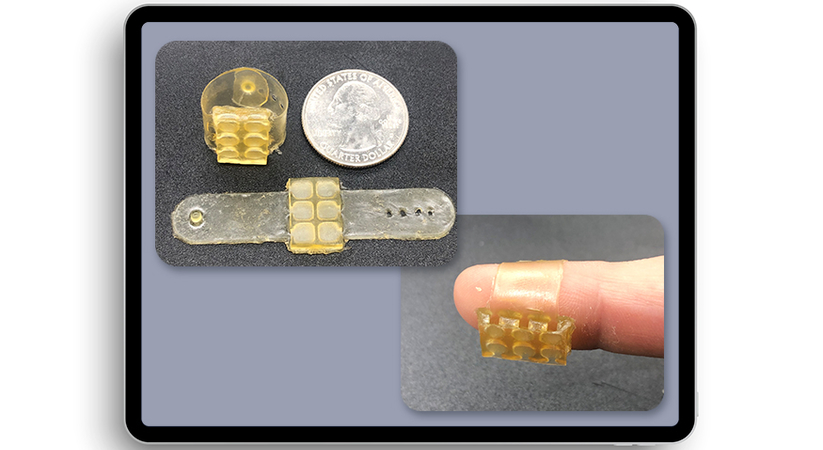
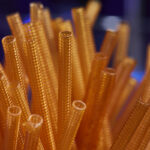
Lifelike wearables that closer mimic human skin. (Image Credit: LLNL)

The team demonstrated the material by designing a 3D printed wearable braille device capable of translating text messages into braille instantly. By adjusting the light intensity during the Digital Light Processing 3D printing process, they achieved continuous mechanical gradients from soft to stiff within a single resin system.

“A beautiful feature of additive manufacturing is that we can create these impossible structures, but also we are somewhat limited in terms of the material properties — we only have a certain amount of material that we can pick from,” lead author and LLNL engineer Sijia Huang.

“One of the initial motivations was, ‘what if we could have the same resin system and replicate the engineered plastic systems effortlessly by merely adjusting the light intensity?’ That would save a significant amount of time and effort for engineers, particularly when incorporating new properties of materials.”

This research opens possibilities for crafting wearable devices with adaptable material properties, with potential applications in soft robotics, energy-absorbing materials, and wearable electronics.

Crucially, the material displays robust stability under both light and ambient conditions, distinguishing it from traditional plastics. This development represents a significant step forward in the realm of variable-stiffness polymer materials with long-term durability.

You can read the full research paper, titled “One-pot ternary sequential reactions for photopatterned gradient multimaterials” over at this link.

Come and let us know your thoughts on our Facebook, Twitter, and LinkedIn pages, and don’t forget to sign up for our weekly additive manufacturing newsletter to get all the latest stories delivered right to your inbox.

Share:
WhatsApp Twitter Facebook LinkedIn Buffer Reddit E-mail
About the author | Phillip Keane
Phillip is an aerospace engineer from UK. He is a graduate of Coventry University (UK), International Space University (France) and Nanyang Technological University (Singapore), where he studied Advanced Manufacturing at the Singapore Centre for 3D Printing.
Join our newsletter

Our newsletter is free & you can unsubscribe any time.

Social

  • Facebook Facebook 3D Printing
  • Linkedin Linkedin 3D Printing
banner
banner
Join our newsletter

Our newsletter is free & you can unsubscribe any time.

Featured Industries

  • Automotive
  • Aerospace
  • Construction
  • Dental
  • Environmental
  • Electronics
  • Fashion
  • Medical
  • Military
  • Snapmaker U1

    • - Print size: 270 x 270 x 270 mm
    • - multi-color printing with SnapSwap
    More details »
    $849.00 Snapmaker
    Buy Now
  • Flashforge Adventurer 5M

    • - Print size: 220 x 220 x 220 mm
    • - 600mm/s travel speed
    More details »
    $299.00 Flashforge
    Buy Now
  • Flashforge AD5X

    • - Print size: 220 x 220 x 220 mm
    • - dual extrusion system
    More details »
    $399.00 Flashforge
    Buy Now
  • Anycubic Kobra S1 Combo

    • - Print size: 250 x 250 x 250 mm
    • - budget multicolor printing
    More details »
    $429.00 Anycubic
    Buy Now
  • Qidi Q2

    • - Print size: 270 x 270 x 256 mm
    • - enclosed heated chamber up to 65°C
    More details »
    $580.00 Qidi
    Buy Now
  • Qidi Max 4

    • - Print size: 390 x 390 x 340 mm
    • - active cooling air control
    More details »
    $1,219.00 Qidi
    Buy Now
  • Anycubic Photon Mono M7

    • - Print size: 223 x 126 x 230 mm
    • - 10.1 inch 14K screen
    More details »
    $279.00 Anycubic
    Buy Now
  • Creality Hi Combo

    • - Print size: 260 x 260 x 300 mm
    • - up to 16-color printing
    More details »
    $399.00 Creality
    Buy Now
  • Flashforge Guider 3 Ultra

    • - Print size: 330 x 330 x 600 mm
    • - dual extruder system
    More details »
    $2,999.00 Flashforge
    Buy Now
  • Creality K2 Plus

    • - Print size: 350 x 350 x 350 mm
    • - multi-color printing
    More details »
    $1,199.00 Creality
    Buy Now

Company Information

  • What is 3D Printing?
  • Contact us
  • Join our mailing list
  • Advertise with us
  • Media Kit
  • Nederland 3D Printing

Blog

  • Latest News
  • Use Cases
  • Reviews
  • 3D Printers
  • 3D Printing Metal

Featured Reviews

  • Anycubic Photon Mono M5s
  • Creality Ender 5 S1
  • The Mole 3D Scanner
  • Flashforge Creator 3 Pro

Featured Industries

  • Automotive
  • Aerospace
  • Construction
  • Dental
  • Environmental
  • Electronics
  • Medical
  • Military
  • Fashion
  • Art
2025 — Strikwerda en Dehue
  • Home
  • Join our mailing list
  • Contact us
Blog
  • Latest News
  • Use Cases
  • Reviews
  • 3D Printers
  • 3D Printing Metal
Featured Industries
  • Automotive
  • Aerospace
  • Construction
  • Dental
  • Environmental
  • Electronics
  • Medical
  • Military
  • Fashion
  • Art
Company Information
  • What is 3D Printing?
  • Contact us
  • Join our mailing list
  • Advertise with us
  • Media Kit
  • Nederland 3D Printing