
Researchers at the University of Arkansas have demonstrated that Mars’ carbon dioxide atmosphere could serve as a substitute for argon shield gas in metal 3D printing processes. The study, published as a pre-print on arXiv by Zane Mebruer and Wan Shou, focused on selective laser melting (SLM) of 316L stainless steel, a common industrial material.
Shield gases are used in metal 3D printing to prevent oxygen from oxidizing the material during the printing process, which can make parts brittle. On Earth, argon is typically used for this purpose, but the gas is expensive and would need to be transported from Earth for Mars missions. The researchers tested whether Mars’ CO2-rich atmosphere could provide adequate protection during the printing process.
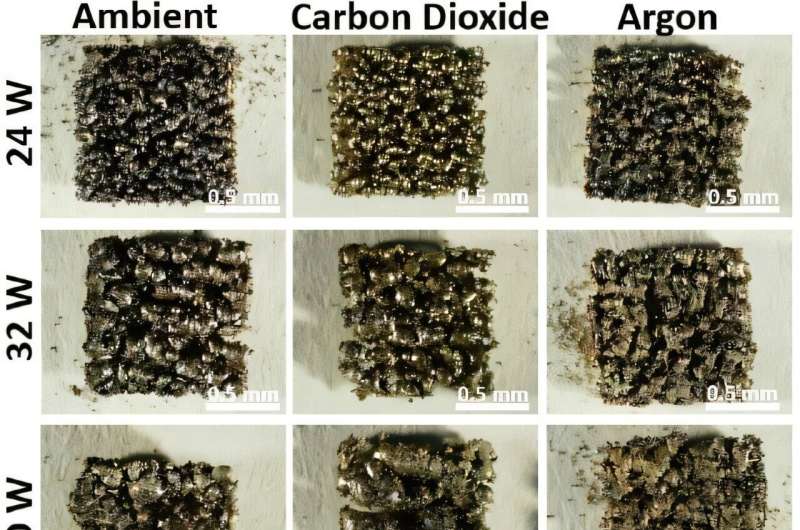
The experiments compared printing results using argon, carbon dioxide, and ambient Earth air. While argon performed best with 98% area retention in solid square layer tests, carbon dioxide achieved 85% retention. Parts printed in ambient air showed less than 50% retention, making them unusable.
The researchers explain that carbon dioxide can work because it dissociates at the high temperatures in the laser melt pool, and the partial pressure of oxygen in pure CO2 environments is lower than in Earth’s nitrogen-rich atmosphere. Parts printed with CO2 contained about 1.6 times more oxygen than those printed with argon, but still significantly less than parts printed in ambient air.
The findings could have applications beyond space exploration, as CO2 is much cheaper than argon for terrestrial 3D printing operations. However, the CO2-printed parts are less visually appealing than those made with argon, which may limit commercial adoption where appearance matters.
Source: arxiv.org