
3D Printing
News Videos Newsletter Contact us
Home / News / Robot Gets Printed Self-Healing Mycelium Skin
qidi

Robot Gets Printed Self-Healing Mycelium Skin

January 5, 2023

Researchers at ETH Zurich, Switzerland, have developed a means of 3D printing a self repairing skin using hydrogels loaded with fungal mycelia.

The skin repairs itself when damaged, provided that it the fungal network is allowed to metabolize, and it does so by receiving nutrients. The fact that it is capable of metabolism means that it is a living organism.

When draped over a robotic body, it is the very definition of a cybernetic organism, as described in The Terminator franchise.

Feast your eyes on the living skinned robotic gripper below.

Mycelial skin
Mycelial skin over a robotic gripper. (Image credit: ETH Zurich)

“Living tissue over a metal endoskeleton”

Materials have a tendency to wear and break over time. To repair them requires energy and effort, usually in the form of maintenance, which is performed by a human being. Conversely, living materials have the ability to regenerate and self repair when damaged.

Think of a growing tree trunk, or your own skin. Of course, living materials also require energy to repair, and that is provided by nutrients.

This concept has been applied to an artificial skin which has been 3D printed in the form of a hydrogen grid, and infused with the Ganoderma Lucidum fungus. This type of fungus grows on hardwood in Asia and parts of Europe.

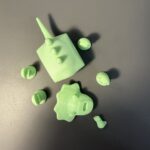
You can see the fruiting body of the fungus in this image.

The Process

The first step in making the living skin involved inoculating the hydrogel with the fungal mycelia. This resulted in the production of a mycelium ink, which was then harvested and loaded into a direct ink writing (DIW) 3D printer.

The hyphae distributed in the ink form an interconnected network of fungal cells within the printed objects, which in this case, were grid like structures in various shapes.

The grid structure allows airways and gaps for the potential dosing of nutrition. The structure can be printed into any geometry, allowing full customisation and directing the growth of the skin.

As mycelium has evolved to grow between gaps, it follows the geometry of the printed grid structure. This property also allows it to self-repair by bridging damaged areas within its own skin.

The mycelium grows according to two different strategies named as phalanx, or guerrilla.

printing process
The printing process. (Image credit: ETH Zurich)

The phalanx strategy involves the coordinated growth of multiple hyphae in a dense, interconnected network, forming a structure known as a mycelial mass or mycelial mat (the skin).

This short-reaching strategy allows the fungus to efficiently explore and colonize new areas in search of food, and it also allows the fungus to defend itself against competitors and predators.

Conversely, the guerrilla strategy is more opportunistic and far-reaching, allowing the mycelium to explore patchy resource landscapes.

The printed mycelia showed both types of growth in the printed network, leading to the growth of a fractal hyphae network giving strength to the printed grid. The hyphae proved to be capable of healing cracks measuring up to 2 mm in width.

The researchers state that there needs to be further development into how the nutrients are provided into the printed skin, as well as how the waste is removed.

In addition to the printed mycelial gripper pictured at the beginning of the article, the researchers printed a skin for an untethered robot.

The combination of living skin over an artificial endoskeleton is the very definition of a cybernetic organism, at least according to James Cameron. Exciting times ahead.

You can read the full paper, titled “Self-regenerating living material made of printed fungi”, published in Nature Materials”, at this link.


Share:
WhatsApp Twitter Facebook LinkedIn Buffer Reddit E-mail
About the author | Phillip Keane
Phillip is an aerospace engineer from UK. He is a graduate of Coventry University (UK), International Space University (France) and Nanyang Technological University (Singapore), where he studied Advanced Manufacturing at the Singapore Centre for 3D Printing.
Join our newsletter

Our newsletter is free & you can unsubscribe any time.

Latest posts

Best Free 3D Printable Models in 2026: A Guide to the Whole Ecosystem

A 2026 guide to finding free 3D printable models, from the 7 main repositories (Printables, MakerWorld, Thingiverse, and more) to parallel channels like... read more »

3D Models
3D model repositories complete guide on 3DPrinting.com

Revopoint May Sale 2026: Save Up to 28% on 3D Scanners and Bundles, Plus an Extra 2% for 3DPrinting.com Readers

Revopoint has launched its May Sale across the official Revopoint website, with discounts on scanners, software, and curated bundles for measurement and reverse... read more »

News
Revopoint May Sale 2026 featured image showing the MetroY, MIRACO, and INSPIRE scanners around a laptop running Revo Design.

Best 3D Printer Slicers in 2026: 8 Picks Tested & Compared

The 2026 guide to the best 3D printer slicers. 8 picks for FDM and resin printers, beginners to power users, with comparison and... read more »

Software

MIT Researchers 3D Print a Three-Sided Zipper Concept

MIT's Computer Science and Artificial Intelligence Laboratory has revived a rejected 1985 invention to create the "Y-zipper," a three-sided fastener that's 3D printed... read more »

News
MIT Researchers 3D Print a Three-Sided Zipper Concept

3D Printed Copper Cold Plates Could Cut Data Center Cooling Energy by 98%

Mechanical engineers at the University of Illinois have 3D printed pure copper cold plates that could reduce a data center's cooling energy consumption... read more »

News

Researchers 3D Print Glowing Shapes Using Bioluminescent Algae Embedded in Hydrogel

Scientists at the University of Colorado Boulder have used a bioluminescent single-celled algae called Pyrocystis lunula to 3D-print light-emitting structures that glow a... read more »

News
Researchers 3D Print Glowing Shapes Using Bioluminescent Algae Embedded in Hydrogel

Revopoint POP 4 Launches on Kickstarter: Hybrid Blue Laser and Infrared 3D Scanner from $579

Revopoint is bringing its next-generation handheld 3D scanner to Kickstarter. The Revopoint POP 4 launches on May 7, 2026, combining blue laser and... read more »

News

Best Resin 3D Printers in 2026: Our Top Picks

The best resin 3D printers in 2026 cover an extraordinary range, from $169 entry-level machines that produce tabletop-grade detail to $9,999 professional systems... read more »

3D Printers

Best 3D Printers for Beginners 2026

A 2026 guide to the best 3D printers for beginners. 15 FDM and resin picks, plus a buying guide and FAQ.

3D Printers
How 3D Printing Enhances the VR and AR Gaming Experience

Apollo’s New $4M Supercar Gets a 3D-Printed Titanium Exhaust That Takes 123 Hours to Print

Apollo Automobil's upcoming Evo supercar will feature what the company describes as the largest one-piece 3D-printed titanium exhaust system ever produced, with each... read more »

Automotive
Apollo's New $4M Supercar Gets a 3D-Printed Titanium Exhaust That Takes 123 Hours to Print

Social

  • Facebook Facebook 3D Printing
  • Linkedin Linkedin 3D Printing
banner
Join our newsletter

Our newsletter is free & you can unsubscribe any time.

Featured Industries

  • Automotive
  • Aerospace
  • Construction
  • Dental
  • Environmental
  • Electronics
  • Fashion
  • Medical
  • Military
  • Creality K2 Plus

    • - Print size: 350 x 350 x 350 mm
    • - multi-color printing
    More details »
    $1,199.00 Creality
    Buy Now
  • Anycubic Photon Mono M7

    • - Print size: 223 x 126 x 230 mm
    • - 10.1 inch 14K screen
    More details »
    $279.00 Anycubic
    Buy Now
  • Snapmaker U1

    • - Print size: 270 x 270 x 270 mm
    • - multi-color printing with SnapSwap
    More details »
    $849.00 Snapmaker
    Buy Now
  • Anycubic Kobra S1 Combo

    • - Print size: 250 x 250 x 250 mm
    • - budget multicolor printing
    More details »
    $429.00 Anycubic
    Buy Now
  • Flashforge AD5X

    • - Print size: 220 x 220 x 220 mm
    • - dual extrusion system
    More details »
    $399.00 Flashforge
    Buy Now
  • Creality Hi Combo

    • - Print size: 260 x 260 x 300 mm
    • - up to 16-color printing
    More details »
    $399.00 Creality
    Buy Now
  • Qidi Max 4

    • - Print size: 390 x 390 x 340 mm
    • - active cooling air control
    More details »
    $1,219.00 Qidi
    Buy Now
  • Flashforge Adventurer 5M

    • - Print size: 220 x 220 x 220 mm
    • - 600mm/s travel speed
    More details »
    $299.00 Flashforge
    Buy Now
  • Qidi Q2

    • - Print size: 270 x 270 x 256 mm
    • - enclosed heated chamber up to 65°C
    More details »
    $580.00 Qidi
    Buy Now
  • Flashforge Guider 3 Ultra

    • - Print size: 330 x 330 x 600 mm
    • - dual extruder system
    More details »
    $2,999.00 Flashforge
    Buy Now

Company Information

  • What is 3D Printing?
  • Contact us
  • Join our mailing list
  • Advertise with us
  • Media Kit
  • Nederland 3D Printing

Blog

  • Latest News
  • Use Cases
  • Reviews
  • 3D Printers
  • 3D Printing Metal

Featured Reviews

  • Anycubic Photon Mono M5s
  • Creality Ender 5 S1
  • The Mole 3D Scanner
  • Flashforge Creator 3 Pro

Featured Industries

  • Automotive
  • Aerospace
  • Construction
  • Dental
  • Environmental
  • Electronics
  • Medical
  • Military
  • Fashion
  • Art
2026 — Strikwerda en Dehue
  • Home
  • Join our mailing list
  • Contact us
Blog
  • Latest News
  • Use Cases
  • Reviews
  • 3D Printers
  • 3D Printing Metal
Featured Industries
  • Automotive
  • Aerospace
  • Construction
  • Dental
  • Environmental
  • Electronics
  • Medical
  • Military
  • Fashion
  • Art
Company Information
  • What is 3D Printing?
  • Contact us
  • Join our mailing list
  • Advertise with us
  • Media Kit
  • Nederland 3D Printing