
3D Printing
News Back to school deals Contact us
Home / News / Volumetric 3D Printing gets Flexible
qidi

Volumetric 3D Printing gets Flexible

November 12, 2020

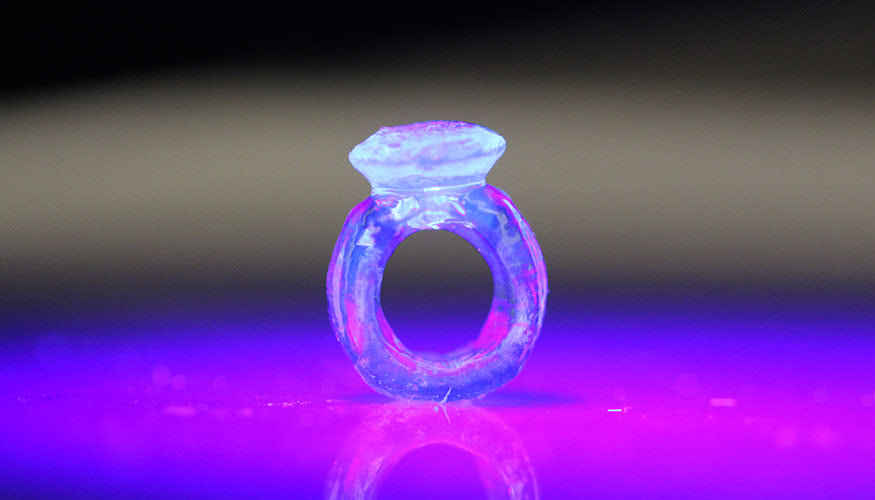
Traditional 3D printing involves a layerwise deposition, whereas volumetric 3D printing is not layerwise. Instead the object being printed appears almost instantaneously within the photopolymer resin thanks to the laser solidifying the resin in three dimensions, super quickly.
no more layers
Goodbye layerwise deposition (Image credit: Maxim Shusteff/LLNL)

And if you enjoy the ever growing list of AM acronyms, then buckle up because we have a couple more here for you.

VAM stands for volumetric additive manufacturing and a subset of VAM is called Computed Axial Lithography (CAL for short). CAL even has its own (small) Wiki page, just in case you were thinking that we make these things up!

For this article we are going to be looking at CAL, which has been developed by researchers at Lawrence Livermore National Laboratory (LLNL) in Livermore, California in collaboration with UC Berkeley.

CAL works by placing the resin into a cylindrical vial, which is spun around as the laser fires into the resin. The solidifying resinous mass grows outwards from the rotational axis as the laser adds 3D surfaces to the already solidified mass at the core of the item in question.

It grows axially, rather than planarly, hence Computed Axial Lithography.
You can see this process in the animation from LLNL above.

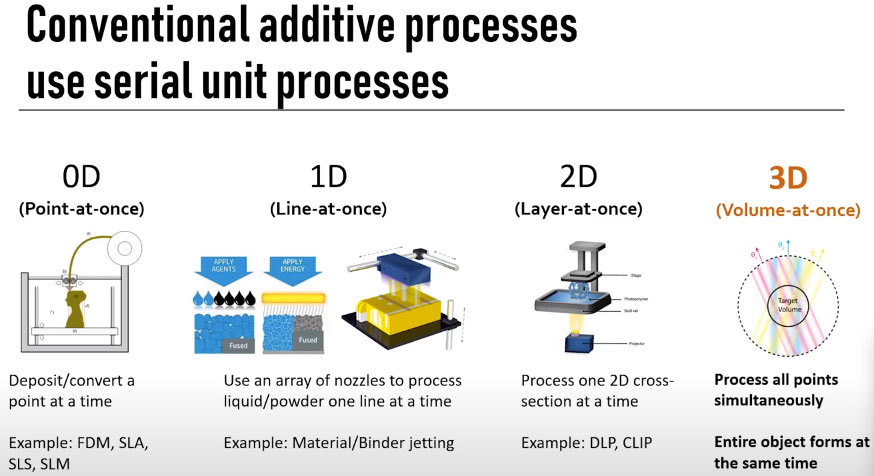
The graphic below shows another way of looking at various processes by category of the process in terms of dimensions. Filament deposition is 0D, CAL is 3D, from a deposition point of view.
volumetric 3d printing comparison
(Image Credit: Presentation from UC Berkeley)

The team from LLNL has just published a paper in the Advanced Materials journal detailing their newly developed resins which will allow a wider range of functionality from the 3D printed plastics.

The paper, titled “Highly Tunable Thiol‐Ene Photoresins for Volumetric Additive Manufacturing”

Their previous resins produced weak and brittle parts (like normal SLA), and with the new materials the team will be able to produce strong parts with varying stiffness and flexibility.

Thiol‐ene materials have more uniform molecular networks allowing a certain amount of tunability of the material during polymerisation and have already found application in the fields of adhesives, electronics, and biomaterials.

The paper introduces this new class of VAM‐compatible thiol‐ene resins and demonstrates the formulation of thiol‐ene resins (for those of you with a polymer lab handy) as well as demonstrating that VAM can print parts as strong as the bulk material equivalent with this layerless method.

Here is a quote from the paper that summarises exactly what they did:

“To exploit controlled thiol‐ene network formation in VAM, we investigated thiol‐ene and acrylate resin formulations differing only in their crosslinking chemistry. Four resins were formulated as shown in Figure 1b from five monomers, each containing either rigid (an isocyanurate ring (ICN)), or flexible (a triethylene glycol chain (TEG)) subunits for tunable mechanical response.”

What does that all mean?

It means they swapped a few molecules around to control the flexibility of the printed parts. Specifically they experimented with the TEG (a plasticizer) and the ICN ( used as a coreactant in elastomers and plastic production).

“By implementing a nonlinear threshold response into a broad range of chemistries, we plan to print with resins such as silicones or other materials that impart functionality,” said Caitlyn Cook, LLNL materials engineer.

Many photopolymer printing methods create lovely parts, but the lack of functional materials available really hampers the adoption of these methods (as does the price of resins).

Hopefully this new line of resins will provide one more avenue into functional resin parts (at a reasonable cost).


Related Story
Lawrence Livermore Researchers Speed Things Up With Volumetric 3D Printing Process
Share:
WhatsApp Twitter Facebook LinkedIn Buffer Reddit E-mail
About the author | Phillip Keane
Phillip is an aerospace engineer from UK. He is a graduate of Coventry University (UK), International Space University (France) and Nanyang Technological University (Singapore), where he studied Advanced Manufacturing at the Singapore Centre for 3D Printing.
Join our newsletter

Our newsletter is free & you can unsubscribe any time.

Latest posts

Creality Pika: The Pocket AI 3D Scanner That Wants Scanning to Feel Like Taking a Photo

Creality has shrunk a dual-mode 3D scanner to the size of a compact camera, given it a touchscreen and two swappable batteries, and... read more »

News

How to 3D Scan With Your Phone in 2026: Apps, Technique, and Limits

Yes, you can 3D scan with your phone, and the results are better than the price of admission suggests, which is zero. A... read more »

Scanners

LLNL Researchers Inspect Direct-Ink Prints Layer by Layer With Cameras

Lawrence Livermore mounted cameras on a direct-ink printer so software can measure filament diameter and flag broken strands before a part leaves the... read more »

News
LLNL Researchers Inspect Direct-Ink Prints Layer by Layer With Cameras

CMU Researchers Turn a Single Photo Into Snap-Fit 3D Printed Parts

Carnegie Mellon software takes a photo, splits the object into 3D parts, and adds peg-and-socket joints so the pieces print and snap together... read more »

News
CMU Researchers Turn a Single Photo Into Snap-Fit 3D Printed Parts

Artec Neo: Artec 3D Launches a Tolerance-Driven Handheld Metrology Scanner

Artec 3D says its new handheld blue-light scanner delivers 0.025 mm accuracy at target-anchored features only, while capturing the whole part in color... read more »

News

MIT Spinout 3D Prints Building Trusses From Recycled Plastic

Atlas Building Composites, a spinout of MIT mechanical engineering research, 3D prints structural trusses from shredded single-use plastic fused with fiberglass, including a... read more »

Construction
MIT Spinout 3D Prints Building Trusses From Recycled Plastic

MIT Researchers Let Users Repair AI-Generated 3D Models Before Printing

MIT CSAIL, with Google and Northeastern, built software that generates 3D models from prompts and lets users fix printability defects with language and... read more »

News
MIT Researchers Let Users Repair AI-Generated 3D Models Before Printing

Elegoo Day Sale 2026: The Four Best Prices, And How The Rest Compare

Elegoo Day runs to September 29 with up to 54% off. Four prices are the lowest we have on record, the material tiers... read more »

News

FibreSeek Opens Pre-Sale of FibreSeeker 3 Continuous Carbon Fibre Printer

FibreSeek has opened a limited global pre-sale of 500 FibreSeeker 3 printers, a desktop machine that lays continuous carbon fibre into plastic parts.

3D Printers
FibreSeek Opens Pre-Sale of FibreSeeker 3 Continuous Carbon Fibre Printer

Reverse Engineering Without CAD Data: How the MetroY Ultra Turns Physical Parts into Digital Designs

A custom seat tray for a 1984 Honda CB400, a hard-to-find grille for a VW Golf Mk1 Convertible, and a black throttle body... read more »

News

Social

  • Facebook Facebook 3D Printing
  • Linkedin Linkedin 3D Printing
Join our newsletter

Our newsletter is free & you can unsubscribe any time.

banner
banner
  • Anycubic Photon Mono M7

    • - Print size: 223 x 126 x 230 mm
    • - 10.1 inch 14K screen
    More details »
    $279.00 Anycubic
    Buy Now
  • Anycubic Kobra S1 Combo

    • - Print size: 250 x 250 x 250 mm
    • - budget multicolor printing
    More details »
    $429.00 Anycubic
    Buy Now
  • Snapmaker U1

    • - Print size: 270 x 270 x 270 mm
    • - multi-color printing with SnapSwap
    More details »
    $849.00 Snapmaker
    Buy Now
  • Qidi Q2

    • - Print size: 270 x 270 x 256 mm
    • - enclosed heated chamber up to 65°C
    More details »
    $580.00 Qidi
    Buy Now
  • Flashforge Adventurer 5M

    • - Print size: 220 x 220 x 220 mm
    • - 600mm/s travel speed
    More details »
    $299.00 Flashforge
    Buy Now
  • Creality K2 Plus

    • - Print size: 350 x 350 x 350 mm
    • - multi-color printing
    More details »
    $1,199.00 Creality
    Buy Now
  • Flashforge Guider 3 Ultra

    • - Print size: 330 x 330 x 600 mm
    • - dual extruder system
    More details »
    $2,999.00 Flashforge
    Buy Now
  • Creality Hi Combo

    • - Print size: 260 x 260 x 300 mm
    • - up to 16-color printing
    More details »
    $399.00 Creality
    Buy Now
  • Flashforge AD5X

    • - Print size: 220 x 220 x 220 mm
    • - dual extrusion system
    More details »
    $399.00 Flashforge
    Buy Now
  • Qidi Max 4

    • - Print size: 390 x 390 x 340 mm
    • - active cooling air control
    More details »
    $1,219.00 Qidi
    Buy Now

Company Information

  • What is 3D Printing?
  • Contact us
  • Join our mailing list
  • Advertise with us
  • Media Kit
  • Nederland 3D Printing

Blog

  • Latest News
  • Use Cases
  • Reviews
  • 3D Printers
  • 3D Printing Metal

Featured Reviews

  • Anycubic Photon Mono M5s
  • Creality Ender 5 S1
  • The Mole 3D Scanner
  • Flashforge Creator 3 Pro

Featured Industries

  • Automotive
  • Aerospace
  • Construction
  • Dental
  • Environmental
  • Electronics
  • Medical
  • Military
  • Fashion
  • Art
2026 — Strikwerda en Dehue
  • Home
  • Join our mailing list
  • Contact us
Blog
  • Latest News
  • Use Cases
  • Reviews
  • 3D Printers
  • 3D Printing Metal
Featured Industries
  • Automotive
  • Aerospace
  • Construction
  • Dental
  • Environmental
  • Electronics
  • Medical
  • Military
  • Fashion
  • Art
Company Information
  • What is 3D Printing?
  • Contact us
  • Join our mailing list
  • Advertise with us
  • Media Kit
  • Nederland 3D Printing