
3D Printing
News Videos Newsletter Contact us
Home / Aerospace / Largest Plastic Aircraft Part Printed

Largest Plastic Aircraft Part Printed

July 30, 2021

Aerospace is gradually looking at new ways to replace metals with plastics, and existing plastics with even better, modern plastics, composites, and manufacturing methods.

Traditionally, aircraft structures have been made from metals, and more recently from composites. Composite manufacturing itself is labor intensive, but modern composites can offer superior performance to both metals and plastics.

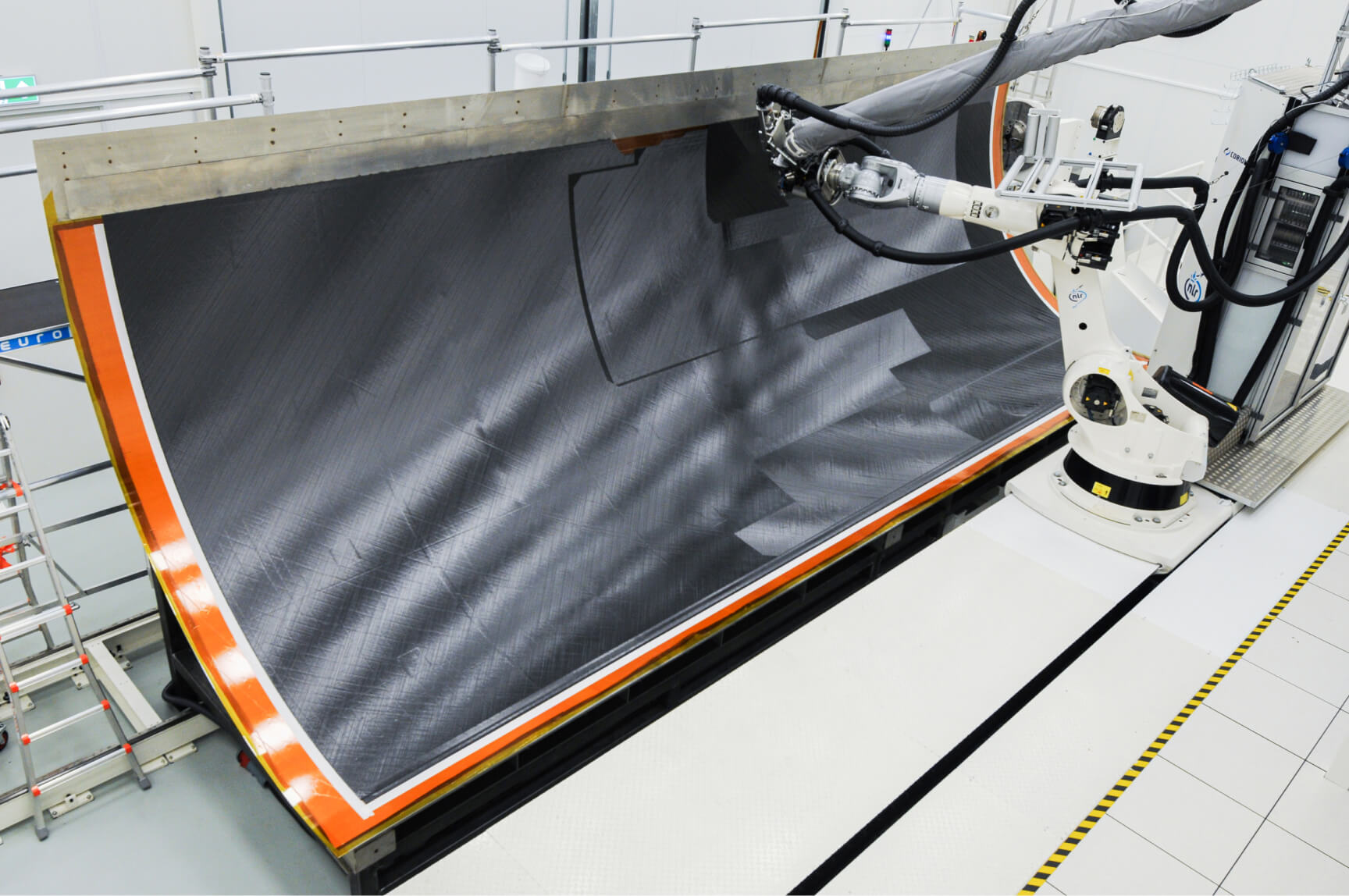
A partnership in the Netherlands between industry and the academe has been working on creating large aerospace structures using robotic fiber placement, and they have so far produced a large fuselage skin panel, measuring over 8 metres in length.

The project, named “STUNNING”, aims to utilize modern manufacturing techniques to create a next generation fleet of aircraft with reduced weight (and reduced emissions) while maintaining the same strength and durability of steel and aluminum in their structures.

In addition, the project will reduce the total time of production and maintenance activities associated with aircraft structures.

You can see the component, which has been described as the largest singular plastic part ever made for an aircraft, in the image below.
nlr-printed-aircraft-part
STUNNING skin section (Image credit: Royal NLR)

The acronym “STUNNING”, in case you were wondering, stands for “SmarT mUlti-fuNctionNal and INtegrated thermoplastic fuselaGe”.

The project is coming under the MFFD (Multifunctional Fuselage Demonstration) framework which itself falls under the European Clean Sky 2 program. As you can guess from the name, Clean Sky 2 is focused on developing innovations to reduce emissions from aircraft.

The partnership working on STUNNING comprises Royal NLR, GKN Fokker, TU Delft, and Diehl Group.

They have created their 8.5 metre long (4m diameter) fuselage skin panel with their automatic fiber placement machine, which lays the pre-preg fibers down robotically, as you can see in the video below. During fiber placement, the fibers are rapidly heated, allowing the thermoplastic resin to bond to the preceding layer. The teams are opting for thermoplastic resin as opposed to thermoset because thermoplastic can be reheated and reformed over and over, ensuring uniformity in bonding.

After the structure is formed, it is placed in an autoclave to even things out a bit and enhance the performance of the structure overall.

Ultimately, the sections will be assembled to form the larger fuselage section, which is the main goal of the MFFD project, which is being overseen by Airbus.

“Beyond optimising the weight savings, the production processes we’re developing are less time consuming which means using less energy, and these efficiencies will eventually translate into CO2 and NOx reductions,” said Ralf Herrmann, Airframe Research & Technology Typical Fuselage at Airbus Operations GmbH.

“Another important aspect is that by using thermoplastic material, components at the end of their service life can be recycled”.

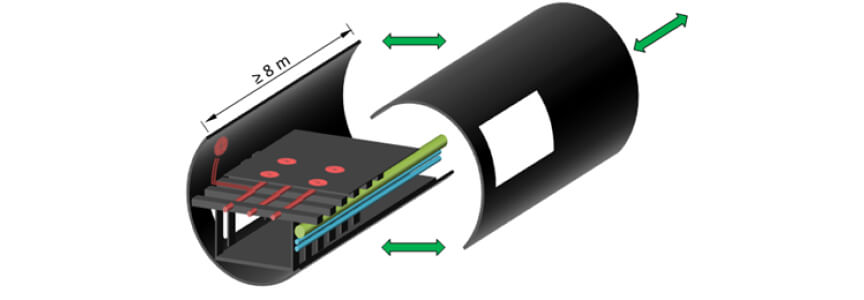
You can see a drawing of a larger assembled fuselage barrel section in the image below.
drawing
Assembled “barrel (Image credit: Clean Sky)

“It is necessary to remove the artificial separation of functions at the aircraft pre-design stage and to plan for a high production rate of aircraft manufacturing, assembly and installation right at the start,” said Paolo Trinchieri, Project Officer at Clean Sky.

“It is not only a question of the thermoplastic materials but also a question of how to design systems that are more efficient in order to increase the rate of aircraft, reduce cost and lower the aircraft weight. This is one of the key factors of the Multifunctional Fuselage Demonstrator project — to devise new solutions to design the fuselage structure and to integrate the systems and the cabin elements in a better way”.

The MFFD project is aiming to have the final barrel ready by the end of 2022.

You can read more about the MFFD project over at this link.

ge additive
Related Story
GE gets USAF Airworthiness Cert for Metal AM Critical Part
Share:
WhatsApp Twitter Facebook LinkedIn Buffer Reddit E-mail
About the author | Phillip Keane
Phillip is an aerospace engineer from UK. He is a graduate of Coventry University (UK), International Space University (France) and Nanyang Technological University (Singapore), where he studied Advanced Manufacturing at the Singapore Centre for 3D Printing.
Join our newsletter

Our newsletter is free & you can unsubscribe any time.

Latest posts

Three Organizations Sign Agreement to Build Materials Research Hub in Singapore

Three organizations have agreed to establish a shared advanced materials development facility in Singapore, signing a Memorandum of Understanding on June 24, 2026.... read more »

Materials
Three Organizations Sign Agreement to Build Materials Research Hub in Singapore

Phase3D Raises $2.9M to Scale In-Situ Inspection for Metal 3D Printing

Phase3D has closed an oversubscribed $2.9 million funding round to accelerate the adoption of its Fringe Inspection technology for metal additive manufacturing. Quest... read more »

3D Printing Metal
Phase3D Raises $2.9M to Scale In-Situ Inspection for Metal 3D Printing

Newcastle University 3D prints replica of Roman Britain’s most popular board game

Newcastle University and the Vindolanda Charitable Trust have used 3D scanning and printing to create a playable replica of a 1,700-year-old Roman game... read more »

News
Newcastle University 3D prints replica of Roman Britain's most popular board game

Best TPU Filament 2026: Flexible Picks for Every Shore Hardness

Flexible filament, demystified: the best TPU of 2026 ranked by shore hardness, from easy 95A to soft 85A and high-speed grades, with the... read more »

Filament

Best ABS and ASA Filament 2026: Low-Warp Picks for Enclosed Printers

The best ABS and ASA filament for 2026: low-warp picks for enclosed printers, when to choose UV-stable ASA, and the settings that stop... read more »

Filament

Best PETG Filament 2026: Tough, Weatherproof Picks for Every Printer

The best PETG filament for 2026: tough, weatherproof picks across everyday, high-flow, Bambu, premium, translucent, and budget, with print settings and prices.

Filament

Hands-On Review: Revopoint Inspire 2 3D Scanner

We have recently got our hands on a couple of new scanners from Revopoint, and in this article we will be taking a... read more »

News
Inspire 2 on the tripod again

Best PLA Filament in 2026: Tested Picks for Every Grade

The best PLA filament for every job in 2026: everyday, value, premium, high-speed, matte, silk, and tough PLA+ picks compared, with prices and... read more »

Filament

New Marine Occupational Specialty Combines Welding, Machining and 3D printing

The Marine Corps is consolidating its metal worker and machinist specialties into a single new military occupational specialty, effective Oct. 1, 2026, with... read more »

Military
New Marine Occupational Specialty Combines Welding, Machining and 3D printing

Snapmaker U1 Drops to $849 for Snapmaker’s 10th Anniversary

The Snapmaker U1 brings true tool-changing to a consumer price: four print heads, five-second swaps, and far less filament waste. For Snapmaker's 10th... read more »

News
Snapmaker U1 color 3D printer with four toolheads

Social

  • Facebook Facebook 3D Printing
  • Linkedin Linkedin 3D Printing
Join our newsletter

Our newsletter is free & you can unsubscribe any time.

Featured Industries

  • Automotive
  • Aerospace
  • Construction
  • Dental
  • Environmental
  • Electronics
  • Fashion
  • Medical
  • Military
  • Creality K2 Plus

    • - Print size: 350 x 350 x 350 mm
    • - multi-color printing
    More details »
    $1,199.00 Creality
    Buy Now
  • Flashforge Adventurer 5M

    • - Print size: 220 x 220 x 220 mm
    • - 600mm/s travel speed
    More details »
    $299.00 Flashforge
    Buy Now
  • Creality Hi Combo

    • - Print size: 260 x 260 x 300 mm
    • - up to 16-color printing
    More details »
    $399.00 Creality
    Buy Now
  • Qidi Max 4

    • - Print size: 390 x 390 x 340 mm
    • - active cooling air control
    More details »
    $1,219.00 Qidi
    Buy Now
  • Anycubic Kobra S1 Combo

    • - Print size: 250 x 250 x 250 mm
    • - budget multicolor printing
    More details »
    $429.00 Anycubic
    Buy Now
  • Snapmaker U1

    • - Print size: 270 x 270 x 270 mm
    • - multi-color printing with SnapSwap
    More details »
    $849.00 Snapmaker
    Buy Now
  • Anycubic Photon Mono M7

    • - Print size: 223 x 126 x 230 mm
    • - 10.1 inch 14K screen
    More details »
    $279.00 Anycubic
    Buy Now
  • Flashforge AD5X

    • - Print size: 220 x 220 x 220 mm
    • - dual extrusion system
    More details »
    $399.00 Flashforge
    Buy Now
  • Qidi Q2

    • - Print size: 270 x 270 x 256 mm
    • - enclosed heated chamber up to 65°C
    More details »
    $580.00 Qidi
    Buy Now
  • Flashforge Guider 3 Ultra

    • - Print size: 330 x 330 x 600 mm
    • - dual extruder system
    More details »
    $2,999.00 Flashforge
    Buy Now

Company Information

  • What is 3D Printing?
  • Contact us
  • Join our mailing list
  • Advertise with us
  • Media Kit
  • Nederland 3D Printing

Blog

  • Latest News
  • Use Cases
  • Reviews
  • 3D Printers
  • 3D Printing Metal

Featured Reviews

  • Anycubic Photon Mono M5s
  • Creality Ender 5 S1
  • The Mole 3D Scanner
  • Flashforge Creator 3 Pro

Featured Industries

  • Automotive
  • Aerospace
  • Construction
  • Dental
  • Environmental
  • Electronics
  • Medical
  • Military
  • Fashion
  • Art
2026 — Strikwerda en Dehue
  • Home
  • Join our mailing list
  • Contact us
Blog
  • Latest News
  • Use Cases
  • Reviews
  • 3D Printers
  • 3D Printing Metal
Featured Industries
  • Automotive
  • Aerospace
  • Construction
  • Dental
  • Environmental
  • Electronics
  • Medical
  • Military
  • Fashion
  • Art
Company Information
  • What is 3D Printing?
  • Contact us
  • Join our mailing list
  • Advertise with us
  • Media Kit
  • Nederland 3D Printing