
3D Printing
News Videos Newsletter Contact us
Home / Electronics / 3D Printed Supercapacitor for Space Exploration
qidi

3D Printed Supercapacitor for Space Exploration

April 22, 2021

Storing energy on space missions can be tricky. Batteries do not like the cold of space and so have to be heated in order to be useful. This requires heaters inside the battery enclosure, which adds a little extra mass (bad) and also incurs a penalty on the spacecraft power budget.

It would be more convenient all around if there was some form of energy storage solution that could function in extreme environments such as in space proper, or on some other frigid wasteland of a planet.

Well there is possibly some good news on that front, as a team of engineers have used additive manufacturing to create a supercapacitor which works when cold. Really cold!

The supercapacitor electrodes are first printed into a matrix structure using a carbon aerogel cellulose nanocrystal-based ink. The matrix is then freeze dried and a surface treatment is applied.

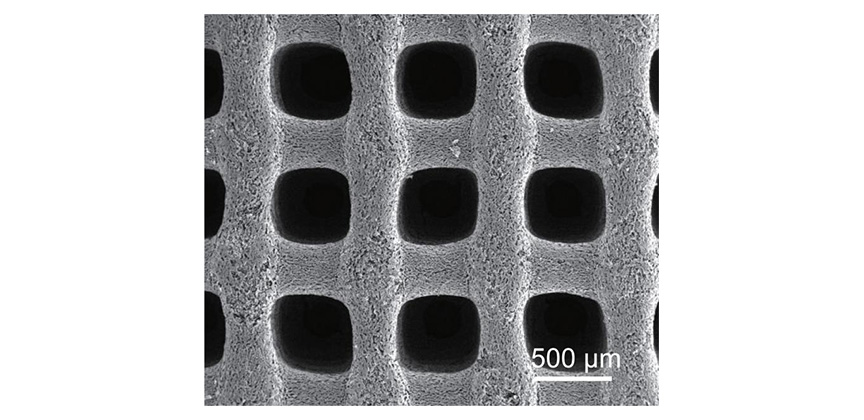
This process results in a porous structure with holes measuring just 500 microns across on the surface as you can see in the picture below. You can see smaller pores in the beams of the matrix itself. These smaller pores measure in the nanometer scale and the resulting porous network allows the ion diffusion and charge transfer through the electrode. And what’s more is that it allows this process to occur at temperatures as low as -70°C, which is perfect for those cold Martian nights, and even for Polar regions right here on Earth.
pores
Pores and more pores (Image credit: University of California)

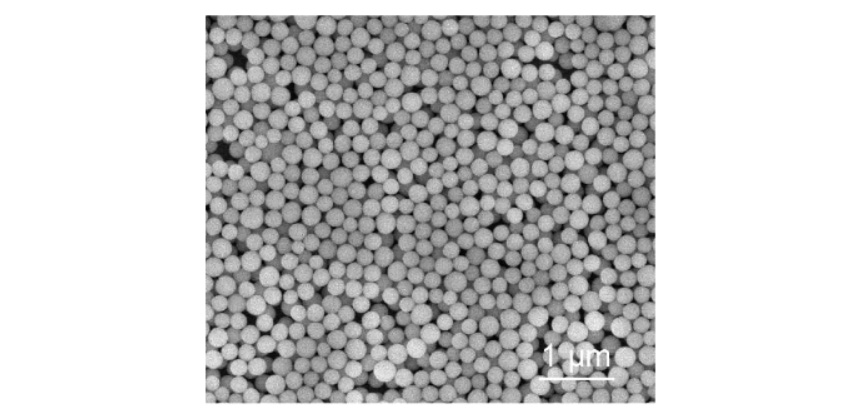
The ink itself was formulated by firstly synthesising SiO2 nanospheres, and then mixing that with the nitrocellulose fluid. The ink was then placed into a syringe before being given some centrifugal action to remove the bubbles, before being loaded onto the printer.
Nanoparticles
Nanoparticles for the ink (Image credit: University of California)

In this case the printer was a Hyrel 30M 3D Printer which can print a number of different materials. After the matrix was printed, it was put into a freezer to prevent the water from evaporating from the structure.

The samples then go to a further freeze-drying process before being treated to some high temperatures in a furnace to carbonize the sample into an SiO2 embedded aerogel.

Further washing and drying cycles are carried out on the sample before it is given a final blast in a furnace to anneal the material.

The result is a 3D printed multiscale porous aerogel (3D-MCA) with a large surface area which helps to achieve high capacitance at low temperatures, and also manages to retain that capacitance at high scan rates. The team points out that the aerogel retains capacitance at value 6.5 times higher than non-3D printed multiscale porous aerogels.

This demonstrates the value of using porous structures in the manufacture of low-temperature capacitors. NASA also agrees and will be assisting the researchers with further characterisation.

The research team is mostly out of University of California, Santa Cruz, and also has collaborators from Sun Yat-Sen University, China, and Lawrence Livermore National Laboratory (also California), and has had their research funded via NASA and the US DoE, who are no doubt pleased with the results.

For researchers interested in this project, you can find more in the paper titled “Printing Porous Carbon Aerogels for Low Temperature Supercapacitors” at this link.

Related Story
3D Printed Aerogels for Miniature Thermal Insulation
Share:
WhatsApp Twitter Facebook LinkedIn Buffer Reddit E-mail
About the author | Phillip Keane
Phillip is an aerospace engineer from UK. He is a graduate of Coventry University (UK), International Space University (France) and Nanyang Technological University (Singapore), where he studied Advanced Manufacturing at the Singapore Centre for 3D Printing.
Join our newsletter

Our newsletter is free & you can unsubscribe any time.

Latest posts

3D Printed Copper Cold Plates Could Cut Data Center Cooling Energy by 98%

Mechanical engineers at the University of Illinois have 3D printed pure copper cold plates that could reduce a data center's cooling energy consumption... read more »

News

Researchers 3D Print Glowing Shapes Using Bioluminescent Algae Embedded in Hydrogel

Scientists at the University of Colorado Boulder have used a bioluminescent single-celled algae called Pyrocystis lunula to 3D-print light-emitting structures that glow a... read more »

News
Researchers 3D Print Glowing Shapes Using Bioluminescent Algae Embedded in Hydrogel

Revopoint POP 4 Launches on Kickstarter: Hybrid Blue Laser and Infrared 3D Scanner from $579

Revopoint is bringing its next-generation handheld 3D scanner to Kickstarter. The Revopoint POP 4 launches on May 7, 2026, combining blue laser and... read more »

News

Best Resin 3D Printers in 2026: Our Top Picks

The best resin 3D printers in 2026 cover an extraordinary range, from $169 entry-level machines that produce tabletop-grade detail to $9,999 professional systems... read more »

3D Printers

Best 3D Printers for Beginners 2026

A 2026 guide to the best 3D printers for beginners. 15 FDM and resin picks, plus a buying guide and FAQ.

3D Printers
How 3D Printing Enhances the VR and AR Gaming Experience

Apollo’s New $4M Supercar Gets a 3D-Printed Titanium Exhaust That Takes 123 Hours to Print

Apollo Automobil's upcoming Evo supercar will feature what the company describes as the largest one-piece 3D-printed titanium exhaust system ever produced, with each... read more »

Automotive
Apollo's New $4M Supercar Gets a 3D-Printed Titanium Exhaust That Takes 123 Hours to Print

Harvard’s 3D-Printed Filaments Mimic Muscle, Bending and Twisting on Command

Harvard researchers have developed a 3D printing technique that programs soft filaments to bend, twist, expand, or contract in response to heat, producing... read more »

News
Harvard's 3D-Printed Filaments Mimic Muscle, Bending and Twisting on Command

Best Composite Filaments for 3D Printing 2026: Carbon Fiber, Nylon and Wood

Also in series Bio Filaments Also in series Engineering Filaments Also in series Flexible Filaments You are here Composite Filaments Composite filaments add... read more »

Filament

Best Flexible Filaments for 3D Printing 2026: TPU, PEBA and More

Also in series Bio Filaments Also in series Engineering Filaments You are here Flexible Filaments Also in series Composite Filaments Flexible filaments are... read more »

Filament

MIT Researchers 3D Print Microscopic Robots That Snap to Attention With a Magnet Swipe

MIT engineers have developed a method for 3D printing soft, microscopic structures infused with iron-oxide nanoparticles that can be remotely controlled by an... read more »

News
MIT Researchers 3D Print Microscopic Robots That Snap to Attention With a Magnet Swipe

Social

  • Facebook Facebook 3D Printing
  • Linkedin Linkedin 3D Printing
banner
Join our newsletter

Our newsletter is free & you can unsubscribe any time.

Featured Industries

  • Automotive
  • Aerospace
  • Construction
  • Dental
  • Environmental
  • Electronics
  • Fashion
  • Medical
  • Military
  • Qidi Max 4

    • - Print size: 390 x 390 x 340 mm
    • - active cooling air control
    More details »
    $1,219.00 Qidi
    Buy Now
  • Anycubic Kobra S1 Combo

    • - Print size: 250 x 250 x 250 mm
    • - budget multicolor printing
    More details »
    $429.00 Anycubic
    Buy Now
  • Flashforge Adventurer 5M

    • - Print size: 220 x 220 x 220 mm
    • - 600mm/s travel speed
    More details »
    $299.00 Flashforge
    Buy Now
  • Anycubic Photon Mono M7

    • - Print size: 223 x 126 x 230 mm
    • - 10.1 inch 14K screen
    More details »
    $279.00 Anycubic
    Buy Now
  • Qidi Q2

    • - Print size: 270 x 270 x 256 mm
    • - enclosed heated chamber up to 65°C
    More details »
    $580.00 Qidi
    Buy Now
  • Creality K2 Plus

    • - Print size: 350 x 350 x 350 mm
    • - multi-color printing
    More details »
    $1,199.00 Creality
    Buy Now
  • Flashforge Guider 3 Ultra

    • - Print size: 330 x 330 x 600 mm
    • - dual extruder system
    More details »
    $2,999.00 Flashforge
    Buy Now
  • Creality Hi Combo

    • - Print size: 260 x 260 x 300 mm
    • - up to 16-color printing
    More details »
    $399.00 Creality
    Buy Now
  • Flashforge AD5X

    • - Print size: 220 x 220 x 220 mm
    • - dual extrusion system
    More details »
    $399.00 Flashforge
    Buy Now
  • Snapmaker U1

    • - Print size: 270 x 270 x 270 mm
    • - multi-color printing with SnapSwap
    More details »
    $849.00 Snapmaker
    Buy Now

Company Information

  • What is 3D Printing?
  • Contact us
  • Join our mailing list
  • Advertise with us
  • Media Kit
  • Nederland 3D Printing

Blog

  • Latest News
  • Use Cases
  • Reviews
  • 3D Printers
  • 3D Printing Metal

Featured Reviews

  • Anycubic Photon Mono M5s
  • Creality Ender 5 S1
  • The Mole 3D Scanner
  • Flashforge Creator 3 Pro

Featured Industries

  • Automotive
  • Aerospace
  • Construction
  • Dental
  • Environmental
  • Electronics
  • Medical
  • Military
  • Fashion
  • Art
2026 — Strikwerda en Dehue
  • Home
  • Join our mailing list
  • Contact us
Blog
  • Latest News
  • Use Cases
  • Reviews
  • 3D Printers
  • 3D Printing Metal
Featured Industries
  • Automotive
  • Aerospace
  • Construction
  • Dental
  • Environmental
  • Electronics
  • Medical
  • Military
  • Fashion
  • Art
Company Information
  • What is 3D Printing?
  • Contact us
  • Join our mailing list
  • Advertise with us
  • Media Kit
  • Nederland 3D Printing