
3D Printing
News Back to school deals Contact us
Home / News / 3D Printing Goes Nuclear TWICE in One Week
qidi

3D Printing Goes Nuclear TWICE in One Week

May 12, 2020

As 3D printing technologies, processes and standards have matured, we have seen additive manufacturing climb the ranks of technically complex manufacturing fields.

We have seen additive manufacturing applied to motorsports, spacecraft engineering, aviation…and now finally, it has made inroads into what could be considered the pinnacle of safety critical sectors: the nuclear power industry.

And like a bus stop, where one may stand waiting for hours before two arrive at once, we have not one but TWO nuclear 3D printing stories this week. Read on.

Nuclear Thimble

For the first time ever, a 3D printed component has been used in a nuclear power station.

US-based Westinghouse Electric Company announced on 4th May that the 3D printed thimble plugging device was installed in their Byron 1 generating station, in Byron, Illinois.

Byron 1 began commercial operations back in 1985, and is operated by the Excelon Generation Company. The plant must undergo regular refuelling, and it was during the recent scheduled spring refuelling outage that the thimble plugging device was installed.

The device itself is used for lowering fuel assemblies into reactor cores.

The 3D printed version is the result of 3 years of research, was constructed using powder bed fusion and is made from 316L grade stainless steel.

“Our additive manufacturing programme offers customers enhanced component designs that help increase performance and reduce costs, as well as provide access to components that may not be available using traditional manufacturing methods,” said Ken Canavan, CTO at Westinghouse.

As you can see from the image below, the device would normally require many different process steps to manufacture. By utilizing 3D printing, Westinghouse has managed to reduce the number of manufacturing process steps.
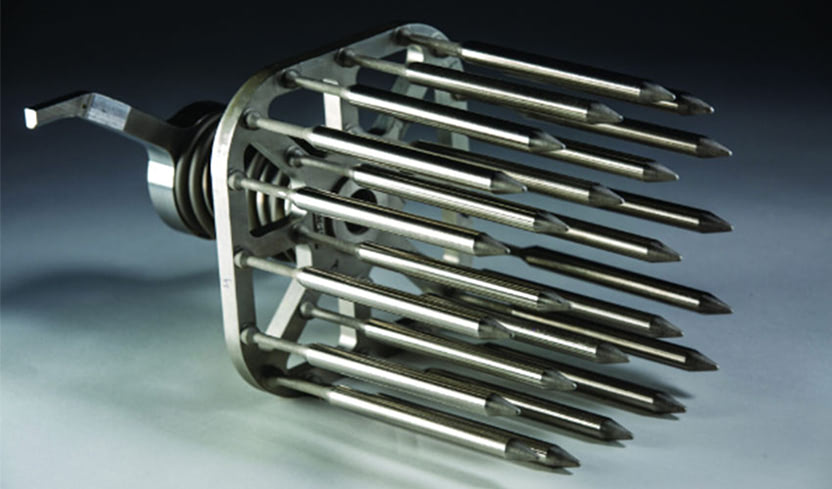
Nuclear thimble plugging device
Figure 1) Nuclear thimble plugging device (Image Credit: Westinghouse Electric Company)<br />

Of course, 3D printing is not only useful for next generation components, but can be super handy where it comes to manufacturing legacy and obsolete parts, which is definitely a boon for industries such as nuclear and aerospace where development lurches forward so slowly that entire OEMs can fade from existence before a project is realised.

Related Story
3D Printing Spare Parts On-Demand

Nuclear Reactor Core

We aren’t nuclear engineers around here, but it’s probably safe to say that a nuclear reactor core is a highly critical component requiring fantastically high reliability combined with unparalleled quality control methods (if you know of any other engineered system on the planet more demanding of reliability, then let us know in the comments!).

So it is perhaps a good indication that AM has come of age when Oak Ridge National Laboratory (ORNL) declares that they have 3D printed an entire nuclear reactor core. And that’s exactly what they announced yesterday (11th May).

ORNL in Tennessee has been working on developing new methods for nuclear component manufacturing as part of the Transformational Challenge Reactor program (TCR), which aims to develop methods enabling faster and more affordable approaches to nuclear energy.

The research team has been focussing on gradually scaling up their 3D printed nuclear reactor core, and plans to have a fully operational core by 2023.

As part of their aggressive timeline, the team has even been continuing with design and simulation remotely during the coronavirus pandemic (which is no doubt good news for cloud based CAD and simulation companies who have struggled to make inroads into high security manufacturing sectors).
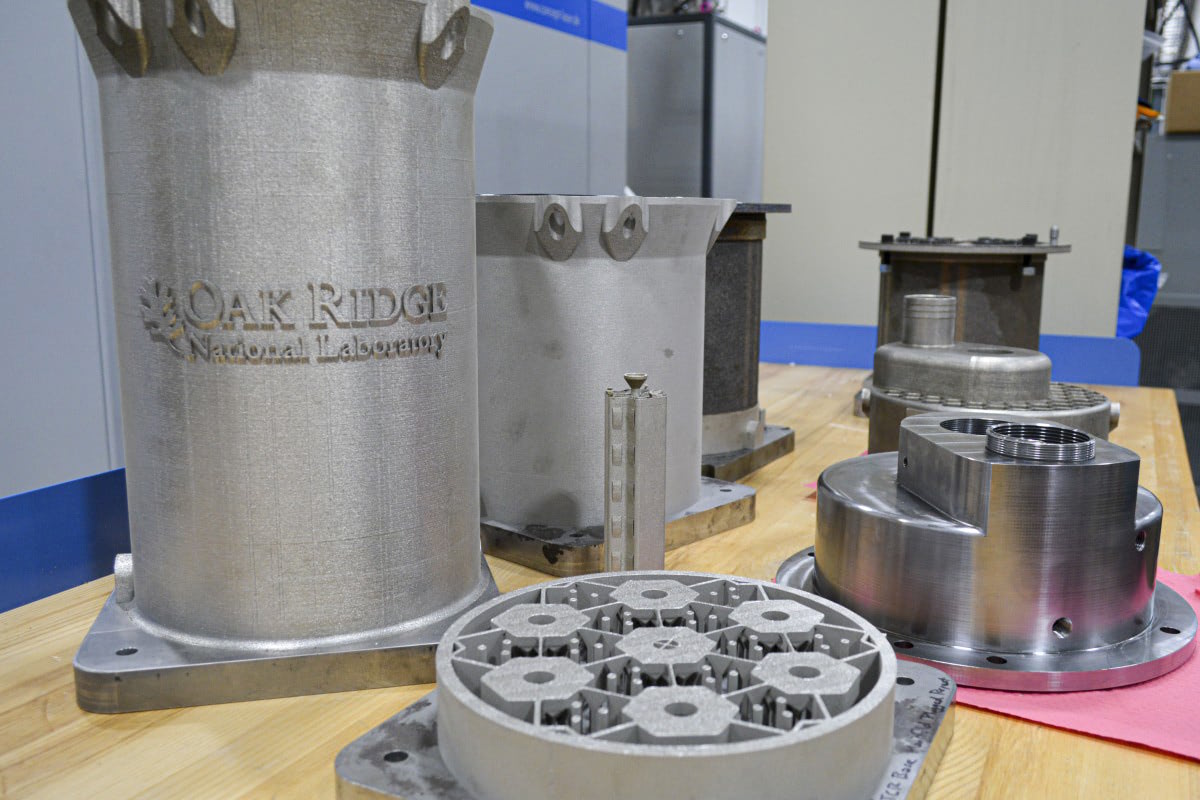
ORNL 3D printed steel reactor core
Figure 2) Reactor core, 3D printed in steel (Image Credit: ORNL)<br />

“The nuclear industry is still constrained in thinking about the way we design, build and deploy nuclear energy technology,” said Thomas Zacharia, ORNL Director.

Traditional nuclear engineering is a very time consuming and costly process, due to availability of materials and glacial plant construction speeds. AS a consequence, the US has been reduced to building one reactor every 20 years. This has put the country on the back foot in terms of new developments, and this has worried industry insiders. The TCR program may offer a solution to these concerns.

“The TCR program will provide a new model for accelerated deployment of advanced nuclear energy systems,” said Zacharia.

You can see the manufacturing demonstration of the reactor core in question in the video below.

The core took a mere 40 hours to print using stainless steel feedstock. The thermal imaging video shows melt pools reaching temperatures of up to 1400 degrees Celsius.

So there it is. The nuclear industry has a bright (glowing) future thanks to additive manufacturing, and 3D printing is further validated in critical system applications. And with that, it seems that AM has finally reached the plateau of productivity for highly safety dependant systems.


Related Story
An Overview of 3D Printing Energy Systems
3D Printed Device Recycles Nuclear Waste
Related Story
3D Printed Device Recycles Nuclear Waste
Share:
WhatsApp Twitter Facebook LinkedIn Buffer Reddit E-mail
About the author | Phillip Keane
Phillip is an aerospace engineer from UK. He is a graduate of Coventry University (UK), International Space University (France) and Nanyang Technological University (Singapore), where he studied Advanced Manufacturing at the Singapore Centre for 3D Printing.
Join our newsletter

Our newsletter is free & you can unsubscribe any time.

Latest posts

MIT Researchers Let Users Repair AI-Generated 3D Models Before Printing

MIT CSAIL, with Google and Northeastern, built software that generates 3D models from prompts and lets users fix printability defects with language and... read more »

News
MIT Researchers Let Users Repair AI-Generated 3D Models Before Printing

Elegoo Day Sale 2026: The Four Best Prices, And How The Rest Compare

Elegoo Day runs to September 29 with up to 54% off. Four prices are the lowest we have on record, the material tiers... read more »

News

FibreSeek Opens Pre-Sale of FibreSeeker 3 Continuous Carbon Fibre Printer

FibreSeek has opened a limited global pre-sale of 500 FibreSeeker 3 printers, a desktop machine that lays continuous carbon fibre into plastic parts.

3D Printers
FibreSeek Opens Pre-Sale of FibreSeeker 3 Continuous Carbon Fibre Printer

Reverse Engineering Without CAD Data: How the MetroY Ultra Turns Physical Parts into Digital Designs

A custom seat tray for a 1984 Honda CB400, a hard-to-find grille for a VW Golf Mk1 Convertible, and a black throttle body... read more »

News

University of Amsterdam 3D Prints Ice Structures Without Supports

University of Amsterdam physicists have developed a way to 3D print structures out of ice that need no extra supports and melt back... read more »

News
University of Amsterdam 3D Prints Ice Structures Without Supports

RMIT 3D Prints Titanium That Floats

RMIT engineers have created a 3D-printed titanium material that floats in water even after severe damage, a candidate for jetties, buoys and marine... read more »

3D Printing Metal
RMIT 3D Prints Titanium That Floats

University of Waterloo 3D Prints Diamond-Shaped Electrodes for Flow Batteries

University of Waterloo researchers 3D printed a diamond-geometry electrode that improved redox flow battery performance by 52 percent in lab tests.

News

University of Maine Launches 30-Foot 3D-Printed Offshore Boat

The University of Maine launched a 30-foot 3D-printed boat designed for offshore speeds near 40 knots, skipping a new mold for every hull.

News
University of Maine Launches 30-Foot 3D-Printed Offshore Boat

SUNLU FilaDC i10: 10-spool filament dehumidifying cabinet

A co-branded storage cabinet that SUNLU rates to hold up to ten 1 kg spools at 10 to 55 percent RH without heating... read more »

News

ORNL Combines 3D Printing and Electroforming for Leak-Free Nuclear Parts

Oak Ridge National Laboratory and A.J. Tuck combined 3D printing and electroforming to make leak-free HIP cans for nuclear and energy components.

News
ORNL Combines 3D Printing and Electroforming for Leak-Free Nuclear Parts

Social

  • Facebook Facebook 3D Printing
  • Linkedin Linkedin 3D Printing
Join our newsletter

Our newsletter is free & you can unsubscribe any time.

banner
  • Qidi Q2

    • - Print size: 270 x 270 x 256 mm
    • - enclosed heated chamber up to 65°C
    More details »
    $580.00 Qidi
    Buy Now
  • Snapmaker U1

    • - Print size: 270 x 270 x 270 mm
    • - multi-color printing with SnapSwap
    More details »
    $849.00 Snapmaker
    Buy Now
  • Creality Hi Combo

    • - Print size: 260 x 260 x 300 mm
    • - up to 16-color printing
    More details »
    $399.00 Creality
    Buy Now
  • Flashforge Guider 3 Ultra

    • - Print size: 330 x 330 x 600 mm
    • - dual extruder system
    More details »
    $2,999.00 Flashforge
    Buy Now
  • Anycubic Kobra S1 Combo

    • - Print size: 250 x 250 x 250 mm
    • - budget multicolor printing
    More details »
    $429.00 Anycubic
    Buy Now
  • Flashforge AD5X

    • - Print size: 220 x 220 x 220 mm
    • - dual extrusion system
    More details »
    $399.00 Flashforge
    Buy Now
  • Creality K2 Plus

    • - Print size: 350 x 350 x 350 mm
    • - multi-color printing
    More details »
    $1,199.00 Creality
    Buy Now
  • Anycubic Photon Mono M7

    • - Print size: 223 x 126 x 230 mm
    • - 10.1 inch 14K screen
    More details »
    $279.00 Anycubic
    Buy Now
  • Flashforge Adventurer 5M

    • - Print size: 220 x 220 x 220 mm
    • - 600mm/s travel speed
    More details »
    $299.00 Flashforge
    Buy Now
  • Qidi Max 4

    • - Print size: 390 x 390 x 340 mm
    • - active cooling air control
    More details »
    $1,219.00 Qidi
    Buy Now

Company Information

  • What is 3D Printing?
  • Contact us
  • Join our mailing list
  • Advertise with us
  • Media Kit
  • Nederland 3D Printing

Blog

  • Latest News
  • Use Cases
  • Reviews
  • 3D Printers
  • 3D Printing Metal

Featured Reviews

  • Anycubic Photon Mono M5s
  • Creality Ender 5 S1
  • The Mole 3D Scanner
  • Flashforge Creator 3 Pro

Featured Industries

  • Automotive
  • Aerospace
  • Construction
  • Dental
  • Environmental
  • Electronics
  • Medical
  • Military
  • Fashion
  • Art
2026 — Strikwerda en Dehue
  • Home
  • Join our mailing list
  • Contact us
Blog
  • Latest News
  • Use Cases
  • Reviews
  • 3D Printers
  • 3D Printing Metal
Featured Industries
  • Automotive
  • Aerospace
  • Construction
  • Dental
  • Environmental
  • Electronics
  • Medical
  • Military
  • Fashion
  • Art
Company Information
  • What is 3D Printing?
  • Contact us
  • Join our mailing list
  • Advertise with us
  • Media Kit
  • Nederland 3D Printing