
3D Printing
News Videos Newsletter Contact us
Home / News / Researchers Print Porous Polymers with Salt

Researchers Print Porous Polymers with Salt

November 4, 2022

Reliance of fossil fuel based plastics is of growing concern for a number of reasons, not least because oil reserves are finite, and because plastics made from oil have a tendency not to biodegrade.

This is why researchers are looking for new means of producing plastics that use other resources, or else biodegrade, and reduce landfill volume. Many researchers are looking at bio-based plastics to reduce the dependence on petroleum products for manufacturing, as we saw with the durian and pineapple based biocomposites that we saw recently.

A team of researchers from Texas A&M University and the University of Kashmir have found a solution to speed up the biodegrading process that does not rely on plant waste, and instead have elected to use salt and CO2 in their printing process.

Read on to learn more.

Microplastics

When big chunks of plastic break down, they often leave microplastics in their wake. So while it may seem they have disappeared, they really haven’t. The polymers chains in those microplastics hang around indefinitely, and the microplastics can carry heavy metals, bacteria, and even fecal matter in them. This makes them not only gross, but harmful to the environment, and everything else in the food chain that inhabits it. And that includes us.

The research team has developed a means of fabricating plastics utilizing NaCl salt crystals and CO2 in the printing ink, that form soluble parts of the main part structure, that dissolve when washed in water, leaving microscopic pores all over the structure. The pores increase the surface area of the part, permitting faster degradation.
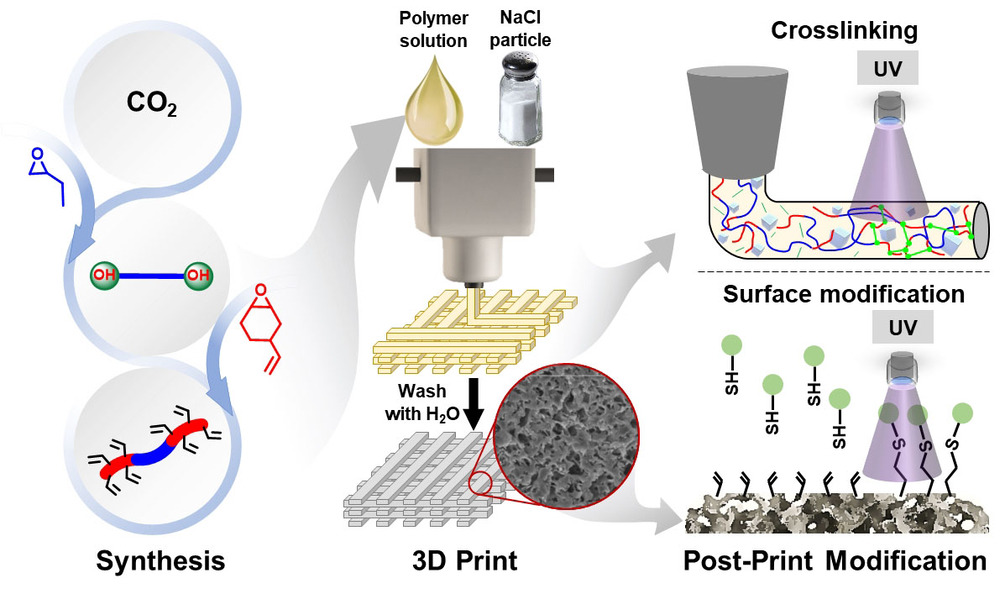
process
The printing process.(Image credit: Texas A&M University / University of Kashmir)

The polymers are prepared using a binary catalyst system and a chain transfer agent, providing a one-pot, two-step strategy to tailor the thermal and mechanical properties of the polymer. The alkene pendant groups on the polymer backbone can also be further modified with UV-induced thiol-ene surface functionalization and crosslinking to give objects with high solvent resistance and selective degradability.
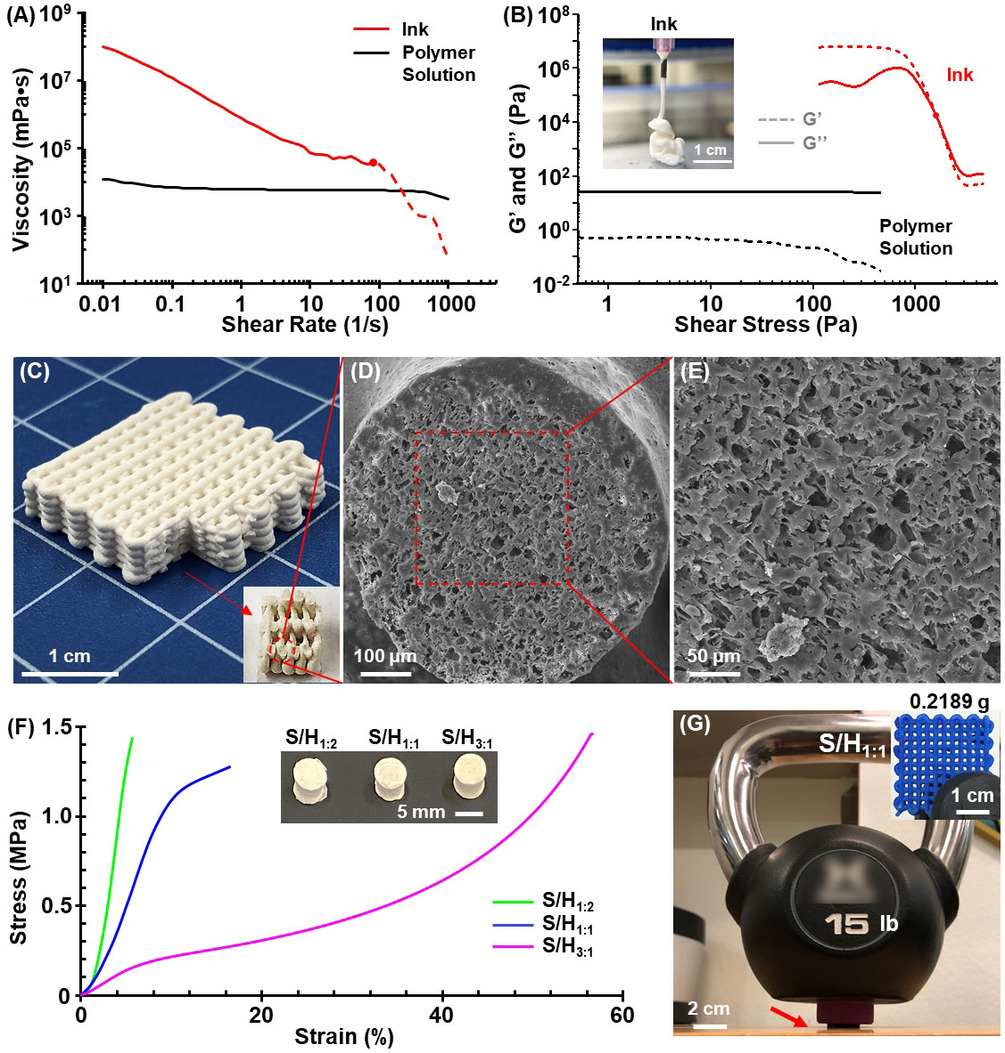
Porosity
Porosity revealed. (Image credit: Texas A&M University / University of Kashmir)

“Our goal was to create sustainable degradable polymeric structures,” said Dr. Emily Pentzer, associate professor at Texas A&M University.

“We did this by leveraging the microstructures afforded by chemistry in conjunction with the macrostructures afforded by 3D printing.”

“Under the right conditions, the polymers we’ve created will actually degrade quickly. Ideally, they’ll break apart into small molecules that are not toxic. These smaller molecules won’t be able to carry things like heavy metals or bacteria.”

The end result was a plastic that had a smooth surface finish, but with microscopic pores that allow faster degradation. So while the polymer chains will still remain, the larger structure will no longer be existing to carry these other foreign elements.

The end-use applications include degradable food packaging, and a range of biomedical applications. In particular this makes the plastic suitable for implants and scaffolds that can degrade in the body.
The paper, titled “3D Printed CO2-Based Triblock Copolymers and Post-Printing Modification” has been published in the international version of German chemistry journal Angewandte Chemie, and is available for your perusal at this link.


Share:
WhatsApp Twitter Facebook LinkedIn Buffer Reddit E-mail
About the author | Phillip Keane
Phillip is an aerospace engineer from UK. He is a graduate of Coventry University (UK), International Space University (France) and Nanyang Technological University (Singapore), where he studied Advanced Manufacturing at the Singapore Centre for 3D Printing.
Join our newsletter

Our newsletter is free & you can unsubscribe any time.

Latest posts

UT Austin Researchers Create 3D-Printable Material That Mimics Human Tissue

Researchers at The University of Texas at Austin have developed a 3D-printable material that replicates human tissue's ability to sort and filter molecules,... read more »

Materials
UT Austin Researchers Create 3D-Printable Material That Mimics Human Tissue

Beyond Prototypes: Scaling with LS Manufacturing’s Integrated On-Demand Solutions

Why hardware teams are pairing additive manufacturing with CNC machining and molding, and what a single point of contact changes about the road... read more »

News

Czech Scientists Test 3D-Printed Titanium Implants That Release Drugs Inside the Body

Researchers at the University of Chemistry and Technology in Prague are testing 3D-printed titanium joint implants capable of releasing medication directly into the... read more »

Medical
Czech Scientists Test 3D-Printed Titanium Implants That Release Drugs Inside the Body

Best 3D Printers for Miniatures 2026: Resin and FDM Picks

Miniatures are the category where the printer decides the ceiling before you open a single STL. The best 3D printer for miniatures is,... read more »

3D Printers

Purdue Researcher Uses 3D Printing to Build Affordable Groundwater Sensors for a Few Hundred Dollars Each

A Purdue University researcher has developed a patent-pending, 3D-printed groundwater sensor that costs a few hundred dollars per unit, offering a cheaper alternative... read more »

Environmental
Purdue Researcher Uses 3D Printing to Build Affordable Groundwater Sensors for a Few Hundred Dollars Each

Queen’s University Belfast Researcher 3D-Prints Flow Battery for £74, Shares Design Globally for Free

A post-doctoral researcher at Queen's University Belfast has developed a 3D-printed flow battery that costs roughly £74 to build and is now being... read more »

Electronics
Queen's University Belfast Researcher 3D-Prints Flow Battery for £74, Shares Design Globally for Free

MIT’s 3D-Printed Concrete Bridge Shows Printer Hardware, Not Concrete, Is the Limiting Factor

MIT researchers have 3D-printed and load-tested a 2.3-meter concrete bridge using a computational framework that bakes a printer's physical limitations directly into the... read more »

Construction
MIT's 3D-Printed Concrete Bridge Shows Printer Hardware, Not Concrete, Is the Limiting Factor

Manchester Researchers Link Temperature Swings to Defects in Aluminium 3D Printing

Scientists at The University of Manchester have found that small temperature changes during molten metal deposition can substantially alter the quality of 3D-printed... read more »

3D Printing Metal
Manchester Researchers Link Temperature Swings to Defects in Aluminium 3D Printing

University of Illinois Engineers Build First 3D Thermal Cloak Using 3D-Printed Aluminum

Engineers at the University of Illinois Urbana-Champaign have built the first physical device that can hide objects from heat in any direction, a... read more »

News
University of Illinois Engineers Build First 3D Thermal Cloak Using 3D-Printed Aluminum

Social

  • Facebook Facebook 3D Printing
  • Linkedin Linkedin 3D Printing
Join our newsletter

Our newsletter is free & you can unsubscribe any time.

Featured Industries

  • Automotive
  • Aerospace
  • Construction
  • Dental
  • Environmental
  • Electronics
  • Fashion
  • Medical
  • Military
  • Snapmaker U1

    • - Print size: 270 x 270 x 270 mm
    • - multi-color printing with SnapSwap
    More details »
    $849.00 Snapmaker
    Buy Now
  • Flashforge Guider 3 Ultra

    • - Print size: 330 x 330 x 600 mm
    • - dual extruder system
    More details »
    $2,999.00 Flashforge
    Buy Now
  • Qidi Q2

    • - Print size: 270 x 270 x 256 mm
    • - enclosed heated chamber up to 65°C
    More details »
    $580.00 Qidi
    Buy Now
  • Qidi Max 4

    • - Print size: 390 x 390 x 340 mm
    • - active cooling air control
    More details »
    $1,219.00 Qidi
    Buy Now
  • Flashforge AD5X

    • - Print size: 220 x 220 x 220 mm
    • - dual extrusion system
    More details »
    $399.00 Flashforge
    Buy Now
  • Flashforge Adventurer 5M

    • - Print size: 220 x 220 x 220 mm
    • - 600mm/s travel speed
    More details »
    $299.00 Flashforge
    Buy Now
  • Creality K2 Plus

    • - Print size: 350 x 350 x 350 mm
    • - multi-color printing
    More details »
    $1,199.00 Creality
    Buy Now
  • Creality Hi Combo

    • - Print size: 260 x 260 x 300 mm
    • - up to 16-color printing
    More details »
    $399.00 Creality
    Buy Now
  • Anycubic Photon Mono M7

    • - Print size: 223 x 126 x 230 mm
    • - 10.1 inch 14K screen
    More details »
    $279.00 Anycubic
    Buy Now
  • Anycubic Kobra S1 Combo

    • - Print size: 250 x 250 x 250 mm
    • - budget multicolor printing
    More details »
    $429.00 Anycubic
    Buy Now

Company Information

  • What is 3D Printing?
  • Contact us
  • Join our mailing list
  • Advertise with us
  • Media Kit
  • Nederland 3D Printing

Blog

  • Latest News
  • Use Cases
  • Reviews
  • 3D Printers
  • 3D Printing Metal

Featured Reviews

  • Anycubic Photon Mono M5s
  • Creality Ender 5 S1
  • The Mole 3D Scanner
  • Flashforge Creator 3 Pro

Featured Industries

  • Automotive
  • Aerospace
  • Construction
  • Dental
  • Environmental
  • Electronics
  • Medical
  • Military
  • Fashion
  • Art
2026 — Strikwerda en Dehue
  • Home
  • Join our mailing list
  • Contact us
Blog
  • Latest News
  • Use Cases
  • Reviews
  • 3D Printers
  • 3D Printing Metal
Featured Industries
  • Automotive
  • Aerospace
  • Construction
  • Dental
  • Environmental
  • Electronics
  • Medical
  • Military
  • Fashion
  • Art
Company Information
  • What is 3D Printing?
  • Contact us
  • Join our mailing list
  • Advertise with us
  • Media Kit
  • Nederland 3D Printing