NTU Singapore Develops Nontoxic Photoinitiators for Safer Resin 3D Printing
NTU Singapore researchers have made nontoxic photoinitiators that could replace TPO and BAPO, resin ingredients now being banned in the EU.

NTU Singapore researchers have made nontoxic photoinitiators that could replace TPO and BAPO, resin ingredients now being banned in the EU.
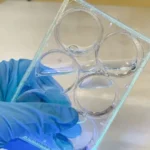
Milan researchers blended peptides from okara, a soybean by-product, into biodegradable polycaprolactone, and the blend kept its healing activity once printed.
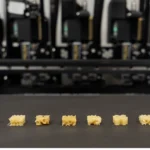
RMIT researchers turned spent Melbourne coffee grounds into a stronger, biodegradable printing material and a full-scale demonstrator for Melbourne Design Week.

MIT researchers have 3D printed a set of modular building blocks that stay electrically connected no matter how you compress, stretch, rotate, or... read more »

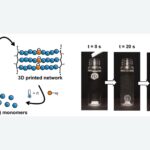
A Heidelberg University team has designed a light-curable 3D printing polymer that a chemical trigger can take apart at room temperature. Printed parts... read more »
An MIT team used category theory to break a pine cone's humidity response into independently validated building blocks, mixed some of those blocks... read more »

Researchers at The University of Texas at Austin have developed a 3D-printable material that replicates human tissue's ability to sort and filter molecules,... read more »
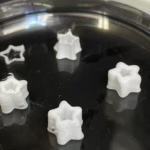
Scientists at The University of Manchester have found that small temperature changes during molten metal deposition can substantially alter the quality of 3D-printed... read more »

Researchers at EPFL have found that a soft material built for 3D printing also solves one of materials science's stubborn problems: making elastomers... read more »

Three organizations have agreed to establish a shared advanced materials development facility in Singapore, signing a Memorandum of Understanding on June 24, 2026.... read more »

BASF commissioned the world's first production plant for 3D-printed catalysts, bringing its proprietary X3D technology to full industrial scale at its Ludwigshafen site.... read more »

Researchers from IMDEA Materials Institute and the Technical University of Madrid have developed a design-focused approach to improve the performance of 3D-printed nitinol... read more »

Researchers at Virginia Tech have developed a method to create shape-memory ceramic materials that can be manufactured at scale using 3D printing technology.... read more »

Researchers from the universities of Heidelberg and Stuttgart have developed a new type of ink that enables 3D printing of conducting polymers capable... read more »

Researchers at the University of Virginia have developed a new 3D-printable material based on polyethylene glycol (PEG) that maintains flexibility while being compatible... read more »

Fraunhofer IWU will present advances in laser powder bed fusion technology and sustainable exhibition design at Formnext 2025 in Frankfurt, November 18-21. The... read more »

Researchers from universities in Scotland and Italy have developed a new 3D-printed metamaterial that can adjust its protective properties based on impact type... read more »

Researchers at Rochester Institute of Technology have developed self-healing materials designed to improve the durability of 3D-printed products. Christopher Lewis, an associate professor... read more »

Swiss Steel Group and its French subsidiary Ugitech have launched UGIWAM wire, a new product designed for wire arc additive manufacturing (WAAM). The... read more »

Daniel Rau, an assistant professor of mechanical engineering at the University of Wyoming, has received a $198,932 grant from the National Science Foundation... read more »
