
3D Printing
News Videos Newsletter Contact us
Home / 3D Printing Metal / NASA uses Blown Powder Method to Scale up Rockets
qidi

NASA uses Blown Powder Method to Scale up Rockets

November 3, 2020

We have taken a look at how the private sector are using additive manufacturing to build rocket engines in this previous article. In that example, the engineers use powder bed fusion for printing their small (30cm diameter) dual-alloy rocket nozzles.

NASA on the other hand have been experimenting not only with powder bed fusion but also with blown powder directed energy deposition, as part of their Rapid Analysis and Manufacturing Propulsion Technology (RAMPT) project.

The RAMPT project is funded by NASA’s Game Changing Development program and includes partners from across the agency such as Marshall Space Flight Center, Glenn Research Center and Ames Research Center as well as from industry and academia.

Previously the NASA team had experimented with powder bed fusion for manufacturing their dual-alloy, composite overwrapped engine assemblies at a smaller scale, but thanks to Direct Energy Deposition (DED) they have been able to scale up the size of their builds having printed a rocket engine measuring 40 inches in diameter and standing 38 inches tall, with fully integrated cooling channels.

Traditionally, a rocket assembly of this complexity would take a year to manufacture via normal welding methods. But by integrating the individual parts into one print, they were able to reduce the build time to just 30 days.

And Boeing thinks that they may be able to go even bigger than 40 inches, suggesting that this method could be used to print the Space Launch System engines.
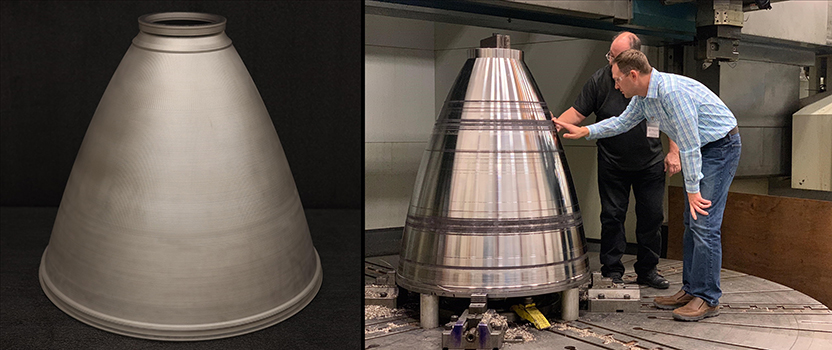
The technology is enabling metal printing of a larger scale that was previously unattainable to NASA. (Image credit: NASA)

Directed Energy Deposition

Blown powder directed energy deposition is also known as Direct Energy Deposition (DED), and works by blasting powder out of a nozzle with an inert gas, directly into the path of a laser which is mounted in the same printer head as the gas/powder nozzles. The resulting meltpool is steered along the toolpath by the printer’s CNC system, and a part is formed layerwise.

The image below shows the arrangement of powder/gas feed tubes arranged around the laser and nozzle.
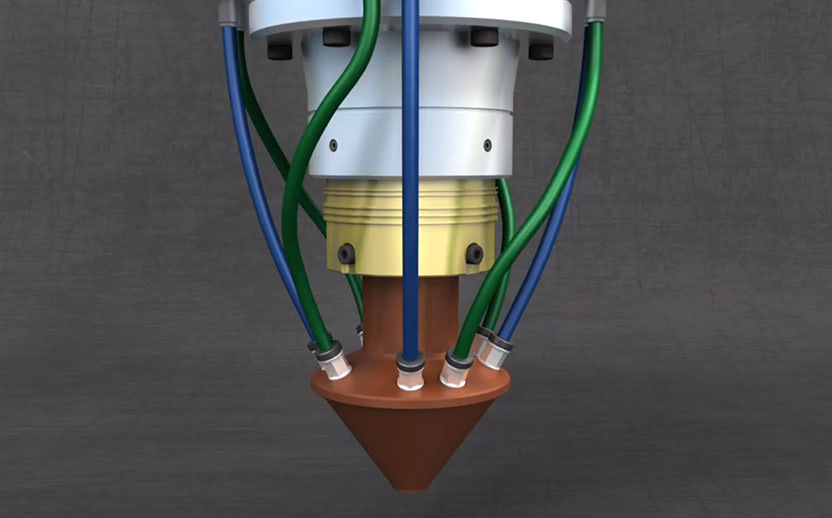
DED print head
DED print head. (Image credit: NASA)<br />

As seen in the cutaway image below, the powders are fired in a steam of gas at the previously deposited matter, where the powder streams are met with a laser and fuses the powder particles to the target.
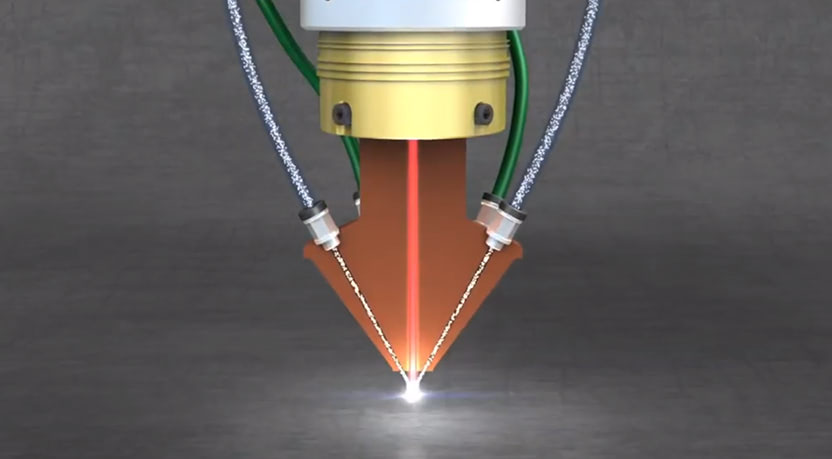
DED print head 2
DED print head cutaway showing laser and powder/gas stream (Image credit: NASA)

“This technology advancement is significant, as it allows us to produce the most difficult and expensive rocket engine parts for a lower price tag than in the past,” said Drew Hope, manager of NASA’s Game Changing Development Program.

“It will allow companies within and outside of the aerospace industry to do the same and apply this manufacturing technology to the medical, transportation, and infrastructure industries”, added Hope.

Boeing & DED

One such company is Boeing, who are undoubtedly excited at the prospect of cutting their manufacturing costs on the already over budget Space Launch System project.

“Producing channel wall nozzles and other components using this new type of additive manufacturing would enable us to make the SLS (Space Launch System) engines at the scale required with a reduced schedule and reduced cost,” said Johnny Heflin, Liquid Engines Office manager for the Space Launch System program.

RAMPT and the Space Launch System team are currently investigating development of a 5 ft diameter variant for qualification testing, which presumably will serve as a roadmap to a possible replacement for the RL-10 engines on the upper stages (which measure around 7ft in diameter).


Related Story
ESA Tests ALM Rocket Engine
Share:
WhatsApp Twitter Facebook LinkedIn Buffer Reddit E-mail
About the author | Phillip Keane
Phillip is an aerospace engineer from UK. He is a graduate of Coventry University (UK), International Space University (France) and Nanyang Technological University (Singapore), where he studied Advanced Manufacturing at the Singapore Centre for 3D Printing.
Join our newsletter

Our newsletter is free & you can unsubscribe any time.

Latest posts

3D Printed Copper Cold Plates Could Cut Data Center Cooling Energy by 98%

Mechanical engineers at the University of Illinois have 3D printed pure copper cold plates that could reduce a data center's cooling energy consumption... read more »

News

Researchers 3D Print Glowing Shapes Using Bioluminescent Algae Embedded in Hydrogel

Scientists at the University of Colorado Boulder have used a bioluminescent single-celled algae called Pyrocystis lunula to 3D-print light-emitting structures that glow a... read more »

News
Researchers 3D Print Glowing Shapes Using Bioluminescent Algae Embedded in Hydrogel

Revopoint POP 4 Launches on Kickstarter: Hybrid Blue Laser and Infrared 3D Scanner from $579

Revopoint is bringing its next-generation handheld 3D scanner to Kickstarter. The Revopoint POP 4 launches on May 7, 2026, combining blue laser and... read more »

News

Best Resin 3D Printers in 2026: Our Top Picks

The best resin 3D printers in 2026 cover an extraordinary range, from $169 entry-level machines that produce tabletop-grade detail to $9,999 professional systems... read more »

3D Printers

Best 3D Printers for Beginners 2026

A 2026 guide to the best 3D printers for beginners. 15 FDM and resin picks, plus a buying guide and FAQ.

3D Printers
How 3D Printing Enhances the VR and AR Gaming Experience

Apollo’s New $4M Supercar Gets a 3D-Printed Titanium Exhaust That Takes 123 Hours to Print

Apollo Automobil's upcoming Evo supercar will feature what the company describes as the largest one-piece 3D-printed titanium exhaust system ever produced, with each... read more »

Automotive
Apollo's New $4M Supercar Gets a 3D-Printed Titanium Exhaust That Takes 123 Hours to Print

Harvard’s 3D-Printed Filaments Mimic Muscle, Bending and Twisting on Command

Harvard researchers have developed a 3D printing technique that programs soft filaments to bend, twist, expand, or contract in response to heat, producing... read more »

News
Harvard's 3D-Printed Filaments Mimic Muscle, Bending and Twisting on Command

Best Composite Filaments for 3D Printing 2026: Carbon Fiber, Nylon and Wood

Also in series Bio Filaments Also in series Engineering Filaments Also in series Flexible Filaments You are here Composite Filaments Composite filaments add... read more »

Filament

Best Flexible Filaments for 3D Printing 2026: TPU, PEBA and More

Also in series Bio Filaments Also in series Engineering Filaments You are here Flexible Filaments Also in series Composite Filaments Flexible filaments are... read more »

Filament

MIT Researchers 3D Print Microscopic Robots That Snap to Attention With a Magnet Swipe

MIT engineers have developed a method for 3D printing soft, microscopic structures infused with iron-oxide nanoparticles that can be remotely controlled by an... read more »

News
MIT Researchers 3D Print Microscopic Robots That Snap to Attention With a Magnet Swipe

Social

  • Facebook Facebook 3D Printing
  • Linkedin Linkedin 3D Printing
banner
Join our newsletter

Our newsletter is free & you can unsubscribe any time.

Featured Industries

  • Automotive
  • Aerospace
  • Construction
  • Dental
  • Environmental
  • Electronics
  • Fashion
  • Medical
  • Military
  • Anycubic Kobra S1 Combo

    • - Print size: 250 x 250 x 250 mm
    • - budget multicolor printing
    More details »
    $429.00 Anycubic
    Buy Now
  • Qidi Max 4

    • - Print size: 390 x 390 x 340 mm
    • - active cooling air control
    More details »
    $1,219.00 Qidi
    Buy Now
  • Flashforge AD5X

    • - Print size: 220 x 220 x 220 mm
    • - dual extrusion system
    More details »
    $399.00 Flashforge
    Buy Now
  • Snapmaker U1

    • - Print size: 270 x 270 x 270 mm
    • - multi-color printing with SnapSwap
    More details »
    $849.00 Snapmaker
    Buy Now
  • Flashforge Adventurer 5M

    • - Print size: 220 x 220 x 220 mm
    • - 600mm/s travel speed
    More details »
    $299.00 Flashforge
    Buy Now
  • Anycubic Photon Mono M7

    • - Print size: 223 x 126 x 230 mm
    • - 10.1 inch 14K screen
    More details »
    $279.00 Anycubic
    Buy Now
  • Creality Hi Combo

    • - Print size: 260 x 260 x 300 mm
    • - up to 16-color printing
    More details »
    $399.00 Creality
    Buy Now
  • Creality K2 Plus

    • - Print size: 350 x 350 x 350 mm
    • - multi-color printing
    More details »
    $1,199.00 Creality
    Buy Now
  • Qidi Q2

    • - Print size: 270 x 270 x 256 mm
    • - enclosed heated chamber up to 65°C
    More details »
    $580.00 Qidi
    Buy Now
  • Flashforge Guider 3 Ultra

    • - Print size: 330 x 330 x 600 mm
    • - dual extruder system
    More details »
    $2,999.00 Flashforge
    Buy Now

Company Information

  • What is 3D Printing?
  • Contact us
  • Join our mailing list
  • Advertise with us
  • Media Kit
  • Nederland 3D Printing

Blog

  • Latest News
  • Use Cases
  • Reviews
  • 3D Printers
  • 3D Printing Metal

Featured Reviews

  • Anycubic Photon Mono M5s
  • Creality Ender 5 S1
  • The Mole 3D Scanner
  • Flashforge Creator 3 Pro

Featured Industries

  • Automotive
  • Aerospace
  • Construction
  • Dental
  • Environmental
  • Electronics
  • Medical
  • Military
  • Fashion
  • Art
2026 — Strikwerda en Dehue
  • Home
  • Join our mailing list
  • Contact us
Blog
  • Latest News
  • Use Cases
  • Reviews
  • 3D Printers
  • 3D Printing Metal
Featured Industries
  • Automotive
  • Aerospace
  • Construction
  • Dental
  • Environmental
  • Electronics
  • Medical
  • Military
  • Fashion
  • Art
Company Information
  • What is 3D Printing?
  • Contact us
  • Join our mailing list
  • Advertise with us
  • Media Kit
  • Nederland 3D Printing