
3D Printing
News Videos Newsletter Contact us
Home / Environmental / 3D Printed Hydroponic Substrates For Soilless Plant Cultivation

3D Printed Hydroponic Substrates For Soilless Plant Cultivation

April 26, 2019

In a paper titled “3D Printable Hydroponics: A Digital Fabrication Pipeline for Soilless Plant Cultivation,” Dr. Yuichiro Takeuchi of Sony Computer Science Laboratories Inc outlines his experiment on 3D printing plant substrates for hydroponic growing systems. Various hydroponic components like nozzles and baskets have already been 3D printed by researchers and DIYers, but nobody had tackled the growing substrate up until now.

Hydroponics is the growing of plants without the use of soil. Water and nutrients are delivered to the plants via drip or pool systems powered by pumps. The benefits of hydroponics include larger harvests, more control over nutrient and pH levels, and less water usage because whatever isn’t absorbed by the roots can be recycled through the system. Obviously, hydroponics are especially useful in areas where good soil is hard to find or expensive to acquire. Vertical growing doesn’t work well with soil, either, which is becoming a popular feature of high-rises.
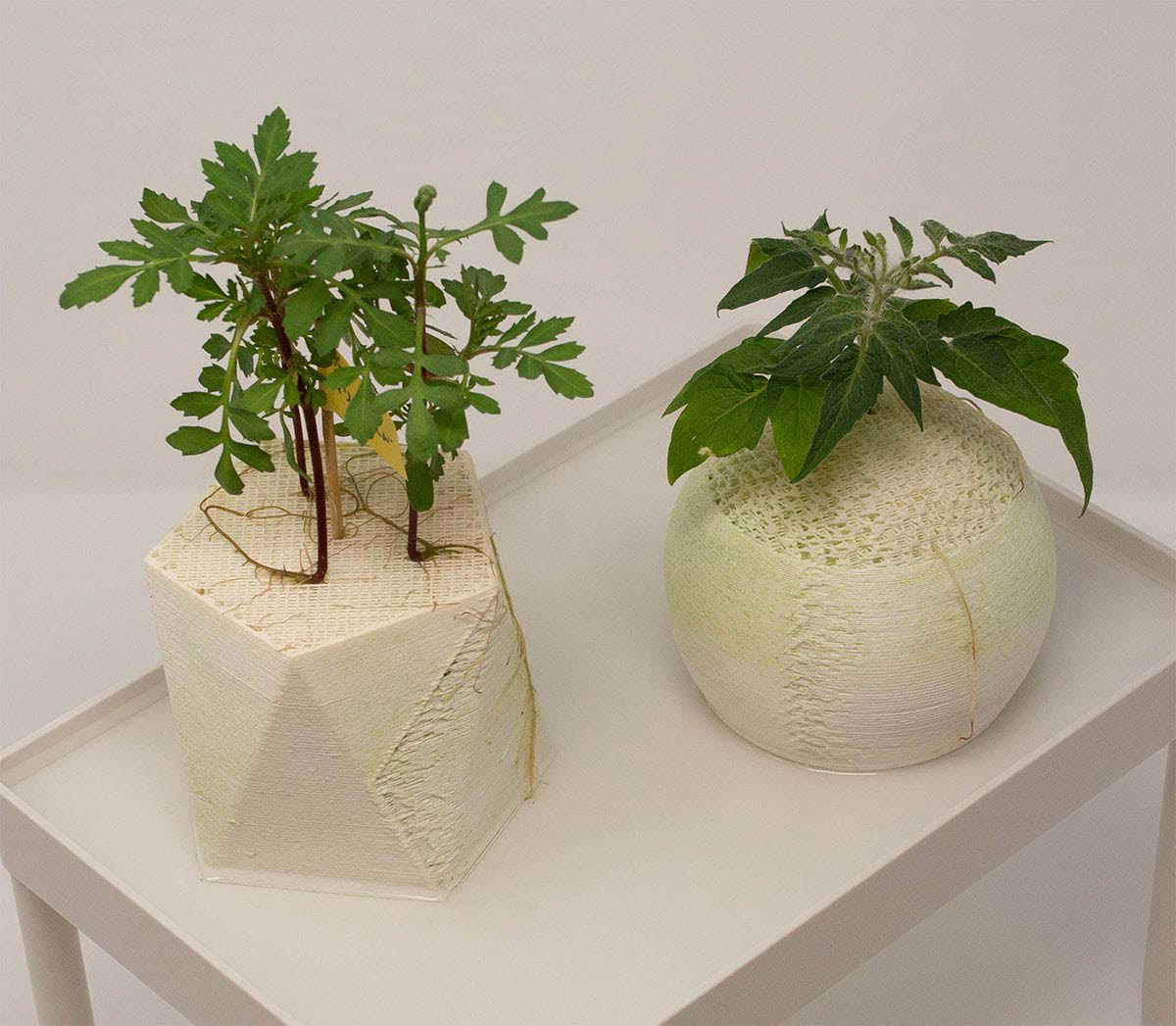
3D printed hydroponic systems, wholly fabricated using porous SBS; the systems were initially cultivated using an automated “drip” irrigation setup, but later moved to manual “pool” irrigation.
3D Printed Hydroponic Substrates examples
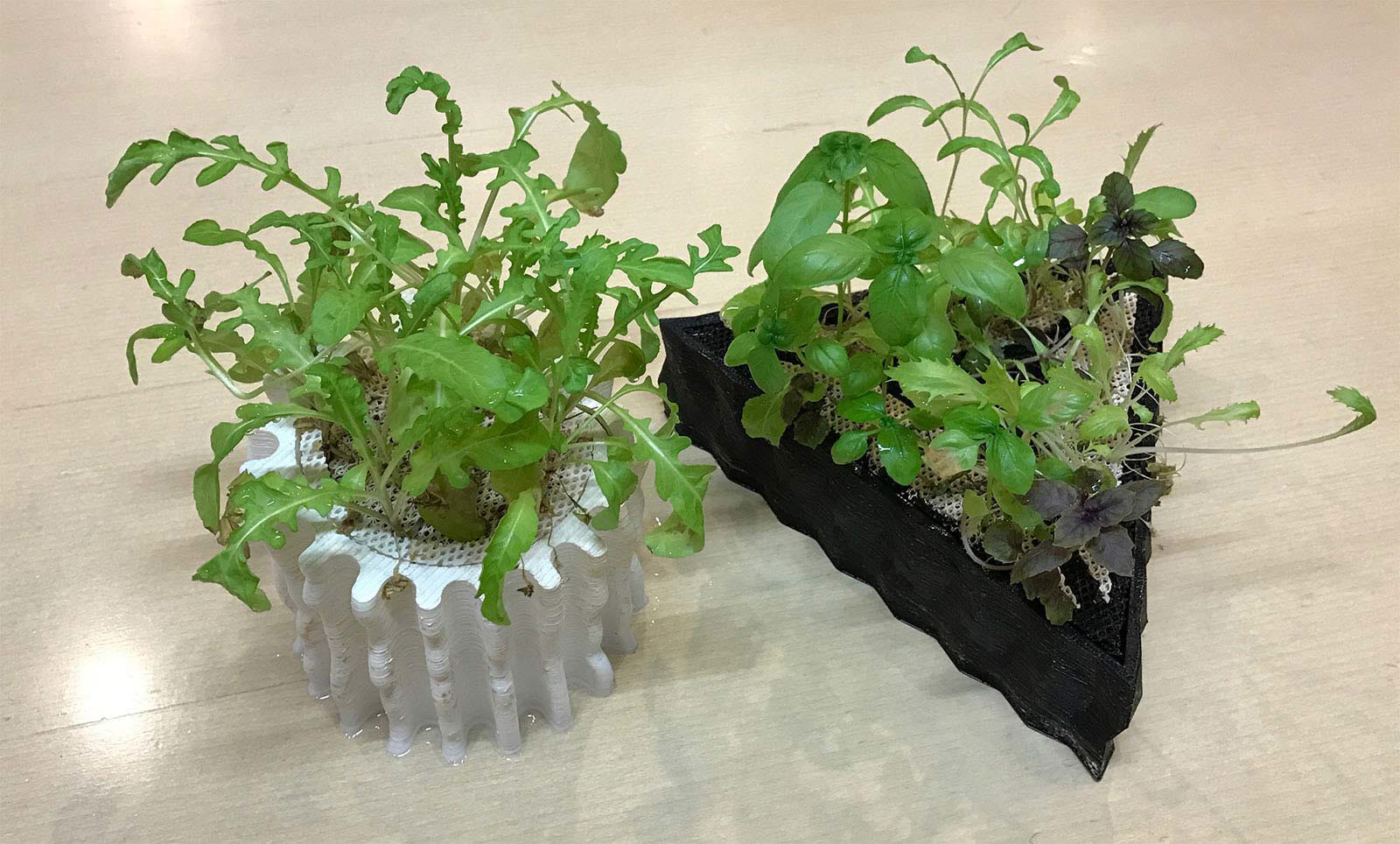
3D printed hydroponic systems made of a combination of porous SBS and PLA, cultivated manually using a “pool” setup.

While soil can be replaced, the necessary traits of soil that plants crave must also be replicated: water retention, oxygen permeability, and a support structure that can hold the plant securely without constricting root growth. Ideal growing substrates include clay pebbles, vermiculite, perlite, coco coir, sponges, and rock wool, the first four of which must be held in a container as they are loose particles. Dr. Takeuchi considered all of these traits before creating his 3D printed substrate, and he tested several plastics before finding one that performed well.

He tested ABS, PLA, TPU (flexible), and SBS, and only SBS had positive results, likely due to its elasticity. With the the stiffer plastics, the plants’ roots were restricted and the plants died. To achieve the porosity that would allow root growth, he made a composite filament made up of 70% SBS and 30% PVA, a material often used for 3D printing support structures because it dissolves in water. By rinsing the printed substrates in water, they become porous.

A variety of plants were successfully grown in the printed substrates, such as arugula, lettuce, basil, sunflower, and tomato. A yield test where six sets of lettuce were grown in porous SBS, sponge, and rock wool substrates indicated that SBS can produce yields that are in line with the traditional substrates, though one of the SBS plants died while none of the others did. Though it was not intended, some mold and algae grew on the SBS substrates; this reveals that it may be possible to also grow lichens and mushrooms on 3D printed substrates.

Those results are promising because SBS was not designed for growing plants. With some materials research, it seems likely that a more ideal material or printing method could be developed. Indoor agriculture and hydroponics are growing quickly as populations become more urban and as more extreme weather events become more common, so streamlining the design, installation, and operation of such systems will prove fortuitous. As such, Dr. Takeuchi also integrated a seed planting head into his 3D printer to demonstrate automated planting.

This concept would scale well with large-scale 3D printers, and substrates could be printed with geometries that are ideal for the specific plants being grown. Irrigation tubes and maintenance access points could also be incorporated into the substrate foundations to further streamline systems. Such 3D printed substrates could even be used to grow custom-shaped fruits and living sculptures.

The full study is available link)” rel=”noopener” target=”_blank”>here.

GROWLAY example
Related Story
Kai Parthy Introduces GROWLAY Indoor Farming Filament
Share:
WhatsApp Twitter Facebook LinkedIn Buffer Reddit E-mail
About the author | Cameron Naramore
Cameron is a 3D printer and CNC operator. He's fond of cooking, traveling, and science fiction.
Join our newsletter

Our newsletter is free & you can unsubscribe any time.

Latest posts

MIT’s 3D-Printed Concrete Bridge Shows Printer Hardware, Not Concrete, Is the Limiting Factor

MIT researchers have 3D-printed and load-tested a 2.3-meter concrete bridge using a computational framework that bakes a printer's physical limitations directly into the... read more »

Construction
MIT's 3D-Printed Concrete Bridge Shows Printer Hardware, Not Concrete, Is the Limiting Factor

Manchester Researchers Link Temperature Swings to Defects in Aluminium 3D Printing

Scientists at The University of Manchester have found that small temperature changes during molten metal deposition can substantially alter the quality of 3D-printed... read more »

3D Printing Metal
Manchester Researchers Link Temperature Swings to Defects in Aluminium 3D Printing

University of Illinois Engineers Build First 3D Thermal Cloak Using 3D-Printed Aluminum

Engineers at the University of Illinois Urbana-Champaign have built the first physical device that can hide objects from heat in any direction, a... read more »

News
University of Illinois Engineers Build First 3D Thermal Cloak Using 3D-Printed Aluminum

Best Large Format 3D Printers 2026: Big Builds Compared

Large format stopped being exotic. A 256 mm cube is the consumer standard now, and the interesting machines start where it ends: 330,... read more »

3D Printers

EPFL’s 3D Printable Elastomer Is 15 Times Tougher Than Comparable Materials

Researchers at EPFL have found that a soft material built for 3D printing also solves one of materials science's stubborn problems: making elastomers... read more »

Materials
EPFL's 3D Printable Elastomer Is 15 Times Tougher Than Comparable Materials

Best Multicolor 3D Printers 2026: Every System Compared

Multicolor went from party trick to default in about two years. Color systems now ship in $299 bundles, toolchangers and multi-nozzle machines have... read more »

3D Printers

University of Utah Develops Holographic 3D Printer That Completes Prints in 20 Seconds

University of Utah engineers have built a holographic 3D printer that produces complete shapes in a single exposure rather than building them layer... read more »

News

Inside Vietnam’s First Connected Surgical Ecosystem, and the Role 3D Printing Plays Within It

When Vinmec switched on a nationwide robotic surgery network, the real advance was the connective tissue around it: preoperative 3D reconstruction, surgical simulation,... read more »

Medical

Best Castable Resin 2026: Clean-Burnout Picks for Jewelry Casting

Castable resin exists for one moment: the burnout. A printed pattern goes into investment plaster, the kiln takes it to several hundred degrees,... read more »

Resin

Best Water-Washable Resin 2026: Easy Cleanup Without the IPA

The messiest part of resin printing has never been the printing; it is the tub of isopropyl alcohol waiting afterwards. Water-washable resin removes... read more »

Resin

Social

  • Facebook Facebook 3D Printing
  • Linkedin Linkedin 3D Printing
Join our newsletter

Our newsletter is free & you can unsubscribe any time.

Featured Industries

  • Automotive
  • Aerospace
  • Construction
  • Dental
  • Environmental
  • Electronics
  • Fashion
  • Medical
  • Military
  • Creality Hi Combo

    • - Print size: 260 x 260 x 300 mm
    • - up to 16-color printing
    More details »
    $399.00 Creality
    Buy Now
  • Anycubic Photon Mono M7

    • - Print size: 223 x 126 x 230 mm
    • - 10.1 inch 14K screen
    More details »
    $279.00 Anycubic
    Buy Now
  • Creality K2 Plus

    • - Print size: 350 x 350 x 350 mm
    • - multi-color printing
    More details »
    $1,199.00 Creality
    Buy Now
  • Flashforge Adventurer 5M

    • - Print size: 220 x 220 x 220 mm
    • - 600mm/s travel speed
    More details »
    $299.00 Flashforge
    Buy Now
  • Flashforge AD5X

    • - Print size: 220 x 220 x 220 mm
    • - dual extrusion system
    More details »
    $399.00 Flashforge
    Buy Now
  • Qidi Max 4

    • - Print size: 390 x 390 x 340 mm
    • - active cooling air control
    More details »
    $1,219.00 Qidi
    Buy Now
  • Flashforge Guider 3 Ultra

    • - Print size: 330 x 330 x 600 mm
    • - dual extruder system
    More details »
    $2,999.00 Flashforge
    Buy Now
  • Snapmaker U1

    • - Print size: 270 x 270 x 270 mm
    • - multi-color printing with SnapSwap
    More details »
    $849.00 Snapmaker
    Buy Now
  • Qidi Q2

    • - Print size: 270 x 270 x 256 mm
    • - enclosed heated chamber up to 65°C
    More details »
    $580.00 Qidi
    Buy Now
  • Anycubic Kobra S1 Combo

    • - Print size: 250 x 250 x 250 mm
    • - budget multicolor printing
    More details »
    $429.00 Anycubic
    Buy Now

Company Information

  • What is 3D Printing?
  • Contact us
  • Join our mailing list
  • Advertise with us
  • Media Kit
  • Nederland 3D Printing

Blog

  • Latest News
  • Use Cases
  • Reviews
  • 3D Printers
  • 3D Printing Metal

Featured Reviews

  • Anycubic Photon Mono M5s
  • Creality Ender 5 S1
  • The Mole 3D Scanner
  • Flashforge Creator 3 Pro

Featured Industries

  • Automotive
  • Aerospace
  • Construction
  • Dental
  • Environmental
  • Electronics
  • Medical
  • Military
  • Fashion
  • Art
2026 — Strikwerda en Dehue
  • Home
  • Join our mailing list
  • Contact us
Blog
  • Latest News
  • Use Cases
  • Reviews
  • 3D Printers
  • 3D Printing Metal
Featured Industries
  • Automotive
  • Aerospace
  • Construction
  • Dental
  • Environmental
  • Electronics
  • Medical
  • Military
  • Fashion
  • Art
Company Information
  • What is 3D Printing?
  • Contact us
  • Join our mailing list
  • Advertise with us
  • Media Kit
  • Nederland 3D Printing