
Large scale 3D printing starts where desktop machines stop. Past the 600 mm mark, printing changes character: gantry systems the size of wardrobes, robotic arms sweeping pellet extruders through non-planar paths, and output measured in kilograms per hour instead of grams. This is the technology that prints one-piece furniture, architectural elements, vehicle parts, and set pieces, and in 2026 the most interesting corner of it is robotic. This page walks through the machine classes, the anatomy of a robotic cell, the toolpath software that quietly decides whether a big print succeeds, and the ceramic side of the field.
Looking for a big printer for your workshop rather than a factory? Machines up to about 600 mm, from $569 to $3,000, are a different category with different rules: see our best large format 3D printers guide. This page covers what lies beyond.
When large scale printing is the right tool
Size is the obvious driver, but rarely the deciding one. The considerations that actually move organisations to large scale printing:
- Unibody parts. Objects that could be assembled from pieces often perform better as one solid print: no fasteners, no seams, no weak joints.
- Weight reduction. Printed polymer replaces wood, metal, or molded plastic at a fraction of the weight, and adjustable infill lets designers put density only where loads demand it.
- No tooling. The bigger the object, the more expensive and slow its molds and jigs. Printing skips tooling entirely, which is why large prototypes and short production runs favour it so heavily.
- Cost at low volumes. For one-offs and small series, printed large parts routinely undercut conventionally-made ones, almost entirely because of the tooling they avoid.
- Design freedom. Internal channels, lattices, and organic geometry are unmakeable by subtractive methods at this scale, and they are exactly what ambitious furniture and interior design ask for.
The three machine classes
Gantry XL: the scaled-up printer
The familiar architecture, grown: a toolhead moving in a rigid frame, printing planar layers over build volumes from 600 mm to several meters. Machines from Modix, BigRep, and CEAD's gantry line define this class. Gantries are the predictable choice: simpler to run, easier to enclose and heat, and well suited to production where the same envelope gets used repeatedly. Their limit is the box itself; the part can never exceed the frame, and flat layers carry the usual anisotropy.
Robotic arm printing: where the field is heading
Mount a high-throughput extruder on a six-axis industrial arm and the box disappears. Robotic LFAM systems, Caracol's Heron platform and CEAD's robot cells among the leaders, print non-planar layers that follow curved surfaces, reach around existing geometry, deposit continuous fiber reinforcement, and scale to boat hulls and building facades; CEAD customers have printed 12-meter vessels. For furniture and interior architecture this is transformative: a robot prints flowing, doubly-curved forms with layer paths that follow the design instead of fighting it. We covered the state of the field from inside its own symposium in our Addidex Connect robotic large-format report. The robotic approach spans metal as well: on Caracol's wire-arc Vipra AM platform, NP Aerospace printed a 110 kg vehicle component in 60 hours, the same arm-based idea applied to a different material class.
Pellet extrusion: the economics underneath
Both classes run on pellets rather than filament, and that changes the economics of scale. Pellet feedstock is the same material injection molders buy, several times cheaper than spooled filament, and pellet extruders output kilograms per hour, which is what makes meter-scale printing finish in days rather than months. Pellet systems also take regrind: shredded bottles, failed prints, and post-industrial waste become feedstock again, closing the loop on production waste. The trade-off is surface finish, since pellet extruders handle retraction poorly; large-scale parts typically get machined or finished after printing, and some machines swap between pellet and filament toolheads to balance speed against finish.
Inside a robotic printing cell
A robotic large-format system is not one machine but a small orchestra. Understanding the parts explains both the capability and the price tag.
The arm and its extra axes
The core is a standard six-axis industrial robot from the brands that build car factories: KUKA, ABB, FANUC, Yaskawa. The arm contributes reach and repeatability, and because it is a commodity of the automation world, spare parts and integrators exist everywhere. What turns six axes into a printing envelope bigger than the arm itself are external axes: a linear rail extends the workspace along one direction, a plinth or riser raises the base, and a turntable rotates the part so the arm prints all sides without repositioning. Caracol's Heron AM cells, for example, configure arm size, rail, and plinth per installation, which is why two Herons rarely look alike.
The end effector: a factory in a fist
Where a desktop printer has a hotend, the robot carries a pellet extruder the size of an outboard motor: a heated barrel and screw that melts granulate and pushes out a bead measured in millimeters, not microns. Vendors tier these by intent, from high-accuracy heads laying fine beads for visual parts to high-flow units built to move kilograms per hour into boat hulls and tooling. Behind the extruder sits a feeding and drying system, typically holding 50 to 80 kg of pellets at controlled humidity and temperature, because fiber-filled engineering pellets print badly wet.
Who builds them
Caracol (Heron AM, plus the wire-arc WAAM Vipra platform for metal) and CEAD (its Flexbot cells, including the hybrid versions that machine what they print) lead the polymer-composite field, with a widening ring of integrators assembling cells from off-the-shelf arms and third-party extruders. On the ceramics side, WASP mounts clay extruders on robotic arms for architectural work, covered further down. The common thread: the robot is bought, the process is engineered around it.
Toolpath and slicing: where large scale is won or lost
Desktop printing made slicing invisible: load a model, click, print. At large scale the toolpath becomes the engineering problem, and it is the part of the field moving fastest.
The thermal tightrope
Every layer of a large print must cool enough to carry the next one, yet stay warm enough to fuse with it. On a meter-scale part a layer can take many minutes, and if the printhead returns to material that has gone cold, the result is a weak seam, poor interlayer adhesion hidden inside a structural part. Too fast and the part slumps under its own heat. Serious toolpath software manages this window actively: modulating flow and travel speed, resequencing regions, and holding each layer inside its thermal budget. This, more than any spec-sheet number, separates production LFAM from an arm that merely extrudes.
Beyond flat layers
With six axes, layers no longer need to be horizontal. Angled slicing at 45 or 60 degrees lets overhangs print without support, non-planar paths follow curved surfaces so the strongest direction of the bead follows the load, and multi-axis strategies print around inserts or onto existing geometry. This is where robotic printing earns its geometry freedom, and it is pure software.
The software doing it
Adaxis AdaOne has become the closest thing to a standard independent toolchain: planar, angled, and non-planar slicing, kinematic and physics simulation with collision checking before a robot moves, support for ABB, FANUC, KUKA, Yaskawa, and Universal Robots, and live process monitoring at 250 Hz once printing starts. Ai Build's AiSync attacks the same problem cloud-first, using AI assistance to generate and correct toolpaths and to watch prints as they run. Machine vendors ship their own suites as well, such as Caracol's Eidos pairing of programming and production-monitoring tools, and design studios frequently drive robots straight from parametric CAD environments like Rhino and Grasshopper when the part is the point. Whichever route, simulation first is the rule at this scale: a collision on a desktop printer costs a nozzle, a collision on a 200 kg arm costs rather more.
Ceramics and clay at architectural scale
Polymer gets the headlines, but some of the most striking large-scale printing happens in ceramics. The process, usually called LDM, liquid deposition modeling, swaps the heated extruder for a pressurised cylinder and auger screw that lays down dense clay bead by bead. Nothing melts; the material is already soft, and the printer's job is placing it precisely without disturbing what stands below.
WASP built this niche almost single-handedly: its LDM lineup runs from the studio-scale Delta WASP 2040 Clay through the meter-tall 40100, a Production version with continuous feeding and a conveyor for serial ceramics, and the industrial 3MT, up to robotic-arm systems with interchangeable clay extruders for facade-scale work. Materials are the potter's shelf: stoneware, porcelain, earthenware, mixes stiffened with chamotte or paper fiber, and at the far end raw earth, the Crane WASP construction system has printed entire experimental dwellings from local soil and straw.
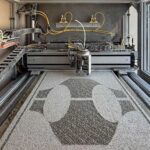
The craft is in what happens after deposition. Wet clay must support its own weight while printing, then survive drying shrinkage and a kiln firing that changes its dimensions again, so geometry, wall thickness, and print speed get engineered around the material's behaviour rather than the machine's limits. Done well the results reach production quality: the 322-tile printed ceramic facade in Rotterdam from earlier in this page is exactly this workflow at building scale.
The classes side by side
| Gantry XL | Robotic arm cell | Ceramic LDM | |
|---|---|---|---|
| Build envelope | Fixed box, roughly 0.6 to 4 m | Room scale; rails and turntables extend it | Studio machines to 1 m; crane and arm systems beyond |
| Feedstock | Filament or pellets | Fiber-filled pellets, regrind, recycled shred | Clay, stoneware, porcelain, raw earth mixes |
| Layers | Planar | Planar, angled 45 to 60 degrees, non-planar, multi-axis | Planar coils within self-supporting angles |
| Throughput | High, limited by the frame | Highest; high-flow extruders move kilograms per hour | Modest; the material sets the pace |
| Typical cost | From ~$12,000 to six figures | Six figures and up, integrated as a cell | Five figures for studio LDM systems |
| Best for | Repeatable production inside a known envelope | Hulls, facades, furniture, tooling, one-piece giants | Tiles, facades, vessels, earthen construction |
Furniture and interior design at print scale
Furniture is the application where large scale printing has moved furthest from novelty to practice. One-piece chairs, sculptural tables, room dividers, lighting, and full interior elements now come off robotic cells in engineering polymers and fiber-filled composites, increasingly from recycled feedstock, with the organic geometry that made this technology famous. Retail and hospitality lead the adoption, and architectural applications keep widening; a Rotterdam studio's 322-tile printed facade shows how far the interior-architecture side reaches. Our furniture industry use-case guide covers the design-side story.
Planning a large-format project?
Get a quote for furniture and interior design printing
For large-scale furniture, interior architecture, and design projects, FOM3D takes quote requests and project inquiries: robotic large-format printing for interiors and high-end furniture, built around circular, premium materials. Tell us about the piece, the space, and the timeline, and we will tell you what is possible.
What large scale printing is used for
- Furniture and interiors: one-piece seating, tables, partitions, lighting, and bespoke interior elements, the fastest-growing application and the subject of the section above.
- Vehicles and industry: tooling, molds, jigs, and end-use components; unibody parts that consolidate whole assemblies.
- Signage and retail: modern lettering, displays, and brand environments at exhibition scale, printed overnight.
- Film, TV, and events: set pieces and oversized props on schedules no workshop could match; see our props industry guide.
- Restoration and research: replicating delicate large artifacts and fossils for study and display.
Frequently asked questions
How much does a large scale 3D printer cost?
Serious money: gantry machines like the Modix 180X start around $12,000, BigRep and CEAD systems run from the mid five figures well into six figures, and robotic-arm cells with pellet extruders typically cost more than a house deposit once the robot, extruder, and integration are counted. That economics is why most organisations commission large-scale parts instead of buying a machine, unless they have continuous production volume.
What is the difference between robotic and gantry large scale printing?
A gantry machine is a scaled-up desktop printer: a toolhead moving in a box, printing flat layers, predictable and simpler to run. A robotic arm carries the extruder on six axes, so it can print non-planar layers, follow curved surfaces, reach around geometry, and work on parts larger than any practical box. Robotics buys shape freedom and scale; gantries buy simplicity and repeatability.
Why do large scale printers use pellets instead of filament?
Cost and speed. Plastic pellets are the same feedstock injection molders use, at a fraction of filament prices, and pellet extruders output kilograms per hour where filament machines manage tens of grams. Pellet systems also accept regrind and recycled feedstock, which makes circular production possible. The trade-off is finish: pellet extruders handle retraction poorly, so surfaces usually need finishing passes.
Can I get a large object printed without buying a machine?
Yes, and for one-off or small-series work it is almost always the right call. Large-scale service providers quote per part, and for furniture and interior design projects specifically, FOM3D, founded by our co-founder, takes quote requests at contact@fom3d.com. General-purpose service bureaus also handle large formats, though few specialise in furniture-scale work.
Is 3D printed furniture actually durable?
When engineered properly, yes: large-scale printed furniture uses thick structural walls, engineering polymers or fiber-filled composites, and internal geometry that desktop printing cannot reproduce. Commercial pieces are in daily use in retail and hospitality. What does not work is scaling up a desktop print; furniture-grade results come from furniture-grade machines and design.
What software is used to slice large scale robotic 3D prints?
Desktop slicers stop at three axes, so robotic cells use multi-axis toolpath software: Adaxis AdaOne is the leading independent option, with angled and non-planar slicing, collision simulation, and support for the major robot brands, while Ai Build's AiSync takes a cloud and AI-assisted approach. Machine makers also ship their own suites, like Caracol's Eidos, and design studios often program robots directly from Rhino and Grasshopper.
Can ceramics be 3D printed at large scale?
Yes, through liquid deposition modeling: a pressurised cylinder and screw extruder lay down dense clay in coils, on machines from studio size up to robotic arms and construction cranes. WASP dominates the category, and printed ceramics have reached production quality in tiles, vessels, and full building facades. The constraint is the material itself, since wet clay must hold its shape while printing and then survive drying and kiln firing.
Keep going
Shopping the desktop and workshop tier instead? Our best large format 3D printers guide ranks the machines from $569 to $3,000, and the flagship best 3D printers guide covers the whole market. For the technology behind this page in the field, read our robotic large-format report from Addidex Connect.