SHINING 3D has expanded its Rigil Series with the launch of the EinScan Rigil Lite, a hybrid light-source all-in-one 3D scanner aimed at professional users who want high-performance scanning without the complexity and cost of a full desktop setup. Building on the foundation of the EinScan Rigil, the Lite brings core Rigil Series capabilities to a broader audience while retaining the standalone, PC-free design that defines the product family.

The Rigil Series traces its origins to 2025, when SHINING 3D introduced the EinScan Rigil as the world’s first Tri-Mode all-in-one 3D scanner. The defining feature of the series is its fully integrated hardware design: scanner, display, computing, storage, and power supply are unified in a single device, eliminating the need for a connected PC and reducing overall system complexity. The Rigil Lite carries that philosophy forward as a more cost-effective entry point into the series.
Hybrid Light Source: Three Modes in One Device
The Rigil Lite integrates two scanning systems across three light sources, allowing it to handle a wide range of object sizes, materials, and environments from a single device.
- 17+17 crossed blue laser lines for high-speed scanning of complex parts
- 7 parallel blue laser lines for fine detail capture
- Near-infrared VCSEL structured light for rapid scanning of large objects indoors and outdoors, including portrait scanning
The dual-laser system (combining the crossed and parallel blue laser modes) provides flexibility to switch between speed and detail within a single session. The NIR VCSEL mode is designed to be safe for portrait scanning, opening up human-subject applications without additional safety precautions. Resolution across modes reaches up to 0.05 mm.
One practical highlight is marker-free laser scanning. Rather than placing physical markers on objects before scanning, the Rigil Lite can lock onto feature-rich geometry directly, reducing setup time and lowering the barrier for less experienced users. For reflective metals, black plastics, and other traditionally difficult materials, the scanner handles these natively without scanning powder or surface preparation.
Multi-Tracking Alignment
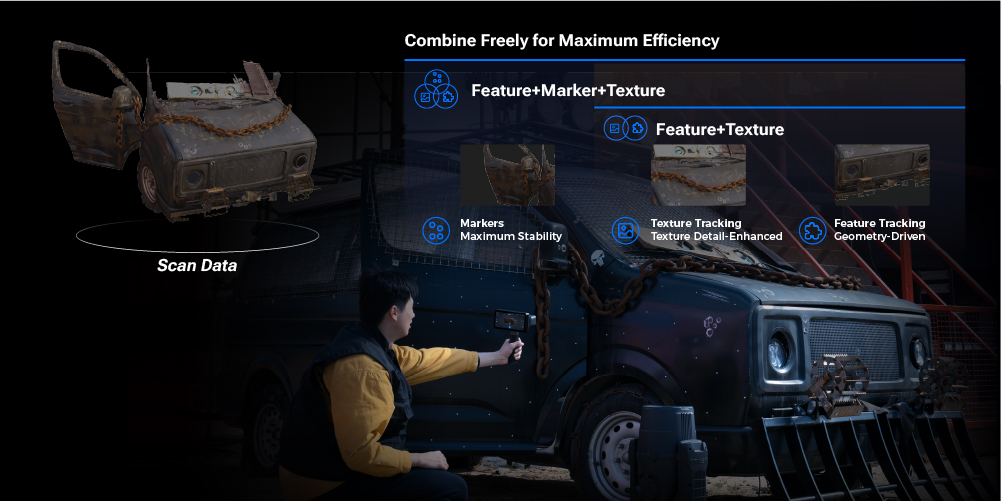
Stable tracking is one of the most critical factors in handheld 3D scanning: lose track mid-scan and the session has to restart. The Rigil Lite addresses this with a hybrid alignment system that freely combines feature, marker, and texture tracking. This means the scanner can adapt to changing conditions mid-session, switching between alignment methods as the surface geometry or environment demands, maintaining smooth and consistent tracking throughout.
All-in-One Hardware: No PC Required
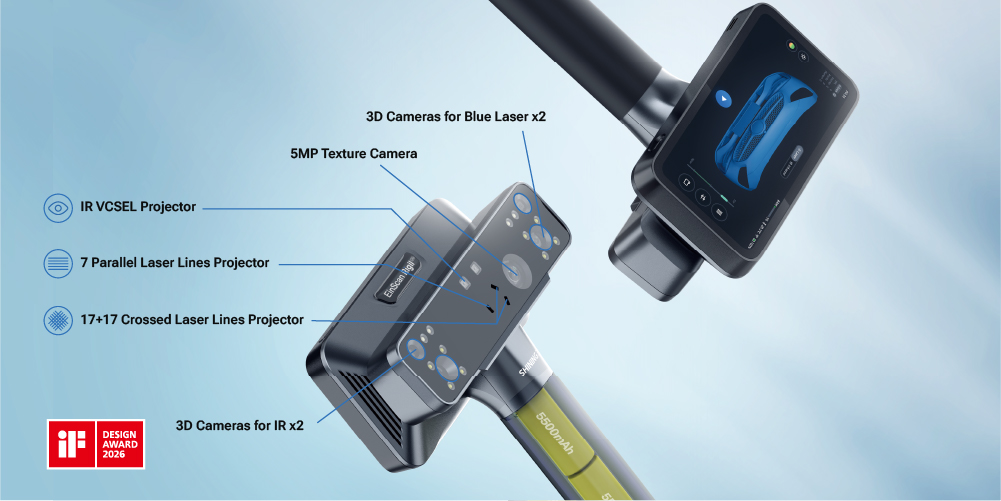
The Rigil Lite is a self-contained scanning system. Its built-in processing handles 24GB of compute power with Wi-Fi 6 connectivity, enabling fully wireless workflows without a tethered laptop or workstation. Storage combines 512GB of internal space with 64GB eMMC and supports USB Drive mode, allowing users to maintain a complete 3D project library on the device itself.
User interaction is handled through a 6.4-inch touchscreen, providing a clear visual interface for scanning, reviewing, and managing data in the field. Replaceable batteries remove the fixed battery constraint that limits many portable scanners, enabling continuous operation by swapping cells rather than waiting for a charge cycle to complete. The ergonomic single-piece design is built for stable, comfortable long-duration use in one hand.
Software: Full On-Device Workflow
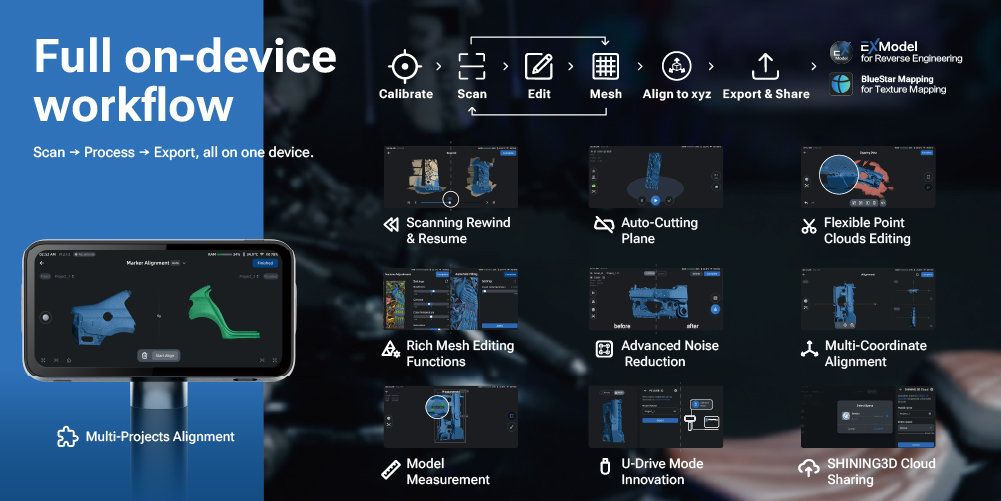
The Rigil Lite supports a complete scan-to-export workflow directly on the device, covering scanning, processing, and file export without needing to transfer data to a separate machine. For users who prefer PC-based work, the EXScan Rigil software provides a richer feature set through an intuitive unified interface, designed to reduce system load and improve overall performance.
For reverse engineering workflows, EXModel provides a direct path from scanned mesh to CAD solid model. The Rigil Lite includes a 2-month free trial of EXModel Pro, the advanced tier that unlocks a fuller set of reverse engineering tools and supports a complete workflow from scanning through to finished CAD geometry. The software is designed to make the conversion process accessible in a small number of steps, covering the gap between raw scan data and manufacturing-ready geometry.
Accuracy and Verification
SHINING 3D ensures reliability and accuracy through meticulous calibration and strict adherence to international standards, following VDI/VDE 2634 Part 2 & 3 guidelines for calibration conditions, items, methods, and result handling.
- VDI/VDE 2634: Framework for traceable optical system accuracy (German engineering standard)
- ISO 10360-13: International standard for acceptance and re-verification of optical 3D CMM systems
Testing and calibration take place in production and quality inspection areas built on specially isolated foundations with constant environmental temperature and humidity, ensuring all accuracy testing is conducted under identical, controlled conditions.
Reference artifacts used in calibration are each certified by a high-precision CMM achieving accuracy up to 2.4 µm + 2.8L/1000 µm. These artifacts are not verified only once, but are regularly recalibrated by accredited laboratories at defined intervals.
Professional-grade devices undergo a two-stage testing process, including production-line testing and final quality inspection. Metrology-grade devices are subject to even stricter accuracy requirements, undergo additional testing cycles throughout the same two-stage process, and must also pass CNAS-accredited testing. Supported by SHINING 3D’s in-house CNAS-accredited accuracy laboratory, SHINING 3D metrology products are delivered with official CNAS certificates and test reports.
As a professional-grade scanner, each EinScan Rigil is subjected to five repeat tests using a 1000 mm sphere rod before leaving the factory, with the maximum deviation from each test rather than the average taken as the final accuracy result.
Applications
The EinScan Rigil Lite is positioned for a broad range of professional use cases: engineering and manufacturing, reverse engineering, digital content creation, and education and research. Its combination of portability, standalone operation, and multi-material scanning capability makes it a practical tool wherever taking a scanner to the object is more practical than bringing the object to a lab, and at a more accessible price point than the EinScan Rigil for professionals who want the core capabilities of the series without the higher investment.
Ready to order?
Use code EINSTARSAS at checkout for $50 / €50 off.
About SHINING 3D
Founded in 2004, SHINING 3D is a developer and manufacturer of high-precision 3D scanning hardware and software with over two decades of experience. The company’s product range spans industrial metrology, full-field inspection, 3D modeling, reverse engineering, and digital dentistry, serving professional users worldwide. The EinScan product line is distributed globally under the Einstar brand.