
Every resin 3D print comes off the build plate coated in liquid, uncured photopolymer resin that is toxic, sticky, and fragile. Before a print is usable it needs two things: washing to remove that surface resin, and UV curing to fully harden the model and develop its final mechanical properties. A dedicated wash and cure station handles both steps automatically, replacing messy jars of IPA and improvised UV setups with a controlled, repeatable process.
The right station depends almost entirely on your printer size. A station sized for a Mars or Photon will not fit prints from a Saturn or Jupiter. This guide covers every category from compact budget units through to professional-grade systems, with verified specifications and honest assessments of each pick’s limitations alongside its strengths.
Quick picks by category
One standout recommendation per wash and cure category.
Best budget wash and cure station
The budget category is defined by printer size as much as price. Compact stations sized for printers up to 7.3 inches are inherently cheaper because their tanks are smaller, and for anyone printing on a Mars 4, Photon Mono 4, or similar small-format machine they are a perfect fit. The honest limitation is that a basket sized for a 7.3 inch printer simply cannot fit prints from an 8.9 inch or larger machine. If your printer is in the small-format category and you want the most capable station at the lowest price, the following picks are the right starting point.
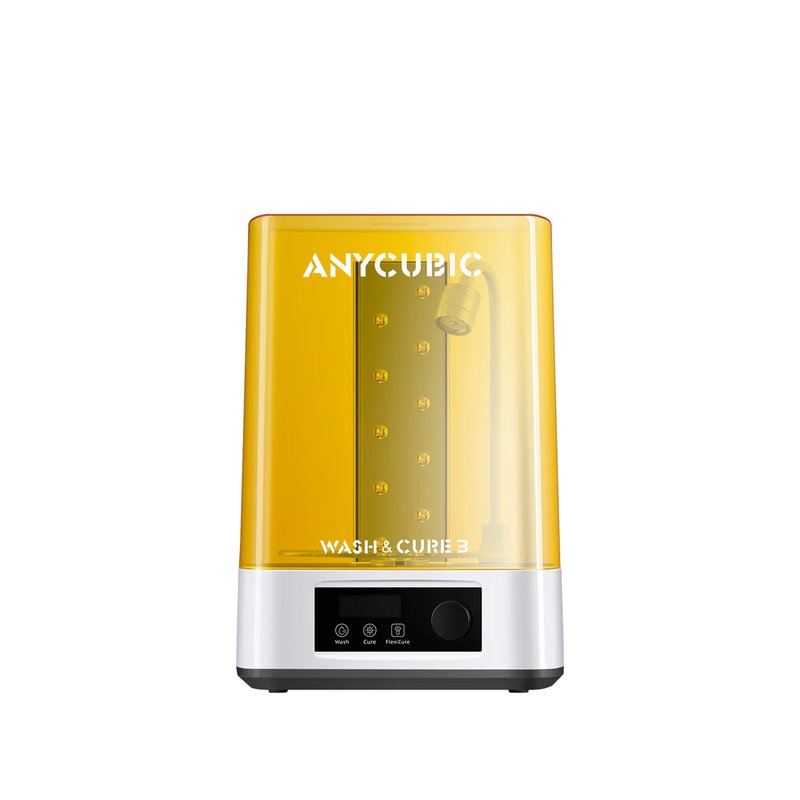
Anycubic Wash and Cure 3
Anycubic | 2-in-1 | up to 7.3 inch printers
The Wash and Cure 3 is Anycubic’s third-generation compact station and the best-value entry point in 2026. It holds 3 litres in the wash basket with 4 litres total bucket capacity, which comfortably handles the full build plate of any printer up to 7.3 inches. The headline upgrade over the previous generation is the Flexicure gooseneck light: a flexible 380mm arm that swings over the curing platform and delivers 30,000 uW/cm² of targeted UV energy at one to three centimetres range, significantly improving the cure quality on the top surfaces of tall models and on fine details like miniature faces and garment folds that top-only lamps consistently under-cure. The basket uses dual adjustable height settings, which reduces IPA consumption for smaller prints by lowering the fill level needed. One-click operation keeps the workflow simple, and the 405nm UV LED array provides reliable curing across all standard consumer resins. The honest limitation is straightforward: if you have a printer larger than 7.3 inches, this station will not fit your build plate and you need the next category up.
Best for: Resin hobbyists using small-format printers up to 7.3 inches who want the most capable station at the lowest price, with a gooseneck light for better detail curing.
Also consider
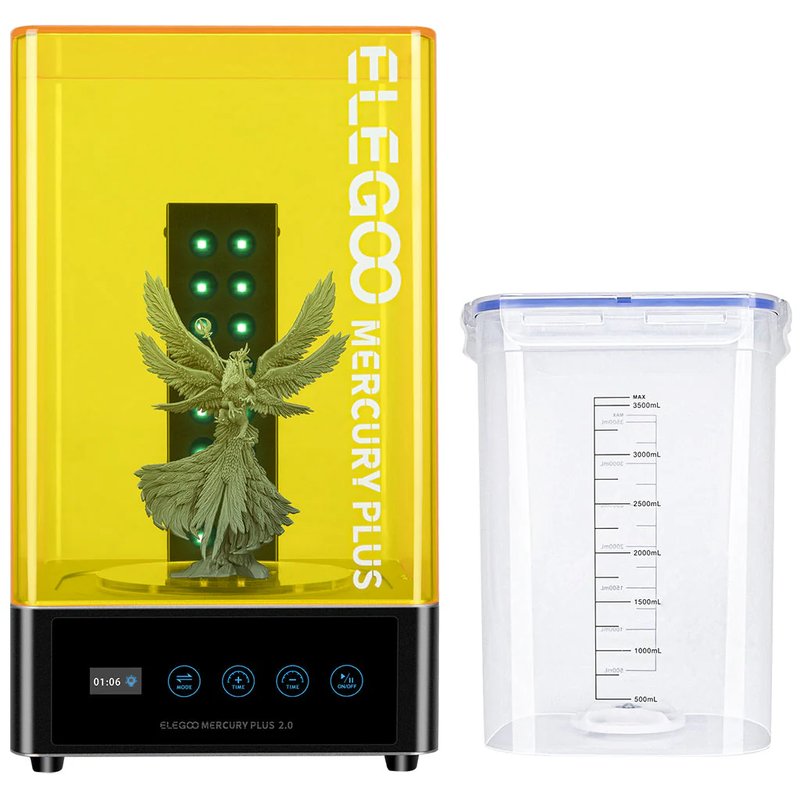
Elegoo Mercury Plus V2.0
Elegoo | 2-in-1 | up to 7.3 inch printers
The Mercury Plus V2.0 is the simpler, more affordable alternative for anyone who just wants a straightforward 2-in-1 without a gooseneck arm or touch panel. Operation is knob-based with a front TFT display showing set time and remaining time. It holds 3.5 litres in the wash tank, uses 16 x 405nm UV LEDs with a 360-degree rotating turntable for curing, and has been a reliable community favourite for years. The V2 is particularly well suited to Mars series printers and equivalent machines. Its main disadvantage compared to the Anycubic Wash and Cure 3 is the absence of any gooseneck or supplemental curing lamp, which can leave the very tops of tall models and deep recesses slightly under-cured without manual intervention. That said, for flat models, miniatures, and standard prints it performs cleanly and reliably. If the V3.0 is available at a similar price, it is worth the upgrade. If not, the V2.0 is a solid and well-proven choice.
Best for: Absolute beginners and casual Mars series users who want the simplest possible 2-in-1 at the lowest entry price.
Best overall wash and cure station
For most resin printers using machines in the 8.9 to 10.6 inch range, a mid-size 2-in-1 station is the right default choice. These stations balance wash capacity, cure quality, and footprint in a way that suits the majority of home and small workshop setups. The key specification to check is the maximum wash size, which must accommodate your printer’s full build plate, and the curing chamber size, which must fit your tallest prints. A touchscreen or digital display is a meaningful quality-of-life upgrade over a simple knob for anyone running multiple resins that need different wash and cure times.
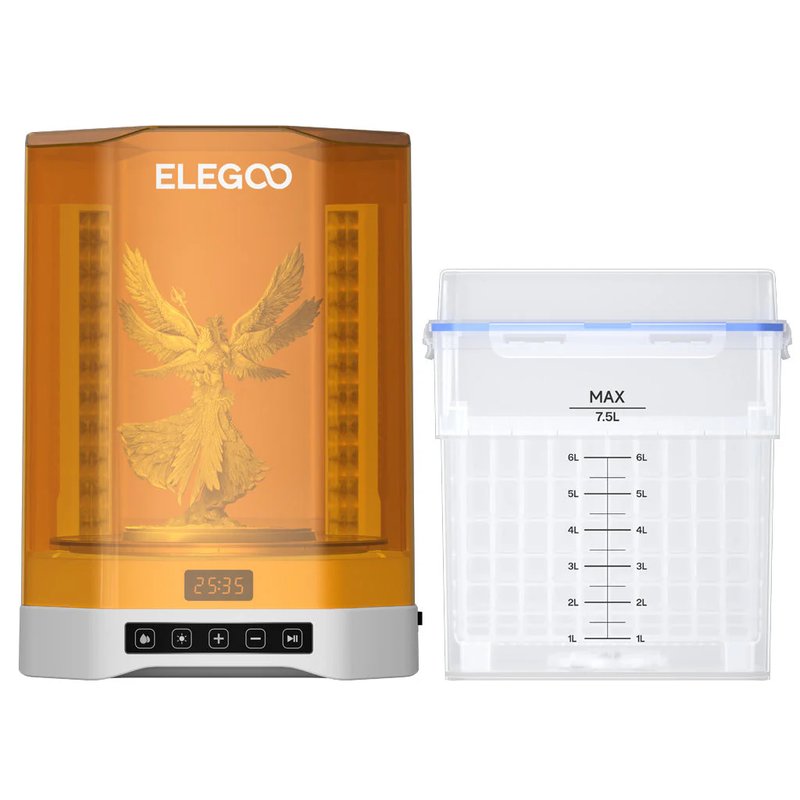
Elegoo Mercury Plus V3.0
Elegoo | 2-in-1 | up to 10 inch printers
The Mercury Plus V3.0 is the consensus best-value wash and cure station in 2026 across every independent review source. Its 7.5L wash capacity is 114% larger than the V2.0, and the curing area is 460% bigger, making it genuinely capable with printers up to 10 inches including the Saturn 3 Ultra and Mars 5 Ultra. The washing system uses an upgraded POM bearing for smoother high-speed rotation and more thorough agitation than the previous generation. The curing upgrade is the more significant change: rather than simple upward-facing LEDs, the V3.0 uses a pair of rectangular mirror arms extending from the vertical light towers to the centre of the turntable, bouncing 405nm light across the entire curing area for more even exposure. The intuitive touch panel shows set and remaining time clearly. Safety is properly implemented with an anti-UV cover that blocks 99.9% of UV light and a microswitch that automatically stops the curing cycle if the lid is opened. The two wash modes accommodate different workflows: basket mode for cleaned-off prints, and hanging mode with adjustable brackets that support build plates up to 10 inches directly. At around $150 it represents outstanding value for what it delivers.
Best for: The default recommendation for most resin users with printers up to 10 inches. Combines large wash capacity, improved curing quality, and simple touch-panel operation at a price that is hard to justify skipping.
Also consider
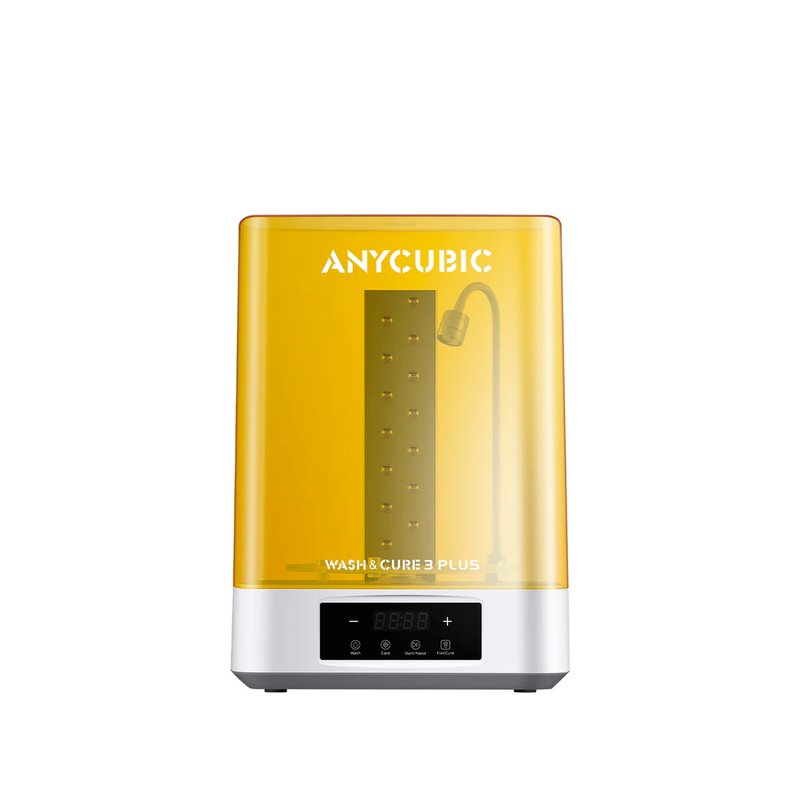
Anycubic Wash and Cure 3 Plus
Anycubic | 2-in-1 | up to 10.6 inch printers
The Wash and Cure 3 Plus is the stronger alternative to the Mercury V3.0 if you regularly cure batches of multiple parts at once or print tall models that benefit from the dual-layer curing platform. The wash basket holds 7.6 litres with 12 litres total bucket volume, the largest of any standard 2-in-1 station in this size category. The dual-layer curing platform increases the curing capacity per cycle by 42% over the previous generation, and the basket height adjusts to two positions to reduce IPA consumption for smaller prints. The Flexicure gooseneck delivers 30,000 uW/cm² at one to three centimetres for targeted detail curing, and the lens-array LED arrangement improves curing uniformity by 20% over the previous Anycubic generation. For Photon Mono M5s, M7, and Saturn users who need to match the increased build volume of those machines and prefer Anycubic’s ecosystem, this is the natural companion station. The V3.0 and the 3 Plus are closely matched at this price level; the Mercury V3.0 edges ahead on value, while the 3 Plus has a slight edge on wash volume and dual-layer curing throughput.
Best for: Anycubic printer users on the M5s, M7, or Saturn who want the largest-capacity 2-in-1 station and batch curing throughput.
Best separate wash and cure stations
Separate wash and cure stations mean washing and curing can run simultaneously on different prints, doubling throughput for anyone printing frequently or with multiple printers. There is no need to reassemble or swap the turntable between modes. The trade-off is desk space: two units occupy significantly more room than a 2-in-1. For casual users, a 2-in-1 is the right choice. For anyone printing daily, running a Saturn or larger machine, or producing prints for sale or commission, the workflow efficiency of separate units is worth the extra footprint.
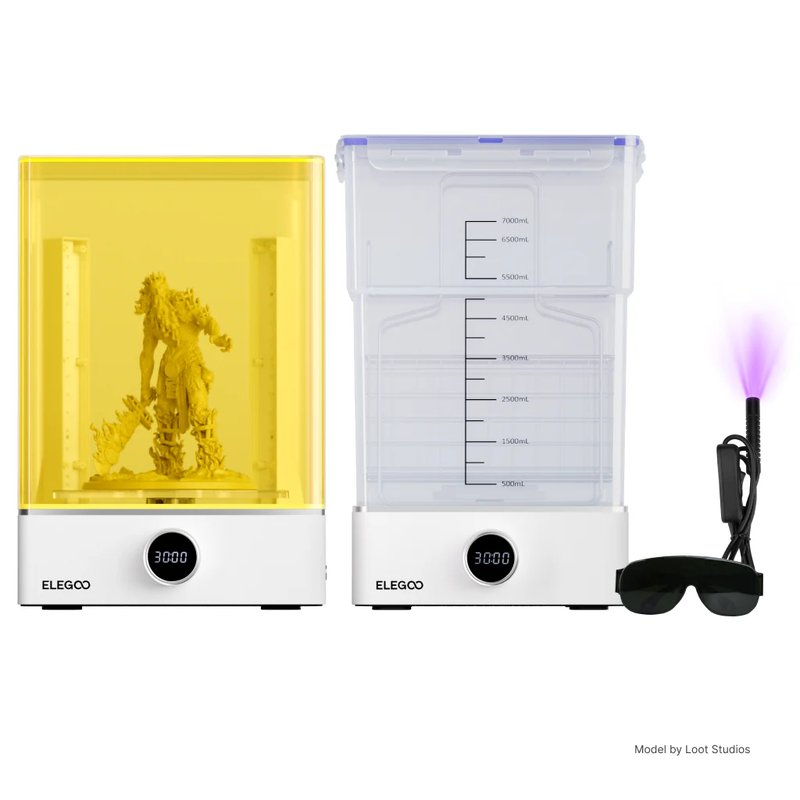
Elegoo Mercury XS Bundle
Elegoo | separate units | up to 10 inch printers
The Mercury XS Bundle is the most popular separate-unit wash and cure setup in the consumer resin printing community and the standard recommendation for Saturn 3 and Mars 5 Ultra users. The 7L sealed wash tank handles Saturn and Mars series build plates directly, with bracket washing allowing the build platform to hang inside the tank without removal. The curing station uses two L-shaped light bars with 14 UV LEDs each, plus four additional LEDs under the rotating turntable, for thorough 360-degree exposure from the side, top, and bottom. The handheld UV lamp included in the XS Bundle is a practical addition that addresses a real limitation of rotary curing stations: models with deep internal cavities, tunnels, or complex overhangs that cast shadow on their own surfaces. The lamp lets you manually target those areas for a full cure. The dual connector power adapter means both units can run from the same power source. One note specific to the Saturn 4 series and Jupiter: the build platform must be removed before washing, unlike smaller Mars series printers which can be washed platform-on.
Best for: Saturn 3 and Mars 5 Ultra users who print regularly and want to wash one batch while curing the previous one, with a handheld lamp for thorough cavity curing.
Also consider
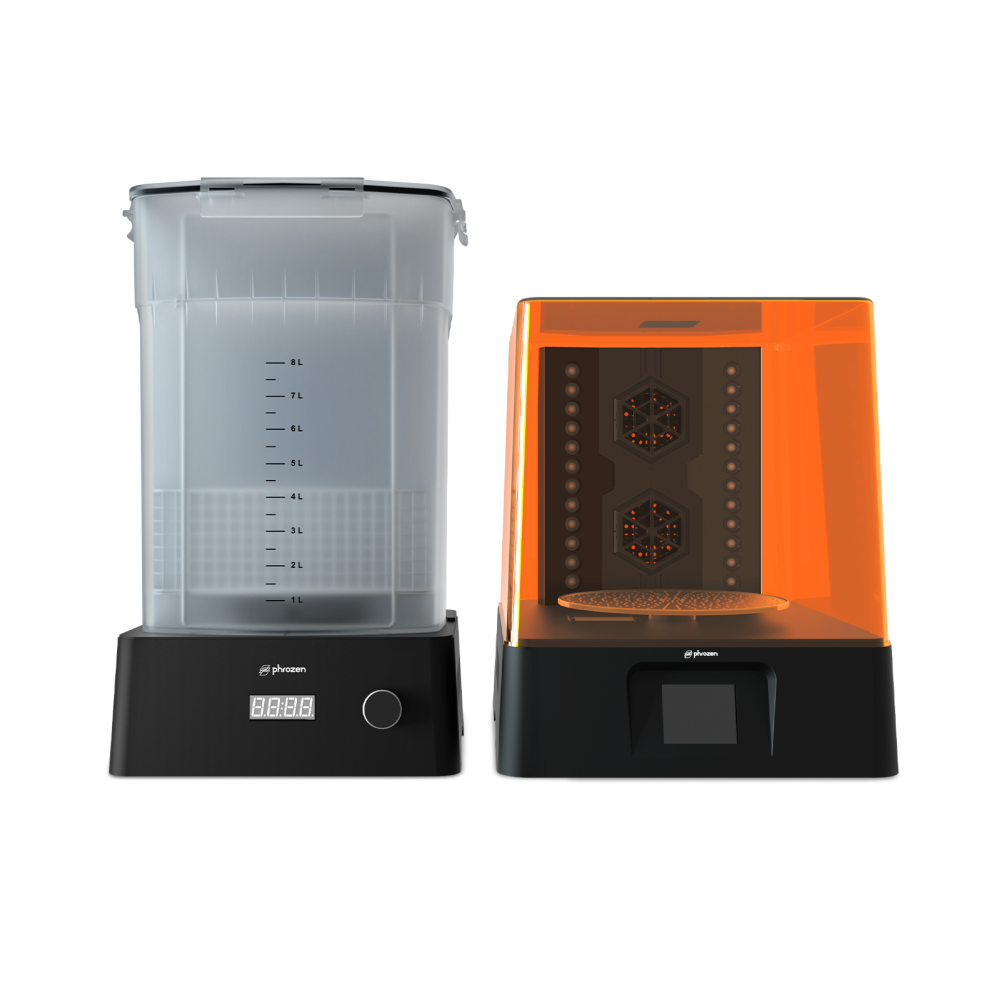
Phrozen Wash and Cure Kit
Phrozen | separate units | up to 10.3 inch printers
The Phrozen Wash and Cure Kit is the stronger alternative to the Mercury XS Bundle for users who prioritise detail precision over raw capacity. Independent side-by-side testing found that the Phrozen washing circulation pattern produces marginally better cleaning results on fine-detail prints with sub-50-micron features, particularly in tight recessed areas where the vortex pattern needs to reach effectively. The 8L wash bucket is slightly larger than the Mercury XS at 7L, and the curing station includes a fan drying mode that the Mercury XS omits: it lets you place a freshly washed, still-wet print directly into the curing station and dry it before UV exposure begins, eliminating the dripping wait time and reducing mess. UV curing uses 405nm LEDs positioned both behind and under the rotating platform, ensuring side and bottom surfaces cure as thoroughly as the top. The kit suits build plates up to 10.3 inches. As with the Mercury XS, the two units run simultaneously. The Phrozen ecosystem match is natural for Sonic Mini 8K and Sonic Mighty 8K users, though it is fully compatible with all 405nm resin printers.
Best for: Miniature painters, dental users, and detail-focused resin printers using Phrozen or similar 8K printers who want a fan drying mode and slightly better wash performance on fine features.
Best 3-in-1 automated station
Standard wash and cure stations require you to handle the print at each stage: remove it from the printer, place it in the wash basket, remove it again after washing, let it drip dry, then transfer it to the curing station. A 3-in-1 automated station compresses all of that into a single sequence. You place the print inside once, set the cycle, and the machine washes, dries, and cures in sequence without intervention. This approach meaningfully reduces resin contact during handling, cuts airborne IPA vapour exposure, and removes the possibility of mishandling a soft, freshly washed print before it cures. The category requires understanding one important constraint: automated stations tend to have smaller cavities than manual ones because the engineering of auto-fill and auto-drain systems takes up internal space.
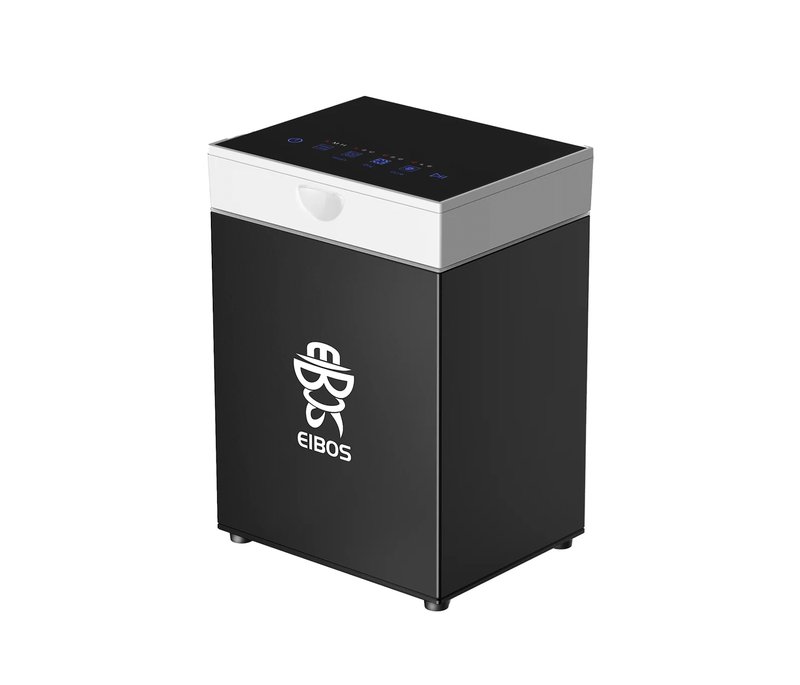
EIBOS Oceanus
EIBOS | 3-in-1 automated | small and mid-size printers
The EIBOS Oceanus is the only consumer 3-in-1 wash, dry, and cure station with a fully automated liquid system. A high-power pump automatically fills the chamber from an external storage bottle before the wash cycle and drains it back after, meaning you never touch the IPA or water-washable solution during the entire post-processing workflow. This is the most significant safety advantage of the Oceanus over every other station in this guide: both direct skin contact and airborne IPA vapour exposure are substantially reduced. The washing motor uses a high-torque impeller rather than a conventional magnetic stirrer, generating more powerful and more directional water flow that reaches areas a brush cannot. The fan-based drying cycle then runs before UV curing begins, ensuring prints are surface-dry before the 96 UV LED array activates for the cure cycle. Three selectable liquid levels (1.3L, 2.2L, and 3L) reduce IPA usage for smaller prints. Safety is comprehensive: water level sensors prevent overflow, the lid automatically pauses the cycle if opened, and all electrical components are housed away from the liquid areas. The Oceanus has one critical constraint that must be stated clearly: its internal cavity is 175 x 125 x 160mm. This limits it to small and mid-size printers with modest build volumes. Prints from a Saturn or Photon Mono M7 will not fit. For its target audience of Mars, Photon Mini, and similarly sized printer users who value hands-off automation, it is an outstanding machine. For larger printers, you need a different station.
Best for: Small and mid-size printer users who want fully automated post-processing with minimal resin and IPA handling, and anyone printing in a shared space or home environment where fume and contact reduction is a priority.
Best large format wash and cure station
Large-format resin printers with build volumes above 10 inches create a specific problem: every standard wash and cure station on the market is too small to fit their full build plate. Users running a Photon Mono M7 Max, Jupiter, Phenom, or similar machine have historically been forced to wash massive prints in improvised Tupperware containers and cure them under DIY UV setups. Dedicated large-format stations are the answer, but they are large, heavy, expensive, and require dedicated bench space. If you are committing to a large-format printer, budgeting for a proper post-processing station is not optional.
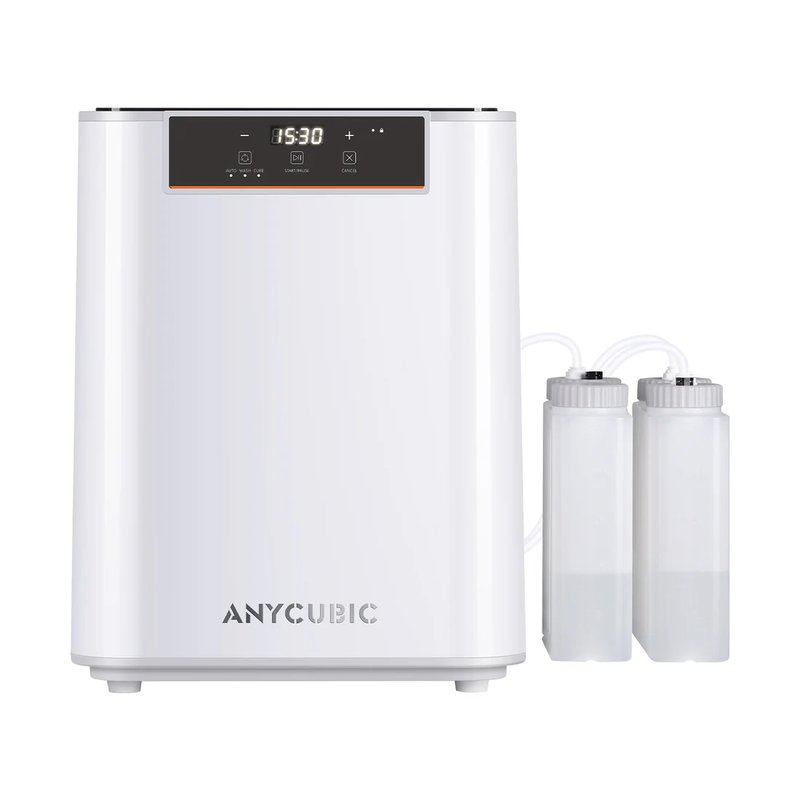
Anycubic Wash and Cure Max 3.0
Anycubic | 2-in-1 | up to 13.6 inch printers
The Wash and Cure Max 3.0 is the only consumer station purpose-built for large-format resin printers with build volumes up to 13.6 inches. Its 15.1L liquid volume is a 98.5% increase over the Wash and Cure 3 Plus, and the wash basket accommodates prints up to 305 x 165 x 300mm. The machine uses spray rinsing rather than pure immersion: active spray nozzles circulate solvent across the model surface and clean the basket bottom, which improves coverage on complex prints and reduces IPA consumption by approximately 50% compared to full-immersion stations. The curing system delivers 25,000 uW/cm² irradiance. Build quality is deliberately industrial: thick ABS plastic with metal reinforcement at stress points, a double-seal lid that prevents both IPA evaporation and UV leakage, and a UV safety interlock that cuts power immediately if the lid opens mid-cure. At approximately 19kg it requires a permanent dedicated spot on a workbench. The honest trade-off is well documented: hollow models and prints with internal voids need pre-washing of the interior before the machine cycle, as spray rinsing cannot effectively reach sealed internal spaces. For solid and semi-solid large-format prints it is excellent; for hollow terrain and figurines with no drainage holes, manual pre-treatment is required first.
Best for: Owners of large-format resin printers including the Photon Mono M7 Max, Jupiter, and Phenom who need a station that fits their full build volume without compromise.
Also consider
Creality UW-03
Creality | 2-in-1 | up to 10.3 inch printers
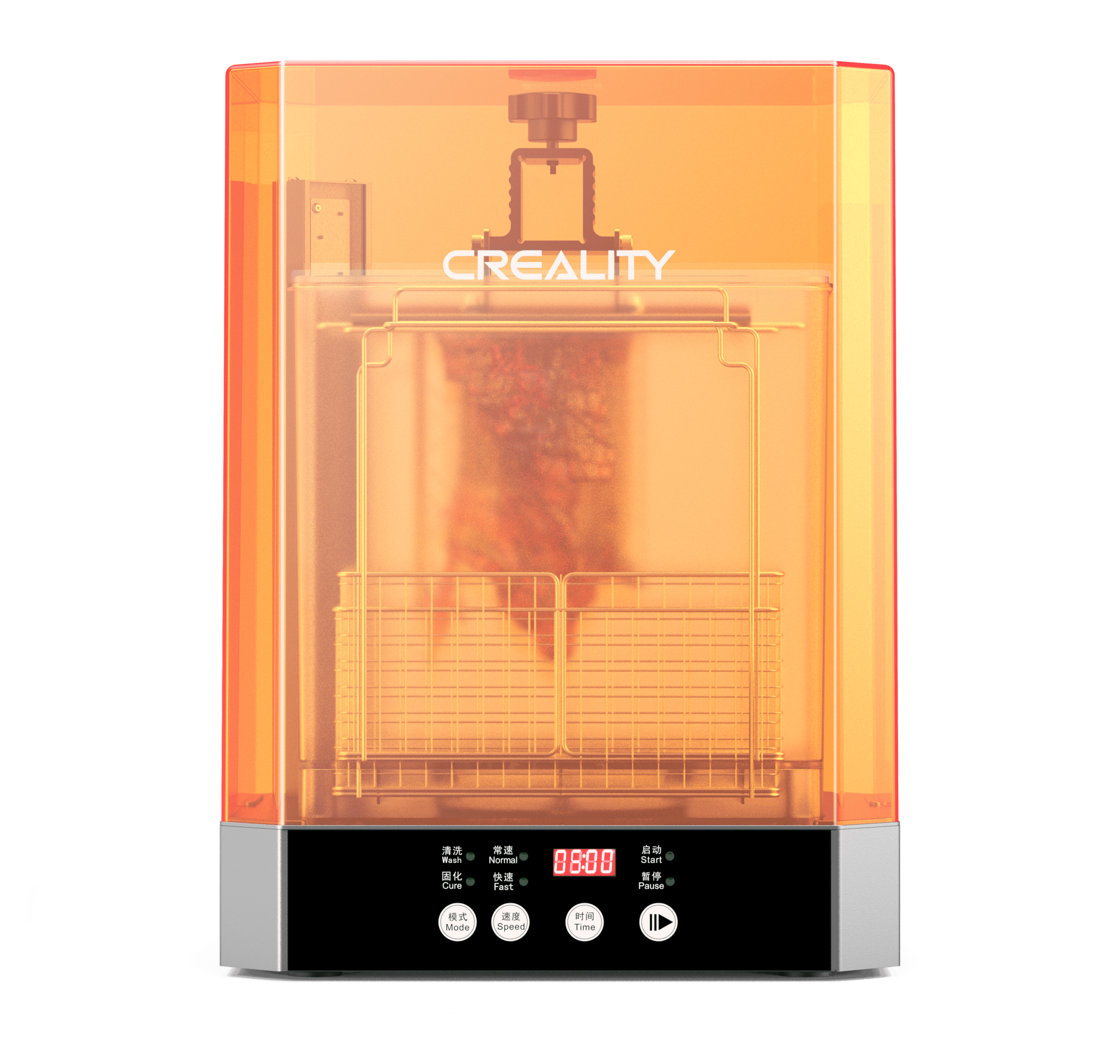
The UW-03 is Creality’s mid-to-large format station, occupying a useful space between the standard 2-in-1 and the Max 3.0 for users whose printers are in the 8.9 to 10.3 inch range. Its 8L wash tank handles prints up to 256 x 180 x 155mm, and the 500 RPM magnetic vortex propeller generates 31% higher water speed than its predecessor for more aggressive resin removal. The cure chamber is notably larger than its tank suggests, at 220 x 220 x 260mm, with 20 x 405nm UV LEDs on a 360-degree rotating square turntable. The square turntable design is a practical advantage over round platforms: it has raised edges that prevent prints from being swept off during the wash cycle, and the flat surface gives better stability for prints with wide bases. Physical tactile buttons rather than a touchscreen is a deliberate choice that provides better reliability in resin-contaminated workshop environments where finger moisture or IPA residue can confuse capacitive panels. The UW-03 will not fit the very largest-format printers that the Max 3.0 handles, but it is a well-engineered mid-range option for the significant user base between standard and large format.
Best for: Users with printers in the 8.9 to 10.3 inch range who want a larger cure chamber than a standard 2-in-1 provides, without the size and cost of the Max 3.0.
Best professional wash and cure station
Professional post-processing requirements are fundamentally different from hobbyist ones. Dental labs must meet regulatory standards for biocompatible resin curing. Engineering teams need validated, repeatable cure cycles for functional prototype materials. Production studios need reliable automated workflows that run unattended across multiple printers without intervention. Consumer stations can approximate these needs but cannot meet them reliably. The professional category is defined by validated presets, documented material traceability, and engineering depth that consumer stations simply do not provide.
Formlabs Form Wash V2 and Form Cure V2
Formlabs | separate professional | Form ecosystem
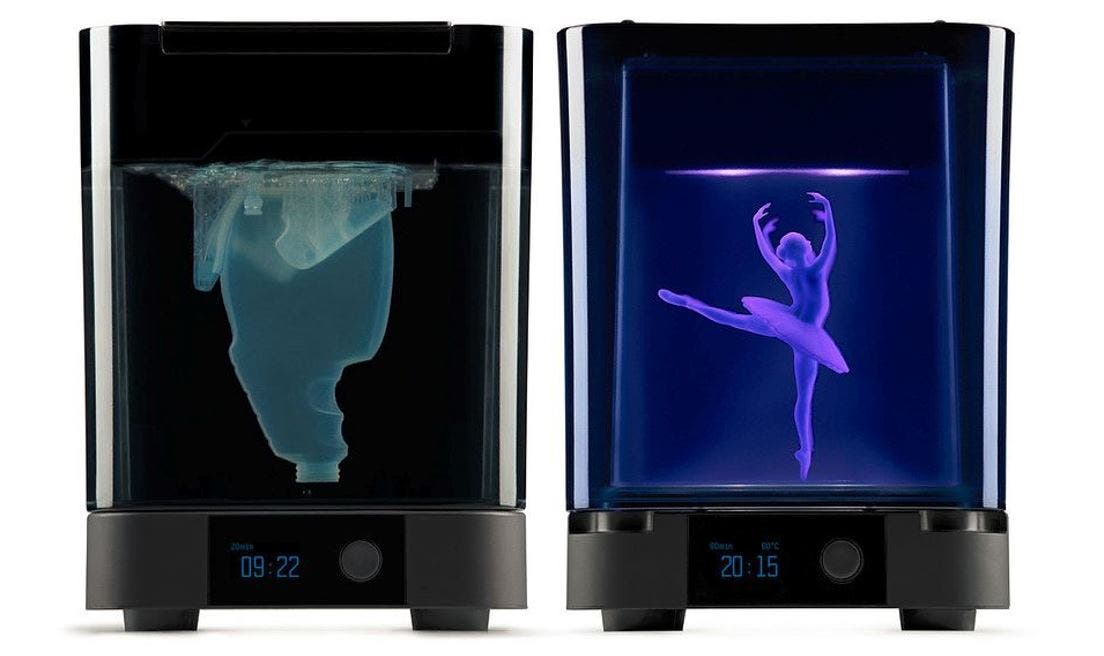
The Formlabs Form Wash and Form Cure are the professional standard for SLA post-processing and the only consumer-accessible system with validated presets for over 45 individual materials. The Form Wash V2 provides powerful agitation in an IPA bath with a preset timer, and critically includes an automatic lift mechanism: when the cycle completes, the basket rises out of the solvent and holds position to air-dry, preventing over-soaking which causes warping. An embedded solvent monitor tracks IPA quality and alerts you when the solvent needs replacing, removing guesswork from a variable that directly affects part quality. The Form Cure V2 combines heat and UV in a way consumer stations do not. Its 48-LED array delivers 14.5 mW/cm² irradiance, which is the relevant professional metric for ensuring complete photo-initiator conversion rather than surface hardness alone. Maximum chamber temperature reaches 100°C, enabling proper post-curing of engineering and high-temperature resins that require thermal activation alongside UV. Curing cycles for standard resins complete in as little as 60 seconds. The system is deeply integrated with Formlabs’ PreForm software, which automatically assigns validated cure parameters when you select a material. For biocompatible applications, this validated material traceability is not optional: regulatory bodies require documented post-curing evidence for dental and medical devices. The Form Wash and Form Cure are sold separately and are priced accordingly as professional equipment. They are not the right choice for hobbyists, and they are not designed to compete with consumer stations on value. For the specific professional use cases they address, nothing else in the consumer market comes close.
Best for: Dental labs, engineering teams, and professional studios using the Formlabs Form 4 or Form 3 series who need validated cure cycles, material traceability, and reliable automated post-processing for biocompatible or engineering resins.
How to choose a wash and cure station
Match the station to your printer size before anything else
The most important specification is the maximum wash size, which must be large enough to fit your printer’s full build plate. Check the wash basket dimensions, not the total bucket volume, because only the basket area is usable for holding prints. A station sold as 7L total may have a basket that only fits printers up to 7.3 inches. When in doubt, measure your build plate and check the maximum wash size in the station’s spec sheet before purchasing.
2-in-1 versus separate units versus 3-in-1
A 2-in-1 station converts between wash and cure mode on the same base, requiring you to swap the turntable insert. This is the right choice for most casual and intermediate users. Separate units allow washing and curing to run simultaneously on different batches, which is meaningful if you print frequently or run multiple printers. A 3-in-1 automated station handles washing, drying, and curing in sequence without your intervention, which is best for users who want minimum resin handling but comes with a smaller cavity. Do not choose a 3-in-1 if your printer produces prints that are larger than the Oceanus cavity of 175 x 125 x 160mm.
Why drying before curing matters
Placing a wet, freshly washed print directly into a UV curing station without drying first causes surface defects. IPA or water sitting on the surface during UV exposure can scatter the light unevenly, leaving tacky patches or creating a slightly cloudy surface finish on transparent resins. The standard process is to let prints air dry for a few minutes after washing, or use a fan. Stations that include a fan drying mode, such as the Phrozen Wash and Cure Kit, handle this step automatically and eliminate the wait.
IPA concentration and replacement frequency
For washing standard resins, use isopropyl alcohol at 90% concentration or above. Lower concentrations contain too much water to effectively dissolve uncured photopolymer. IPA becomes visibly amber and cloudy as it accumulates dissolved resin. For moderate users, plan to replace it approximately every 30 models or when it noticeably darkens. Spent IPA should be left uncovered in sunlight for several hours to cure the suspended resin particles before disposal. Never pour uncured resin-contaminated IPA down a drain. Water-washable resins use water instead of IPA but follow the same degradation pattern: replace when it becomes visibly milky and no longer produces clean surface results.
UV wavelength and curing completeness
Virtually all consumer MSLA, DLP, and SLA resins cure at 405nm. Every station in this guide uses 405nm UV LEDs. What varies is the irradiance, which is how much UV energy reaches the print surface per unit of time. Higher irradiance means faster curing and more thorough cross-linking deep in the model. Consumer stations typically describe their curing quality in relative terms, while professional stations like the Formlabs Form Cure quote specific mW/cm² figures. For most consumer resins, any 405nm station in this guide will produce a fully cured print within the recommended time. The Formlabs Form Cure V2 at 14.5 mW/cm² is in a different class and is relevant specifically when working with engineering resins that require both UV and heat to reach their rated mechanical properties.
Wash and cure station comparison
| Station | Type | Wash capacity | Max printer size | Best for |
|---|---|---|---|---|
| Anycubic Wash and Cure 3 | 2-in-1 | 3L basket, 4L total | Up to 7.3 in | Budget, small format printers |
| Elegoo Mercury Plus V2.0 | 2-in-1 | 3.5L | Up to 7.3 in | Entry level, Mars series |
| Elegoo Mercury Plus V3.0 | 2-in-1 | 7.5L | Up to 10 in | Best overall value, Saturn and Mars |
| Anycubic Wash and Cure 3 Plus | 2-in-1 | 7.6L basket, 12L total | Up to 10.6 in | Batch curing, Photon M5s and M7 |
| Elegoo Mercury XS Bundle | Separate | 7L | Up to 10 in | High output, simultaneous processing |
| Phrozen Wash and Cure Kit | Separate | 8L | Up to 10.3 in | Miniatures, detail work, fan drying |
| EIBOS Oceanus | 3-in-1 auto | 3L max | Small and mid-size | Hands-off automation, minimal handling |
| Creality UW-03 | 2-in-1 | 8L | Up to 10.3 in | Mid-large format, Halot series |
| Anycubic Wash and Cure Max 3.0 | 2-in-1 | 15.1L | Up to 13.6 in | Jupiter, M7 Max, large-format printers |
| Formlabs Form Wash V2 + Form Cure V2 | Separate pro | Full Form 4 platform | Form ecosystem | Dental, engineering, validated workflows |
Frequently asked questions
Where to go next
A wash and cure station is one part of a resin setup. If you are still choosing a printer, start with our best resin 3D printers guide, and if you are weighing resin against filament see FDM vs resin 3D printing. Resin and IPA give off fumes, so read our 3D printing safety guide on ventilation and handling, and consider an enclosure from our 3D printer enclosure guide to contain them.