
Researchers have developed a 3D-printed scaffold that reprograms immune cells to repair bone damaged by steroid-induced osteonecrosis of the femoral head (SONFH), a condition that affects up to 40% of patients receiving prolonged high-dose glucocorticoid therapy. The study was published June 30, 2026, in Volume 14 of the journal Bone Research.
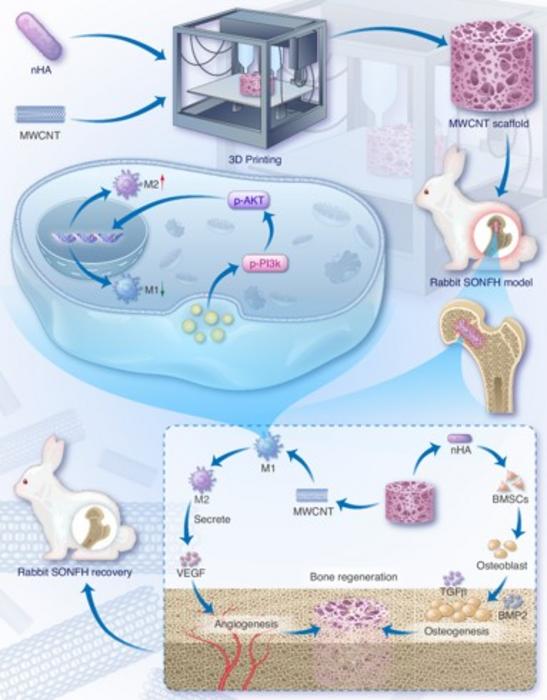
The scaffold is modeled on coral’s hierarchical pore structure and combines multi-walled carbon nanotubes (MWCNT) with nano-hydroxyapatite (nHA). MWCNT pushes macrophages from a pro-inflammatory M1 state into a tissue-repairing M2 state, breaking what the researchers call an “immune freeze.” The nHA component provides a biomimetic mineral matrix that supports bone-forming cell attachment, growth, and differentiation.
That immune shift is what makes the approach distinct. Standard core decompression surgery, the current treatment for early-stage SONFH, offers structural relief but can’t overcome the persistent inflammation that blocks new bone from forming. “Current treatments mainly provide structural support but do not address the pathological immune microenvironment that prevents bone regeneration. Our coral-inspired immunoreprogramming strategy provides a new approach for targeting this microenvironment and promoting bone repair,” said Dr. Yan Xiong, from the Department of Orthopaedics at Army Medical University (Third Military Medical University) in China.
In both cell-based experiments and rabbit models of SONFH, the scaffold shifted macrophages toward the M2 state, reduced inflammatory responses, and promoted migration and osteogenic differentiation of bone marrow mesenchymal stem cells. It also enhanced angiogenesis, the formation of new blood vessels that deliver oxygen and nutrients to regenerating tissue. Compared with conventional scaffolds, the coral-inspired version produced better new bone formation and reconstruction of bone defects in the animal model.
Further analysis tied the results to activation of the PI3K-AKT signaling pathway, which governs several cellular processes involved in tissue repair. “The coral-inspired immunoreprogramming technique proposed in this study provides a new strategy for targeting the regulation of the pathological microenvironment in SONFH. Although further studies are needed before clinical application, our findings provide a foundation for developing regenerative therapies that improve bone repair by restoring a pro-regenerative immune environment,” said Dr. Meng Tian from the Department of Neurosurgery and Neurosurgery Research Laboratory at Sichuan University.
Source: eurekalert.org