
The best professional 3D scanners in 2026 sit a clear tier above the consumer devices on our other pages, and the difference shows up first in the light source. Where consumer scanners lean on infrared structured light, professional scanners use industrial blue laser (and increasingly hybrid laser plus structured light) to capture dark, reflective, and metallic surfaces accurately without scanning spray. You also gain metrology-grade volumetric accuracy, multi-mode scanning, marker-free tracking, and in the newest models fully standalone hardware that needs no PC at all. These tools are built for engineers, product designers, quality-control and metrology teams, reverse-engineering work, and serious prosumers who have outgrown a consumer scanner.
Independently researched. 14 years of 3D printing and 3D scanning coverage at 3DPrinting.com, including hands-on reviews across the consumer and prosumer tiers. Some of the links on this page are affiliate links, and we never recommend a scanner we would not buy ourselves. Prices shown are approximate (the ~$ figure) where available, researched on 2026-05-28; pro and industrial scanners are often sold by quote, and all prices vary by bundle, sale period, and region. Click through to the manufacturer for current pricing.
Our top picks
The fast answer by job. Tap a card for the full breakdown below.
What counts as “professional”, and which do you need?
- Accuracy: prosumer pro lands around 0.02mm to 0.05mm; true metrology reaches 0.02mm and below with certified volumetric accuracy.
- Light source: blue laser handles dark and shiny surfaces without spray; structured light is fast on feature-rich shapes; hybrids do both.
- Marker-free vs targets: most modern handhelds track marker-free; the highest-accuracy metrology systems often still use positioning targets.
- Standalone vs PC: onboard-computing scanners free you from a laptop in the field; PC-dependent models need a real workstation.
- Software: for reverse engineering and inspection, the scan-to-CAD and QC toolset matters as much as the hardware.
How to read 3D scanner accuracy specs
Accuracy numbers are the most misread part of any scanner spec sheet, and two figures matter that are not the same thing. Point accuracy (often labelled just “accuracy”) is how precise a single close-up measurement is, the small headline number, typically 0.02mm to 0.1mm here. Volumetric accuracy, written as a base figure plus an error that grows with size (for example 0.02mm + 0.04mm/m), is what actually governs results on anything larger than a breadbox, and it is the number metrology buyers should weigh most.
Just as important, a “0.02mm” claim from one brand is not directly comparable to another unless both are verified to the same standard. Reputable metrology scanners publish accuracy certified to ISO 10360 or VDI/VDE 2634 and ship with a traceable calibration certificate; many consumer-pro scanners quote a best-case lab figure with no standard attached. If certified accuracy matters for your work (regulated QC, aerospace, automotive sign-off), treat an uncertified number as marketing rather than metrology.
Revopoint
Revopoint’s professional line steps up from its popular consumer range with industrial blue laser technology, multi-mode scanning, and metrology-grade accuracy at prices well below the traditional pro tier. The MetroX Pro and MetroY Pro are PC-connected workhorses for engineers and QC professionals, while the Trackit adds a full optical tracking system for truly marker-free scanning of objects from a coin up to a full vehicle. The new Trackit SR, launched July 2026, packages the same optical tracking fully wireless, with three laser modes and on-site CMM accuracy verification; see the card below. The MetroY Ultra tops the line as Revopoint’s certified-metrology option, with a CMM edition that brings traceable, on-site accuracy verification at a fraction of the usual cost.
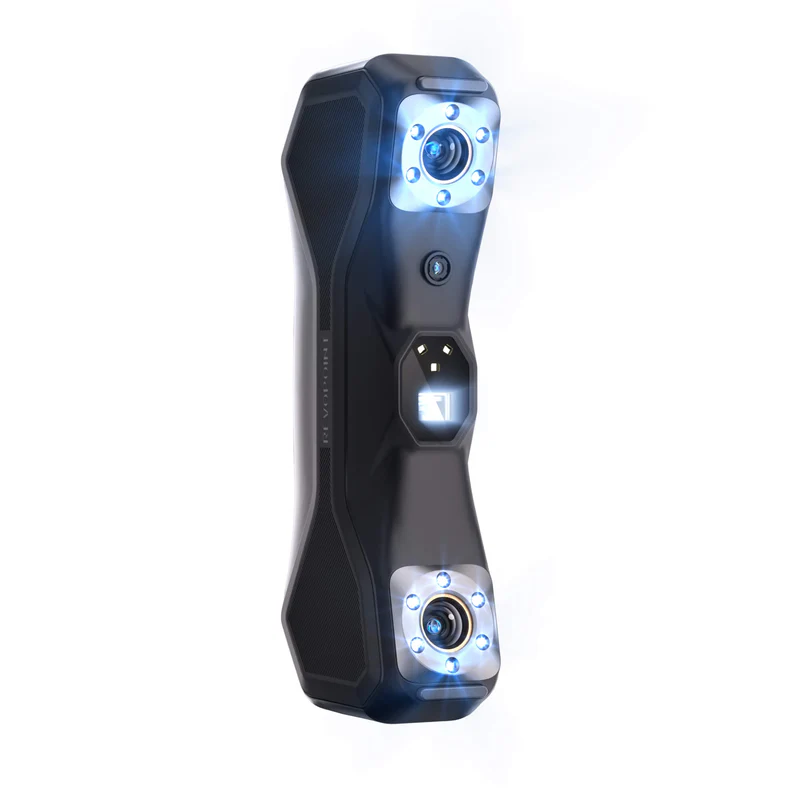
Revopoint MetroX Pro
Best for: quality control, reverse engineering, small-to-medium industrial workpieces, additive-manufacturing verification. The MetroX Pro brings 20% tighter volumetric accuracy and far faster speeds than the MetroX, combining 30-line and 15-line blue laser modes for dark and reflective surfaces without spray, plus a 62-line structured-light mode at up to 7M points per second. Free Revo Metro software covers capture, point-cloud editing, mesh export, and scan-to-CAD via Revo Design and Revo Measure.
Price: ~$1,209 (approximate; varies by bundle, sale period and region, click through for current pricing)
- Accuracy 0.02mm; volumetric 0.02mm + 0.04mm/m
- 4 scan modes (blue laser + structured light), up to 7M pts/s
- No spray on all laser modes; HD RGB color in turntable mode
- PC streaming to phone/tablet via Revo Mirror
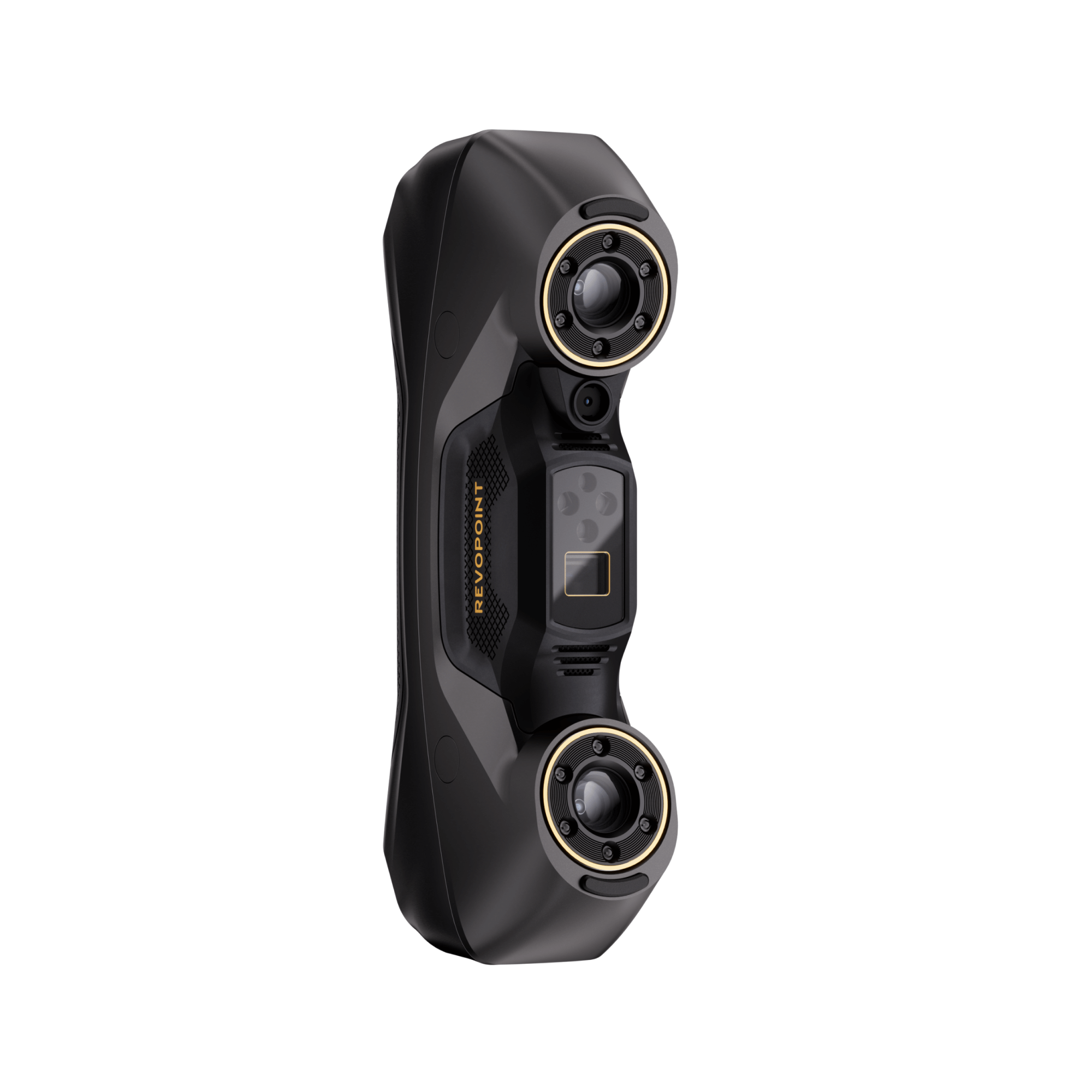
Revopoint MetroY Pro
Best for: industrial inspection, precision reverse engineering, deep holes and grooves, scan-to-CAD. Revopoint’s most capable wireless blue laser scanner adds full-field structured light and auto-turntable modes for five modes total: cross-line for speed, parallel-line for fine edges, single-line for deep crevices, and structured light at up to 7M pts/s. Wi-Fi 6 enables fully wireless scanning with Revo Mirror streaming, and temperature sensors guard against drift on long sessions.
Price: ~$1,759 (approximate; varies by bundle, sale period and region, click through for current pricing)
- Accuracy 0.02mm; volumetric 0.02mm + 0.04mm/m
- 5 scan modes; object size 10mm to 1m
- Wi-Fi 6 / USB-C; HD RGB color; Revopoint Robot compatible
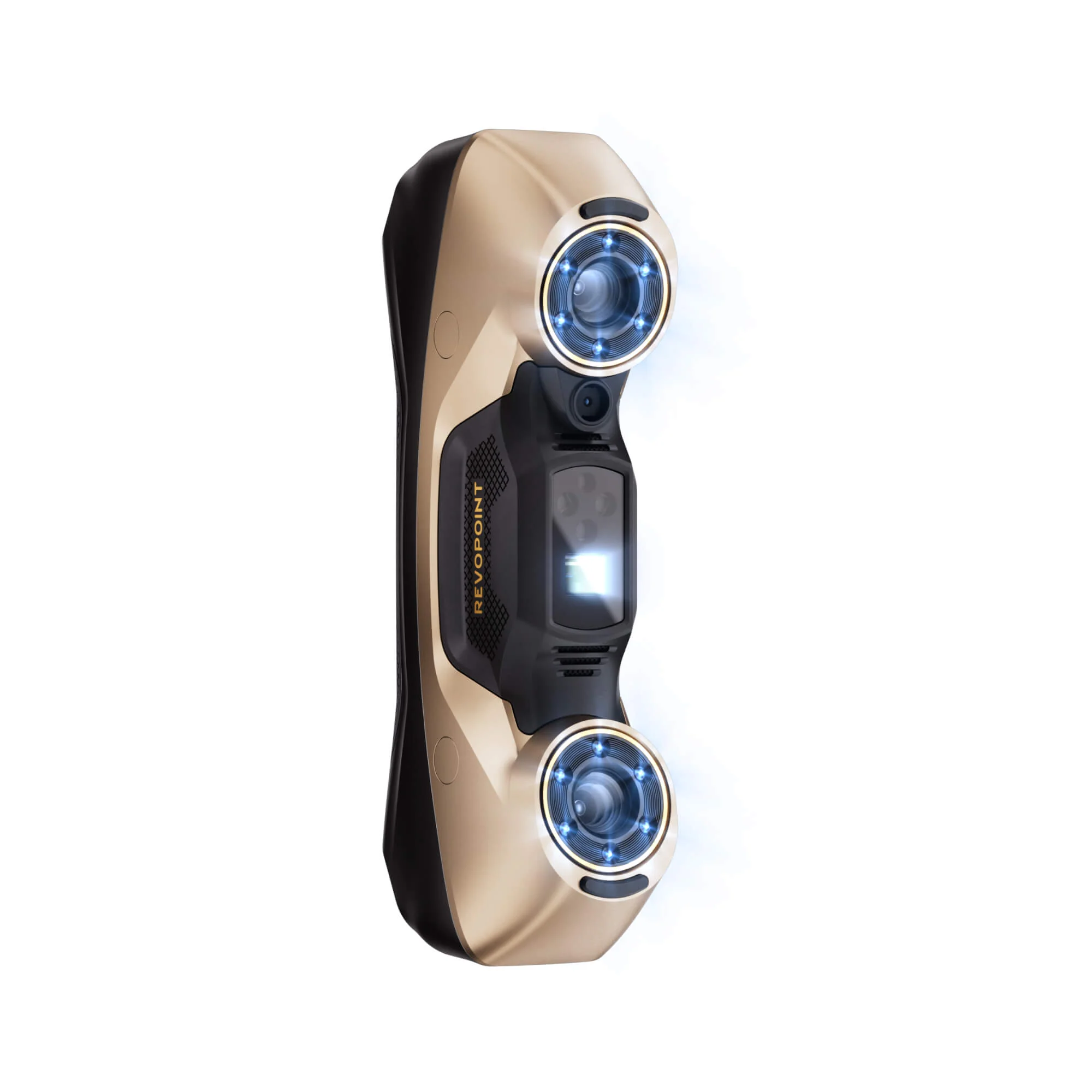
Revopoint MetroY Ultra
Best for: certified inspection, GD&T, reverse engineering, and design validation at a price the metrology tier has rarely seen. The Ultra is the top of the MetroY line, with the highest accuracy in the range and five blue-light modes (34 crossed, 15 parallel, and single laser lines, plus auto turntable and structured light) at up to 7M points per second and 90fps. Wi-Fi 6 keeps it fully wireless, and it works outdoors up to 100,000 lux. The CMM Edition is the standout: real-time on-site accuracy verification using a certified carbon-fiber ball plate, plus Revo Measure, a PTB-certified GD&T analysis platform, bringing traceable metrology for a fraction of the usual cost.
Price: ~$1,899 (approximate; varies by bundle, sale period and region, click through for current pricing)
- Volumetric accuracy 0.015mm + 0.04mm/m (best in the MetroY line)
- 5 blue-light scan modes; up to 7M pts/s; 90fps; outdoor to 100,000 lux
- Wi-Fi 6 wireless; HD color
- CMM Edition: certified ball plate + Revo Measure (PTB-certified GD&T)
- From ~$1,899 (Standard); ~$2,499 (CMM Edition)
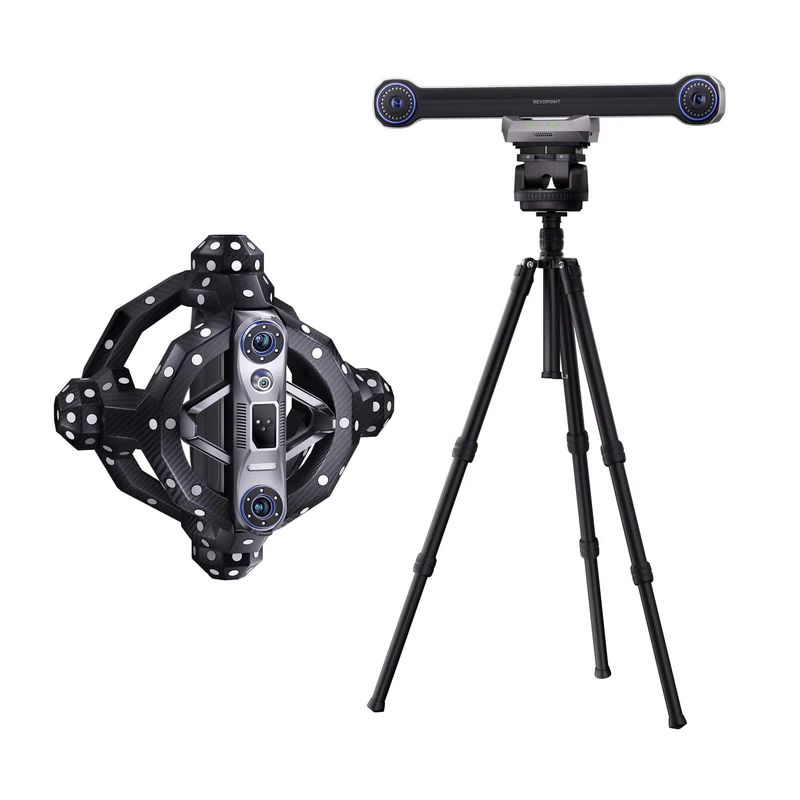
Revopoint Trackit
Best for: large-object scanning without markers, automotive and machinery inspection, production lines. The Trackit is the only scanner here with optical tracking, a technology previously confined to systems costing $60,000 or more. A dual-camera base station tracks the scanner in real time, eliminating physical markers entirely, and can be leapfrogged around large objects with anchor blocks. It covers a 10mm coin up to a 6m vehicle. The PC requirement is real: an RTX 3060 (8GB) and 32GB RAM are the minimum.
Price: ~$4,980 (approximate; varies by bundle, sale period and region, click through for current pricing)
- Scanner accuracy 0.02mm; volumetric 0.02mm + 0.04mm/m
- Object range 10mm to 6,000mm; marker-free optical tracking
- Auto-calibrating dual-axis gimbal; Revopoint Robot compatible
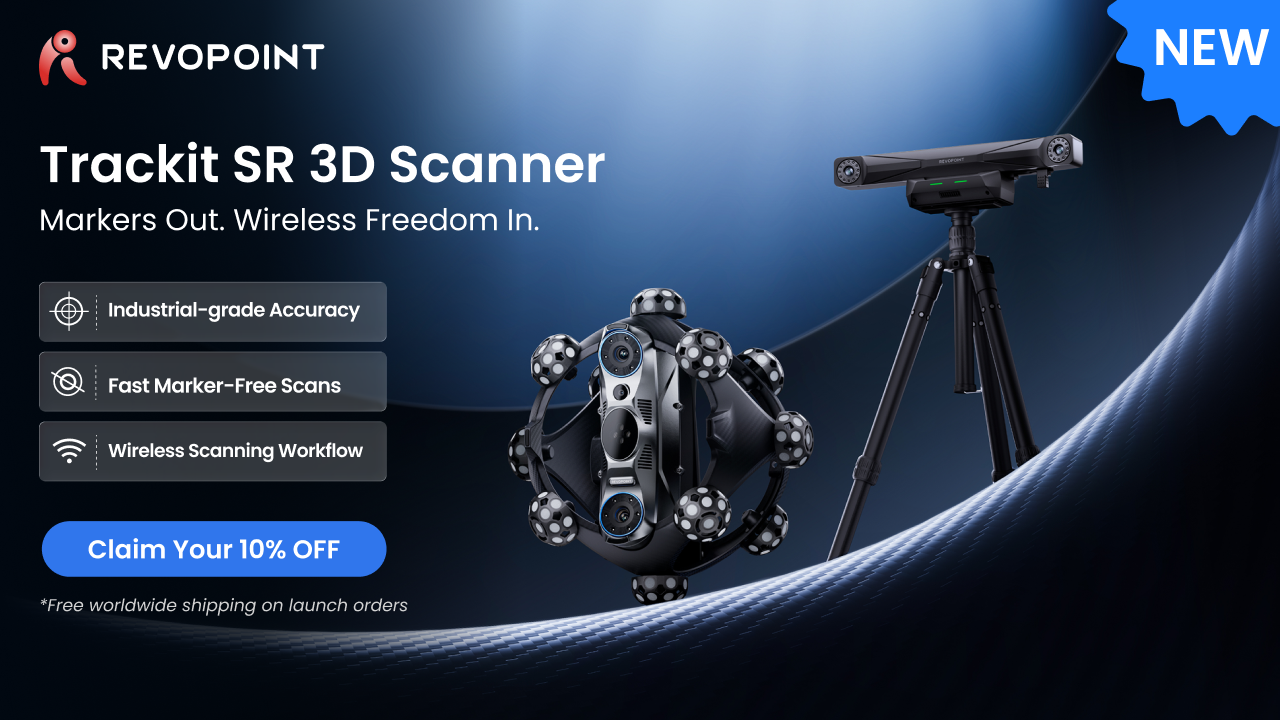
Revopoint Trackit SR
Best for: marker-free metrology that has to leave the bench. The Trackit SR takes the Trackit formula fully wireless: scanner and Tracker both connect over Wi-Fi 6, the built-in battery runs about 2.5 hours, and carbon fiber construction keeps handheld sessions comfortable. Three laser modes (30 cross-line, 17 parallel-line for range, single-line for deep holes) capture dark, reflective, and metallic surfaces without spray or markers, and the CMM Edition adds a certified ball plate for on-site accuracy verification. It works in ambient light up to 100,000 lux, so shop floor and field work are both in play.
Price: ~$3,699 (approximate; varies by bundle, sale period and region, click through for current pricing)
- Single-frame accuracy up to 0.02mm; volumetric 0.025mm + 0.04mm/m
- Objects 0.01 to 4m; marker-free optical tracking, fully wireless (Wi-Fi 6)
- Up to 2M pts/s; 100,000 lux; on-site CMM verification (CMM Edition)
Shining3D / Einstar
Shining3D is the professional-grade parent behind the consumer Einstar brand, with decades of metrology and industrial scanning behind it. The Rockit is its wireless prosumer flagship, the EinScan Rigil pair (regular and Lite) gives you a standalone tri-mode workflow at two price points, and the FreeScan line is the certified metrology tier that competes with the industrial names lower on this page.
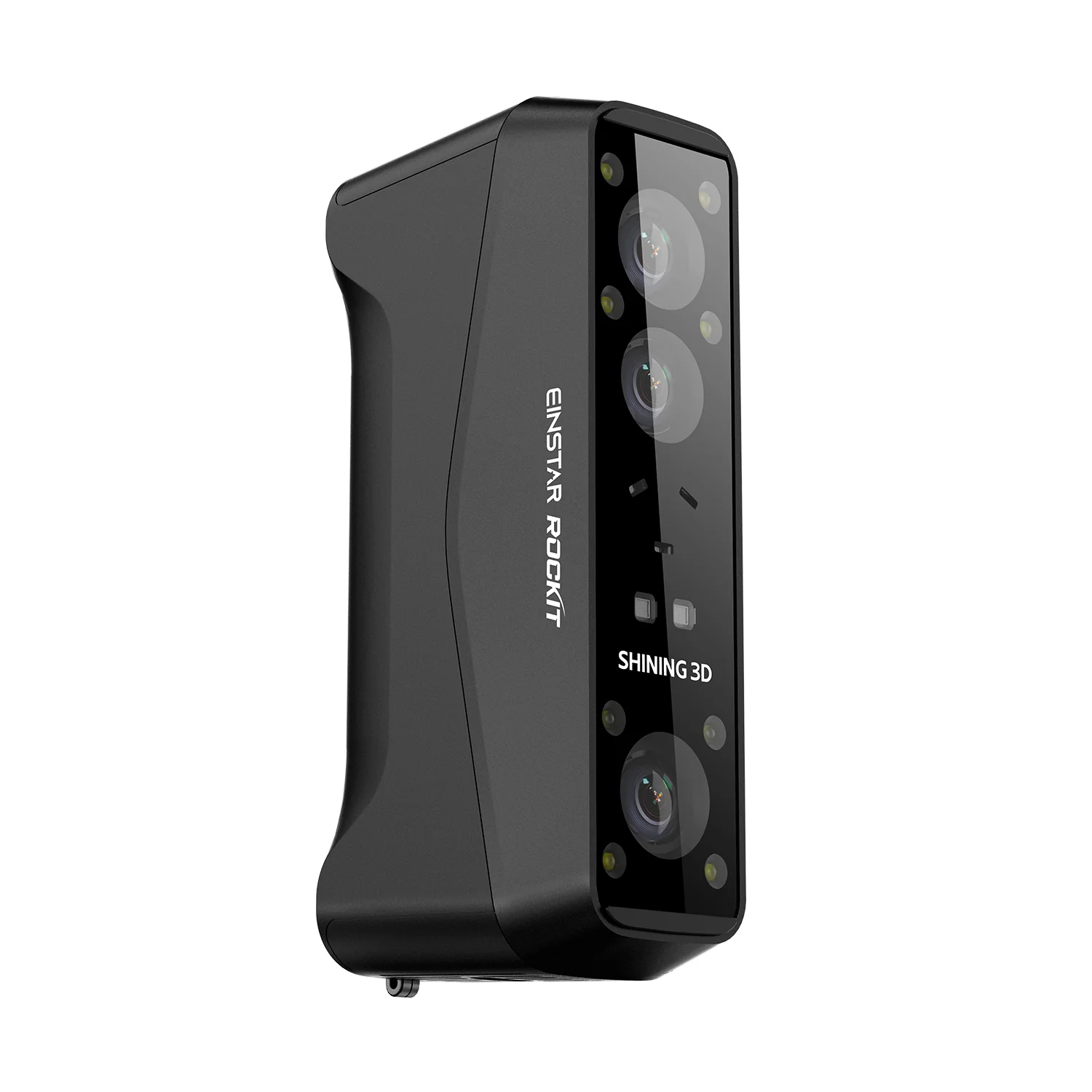
Einstar Rockit
Best for: automotive parts, product design, outdoor and bright environments, dark or reflective surfaces. Einstar’s professional entry point adds marker-free laser scanning and a 38-line blue laser array. Dual light sources handle any scenario: blue laser for complex, dark, or shiny surfaces without spray, and IR VCSEL for fast large-area capture. Fully wireless with two swappable 3-hour batteries, rated to 110,000 lux in laser mode. Needs a capable PC (RTX 3060, 32GB DDR5 minimum).
Price: ~$1,999 (approximate; varies by bundle, sale period and region, click through for current pricing)
- HD resolution 0.05mm; up to 90fps
- Blue laser (38 lines) + IR VCSEL; marker-free in laser mode
- Wireless, dual battery; object sizes 5mm to 10m
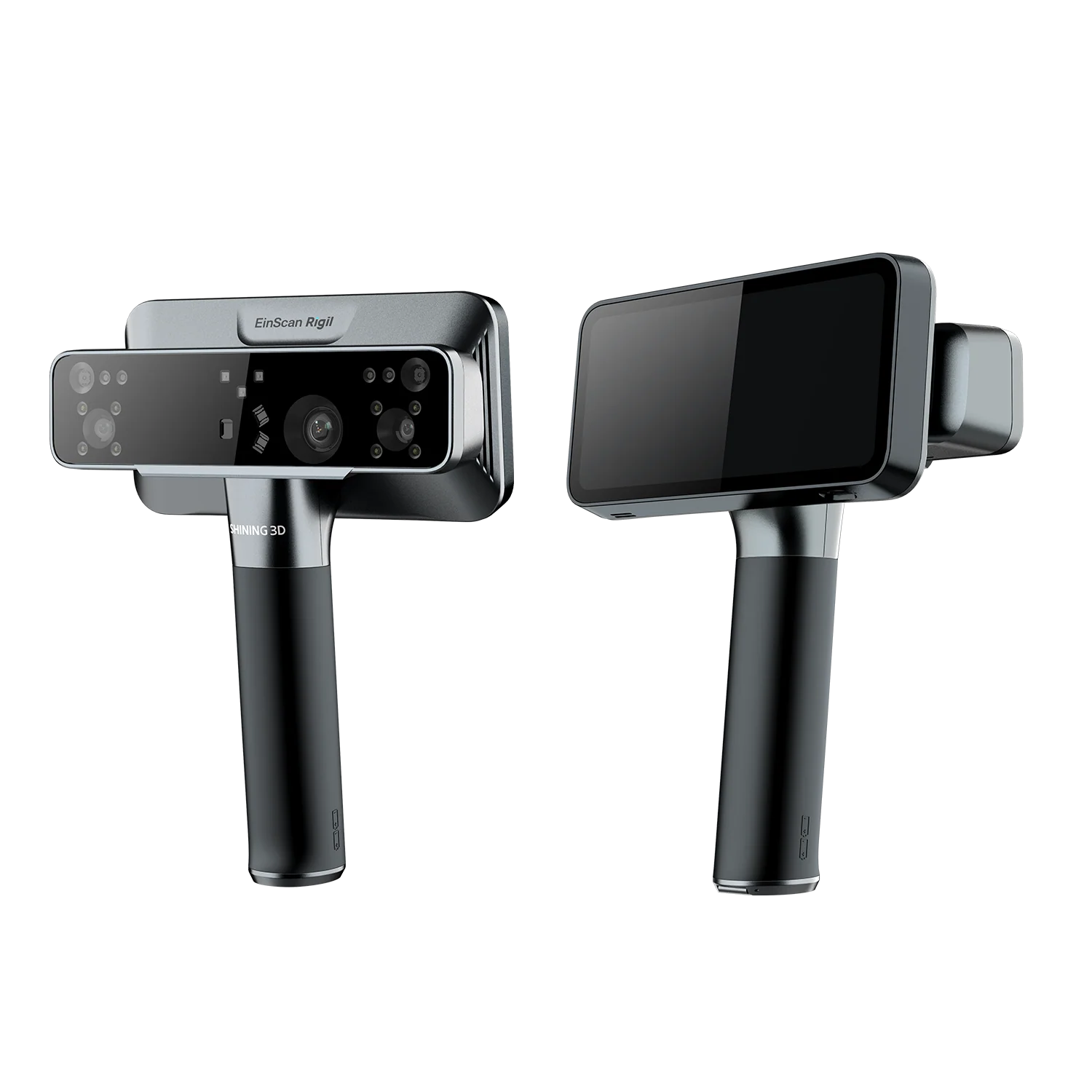
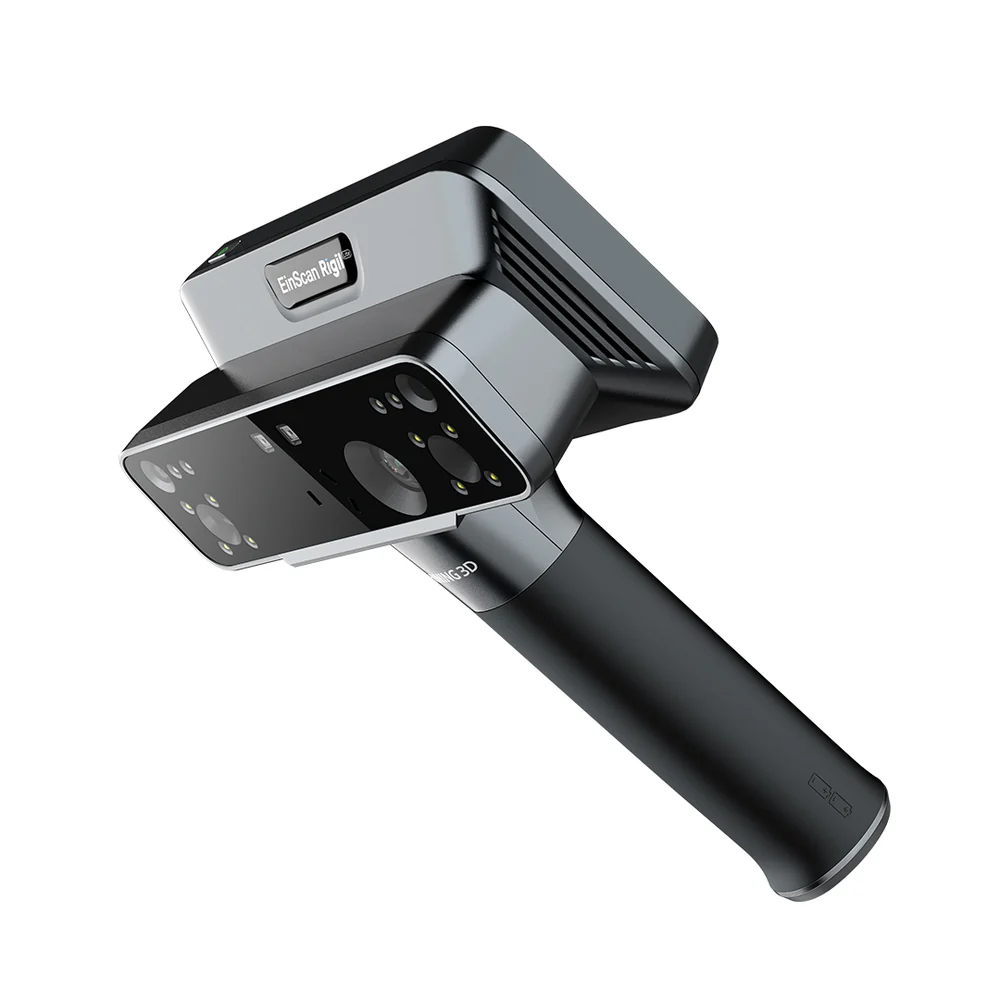
EinScan Rigil
Best for: automotive bodywork, field scanning, standalone on-site work with no PC. The first tri-mode scanner to ship with full onboard computing: a 2.4GHz processor, 32GB DDR5, 1TB SSD, and a 6.4-inch AMOLED touchscreen are built in, so you scan, process, edit, and export on-site. Three technologies cover everything: crossed blue laser for dark and reflective surfaces, parallel laser for fine detail, and IR VCSEL for large-area capture, with a hybrid mode for marker-free scanning. Wireless PC mode is available for heavier post-processing.
Price: ~$4,999 (approximate; varies by bundle, sale period and region, click through for current pricing)
- Accuracy 0.04mm; volumetric 0.04mm + 0.06mm/m
- Tri-mode (laser + IR VCSEL); marker-free hybrid mode
- Fully standalone: 32GB DDR5 + 1TB SSD + 6.4″ AMOLED
EinScan Rigil Lite
Best for: the standalone all-in-one workflow at a lower entry price than the full Rigil. The Rigil Lite keeps the integrated touchscreen, onboard processing, and dual battery setup, but trims the spec sheet: 17 + 17 crossed blue laser lines (vs 25 + 25 on the Rigil), 24GB DDR5 and 512GB SSD (vs 32GB and 1TB), and a 0.05mm laser HD resolution. Three modes are kept: standalone, wireless PC, and wired PC. A 32GB / 1TB Limited Edition Hardware step-up version is offered at ~$4,199.
Price: ~$3,499 (approximate; varies by bundle, sale period and region, click through for current pricing)
- Laser HD resolution 0.05mm; IR Rapid up to 16M pts/s
- 17+17 crossed blue laser + 7 parallel + IR VCSEL; marker-free hybrid
- Fully standalone: 24GB DDR5, 512GB SSD, 6.4-inch 2K AMOLED touchscreen
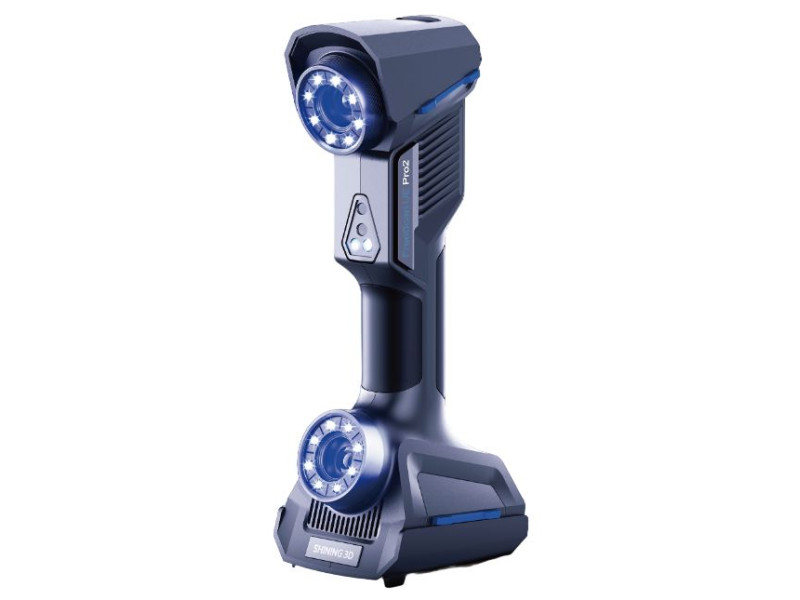
Shining3D FreeScan UE Pro2
Best for: certified industrial metrology, inspection, and reverse engineering where 0.02mm accuracy and traceability matter. The FreeScan UE Pro2 (the 2024 successor to the UE Pro) is a sub-kilogram wireless blue laser handheld with Shining3D’s patented VPG video photogrammetry for high global accuracy on large parts without a separate tracker. The FreeScan Combo series adds a hybrid blue-laser plus IR VCSEL option for mixed workflows.
Price: Quote (approximate; varies by bundle, sale period and region, click through for current pricing)
- Accuracy up to 0.02mm; volumetric up to 0.02mm + 0.015mm/m with VPG
- Blue laser, marker-free via photogrammetry; 0.95kg, wireless
- Point distance 0.01mm to 10mm
Artec 3D
Artec 3D is the reference name in professional structured-light scanning, used across aerospace, automotive, healthcare, and heritage. It sits well above the consumer brands on price, but the workflow, software (Artec Studio), and reliability are why studios and engineering teams standardize on it.
Artec Leo
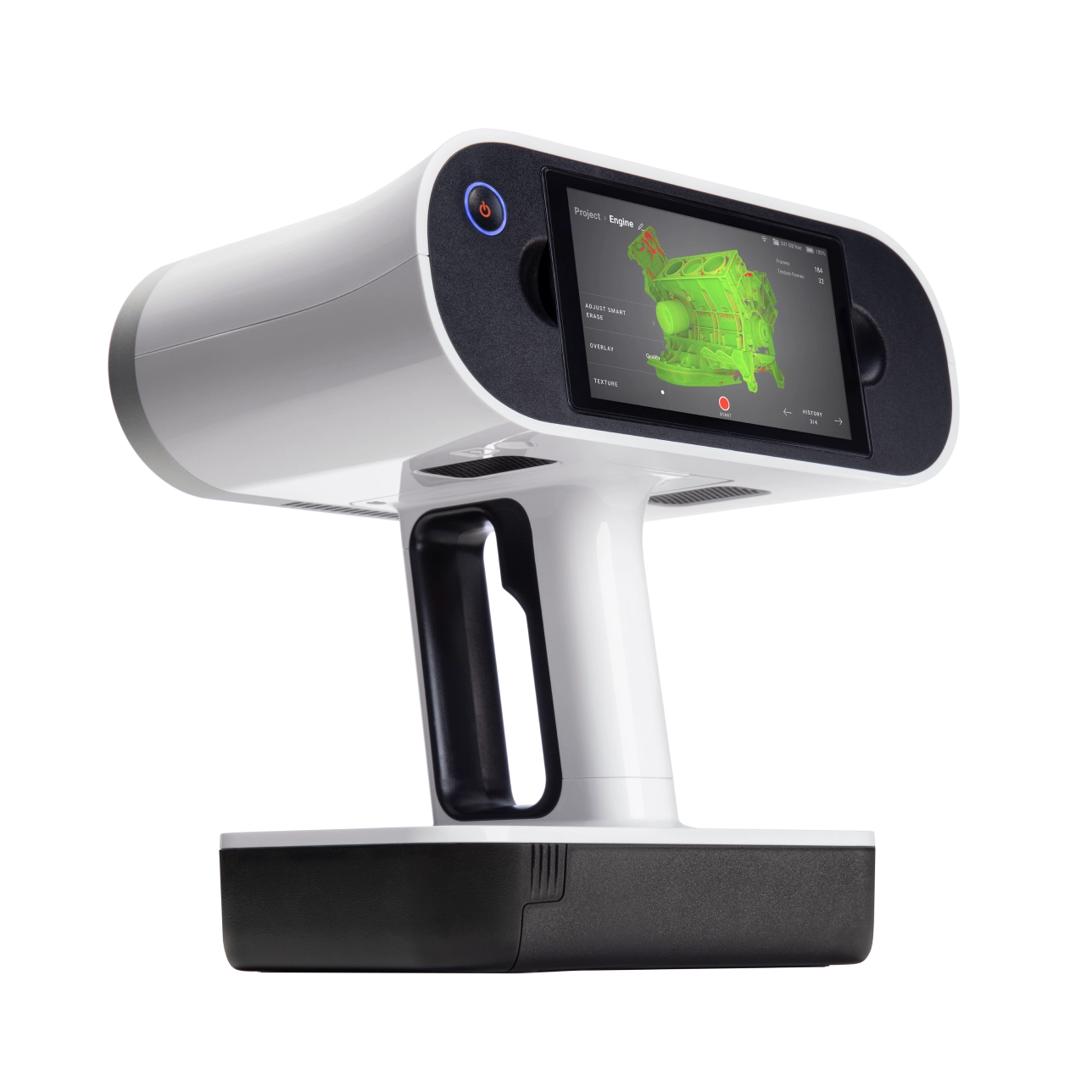
Best for: professionals who want the smoothest fully wireless, PC-free workflow at scale. The Leo is a self-contained handheld with onboard processing, a built-in touchscreen, and battery power, so you walk around an object and watch the 3D model build in real time with no laptop or cables. Marker-free structured light (VCSEL) at up to 80fps makes it fast on organic and large objects. It is expensive, but for a working studio the time saved is the point.
Price: ~$38,300 (approximate; varies by bundle, sale period and region, click through for current pricing)
- 3D point accuracy 0.1mm; resolution up to 0.2mm
- Structured light (VCSEL), marker-free, up to 80fps
- Fully standalone: onboard compute, screen, battery
Also worth knowing: the tethered Artec Eva (0.1mm, structured light) remains a studio workhorse at roughly half the Leo’s price for those happy to work tethered to a PC.
peel 3D
peel 3D is Creaform’s accessible brand, bringing genuine professional structured-light scanning down to a price small shops can justify. It is the bridge between prosumer handhelds and full industrial metrology.
peel 3 / peel 3.CAD
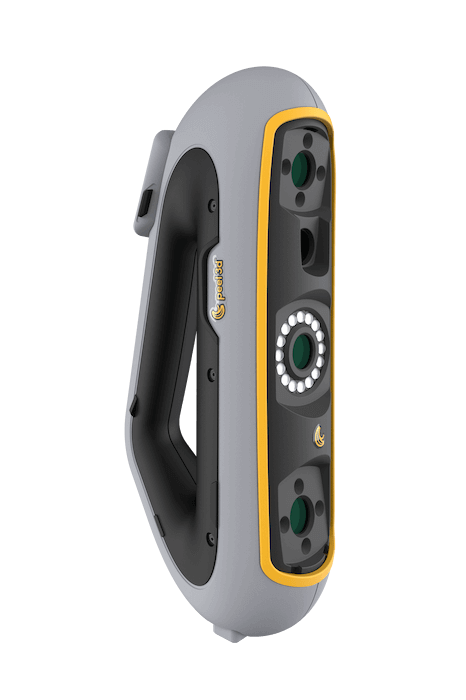
Best for: reverse engineering and inspection on a real budget. The peel 3 captures at up to 0.05mm with hybrid tracking (geometry, texture, or targets) on objects from 10cm to 3m, and runs on peel.OS. The peel 3.CAD bundle adds a reverse-engineering toolset that turns scans into editable CAD, which is the version most engineering buyers actually want.
Price: ~$8,490 (approximate; varies by bundle, sale period and region, click through for current pricing)
- Accuracy up to 0.05mm; resolution up to 0.05mm
- Structured light (LED + IR); marker-free hybrid tracking
- Objects 10cm to 3m; ~$8,490 (peel 3) / ~$11,990 (peel 3.CAD)
Thor3D
Thor3D builds accessible professional handhelds with a refreshingly simple model: buy the scanner and the Calibry Nest software is yours with an unlimited license and no recurring fee. The Calibry line suits users who scan larger objects and want professional results without a subscription or a five-figure budget.
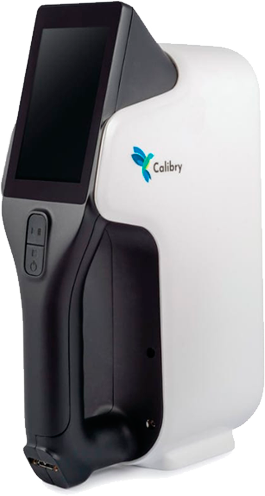
Thor3D Calibry
Best for: scanning medium-to-large objects (30cm to 10m) without breaking the budget, with an unlimited Calibry Nest software license (no recurring fee). Marker-free with geometry, texture, or target tracking. For small, high-detail parts, the Calibry Mini drops to a 0.07mm point accuracy over a 2cm to 30cm range.
Price: ~$5,790 (approximate; varies by bundle, sale period and region, click through for current pricing)
- Structured light; objects 30cm to 10m; ~$5,790
- Calibry Nest software, unlimited license
- Calibry Mini: 0.07mm, 2cm to 30cm, for small parts
3DMakerpro
3DMakerpro made its name on affordable consumer scanners, but the Toucan is a deliberate step into professional territory: a fully standalone, all-in-one device with onboard processing and high-fidelity 8K color, built to need no PC at any scale.
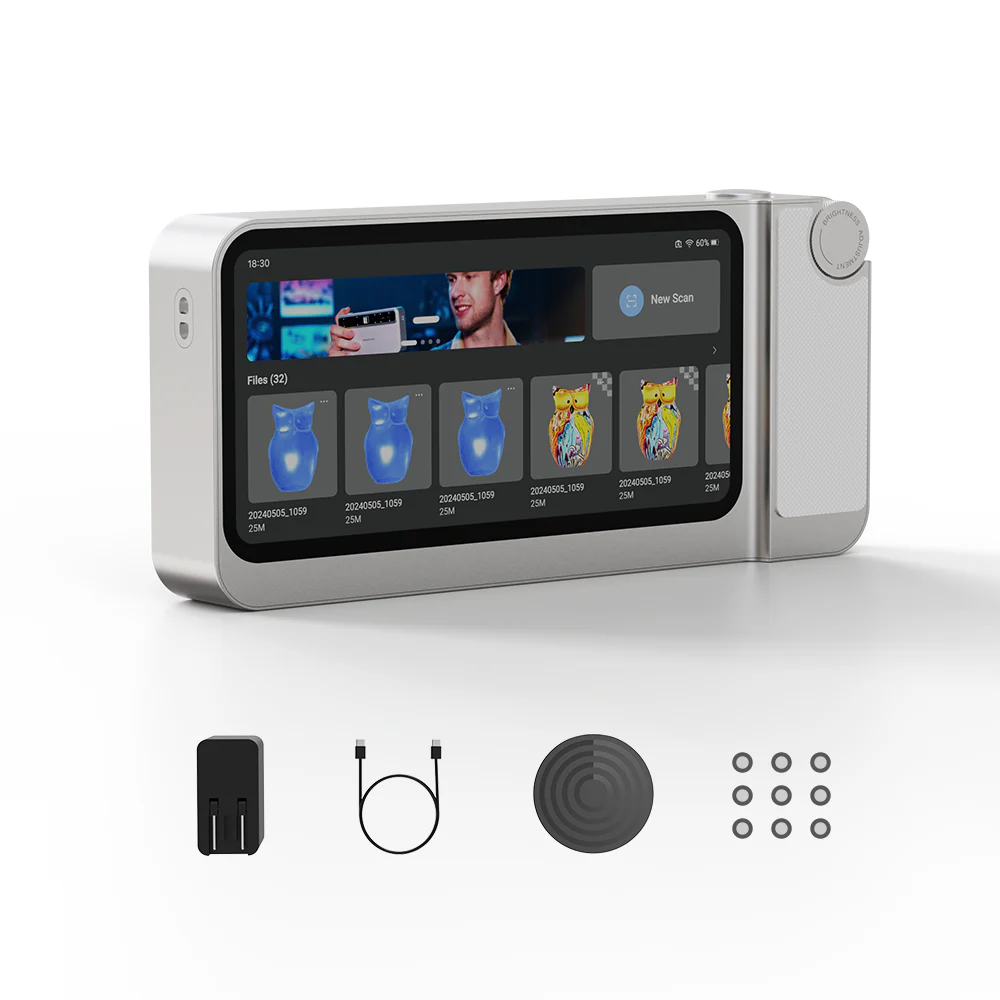
3DMakerpro Toucan
Best for: standalone full-body and large-object capture with high-fidelity color, with no PC at any scale. Announced late 2025 as a fully standalone all-in-one, the Toucan scans from jewelry-scale up to 4 x 4 x 4m. A high-end MEMS projector offers Class 1 and Class 3R power modes, four 48MP cameras generate 8K color textures on-device, and a 6-inch AMOLED plus 8-core processor handle scan-to-mesh in hand.
Price: ~$1,499 (approximate; varies by bundle, sale period and region, click through for current pricing)
- Accuracy up to 0.03mm; resolution 0.05mm
- Standalone (8-core, 32GB RAM, 256GB); 4 x 48MP cameras, 8K color
- Scan volume up to 4 x 4 x 4m; 120 min battery
Creality
Creality has stepped firmly into the professional scanner market with five new pro models: the Raptor Pro (entry pro at 0.02mm), the Sermoon S1 (four-mode hybrid bench scanner), the Sermoon P1 (standalone all-in-one), the RaptorX (wireless hybrid), and the Sermoon X1 (industrial flagship with built-in photogrammetry). All Creality scanners pair with QuickSurface and Geomagic Design X for reverse-engineering workflows.
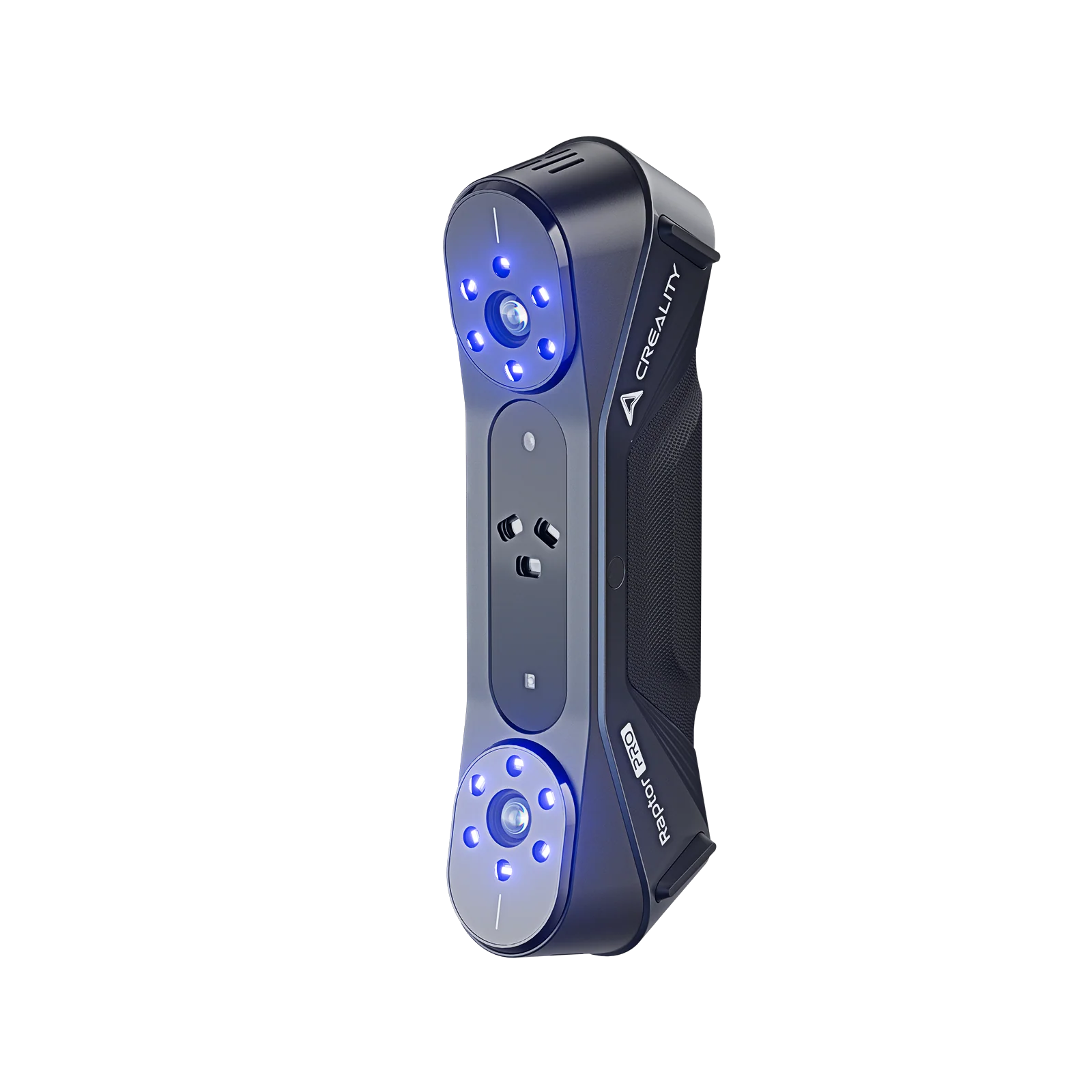
Creality Raptor Pro
Best for: the most-affordable way into 0.02mm-grade scanning. Creality drops the CR-Scan branding to mark this as the step up from the consumer Raptor: 22 cross blue laser lines at up to 60fps, 0.02mm accuracy, and full-color capture in a familiar handheld format. The Raptor Pro is the entry to the professional Creality scanner family below the RaptorX and the Sermoon line.
Price: ~$1,899 (approximate; varies by bundle, sale period and region, click through for current pricing)
- Accuracy 0.02mm; 22 cross blue laser lines; 60fps
- Full color; spray-free on dark and metallic surfaces
- Pairs with QuickSurface and Geomagic Design X
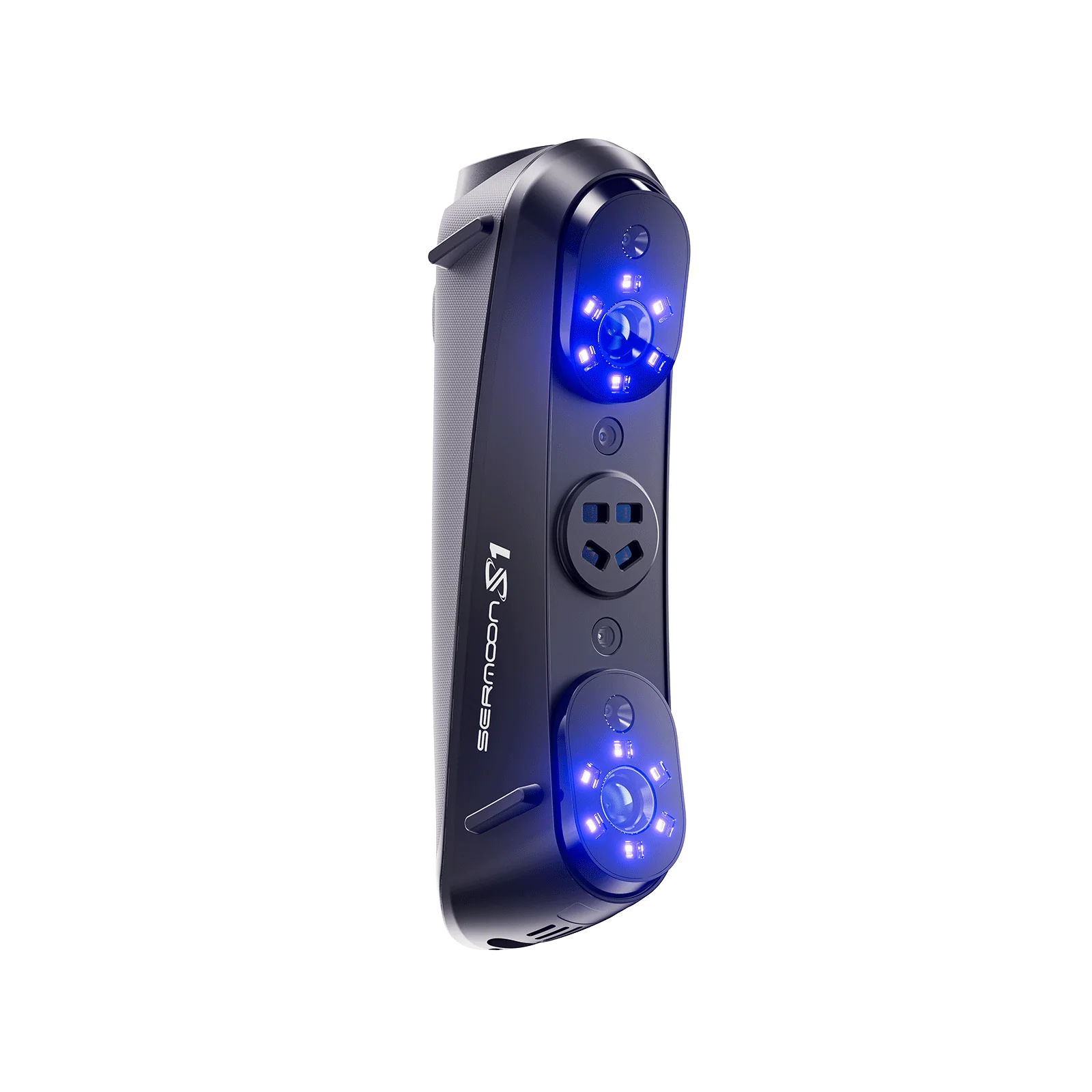
Creality Sermoon S1
Best for: the bench-mounted Sermoon experience without the X1’s photogrammetry kit. Four light modes cover everything: single-line blue laser for deep holes and narrow gaps, 7 parallel laser lines (756,000 pts/s, 0.1mm resolution) for HD detail, 34 crossed lines for fast mid-to-large capture, and NIR structured light (4.6M pts/s) for markerless large-object and human body scanning. 0.02mm accuracy, 0.02mm + 0.08mm/m volumetric, up to 90fps, scans objects from 5mm to 4m.
Price: ~$2,699 (approximate; varies by bundle, sale period and region, click through for current pricing)
- Accuracy 0.02mm; volumetric 0.02mm + 0.08mm/m; up to 90fps
- Four-mode hybrid: 1 + 7 + 34 blue laser lines + NIR structured light
- NIR markerless mode (4.6M pts/s) for large objects and body scanning
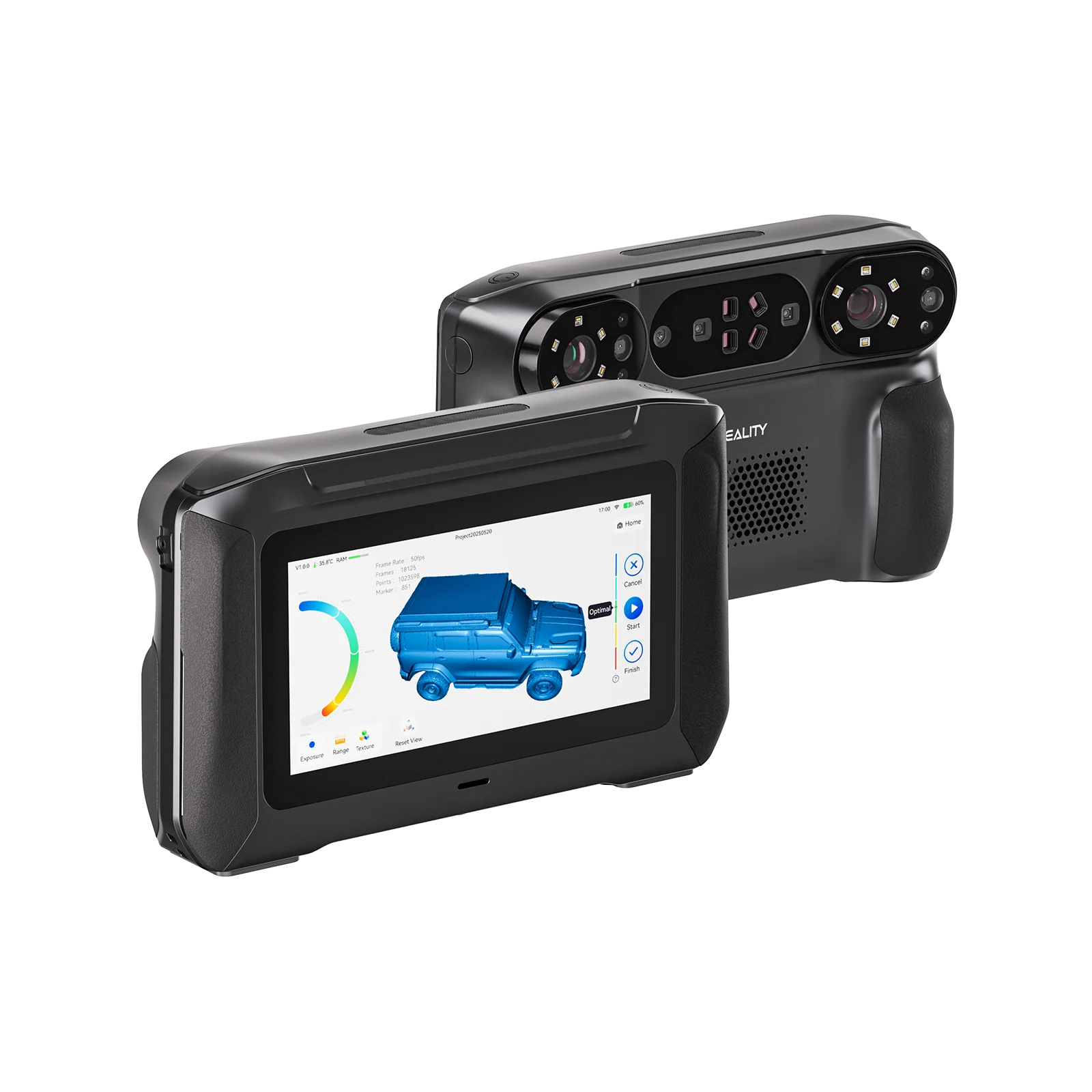
Creality Sermoon P1
Best for: standalone scanning with a complete on-device workflow, no laptop required. A TechRadar Best of CES 2026 winner, the P1 packs a four-light hybrid (22 cross + 7 parallel + 1 single blue laser, plus NIR structured light) that covers everything from deep holes (5:1 depth-to-diameter ratio) to large parts. A 6-inch HD touchscreen, 24GB LPDDR5X RAM, 256GB UFS 4.0 storage, and Wi-Fi 7 handle capture, fusion, and editing on-device. Dual swappable 3300mAh batteries fast-charge to 80% in 50 minutes.
Price: ~$3,299 (approximate; varies by bundle, sale period and region, click through for current pricing)
- Hybrid: 22+7+1 blue laser + NIR; scan range 5mm to 4000mm
- Standalone, wired PC, or wireless PC; 6-inch HD touchscreen
- Wi-Fi 7; 24GB RAM, 256GB UFS 4.0; swappable dual batteries
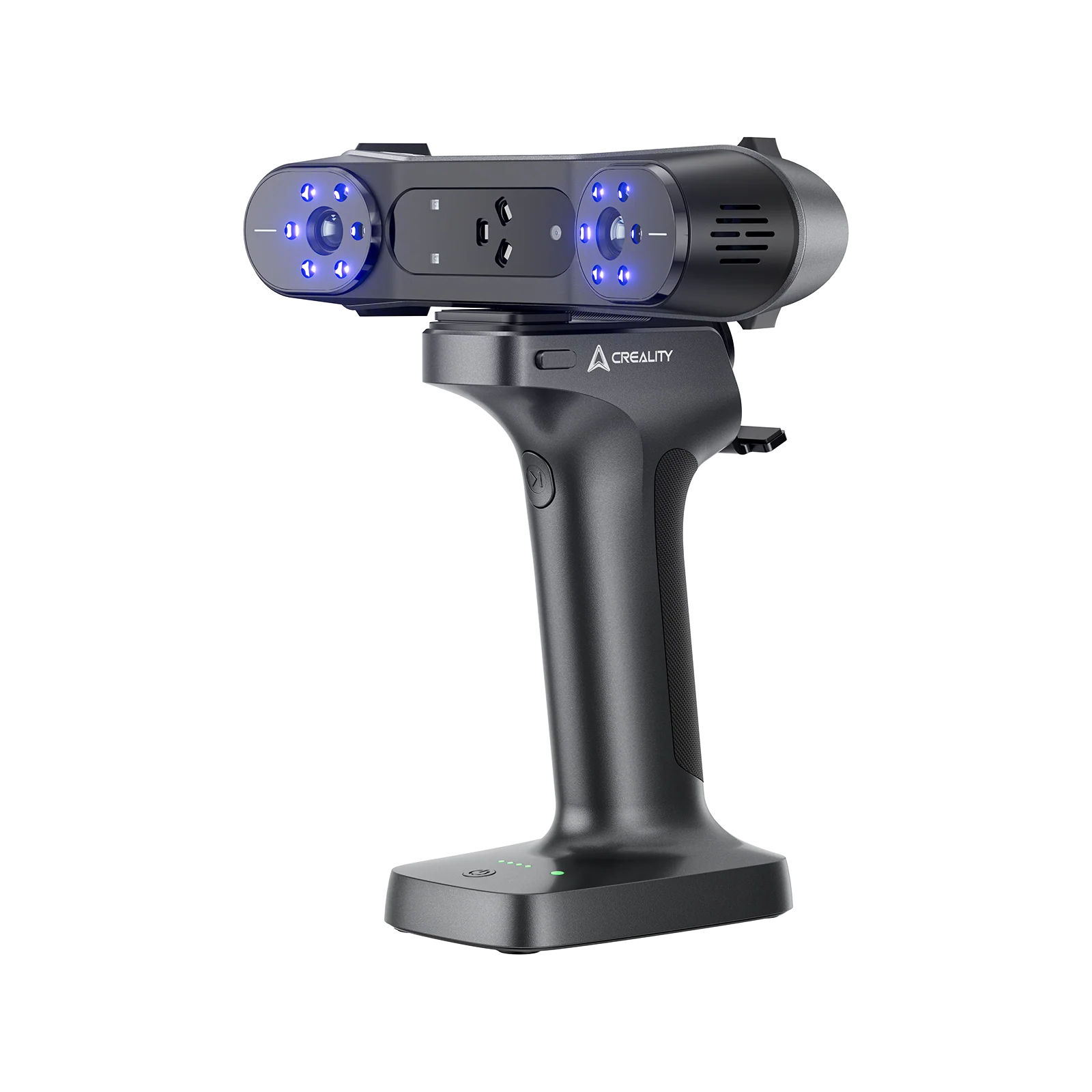
Creality RaptorX
Best for: the step up from the Raptor Pro for high-end wireless professional work. The RaptorX runs 41 blue laser lines total (34 crossed for fast medium-to-large capture and 7 parallel for HD detail at 0.1mm resolution) plus NIR structured light at 1.02M points per second. 0.02mm accuracy across a 5mm to 4m range, 60fps in laser mode and 30fps in NIR. Wi-Fi 6 AX6000 (4.7 Gbps) and USB-C connectivity. Reads dark and metallic surfaces without spray. The wireless industrial pick sitting under the Sermoon X1.
Price: ~$3,599 (approximate; varies by bundle, sale period and region, click through for current pricing)
- Accuracy 0.02mm; 5 to 4000mm range; 41 blue laser lines (34 cross + 7 parallel)
- NIR mode 1.02M pts/s; laser up to 60fps, NIR up to 30fps
- Wi-Fi 6 AX6000 (4.7 Gbps) or USB-C; spray-free on dark and metallic
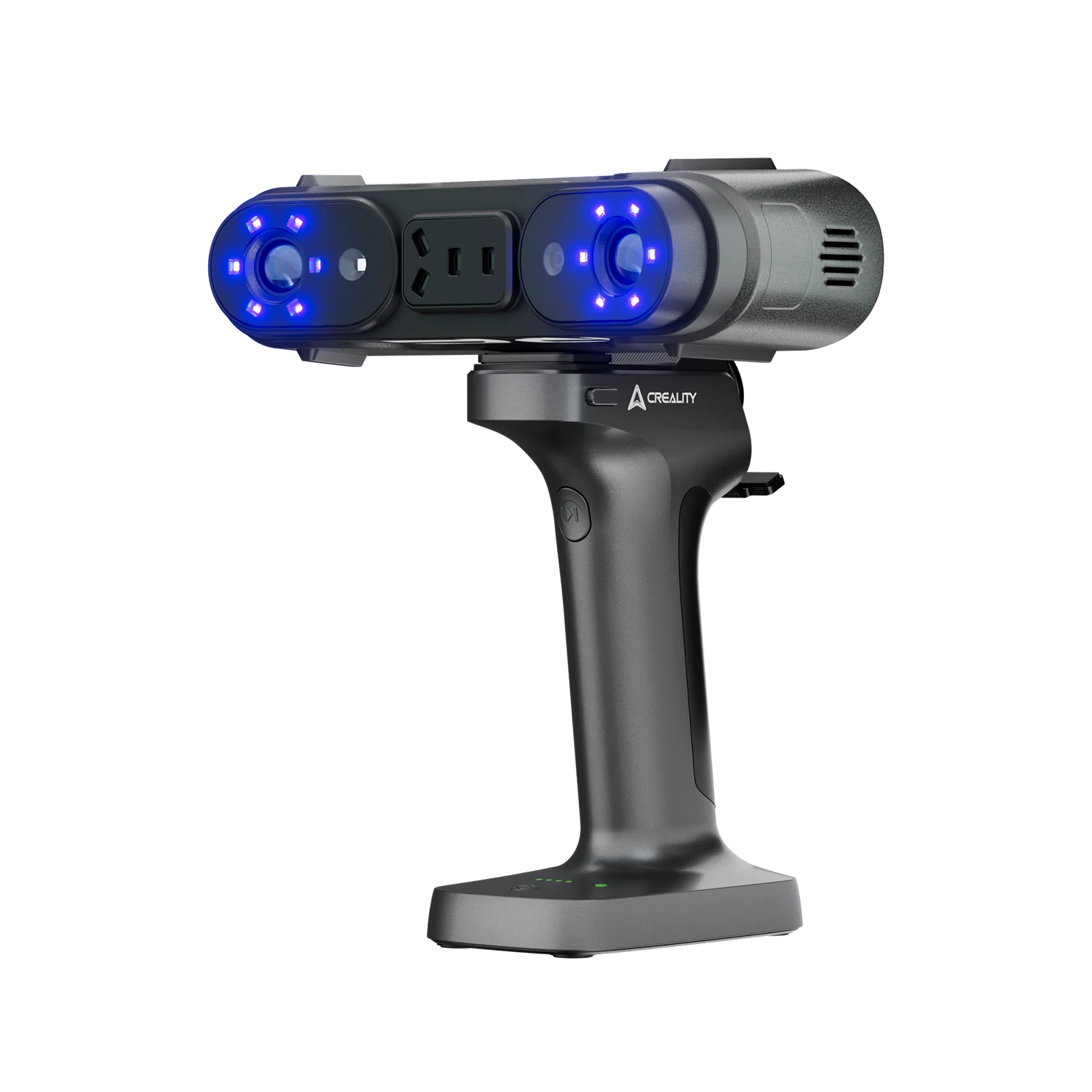
Creality Sermoon X1
Best for: industrial-grade wireless scanning where built-in photogrammetry matters. The Sermoon X1 pushes Creality firmly into the pro tier: volumetric accuracy of 0.02mm + 0.04mm/m (tightening to 0.02mm + 0.03mm/m with scale bars), built-in photogrammetry with 2 scale bars, four-light hybrid (1 + 7 + 34 blue laser lines plus NIR), a 6:1 depth-to-diameter ratio for deep holes, and a CNC all-metal unibody for vibration resistance. Wi-Fi 6 wireless with 4+ hour battery, working outdoors up to 100,000 lux.
Price: ~$5,999 (approximate; varies by bundle, sale period and region, click through for current pricing)
- Volumetric accuracy 0.02mm + 0.04mm/m (0.02 + 0.03 with scale bars)
- Built-in photogrammetry + 2 scale bars; scan range 5mm to 4000mm
- Wi-Fi 6, 4+ hr battery; CNC unibody; outdoor to 100,000 lux
3DeVOK
3DeVOK, a brand under SCANOLOGY, brings industrial-grade scanning to a wider range of professionals. Its MT Gen2 packs four light sources into a single handheld, with a factory calibration certificate and international compliance certifications usually reserved for far pricier metrology gear.
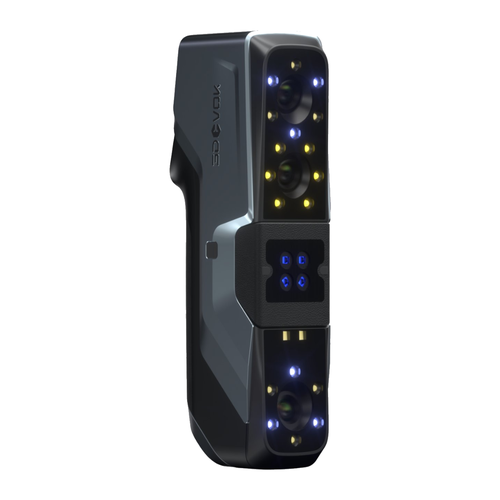
3DeVOK MT Gen2
Best for: reverse engineering and inspection on complex multi-surface parts, including deep holes and recesses. A quad-light handheld combining 34-line cross blue laser (0.03mm), 11-line parallel laser for fine detail, a single-line mode for deep holes, and IR VCSEL for fast large-area capture at up to 4.5M pts/s. No spray on dark or metallic surfaces, ships with a factory calibration certificate and CE/FCC/RoHS/IEC 60825 compliance.
Price: Quote (approximate; varies by bundle, sale period and region, click through for current pricing)
- Accuracy up to 0.03mm; volumetric 0.03mm + 0.04mm/m
- Quad light source; objects 50mm to 5m; up to 4.5M pts/s
- Optional Wi-Fi 6 Airgo handle; software for CAD, Rhino, PolyWorks
The industrial metrology tier
At the top of the market sit certified, quote-only systems built for traceable inspection in regulated industries. They are enterprise purchases rather than add-to-cart products, but any serious “professional” guide should name them so you know the ceiling.
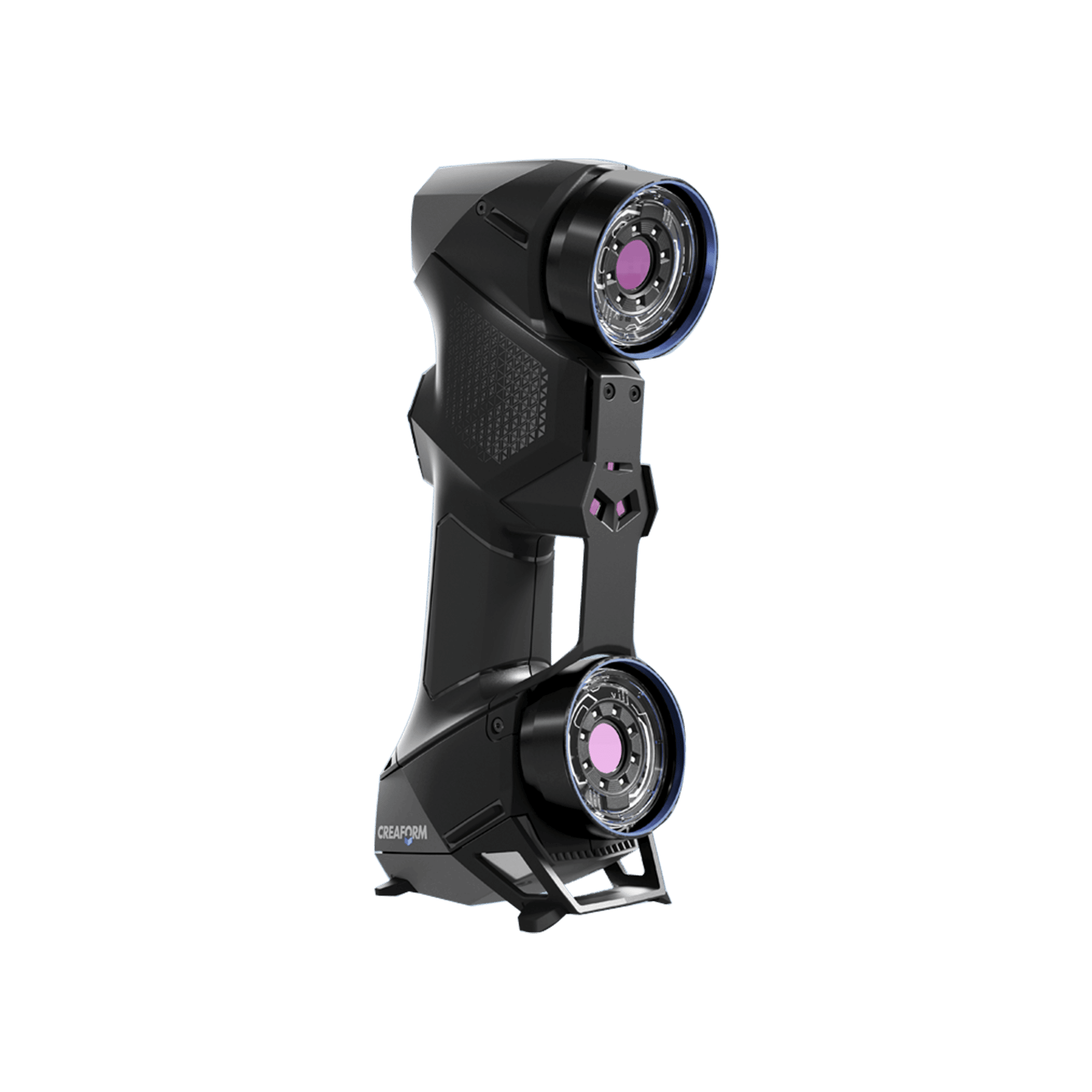
Creaform HandySCAN 3D (BLACK series)
The industrial benchmark: a blue-laser metrology handheld at 0.025mm accuracy with ISO 17025-traceable calibration, used for QC on shop floors worldwide. Marker-based for maximum global accuracy, runs VXelements. Sold by quote through Creaform.
Price: Quote (approximate; varies by bundle, sale period and region, click through for current pricing)
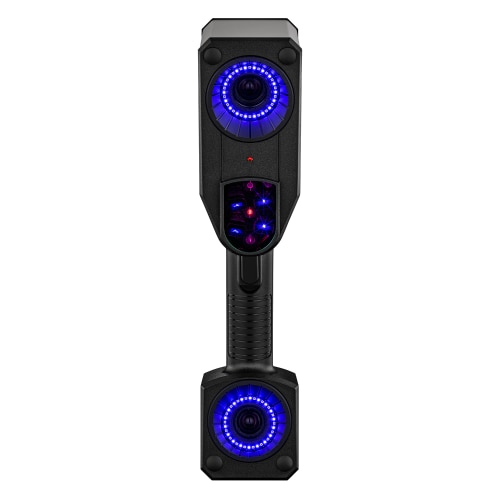
ZEISS T-SCAN hawk 2
A blue-laser handheld with 0.02mm + 0.015mm/m volumetric accuracy and a photogrammetry mode for parts over 1m, feeding directly into ZEISS INSPECT. The metrology buyer’s alternative to Creaform. Also worth knowing: Scantech rebranded to Scanology in 2025, whose KSCAN flagship reaches 0.02mm fully wireless and is a rising name in this tier.
Price: Quote (approximate; varies by bundle, sale period and region, click through for current pricing)
A note on a name you may remember: Polyga exited the 3D-scanner market in January 2025, so its Compact L6 and H3 are no longer sold. If you were considering them, the peel 3, Thor3D Calibry, or a Shining3D EinScan are the closest living equivalents in that precision and price band.
Full spec comparison: all 15 scanners
Every pick compared on the specs that matter for professional work. Scroll sideways on a phone to see every column.
What professional 3D scanners cost
Professional scanning covers a wide price range, and the “quote” labels in the table hide real tiers. Accessible professional handhelds (peel 3, Thor3D Calibry, Revopoint MetroX and MetroY Pro, EinScan Rigil) run roughly $2,000 to $12,000. Premium wireless and standalone systems like the Artec Leo land around $20,000 to $40,000. Certified, quote-only metrology systems such as the Creaform HandySCAN, ZEISS T-SCAN hawk 2, and Shining3D FreeScan commonly start near $30,000 and climb past $100,000 with options and software.
The scanner is rarely the whole bill, so budget for total cost of ownership: a capable RTX-class workstation for PC-dependent models (often $1,500 to $3,000), software (some licenses are perpetual, others are annual subscriptions with maintenance), positioning markers and calibration artifacts, and, at the pro tier, training and onboarding, which usually comes through a reseller rather than a checkout page.
How to choose a professional 3D scanner
Start with the accuracy you actually need, not the lowest number you can find. Reverse engineering and additive verification are usually well served at 0.02mm to 0.05mm; certified inspection in aerospace or automotive QC is where true metrology systems and their traceable calibration earn their cost. Buying more accuracy than your tolerances require mostly buys a bigger workstation bill.
Then weigh the light source and tracking. Blue laser is the safe default for dark, shiny, and metallic parts without spray; structured light is faster on feature-rich organic shapes; hybrids do both. Marker-free tracking saves enormous setup time, but the highest-accuracy metrology systems still use targets for a reason. If you scan in the field or on a shop floor, a standalone scanner with onboard computing (Rigil, Leo, Toucan) removes the laptop from the equation, otherwise budget for a real RTX-class workstation alongside the scanner.
Finally, judge the software, because that is where scans become useful. Our 3D scanner software guide compares the scan-to-CAD and inspection packages named below. For reverse engineering you want a clean path to CAD (peel.CAD, Revo Design, Geomagic, or your existing package); for inspection you want a real QC and deviation-analysis toolset. A cheaper scanner with mature software often beats a pricier one with weak software.
Two practical checks before you commit. Confirm the export formats and licensing fit your pipeline: you want clean export to the formats you already use (STL, OBJ, and PLY for meshes, STEP or IGES through the scan-to-CAD tools, and raw point clouds for inspection), and you should know whether the software is a perpetual license or an annual subscription. And remember that professional scanners are usually bought through a reseller rather than an add-to-cart page, which is where training, calibration support, and warranty live; on a five-figure purchase, that relationship is part of what you are paying for.
Where to go next
For the full picture across all brackets and price tiers, start with our complete 3D Scanner Buyer’s Guide 2026. Scanning at consumer or prosumer scale? Companion bracket guides: small-format and budget, medium-sized objects, and large objects. For the full software and metrology pipeline (Geomagic, PolyWorks, ZEISS INSPECT), see our 3D scanner software guide. Considering a metrology service contract instead of in-house? Our 3D scanning service vs buying a 3D scanner guide walks the decision. Hands-on impressions in our Revopoint MetroX Pro, Trackit, and Einstar VEGA reviews. Planning to print what you scan? Start with the best 3D printers of 2026.
Frequently asked questions
What makes a 3D scanner “professional”?
Mainly accuracy and the light source. Professional scanners deliver metrology-grade accuracy (commonly 0.02mm to 0.05mm) with published volumetric accuracy, and they use blue laser or hybrid light to capture dark, reflective, and metallic surfaces without spray. They also bring marker-free tracking, scan-to-CAD and inspection software, and often standalone hardware.
Blue laser or structured light, which is more accurate?
Blue laser generally wins on dark, shiny, and metallic surfaces and on overall accuracy, and it needs no scanning spray. Structured light is faster on feature-rich organic shapes and capturing large areas. Many 2026 professional scanners are hybrids that switch between both, which is the most flexible option.
How much accuracy do I actually need?
Match it to your tolerances. General reverse engineering and 3D-printing verification are fine at 0.05mm; precision mechanical work wants 0.02mm to 0.03mm; certified inspection in regulated industries is where 0.02mm-and-below metrology systems with traceable calibration are worth it. Over-buying accuracy mostly raises your workstation and software costs.
Do I need a PC, or are standalone scanners good enough?
Standalone scanners (EinScan Rigil, Artec Leo, 3DMakerpro Toucan) now process on-device and are genuinely good enough for most professional work, with the freedom to scan anywhere. PC-dependent models can be faster on heavy datasets but need a real RTX-class workstation, so factor that into the budget.
Can these scan dark or shiny surfaces without spray?
Yes, that is the main reason to buy a blue-laser professional scanner. The laser modes on the scanners here capture dark, reflective, and metallic surfaces directly, where consumer infrared scanners usually need matting spray. Highly polished mirror finishes can still be challenging on any scanner.
How much does a professional 3D scanner cost?
A wide range. Accessible professional handhelds run roughly $2,000 to $12,000; premium wireless and standalone systems like the Artec Leo are around $20,000 to $40,000; and certified, quote-only metrology systems such as the Creaform HandySCAN and ZEISS T-SCAN hawk 2 commonly start near $30,000 and climb past $100,000. Budget also for a capable workstation, software licensing, markers, and training.
What software do professional scanners use for scan-to-CAD?
Each brand ships its own (Revo Design and Revo Measure, peel.CAD, EXScan, VXelements, Artec Studio, ZEISS INSPECT), and many also export to general reverse-engineering and inspection packages like Geomagic Design X, SOLIDWORKS, and PolyWorks. For reverse engineering specifically, look for a guided mesh-to-solid workflow rather than just mesh export.