
University of Utah engineers have built a holographic 3D printer that produces complete shapes in a single exposure rather than building them layer by layer, eliminating the structural seams that weaken conventionally printed parts. The process takes about 20 seconds, compared to the hours required by other laser-based printing methods.
The research, led by Rajesh Menon, professor of electrical and computer engineering at the Price College of Engineering, and lab member Dajun Lin, was published June 4 in Nature Communications under the title “Single-exposure holographic lithography of ultra-high aspect-ratio microstructures.” Brian Baker of the Utah Nanofab is a co-author, and the National Science Foundation and the University of Utah funded the work.
The technique uses a nanopatterned mask placed in front of a laser. That mask diffracts light into a holographic pattern, channeling the laser’s energy only into the specific volume of a substrate called SU-8, a photolithography material made of stringy polymers that crosslink and harden when exposed to laser light. The unexposed portions wash away, leaving the final shape behind. The mask compensates for the blurring that normally occurs when laser light passes through a non-transparent material, which has been a persistent obstacle for volumetric laser printing.
Menon describes his team’s current prints as “extended 2D” rather than true 3D. They have length, width, and height, but the researchers can only control shape in two of those dimensions. “The mask is working like a cookie cutter, stamping a complex shape out of thick dough,” Menon said. “The laser is ‘baking’ the dough on the inside at the same time, so the resulting shape is physically tough.”
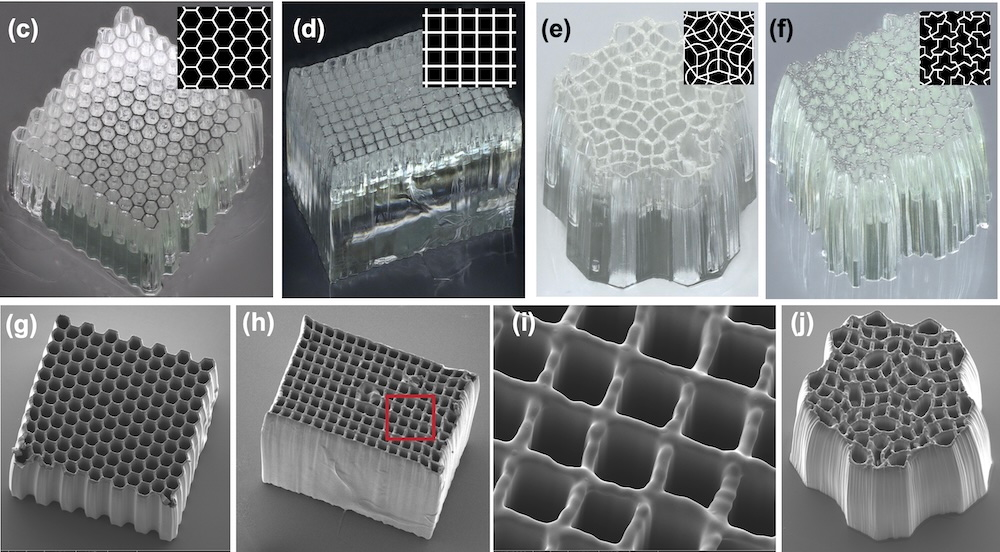
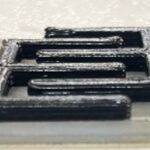
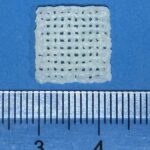
The team used the printer to produce microtubule assemblies with individual diameters as small as 6 micrometers and dimensional ratios as high as 120:1. Those microtubules successfully transported liquid via capillary action and held up under compression testing. The researchers also demonstrated they can print multiple shapes in a conveyor-belt fashion, running one print after another.
Menon’s team is now working to achieve true 3D prints with the technique.
Source: attheu.utah.edu