
Good coffee, a few robot arms, and two days of unusually open talks: inside the symposium bringing robotic large-format 3D printing together.
By Robert Dehue · 3DPrinting.com
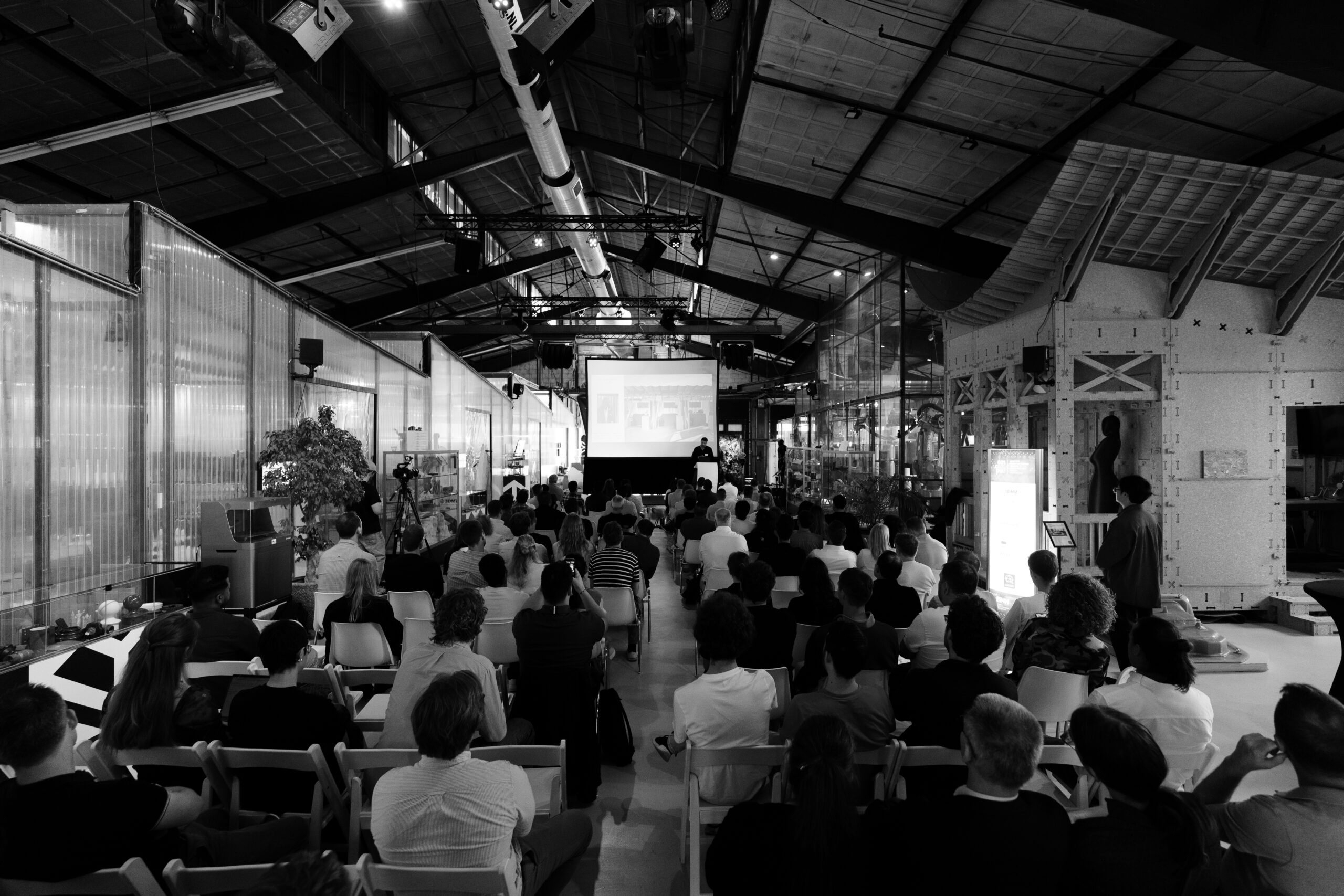
Walk into 3D Makers Zone in Haarlem and the first thing you notice is that the decor has elbows. Industrial robot arms sit around the workspace like patient colleagues waiting for someone to hand them a job, and for a two-day symposium about robotic large-format additive manufacturing, that setting does a lot of the talking. This is a working floor, not a hotel ballroom, and it sets the tone before a single slide goes up.
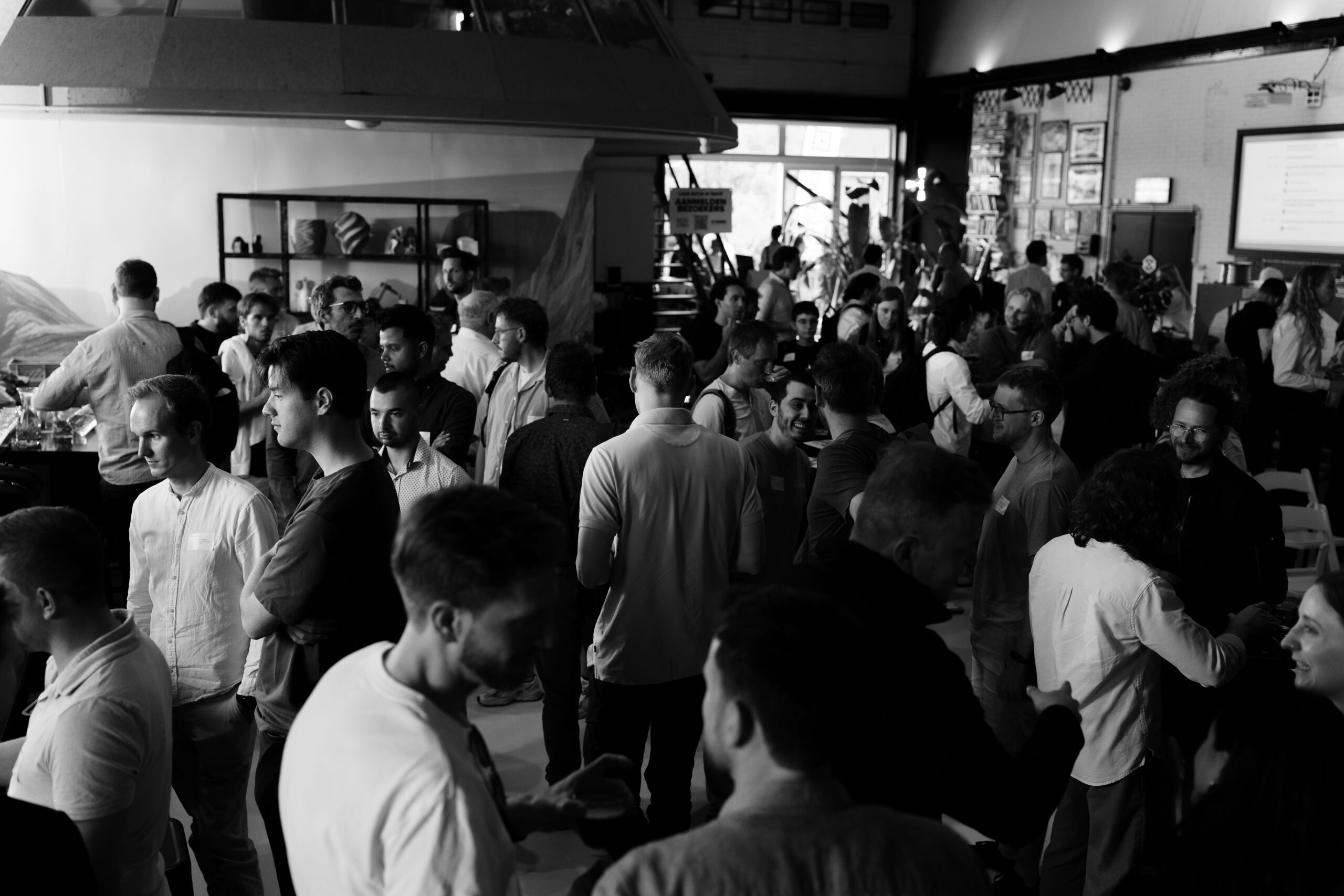
The event was Addidex Connect, and it did not feel like a first-time event. The curation of speakers and panels, the balance of sponsors, the calibre of the people in the chairs, all of it felt considered, and the credit goes largely to organiser Michael John Sweers, who runs Addidex alongside his other outfit, More Than Layers. The program left real room to breathe: long breaks, a campus crawl, genuinely good food and drinks, and deliberate space to network. Around 170 people came through across the two days, and the design of the thing kept nudging them into conversation. For an event whose entire pitch is connection in a fragmented field, that was the point being made in practice, not just from the stage.
Everyone seems to be reinventing the same wheel
And it is a fragmented field. The premise of Addidex Connect, stated without much hedging, is that robotic AM is full of brilliant people quietly reinventing the same wheel. There are no standards yet. Designers do not always know the machine limits, integrators do not always know the design intent, handovers are messy, and “it works on my machine” is doing a lot of load-bearing work as an industry standard. The organisers’ answer was to get everyone to share the parts they normally keep to themselves, the workflow, the data, the failures, so the field can spend its energy on the interesting parts instead. Running alongside that was a blunter message: LFAM is still too quiet, and Europe in particular needs to start paying it real attention. Over two days, though, the sharpest question in the room was quietly this: who would actually do it?
The keynote answered it almost by accident. Aldo Sollazzo of LaMáquina opened the design block with a sweeping tour of a decade of work, part masterclass and part company showreel, and the most telling moment was the origin story. Around ten years ago the founder of WASP, Massimo Moretti, handed the studio one of the first pellet-fed large-format machines and asked what they could design for it. A whole practice, several companies and a great deal of printed architecture grew out of that single open door. His framing of material innovation as three steps, invention, validation, then the hard-won integration into industry, could double as a portrait of the field sitting in the room. If a single introduction can spawn a whole practice, the organisers were right to leave so much room in the schedule for the next one.
Design is the lever
The design talks made the case that everything downstream is decided before the robot moves, and Miguel García Jiménez of Nagami made it most vividly. His central claim is that the real project lives in the gap between the geometry and the machine, in the toolpath and the data, not in the CAD model everyone likes to point at. He walked through it as four hard-won lessons.
The first was counterintuitive. The hardest thing his team ever had to print was not an organic double-curved surface or a wall of overhangs, but a nearly flat panel with a subtle two to five centimetre relief. It warped, pulled off the bed and cracked, worse at every scale. They blamed the process first, changing parameters, settings, even materials, before admitting they were trying to fix a design problem through fabrication. The real fix was a smarter segmentation strategy that let the material do what it wanted instead of fighting it. Flat, it turns out, can be the enemy.
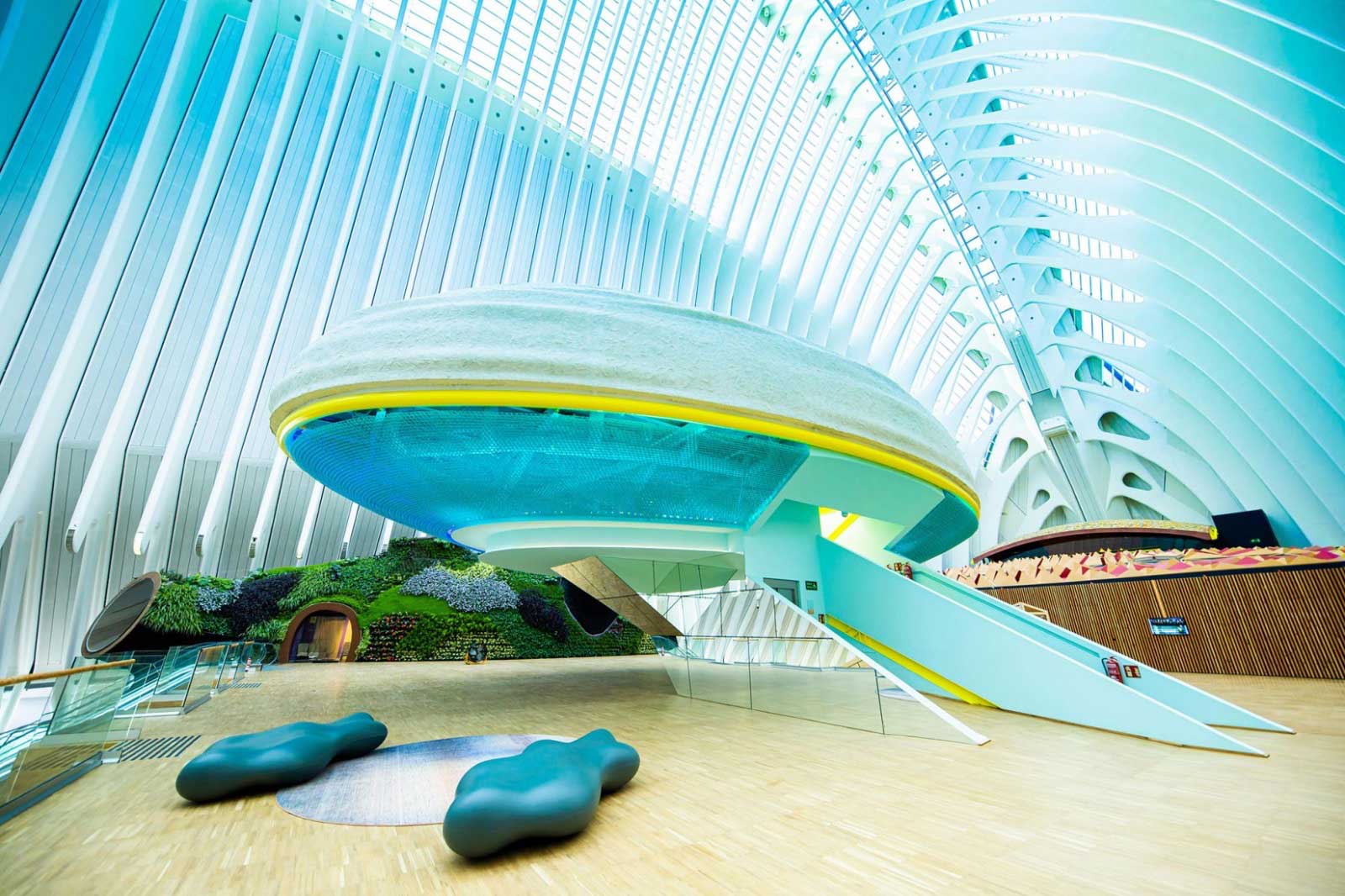
The second lesson was about failure, and it is where the economics live. On La Nube, a fire-rated panel project in Valencia, each panel took around 48 hours and the full run stretched to some 3,400 hours of printing. Failures always seemed to strike overnight, the same overnight print that haunted Sollazzo’s story a session earlier. Rather than write off 48 hours each time, Nagami built the job to recover: spot the failure, cut out the bad section, and restart the toolpath from there, turning a 48 hour loss into a 6 to 10 hour one. Success, as García Jiménez put it, is not the absence of failure but a system that can take a hit.
The third lesson came from an unlikely client: a Stellantis and Peugeot concept car with printed seats, consoles, doors and wheel covers. Because every surface was visible, the toolpath became the finish, and for once a client was judging the tool marks rather than begging to remove them. You are not building a CAD model, you are choreographing where material lands.
The fourth lesson pulled it together. In their printed chairs and the Albina pavilion, the infill stops being a slicer default and starts following the structural load, the toolpath doubling or tripling where stress concentrates, and in the pavilion the visible model was reverse-engineered from the toolpath rather than the other way around. Which led to the line that could headline the whole event: we are no longer designing objects, we are designing the systems that make those objects possible.
Ceramics, and designing for shrinkage
Ceramics turned out to be the perfect stress test for that idea, and Sollazzo had already teed it up: his own LaMáquina had just delivered a monumental ceramic commission for a new gallery at London’s Natural History Museum, working with IOUS Studio, whose Agustín Ros was up next. Ros talked about designing rules instead of forms, translating geometry into fabrication, and living with a material that actively fights back. Clay shrinks, in his case in two distinct stages, first during printing and then again as the piece dries, for a total of roughly 15 percent, which makes predicting the final dimensions of a unique part a genuine puzzle. You do not fight the shrinkage, you design for it. One detail I caught almost in passing, on a slide rather than in his emphasis, was how the studio reckons capacity: a full month of output works out to the equivalent of 21 printing days, presumably 21 stretches of 24 hour printing. A quietly sobering figure for anyone picturing infinite free capacity.
Cristina Nan of TU Eindhoven sharpened both the technical and the philosophical point. On the technical side, warping shows up almost always along the print direction, which makes infill less of a boring default and more of a lever for stabilising shrinkage and warping. On the bigger picture, her talk, “Beyond the Parametric Pattern,” argued that the number of printable shapes is not the same as the number of inhabitable architectures, and that the answer is architecture, not objects: modular, situated, and drawing openly on cultural ornament from Portuguese azulejos to Louis Sullivan. Her printed ceramic columns and Turing-pattern moulds made the case better than any manifesto.
Designing with feeling
The design panel, hosted by Aga Blonska with Lilian van Daal, Mikkel Huse, Carmen Enríquez and Sol Sanchez Cimarelli, widened the lens from tolerances to feeling. The strongest thread was biomimicry: the observation that the extreme complexity of nature is, oddly, calming to humans, which makes nature-imitating design worth chasing for more than efficiency. The practical advice was refreshingly humble: prototype from the very beginning because the material almost never behaves the way you expect, watch how it actually moves and adapt to it, and, unofficially, learn to live with uncertainty, because you never really know how a piece will turn out until it is done. If LFAM ever needs a motto, it is already written.
Materials, and the openness surprise
Here is where the event surprised me. Going in, I expected polite guardedness. What I found, especially in materials and the software tied to them, was a real willingness to share, leaning gently towards open source.
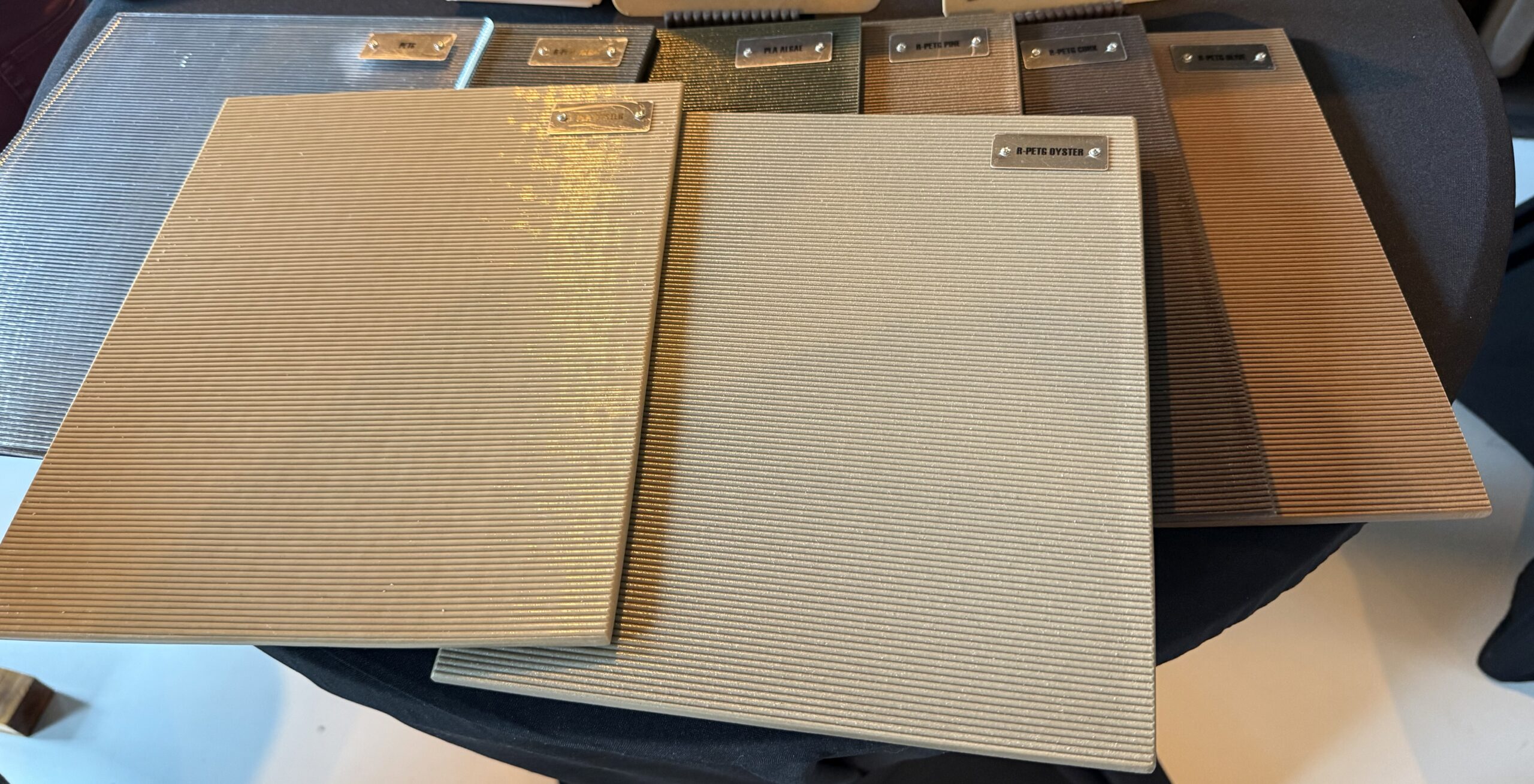
Raquel Navarro Miguel of Aitiip, a Spanish technology centre, set the tone with a bio-based and recycled materials library that reads a little like a farmers’ market: cellulose acetate bulked out with hemp or almond shells, PLA with cellulose fibres, seaweed, Mater-Bi, recycled PET blended with cork, even a recycled PETG tinted with an orange-peel masterbatch. She was equally frank about the catch, the long list of things that break when you scale a material from lab to LFAM, from interlayer adhesion and warping to nozzle clogging and layer cooling.
The materials panel then got refreshingly honest about how hard the basics still are. Pellets and filament are different animals: pellets carry far more fibre, but uniformity across extruders remains a problem, and print engineers still spend too much of the day dialling in settings by hand. With bio-materials it is worse, because even two batches of the same material can behave differently at the nozzle. Your feedstock, in other words, has moods. The concrete answer came from Deborah Claxton of Polymaker, who pointed to open-source software for material-smart G-code refinement, improving the code from accumulated experience with a given material. Cesar L. Patricio of FibeCycle added the sustainability angle: recycle locally and the carbon footprint drops. Esther Perez of Smart Materials 3D rounded out a panel that, notably, spent more time on shared problems than on product lines.
Software, toolpaths, and the open question
If materials were the pleasant surprise, software was where the open versus closed tension actually played out.
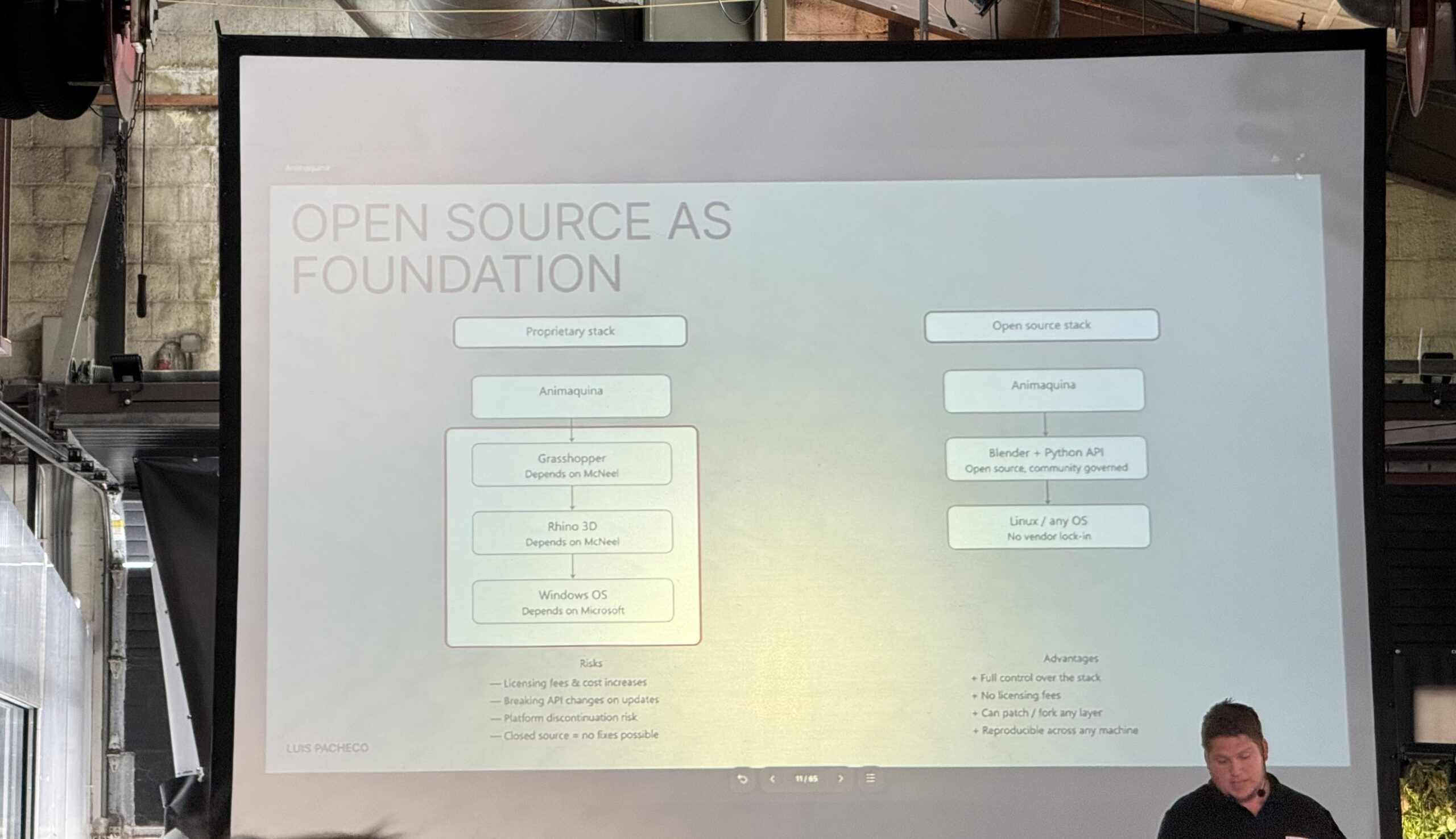
The open end was well represented, and Luis Arturo Pacheco of Animaquina answered my Blender-versus-Rhino question head on. His plugin brings robotic printing into Blender, and one slide made the case plainly: a proprietary stack, Animaquina on Grasshopper on Rhino on Windows, each layer a dependency and a licensing risk, against an open one, Animaquina on Blender plus the Python API on any operating system. The advantage is not that Blender is a nicer place to draw, it is that nothing in the chain can lock you in, meter you, or break your workflow on its next update. This was also one of the event’s two most technical sessions, alongside Özgüç Bertuğ Çapunaman’s adaptive-workflow talk, both deep enough to reward specialists more than newcomers.
Luc Morroni of MORRONI made a compelling case for running the entire pipeline, design and manufacturing both, inside Houdini. It is a steep, complex workflow, and he owned it with a tongue-in-cheek slide ranking Houdini as the hardest climb among the popular 3D packages, but a rewarding one if you already live in Grasshopper. The payoff was a facade panel engineered to do four jobs at once, self-shading in summer, harvesting solar energy in winter, diffusing sound through its folds, and handling insulation and ventilation, shown through a striking render near the Deutsches Museum in Munich. Aslinur Taskin of ADAXIS presented AdaOne, a single place for hybrid manufacturing, 3D printing, scanning and milling, with an AdaSync plugin that links Grasshopper straight to the machine and regenerates the toolpath live as the design changes. The software panel, hosted by Peter Storey with Marc Weyermann of Layer Performance, Thomas Van Glabeke of MX3D and Anders Spaak of ABB, kept the conversation on where digital workflows go next.
Even the most commercially integrated player made a sharing pitch, and it was one of the most complete talks of the event. Francesco De Stefano of Caracol AM opened with a line that could be the industry’s motto, that applications drive technology development and never the other way around, and followed it with a blunt reminder that a robot alone never delivers a part: you need a full ecosystem of ingredients to reach a finished one. The proof was concrete. Caracol qualified Alstom’s first exterior rail application made with LFAM, with a printed core certifiable to the EN 45545 railway fire standard, then set up micro-factories in three countries so a single parametrised file can become a qualified part wherever it is needed. Underneath sits a monitoring platform, EIDOS Nexus, fed by thermal and optical sensors and roughly ten years of anonymised project data. A fully integrated platform can always risk looking like a walled garden, and Caracol’s closing argument tried to head that off: share data and experiences, build shared certification standards, and build awareness together. It is a genuinely compelling pitch, but it is worth asking who it strengthens. The shared data flows back into Caracol’s own platform, the certification path runs through Caracol’s ecosystem, and every new hub reinforces the network Caracol built. This is openness in the sense of a shared standard, not open source, and squint at it and the commons starts to look less like a commons and more like a very well-argued reason to build your factory on Caracol. The line between an open ecosystem and a gilded lock-in can be thinner than the slides suggest.
Production reality, and the regulatory wall
The production talks kept everyone honest about the gap between a clever toolpath and a finished part. Özgüç Bertuğ Çapunaman, a postdoctoral researcher at SDU CREATE, described adaptive workflows built around a feedback loop: if something changes mid-process, you update the toolpath accordingly rather than praying to the original plan. His sharpest point cut against all the optimism about open data. Fabrication data, he argued, is situated: every useful data point belongs to a specific machine, material, sensor, toolpath, nozzle, calibration, flow rate and batch, which is exactly why sharing it, or building standards on top of it, is so much harder than it sounds. Jun Wu of TU Delft then opened day two with space-time topology optimisation, a framework that keeps manufacturability and print sequence in view from the start. In one example it cut a distortion score from roughly 9.2 to nearly zero purely by reordering how the part was built, and his takeaway, that curved layers have more to offer than only aesthetics, stuck with me.
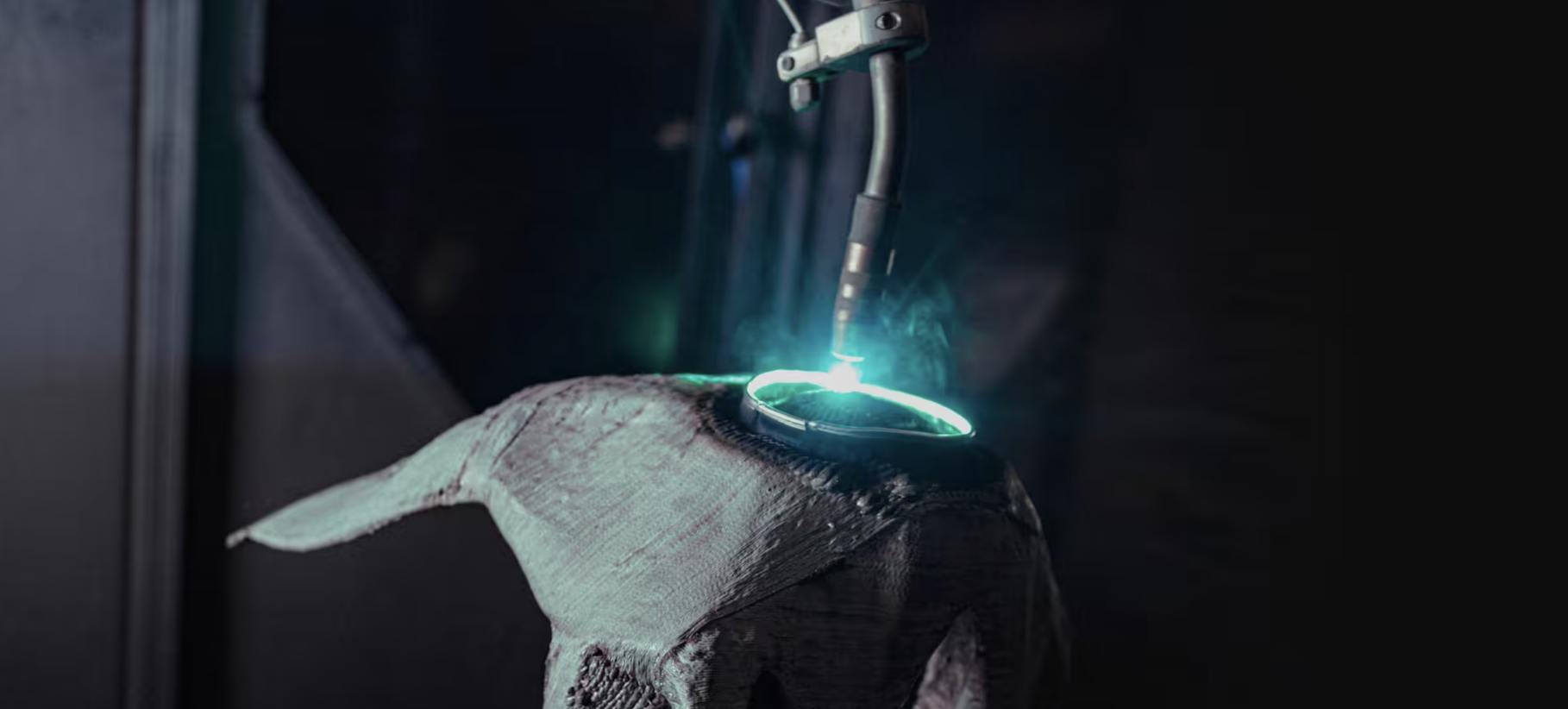
Metal wove through both days. Kasper Siderius of MX3D made the case for wire-arc printing in the creative industry, and for the discipline of splitting art from industry, folding conventional craft like casting together with 3D printing and laser cutting, in work that includes sculptural pieces such as a 2022 collaboration with Studio C&C. ROSO, presented by Han Lin with Shih-Yuan Wang, showed a full ecosystem of software, design and production with robot arms mounted on rails, driven by their own tools: a TACOarm plugin for Rhino Grasshopper and a standalone TACOarm Pro that controls the robot in real time from a tablet. One small detail stuck with me: to matte-finish large parts like a bar, they used sandblasting, and the result was genuinely beautiful. Regulation kept surfacing as the quiet gatekeeper. Both Sollazzo and García Jiménez described printing to strict fire ratings, one certified to a PS1-D0 rating, and the reminder was hard to miss: for construction and load-bearing work, approval is a long, application-dependent process, not a checkbox.
I had to leave before the end on both days, so I missed the closing stretch, including the CEAD panel bringing together construction, aerospace, maritime and defence, and the closing gallery in The Koepel, where the 3D-print exhibition is refreshed every three months. That was a genuine loss rather than a choice. On paper the CEAD panel was one of the sessions I most wanted to see, and I would happily have stayed if the day had let me.
Louder, and what comes next
If there was a second core message under all the toolpaths, it was volume, in the sense that the industry needs to be louder. LFAM is still niche, and more than one speaker argued it deserves far more attention: from the public, from clients, and from Europe in particular, which risks letting the technology’s centre of gravity drift elsewhere. That is exactly why Addliance, the European AM hub alliance behind the pan-European AMin4Y roadmap, was in the room, there to push European engagement and gather the sector’s own input. Caracol’s pitch fed the same idea from the commercial side: the more openly the hubs share what they learn, the faster the whole field earns trust. Awareness here is not marketing fluff, it is how a fragile young industry reaches escape velocity.
A note of friction, because the event earned the right to be judged by its own standard. Addidex asked speakers to leave the pitch at home, and most did, but a handful of talks drifted closer to a polished sales deck than an honest teardown. And for all the ambition of being louder and better known, this was unmistakably a room for insiders. The vocabulary, the depth, the assumed fluency in toolpaths and WAAM and slicer internals all signalled that you needed to be well inside the tent already. For a designer or a manufacturer simply curious about whether robotic large-format printing might work for them, the on-ramp looked steep, and little about the two days was built to flatten it. For a technology that says it wants more adopters, the door is still surprisingly hard to find.
Which brings it back to the opening question. Does an industry this young and this commercial actually keep sharing once the stakes rise? For two days in Haarlem, the materials and software people made the strongest case for yes. The organisers are already taking submissions for 2027, and their brief says it plainly: they value process over polish, and they want your breakthroughs and your disasters. On the evidence here, the disasters might be the most valuable thing anyone brought.