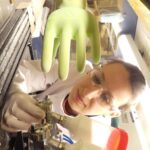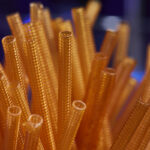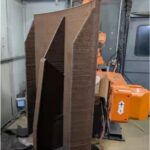

Researchers at Pusan National University in South Korea have developed the first 3D-printable smectic liquid crystal elastomer ink capable of switching molecular alignment during printing, allowing a single printed filament to either elongate or contract when heated. The study, led by Professor Suk-kyun Ahn from the university’s School of Chemical Engineering, was published in Nature Communications on July 10, 2026.
Conventional extrusion-based 3D printing locks molecules inside each filament into a single orientation, which means every printed segment can only move in one direction. The new ink sidesteps that constraint entirely. By adjusting printing speed or temperature, researchers can flip the molecular orientation between two perpendicular directions in the same filament, determining whether it shrinks or grows on heating.
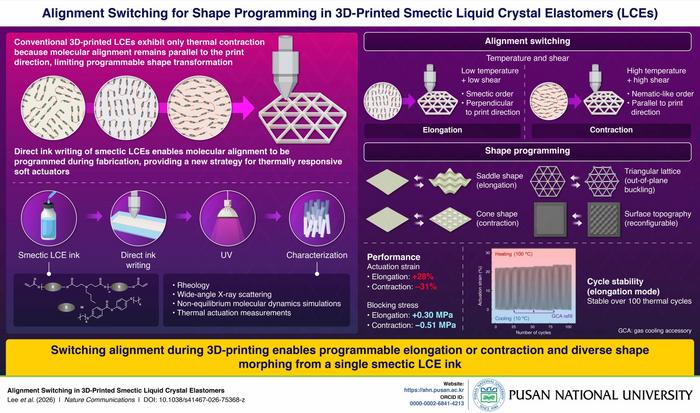
“Our work provides the first demonstration of switching molecular alignment between two orthogonal directions using a single 3D-printable smectic LCE ink, simply by tuning the printing speed and temperature,” Prof. Ahn said.
The team used direct ink writing alongside rheological measurements, wide-angle X-ray scattering, and molecular dynamics simulations to pin down the mechanism driving the alignment switch. They then printed two- and three-dimensional structures, including lattices, curved surfaces, and switchable surface topographies. The materials held up through repeated heating and cooling cycles without losing performance. Collaborators from Oak Ridge National Laboratory in the United States contributed to the research.
Prof. Ahn listed soft robotic actuators and artificial muscles, reconfigurable surfaces for haptic displays, and adaptive textures that regulate aerodynamic drag as potential real-world uses. Wearable devices and minimally invasive medical tools that change shape on demand are also on the table.
The study was conducted under laboratory conditions using one smectic LCE formulation. More work is needed to extend the approach to other materials and larger-scale production. “Over the next 5–10 years, this work could help 3D-printed objects go beyond just holding a fixed shape. Instead, they could actively change shape and carry out specific functions,” Prof. Ahn added.
Source: eurekalert.org