
Bio filaments are 3D printing materials made from renewable, recycled, or naturally sourced feedstocks rather than virgin petroleum. The category covers everything from standard PLA to bacterial fermentation polymers, recycled ocean plastic, and wood-particle composites. It is also a category full of marketing claims that deserve careful scrutiny. Whether a material is bio-based, biodegradable, compostable, or upcycled are four different things, and most products only qualify for one of them.
This guide covers every type of bio filament available for FDM and FFF 3D printing in 2026, explains what the sustainability claims actually mean, and recommends specific products in each category. If you want to reduce the environmental footprint of your printing without buying specialist equipment, this is the right place to start.
Jump to menu
Quick picks by category
One standout recommendation per bio filament type.
Understanding the labels: bio-based, biodegradable, compostable, and recycled
The bio filament category has a serious greenwashing problem. Terms like “eco-friendly,” “green,” and even “biodegradable” are applied loosely, and the distinctions between them matter enormously when you are trying to make an informed purchase. Here is what each term actually means.
The raw material comes from plants rather than petroleum. PLA is made from corn or sugarcane. Bio-based does NOT mean the finished product will biodegrade. A bio-based plastic in a landfill behaves almost identically to a petroleum-based one.
Breaks down in a commercial composting facility at 55 to 70°C with controlled humidity and microbes, conditions not available at home. Most PLA qualifies here (certified to ASTM D6400 or EN 13432). This is not the same as putting it in your garden bin.
Breaks down in ambient conditions without industrial equipment. Certified under OK Compost HOME or equivalent. PHA qualifies. Standard PLA does not. This is the gold standard for genuine biodegradability in practice, because most people do not have access to industrial composting.
Made from recovered plastic waste rather than virgin feedstock. Not bio-based, but circular. Reduces CO2 by 50 to 60% vs virgin production. Upcycled means the source material (ghost nets, algae, ocean plastic) had no other viable end-of-life route, a higher environmental bar than standard recycled.
The honest sustainability ranking for 3D printing: PHA (home compostable, marine-safe) > PLA/PHA blends (partially biodegradable) > Recycled/upcycled PLA (circular, lower CO2) > Natural fiber composites (benign filler) > Standard PLA (bio-based production only). Any filament marketed as “eco-friendly” without specifying which of these applies is worth investigating before you buy.
PLA: the gateway bio material
PLA (polylactic acid) is the most widely used 3D printing filament in the world. It is made from fermented plant sugars, primarily corn starch or sugarcane, which makes it bio-based. It prints at low temperatures (190 to 220°C), does not require a heated enclosure, emits minimal odour, and works on virtually every FDM printer. For beginners and casual users, PLA is the right default choice.
The critical nuance to understand: PLA is not biodegradable in the way most marketing suggests. It requires industrial composting conditions, at temperatures above 55 to 70°C with controlled humidity and active microbes, to break down within weeks. In a landfill, PLA persists for decades. In home compost, most garden bins never reach the required temperature. Research shows that in marine environments, PLA remains largely intact after 400+ days. The takeaway is that PLA is a better choice than conventional plastic from a production standpoint, but proper disposal requires industrial composting infrastructure that most people do not have access to.
PLA is available in a wider range of colours, finishes (silk, matte, satin, dual-tone), and formulations (PLA+, high-speed, high-temp) than any other filament. The products below represent the best bio-focused PLA options on the market.
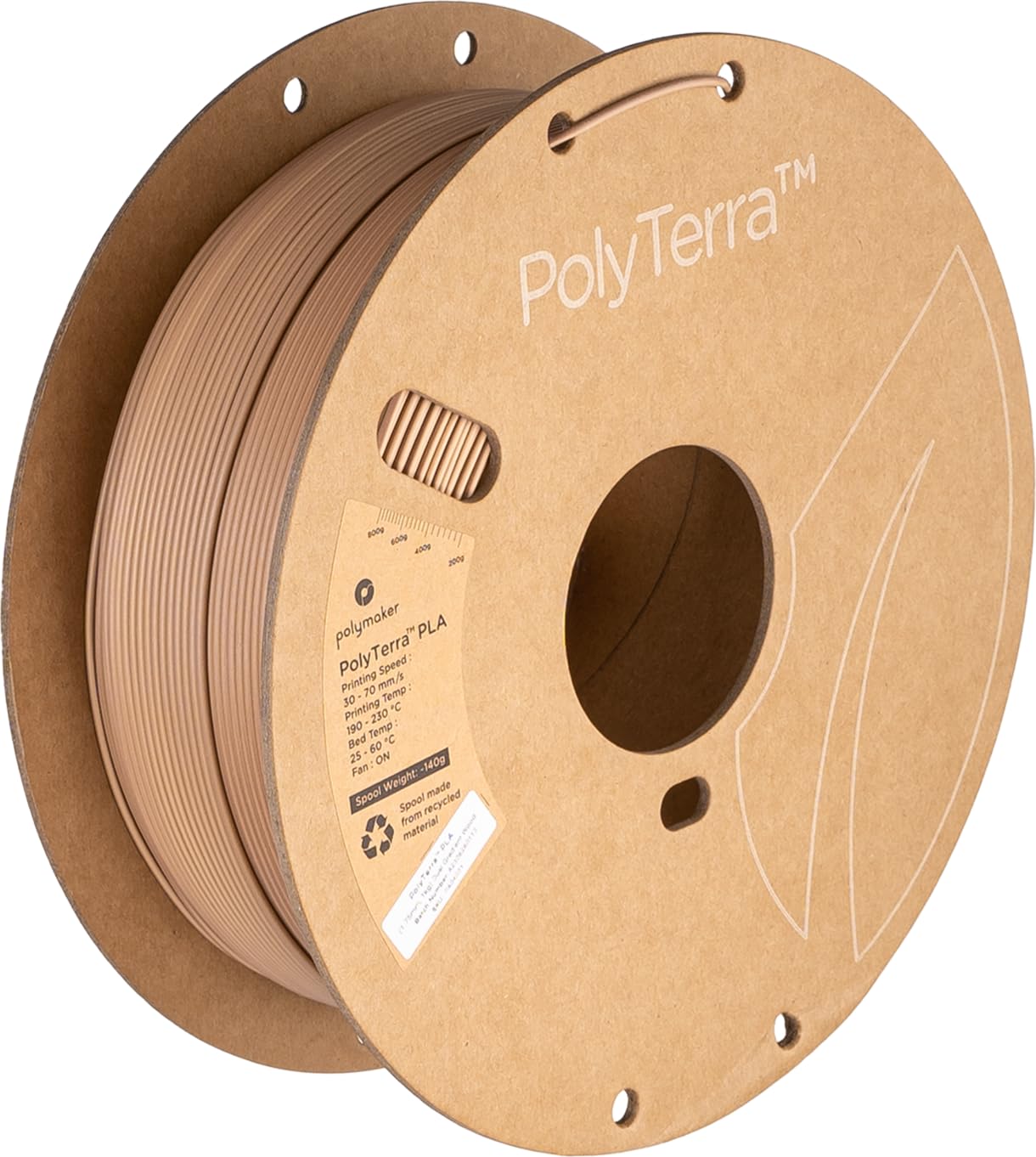
Polymaker Panchroma Matte PLA (formerly PolyTerra PLA)
Polymaker | 1.75mm | 0.5kg, 1kg, 2kg, and 3kg spools
Polymaker rebranded their PolyTerra PLA line to Panchroma Matte in 2025: same formula, same quality, new name that sits clearly alongside their broader Panchroma product family. The filament ships on a cardboard spool that eliminates single-use plastic reel waste, and every spool purchased contributes to Polymaker’s tree-planting partnership with One Tree Planted. The compound is formulated for a matte surface finish that hides layer lines effectively and gives prints a clean, crafted look. Dimensional tolerance is held to plus or minus 0.05mm. Panchroma Matte prints on any standard FDM printer and is available in a very wide colour range across matte, gradient, marble, and dual-tone variants. It is ASTM D6400 certified for industrial composting. One community-noted caveat: the cardboard spool can absorb ambient humidity if left open in a damp environment, which makes the filament harder to dry properly in a standard drybox. Keep the spool sealed in a bag with desiccant between sessions.
Best for: Beginners, everyday printing, anyone who wants eco-friendly packaging alongside a proven filament formula.
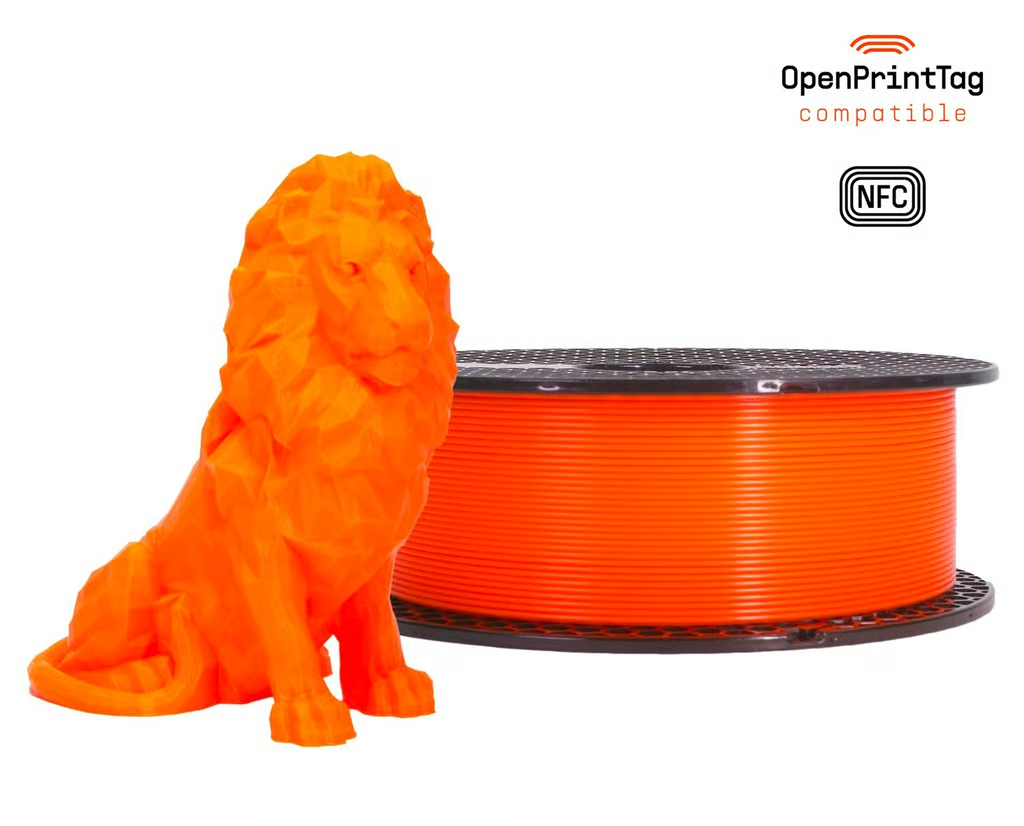
Prusament PLA
Prusa Research | 1.75mm | 1kg spools
Prusament PLA sets the benchmark for dimensional consistency in consumer filament. Prusa manufactures it in their own facility in the Czech Republic and measures every spool during production, and diameter variance is typically held to plus or minus 0.02mm, among the tightest tolerances in the consumer market. The result is print-to-print consistency that budget filaments cannot match, which matters on large or complex prints where diameter drift causes flow inconsistencies. The bio-based PLA compound delivers strong layer adhesion and vivid, accurate colours. Prusament also offer recycled PLA variants (rPLA) covered in the recycled section below. Each spool ships with a QR code linking to the specific production batch data, so you can verify the material you received.
Best for: Users who need consistent results on detailed prints, long print runs, or multi-material systems where diameter drift causes problems.
Bambu Lab PLA Basic
Bambu Lab | 1.75mm | 1kg and 250g spools
Bambu Lab PLA Basic is designed to work seamlessly with Bambu’s AMS (Automatic Material System) multi-colour printing workflow, but it prints perfectly well on any FDM printer. The filament uses a bio-based PLA formulation with an RFID chip embedded in the spool, which allows compatible Bambu printers to read material properties automatically and configure print settings without manual input. For users running Bambu A-series or X-series printers with AMS, this removes the guesswork from filament management entirely. The material delivers clean surfaces, good layer adhesion, and reliable bridging at standard PLA settings. Available in a wide colour range with matte and glossy variants. The 250g refill spool option reduces packaging waste for regular users.
Best for: Bambu Lab printer owners, multi-colour AMS printing, users who want plug-and-play material settings.

Hatchbox PLA
Hatchbox | 1.75mm and 3mm | 1kg spools
Hatchbox is one of the most consistently recommended budget PLA filaments in the 3D printing community, and for good reason. It delivers reliable diameter consistency, strong layer adhesion, and minimal warping at a price that significantly undercuts premium brands. The bio-based PLA compound produces clean surfaces and accurate details on most standard printers. While it lacks the eco-packaging credentials of PolyTerra or the batch traceability of Prusament, the material itself performs well above its price bracket. Hatchbox PLA is available in an extensive colour range and ships in a resealable bag to help protect against moisture. For high-volume hobbyist printing where cost-per-kg matters, Hatchbox is the benchmark budget option.
Best for: High-volume hobbyist printing, prototyping, schools and makerspaces where cost per kilogram is the primary consideration.
Toughened and bio-blended PLA: stronger alternatives at standard print settings
Standard PLA is the most accessible 3D printing material but it has a well-known weakness: brittleness. Toughened PLA formulations address this through two different approaches. The first is blending PLA with PHA (polyhydroxyalkanoate), the bacterially-produced biopolymer covered in the next section. The PHA content improves toughness and also partially improves biodegradability credentials. The second is nano-particle reinforcement, which achieves similar toughness gains without a PHA component. Both types print identically to standard PLA.
Note on colorFabb PLA/PHA: colorFabb’s original PLA/PHA blend, the product that pioneered this category, has been discontinued for retail sale in 1.75mm. It is now only available in bulk orders of 80 or more spools, making it inaccessible to individual buyers. The High-Speed Pro below is colorFabb’s recommended successor for everyday users.

colorFabb High-Speed Pro PLA
colorFabb (Netherlands) | 1.75mm | 1kg spools
colorFabb’s classic PLA/PHA blend, the original toughened PLA reference product, has been discontinued for retail sale in 1.75mm (it is now only available to businesses ordering 80 spools or more). The High-Speed Pro is colorFabb’s recommended successor and a significant upgrade: it is their toughest PLA formulation to date, engineered for high-speed printing at up to 300mm/s while maintaining the bio-based PLA compound that colorFabb has always used. It integrates directly with Bambu Lab high-speed profiles out of the box. The material delivers excellent layer adhesion, no warping, and a smooth surface finish. As a bio-based PLA, it carries the same industrial composting credentials as the PLA/PHA it replaces, without the availability constraints. Available on Amazon with consistent global stock.
Best for: Bambu Lab and other high-speed printer users, functional prints where standard PLA is too brittle, anyone who was previously using colorFabb PLA/PHA and needs a readily available replacement.

Polymaker PolyMax PLA
Polymaker | 1.75mm and 2.85mm | 1kg spools
PolyMax PLA uses Polymaker’s Nano-reinforcement technology to produce a toughened PLA that Polymaker claims delivers up to nine times the impact resistance of standard PLA. The formulation is based on a bio-based PLA compound with added micro-particle reinforcement rather than a PHA blend, but the end result is functionally similar: a PLA-printable material with dramatically improved toughness. Surface quality is excellent, and parts have a smooth, slightly glossy finish with good dimensional accuracy. PolyMax is widely used for snap-fit enclosures, brackets, housings, and functional parts that need to survive repeated handling or mild impacts. It retains the easy-printing characteristics of standard PLA and does not require enclosure or elevated chamber temperatures.
Best for: Snap-fit enclosures, functional brackets, hinges, and any application where standard PLA would crack under stress or repeated use.

colorFabb Vibers PLA (Elephant Grass)
colorFabb (Netherlands) | 1.75mm and 2.85mm | 750g spools
This is one of the more thoughtfully engineered bio filaments on the market. colorFabb collaborated with Dutch company Vibers to add 10% elephant grass cellulose fibers to their PLA/PHA base compound. Elephant grass is a highly efficient carbon-capturing plant that grows on fallow agricultural land, does not require irrigation beyond natural rainfall, and sequesters roughly four times the CO2 per acre compared to a standard European forest. The resulting filament reduces carbon footprint by approximately one third compared to standard PLA, according to colorFabb’s lifecycle assessment. The spool is made from recycled cardboard rather than plastic. Surface finish has a subtle, natural texture with visible fiber hints at close range. Prints behave like standard PLA with slightly improved layer adhesion from the cellulose content.
Best for: Users who want the most credible carbon-reduction story in the PLA-printable range, design and architecture studios with sustainability reporting commitments.
PHA: the genuinely biodegradable option
Polyhydroxyalkanoate (PHA) is a family of biopolymers produced by microorganisms through bacterial fermentation. Bacteria are overfed with a carbon feedstock until they store PHA as intracellular fatty deposits; the material is then extracted and processed into filament. The result is a 100% bio-based, 100% naturally biodegradable polymer that leaves no microplastics behind when it degrades.
Unlike PLA, PHA biodegrades under real-world conditions: home compost, soil, and marine environments. Research published in 2026 confirmed that PHA samples showed noticeable biodegradation within months under indoor soil and home compost conditions. In marine environments, PHA breaks down within approximately six months without generating toxic byproducts. It is certified under the OK Compost HOME and OK Biodegradable MARINE standards, certifications PLA cannot obtain.
The print behaviour requires some adjustment compared to PLA. PHA needs a cold or unheated build plate with 100% fan cooling, which is the opposite of what most warp-prone materials require. Bed adhesion can be less forgiving than PLA on a heated surface. Mechanical strength is broadly comparable to PLA with slightly lower tensile strength but better toughness. The material is also stable above 120°C, which is significantly better than standard PLA’s 60°C limit.
Commercial availability is more limited than PLA, and prices are higher, typically two to three times the cost per kilogram. PHA is not the everyday filament for high-volume printing, but for any application where end-of-life environmental impact genuinely matters, it is the honest answer.
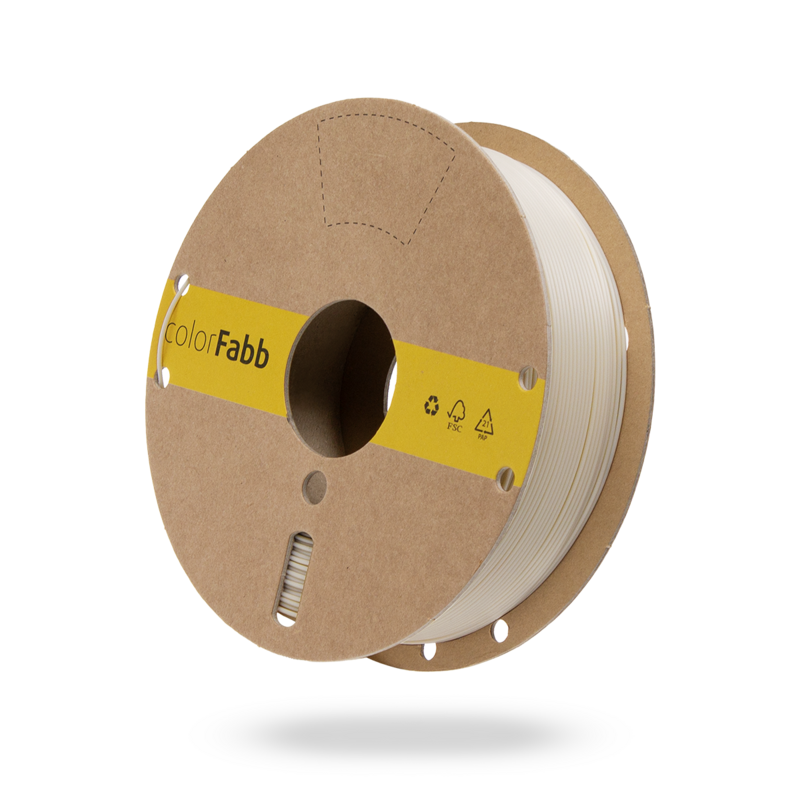
colorFabb allPHA
colorFabb (Netherlands) | 1.75mm and 2.85mm | 750g spools
colorFabb allPHA is the benchmark commercial PHA filament for FDM printing. It is 100% bio-based (produced through bacterial fermentation with no synthetic additives) and 100% biodegradable in home compost, soil, and marine environments without generating microplastics. The cardboard spool eliminates single-use plastic reel waste. PHA shows exceptional layer-to-layer adhesion in most printing conditions and feels notably tough and capable. It is thermally stable above 120°C, significantly better than standard PLA. The counterintuitive requirement: print on a cold or room-temperature bed with 100% fan cooling. A heated bed causes adhesion problems rather than fixing them. Parts that are accidentally left in the garden or outdoor environment will simply biodegrade back into the ground. The material is recognised by soil bacteria as a natural feedstock.
Print note: PHA requires a cold or room-temperature build plate, not a heated one. Use 100% fan cooling from the first layer. This is opposite to most warping-prone materials and catches many first-time PHA users off guard. Community tip: print two copies of the same object simultaneously. The nozzle moving between the two objects naturally gives each layer time to cool before the next is deposited, which helps PHA set correctly without needing very slow speeds or long layer pauses.
Best for: Agriculture (plant labels, markers), education, packaging, any application where the part may end up in the environment and genuine biodegradability matters.

Fillamentum NonOilen
Fillamentum (Czech Republic) | 1.75mm and 2.85mm | 750g spools
NonOilen is Fillamentum’s fully biodegradable and recyclable filament, developed in partnership with the Slovak Technical University. It is a PLA/PHB blend: polylactic acid combined with polyhydroxybutyrate (PHB), which is a specific member of the PHA polymer family. The PHB content meaningfully improves toughness, temperature resistance (up to 110°C, allowing dishwasher-safe prints), and biodegradability compared to straight PLA. NonOilen decomposes in compost approximately three times faster than standard PLA and can be mechanically recycled multiple times with minimal property loss. Fillamentum also operate a filament take-back scheme. One practical note from both the manufacturer and community users: NonOilen sticks strongly to print beds and requires a release agent: 3DLac or PVA glue applied in a thin layer is recommended to prevent the part from bonding too tightly and damaging the bed or print on removal. Availability varies by region; check stock at time of purchase.
Best for: Circular economy projects, product designers with end-of-life recovery systems, professional users who need larger spool sizes alongside genuine biodegradability.
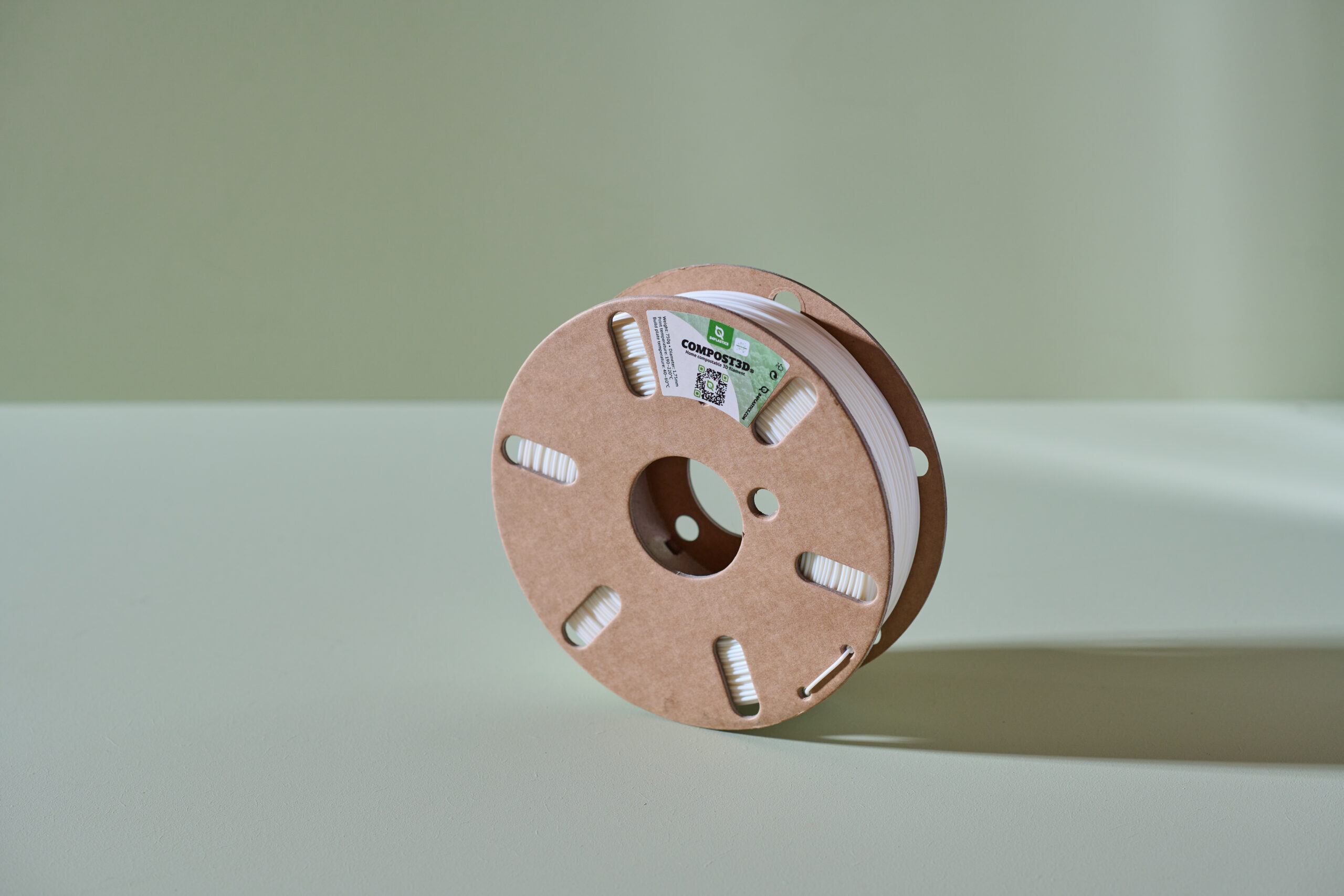
B4Plastics COMPOST3D
B4Plastics (Belgium) | 1.75mm | 750g spools
COMPOST3D from Belgian company B4Plastics pushes the bio-based credentials further than most commercial filaments. The compound is primarily made from natural raw materials, and the company describes it as the most ecologically produced 3D printing filament currently available, and is 100% compostable. B4Plastics focuses on biopolymer research and material development rather than mass-market distribution, which means COMPOST3D is a specialist product for users who specifically need the highest environmental credentials rather than a broadly available everyday filament. Real-world use case examples include compostable surfboard fins (tested at the New Design University in Austria), agricultural markers, and temporary packaging prototypes where the part will be composted at end of use. Availability is primarily through specialist distributors and direct from B4Plastics.
Best for: Researchers, designers, and engineers who specifically need the most ecologically certified filament available and are comfortable sourcing from specialist suppliers.
Recycled PLA (rPLA): the circular option
Recycled PLA is produced from post-industrial waste: primarily off-spec material, failed prints, and production scraps from filament extrusion facilities. This waste is collected, shredded, reprocessed, and extruded into new filament. The result is not bio-based in the plant-feedstock sense, but it is genuinely circular: lifecycle assessment studies consistently show recycled PLA reduces CO2 emissions by approximately 50 to 60% compared to virgin PLA production, primarily through avoided energy costs in raw material synthesis.
Print behaviour is very close to standard PLA. The main practical difference is moisture sensitivity: rPLA is slightly more hygroscopic than virgin PLA and should be dried before printing if it has been stored open. Dry at 45°C for six hours if you notice stringing or bubbling. rPLA can itself be recycled again after use, supporting a multi-cycle circular workflow, though each reprocessing cycle slightly degrades mechanical properties.
For users and organisations with sustainability reporting commitments, rPLA offers a measurable, verifiable CO2 reduction that is easier to document than the qualitative claims attached to standard “eco PLA” marketing.
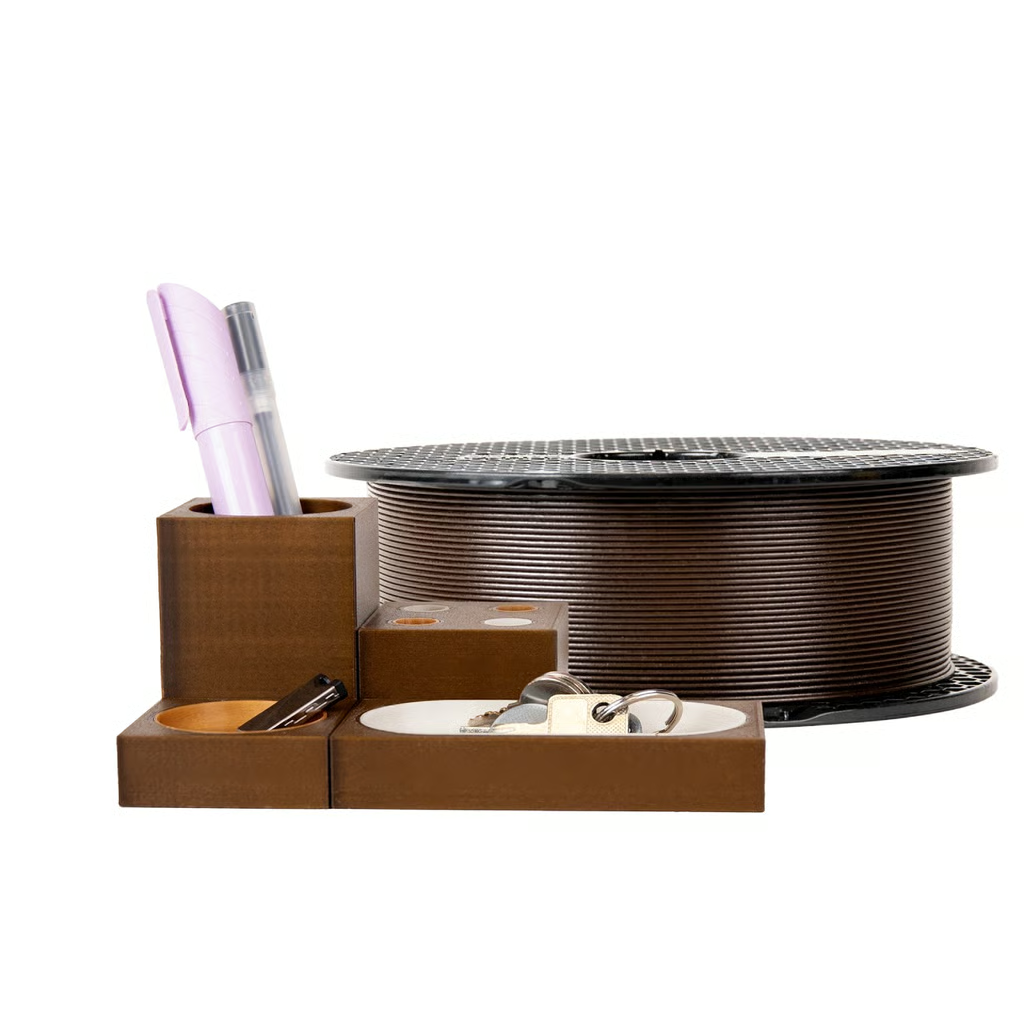
Prusament rPLA Recycled
Prusa Research | 1.75mm | 1kg spools
Prusament rPLA is produced from post-industrial PLA waste and maintains the same tight diameter tolerances (+/- 0.02mm to +/- 0.03mm) that make Prusament standard PLA a benchmark product. Prusa has expanded the line to include variants coloured using organic waste pigments: Algae Pigment (brown, from red algae pharmaceutical byproduct), Wine Pigment (Bordeaux, from grape pomace), Corn Pigment (beige, from processed corn), and Risotto Pigment (creamy white, from food leftovers). These are genuine circular-economy ingredients: waste streams from food and pharmaceutical production repurposed as colourants. The pigmented variants are slightly more brittle than standard PLA and prone to stringing if not dried, but they offer a unique material story that no other consumer filament brand has matched. Each spool batch is traceable via QR code.
Best for: Users who want verifiable CO2 reduction with no print quality compromise, organisations with sustainability reporting needs, Prusa printer owners.

FormFutura ReForm rPLA
FormFutura (Netherlands) | 1.75mm and 2.85mm | 750g and 2.3kg spools
FormFutura’s ReForm rPLA is part of the company’s dedicated sustainable filament line, produced from post-consumer and post-industrial PLA waste. The Dutch company has been manufacturing premium filaments since 2012 and applies the same quality controls to their recycled line as to their standard products. ReForm rPLA prints identically to standard PLA and is available in both 1.75mm and 2.85mm diameters, with the latter being important for users of Ultimaker and other 2.85mm-format printers. The larger 2.3kg spool option reduces per-gram packaging waste for high-volume users. FormFutura’s Netherlands manufacturing means European buyers benefit from shorter supply chains and lower transport emissions compared to filaments shipped from Asia.
Best for: European buyers, Ultimaker and 2.85mm printer users, high-volume users who want recycled filament in larger spools.
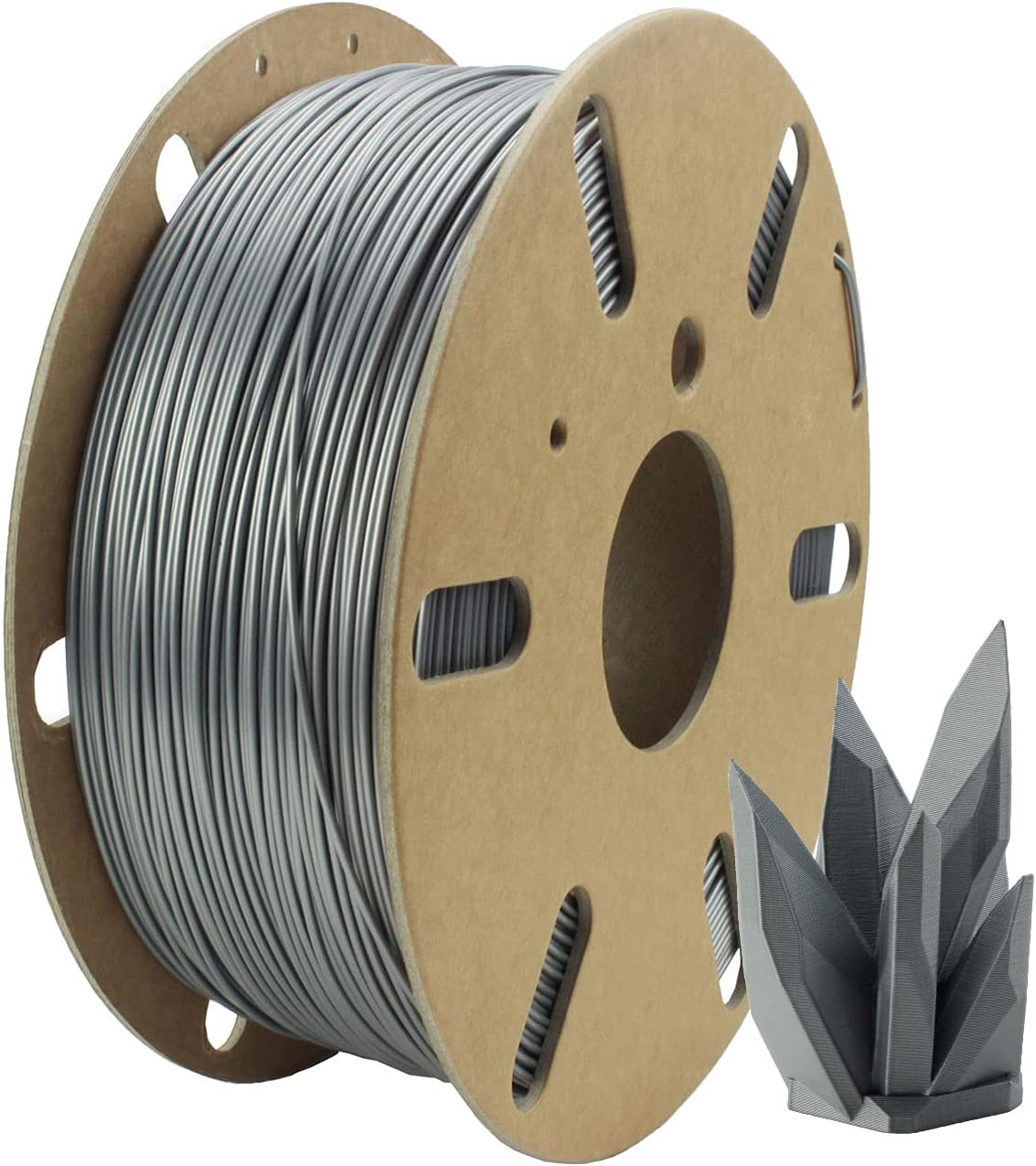
Filamentive Recycled PLA
Filamentive (UK) | 1.75mm and 2.85mm | 500g and 1kg spools
Filamentive is a UK-based company that manufactures its rPLA using post-industrial extrusion waste and has its recycled content claim independently verified to ISO 14021, the international standard for self-declared environmental claims. As of mid-2025, their PLA contains a verified 50% recycled content. This ISO verification distinguishes Filamentive from brands that make recycled content claims without third-party validation. The company is also transparent about what industrial composting means for PLA, publishing a detailed guide on their website correcting the biodegradability myths common in the category. They also run a free PLA recycling take-back service for UK customers. Print quality is solid across both diameter options.
Best for: Buyers who need independently verified recycled content for procurement or reporting, UK users, anyone who values transparency over marketing language in the sustainability space.
Upcycled filaments: waste streams given a second life
Upcycled filaments go a step further than standard recycled material. Where rPLA typically uses clean post-industrial manufacturing scraps that would have been reprocessed anyway, upcycled filaments start from waste streams that had no viable alternative end-of-life route: decommissioned fishing nets, algae blooms, ocean-recovered plastic, agricultural byproduct, and food processing waste. The environmental case is stronger because you are diverting material from landfill, ocean, or incineration, not just reprocessing clean factory offcuts.
The trade-off is consistency. Upcycled feedstocks are inherently harder to clean and homogenise than post-industrial waste, which means diameter variation, occasional impurities, and batch-to-batch colour variation are more common in this category than in standard recycled or virgin filaments. Always dry upcycled filaments thoroughly before printing and check recent user reviews for the specific batch you receive.
Despite these caveats, upcycled filaments are among the most genuinely impactful materials in the category, and the origin stories make them compelling for brands and designers who want to communicate sustainability credentials to their customers.
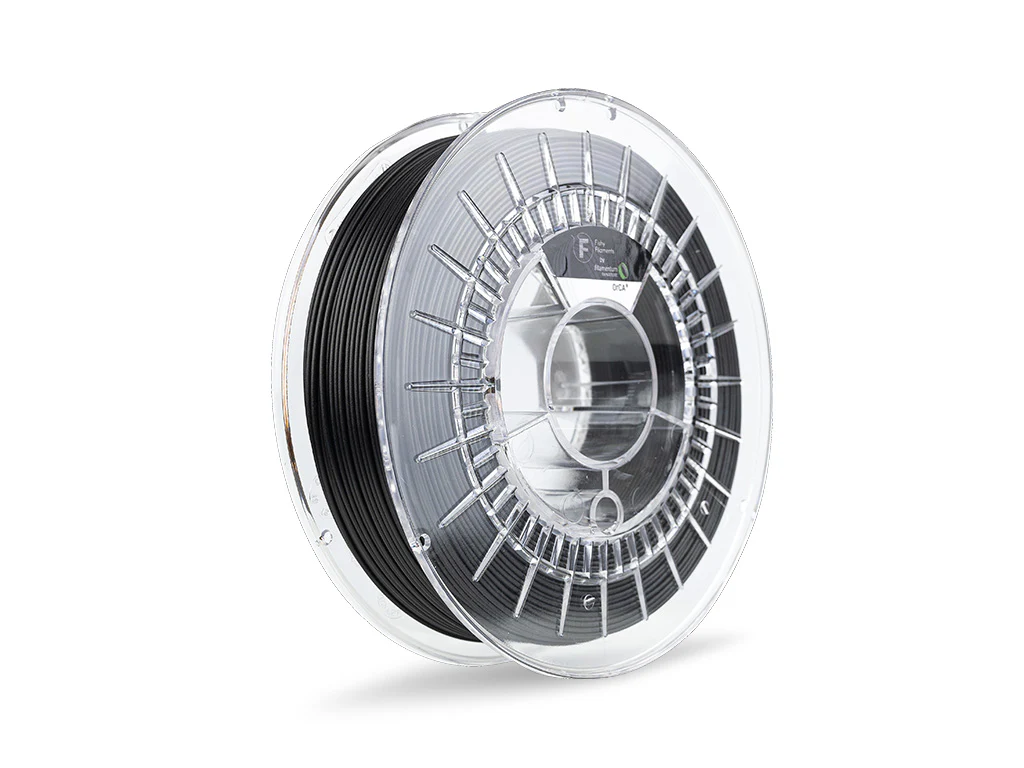
OrCA Reclaimed PA6 (formerly Fishy Filaments)
OrCA / Fishy Filaments (Cornwall, UK) | 1.75mm | 500g spools
OrCA (formerly Fishy Filaments) is a Cornish company that converts decommissioned fishing nets, one of the ocean’s most persistent and destructive waste streams, into nylon PA6 filament. The company rebranded from Fishy Filaments to OrCA to better reflect its expanded B2B focus, but the mission and process are unchanged. Ghost fishing gear (nets lost or abandoned at sea) is responsible for a significant proportion of ocean plastic pollution. OrCA works directly with fishing communities in Cornwall to collect decommissioned nets before they enter the ocean, processes them in the UK using only water and power, and extrudes filament with full chain-of-custody traceability. The process produces material with less than 3% of the carbon impact of virgin nylon. The resulting PA6 has good mechanical properties: nylon toughness and flexibility, and prints on any printer capable of handling nylon (all-metal hotend, 240 to 260°C, dry storage essential).
Best for: Product designers and brands who need a compelling and verifiable ocean-impact story, functional nylon parts where the sustainability origin can be communicated to end customers.
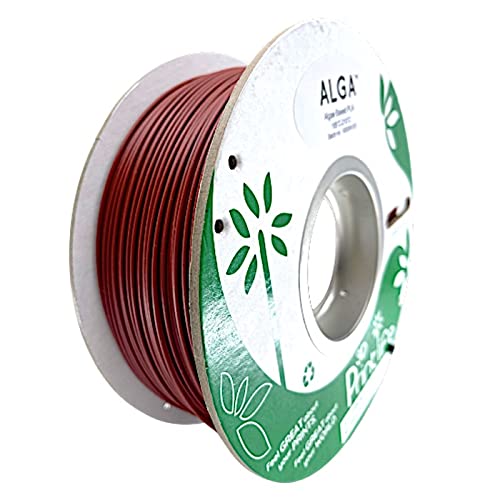
3D Printlife ALGA
3D Printlife / Algix (USA) | 1.75mm and 2.85mm | 1kg cardboard spool
ALGA is made from nuisance algae physically removed from lakes and ponds where algal blooms were damaging the surrounding ecosystem. Harmful algal blooms deplete oxygen, generate toxins, and throw aquatic environments out of balance. Algix harvests this algae, dries and processes it, then blends it into a PLA compound to produce ALGA filament. The environmental story is genuinely circular: the algae had no other practical use and was actively causing harm where it was growing. Prints have an earthy, organic texture that resembles bone or sandstone, with a natural colour palette. ALGA is certified to ASTM D6400 biodegradability standards, prints at standard PLA temperatures without a heated bed, and is wound onto a 100% recycled cardboard spool. It has been available on Amazon since 2021 and has been named by All3DP as one of the best biodegradable filaments.
Best for: Makers who want a proven, Amazon-available upcycled filament with a genuine environmental remediation story and a distinctive earthy surface finish.

Prusament rPLA Wine Pigment
Prusa Research (Czech Republic) | 1.75mm | 1kg spool
Prusament rPLA Wine Pigment is made from 100% recycled PLA sourced from industrial foil manufacturing waste, then coloured with dried pigment from red wine grape skins, a byproduct of the winemaking process. No synthetic dyes are used anywhere in the filament. The Bordeaux-red colour is entirely derived from processed grape waste, and the pigment can only be produced during the two-month red wine harvest season (September and October), which means each batch has a distinctive, slightly variable shade. Prusa calculated the full carbon footprint of this filament line as part of their sustainability reporting. Prints have the same dimensional accuracy as standard Prusament PLA (plus or minus 0.03mm) but the material is slightly more brittle and hygroscopic than regular PLA, making it best suited to decorative and display prints rather than functional parts. Keep it in a dry box and dry at 45°C for six hours before printing if moisture is suspected.
Best for: Home decor, display models, sustainable design projects where a distinctive Bordeaux tone and a genuine no-synthetic-dye story are part of the brief.
Wood and natural fiber filaments: organic finishes on any printer
Wood filaments combine a PLA base with 20 to 40% natural particles: pine, bamboo, cork, cedar, birch, coconut, or other wood types. The PLA base keeps them printable on standard FDM printers with no hardware modifications; the natural fill gives prints a matte, fibrous surface that looks and feels like particle board or MDF. Wood-printed parts can be sanded, stained, painted, waxed, and even scorched to create an aged or distressed appearance, none of which are possible with standard PLA.
The most useful technique with wood filament: print temperature controls the darkness of the finish. Printing at the lower end of the temperature range (170 to 180°C) keeps the wood particles pale and unstained. Raising the temperature gradually burns the fibers slightly, producing progressively darker, more aged-looking tones. This lets you achieve a range of finishes from a single spool without any post-processing.
Practical notes: wood particles are mildly abrasive, so a 0.4mm or larger nozzle is recommended, and a hardened steel nozzle is wise for extended printing. Remove the filament from the hotend soon after finishing a print. Wood particles left sitting in a hot nozzle will scorch and cause clogs. Store in a dry, sealed bag as wood filaments are hygroscopic.
On the sustainability side: wood filament shares PLA’s industrial-composting-only caveat, but the natural filler is benign if the part eventually ends up in the environment. Bamboo, cork, and coconut-based variants come from fast-growing, low-impact plant sources that add a genuine bio-content story.
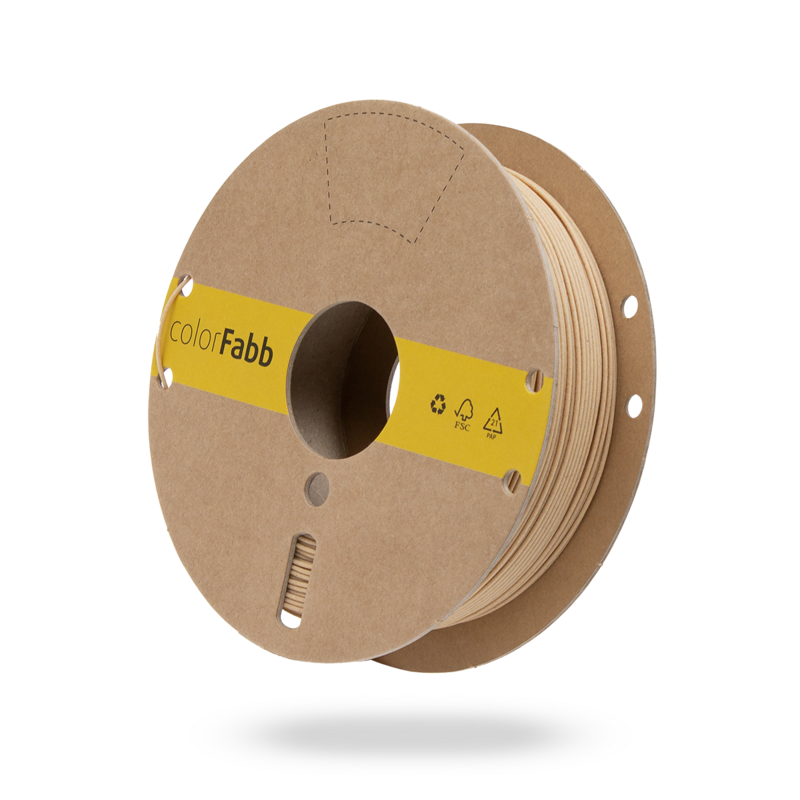
colorFabb woodfill
colorFabb (Netherlands) | 1.75mm and 2.85mm | 750g spools
colorFabb woodfill is the reference product in the wood filament category and has been for over a decade. It combines a PLA/PHA base with fine pine wood particles, producing prints with an authentic wood scent during printing and a matte, fibrous surface finish that takes staining, sanding, and carving well. The PLA/PHA base improves toughness over a plain PLA base, which helps with post-processing. Prints can be worked with woodworking tools: sanded, filed, drilled, and etched with a hot knife or soldering iron. colorFabb also produce bamboofill (bamboo particles, more versatile but trickier to dial in) and corkfill (cork particles, lighter weight, darker tone) as variants within the same line. All three are part of their PLA/PHA base system and share the same bio-credentials.
Best for: Decorative objects, home decor, art and craft applications, architects and designers who want organic-finish prototypes, anyone new to wood filament.

Prusament Woodfill Linden Light
Prusa Research (Czech Republic) | 1.75mm | 1kg spools
Prusament Woodfill Linden Light is Prusa’s in-house wood-filled filament and stands out from most wood filaments in one key way: it prints reliably on a standard 0.4mm brass nozzle without needing an upgrade to 0.6mm. Most wood filaments require the larger nozzle to avoid clogs, which is a barrier for beginners. The wood used in the compound comes from wood manufacturing process waste, giving it a genuine sustainability story alongside the wood aesthetics. Prints look, feel, and smell like real wood and, unlike foamed wood mimics with no actual wood content, can be stained using the same wood stains used on furniture. Temperature control affects darkness as with other wood filaments: lower temperatures produce paler finishes, higher temperatures produce darker, more aged tones. No pre-drying required before printing, which removes another common friction point. The colour is based on linden wood (Czech national tree), giving it a warm, natural off-white starting tone. Available direct from Prusa and US and EU distributors.
Best for: First-time wood filament users, decorative prints and home decor, anyone who wants genuine wood staining capability without upgrading their nozzle.

Fillamentum Timberfill
Fillamentum (Czech Republic) | 1.75mm and 2.85mm | 750g spools
Timberfill is Fillamentum’s wood-fill PLA product and occupies the premium end of the wood filament category. The filament uses fine pine particles in a PLA base and is 100% biodegradable (industrial composting). Fillamentum offers Timberfill in multiple wood tones: Light Wood, Cinnamon, and Hazelnut Brown, which let you select a starting colour before applying temperature control for shade variation. The formulation delivers reliable clog-free printing when used with a 0.4mm or larger nozzle and responds well to all standard post-processing techniques. Available in 2.85mm as well as 1.75mm, making it a strong option for Ultimaker owners who find wood filament options in that diameter limited.
Best for: Premium decorative work, 2.85mm printer users, projects where multiple wood tones from the same brand are needed.
Bio filament comparison: all types at a glance
| Material | Bio-based | Industrial compostable | Home compostable | Recycled/upcycled | Print difficulty | Relative price |
|---|---|---|---|---|---|---|
| Standard PLA | Yes | Yes | No | No | Easy | Low (from ~$15/kg) |
| Toughened PLA / PLA/PHA blend | Yes | Yes | Partial (PHA variants only) | No | Easy | Low-Mid (~$25/kg) |
| PHA (pure) | Yes | Yes | Yes | No | Moderate (cold bed required) | High (~$50-80/kg) |
| Recycled PLA (rPLA) | Partial | Yes | No | Yes (recycled) | Easy (dry first) | Low-Mid (~$20-30/kg) |
| Upcycled (e.g. fishing net PA6) | No | No | No | Yes (upcycled) | Moderate to hard | Mid-High (varies) |
| Upcycled (PA6 fishing nets, algae PLA, wine pigment rPLA) | Yes | Yes | No | Yes (upcycled filler) | Easy (hardened nozzle advised) | Mid (~$30-40/kg) |
| Wood/natural fiber PLA | Yes | Yes | No | No | Easy-Moderate | Mid (~$25-40/kg) |
Frequently asked questions
Where to go next
Most bio filaments print on any standard FDM machine, so if you are still choosing hardware, start with our best 3D printers guide. PLA, PHA, and other bio filaments absorb moisture over time, so dry damp spools in a filament dryer before printing. New to printing? Read what is 3D printing and keep the 3D printing glossary handy for terms like compostable, hygroscopic, and PHA. Need a tougher material? The engineering filaments guide covers PETG, nylon, and polycarbonate, and the 3D printing safety guide covers ventilation for higher-temperature materials. Most bio spools are PLA based, so for tested PLA brands and finishes see our Best PLA Filament guide.
Explore the filament guides
Some links on this page are affiliate links. If you buy through them we may earn a small commission at no additional cost to you. This never affects which products we feature or how we rank them.