3D Printing
News Videos Newsletter Contact us
Home / Types of 3D Printing: FDM, SLA, SLS, DLP and MJF Explained

Types of 3D Printing: FDM, SLA, SLS, DLP and MJF Explained

There are several types of 3D printing, and they are best understood by the form of material they use: filament (FDM/FFF), resin (SLA and DLP), powder (SLS and MJF), and metal (DMLS/SLM). Each one builds objects layer by layer, but uses a different mechanism, melting, light-curing, or fusing, which gives each its own strengths, costs, and ideal uses.

This guide compares the main technologies so you can see how they differ. It is part of our complete introduction to what 3D printing is; for the general workflow they all share, see how 3D printing works.
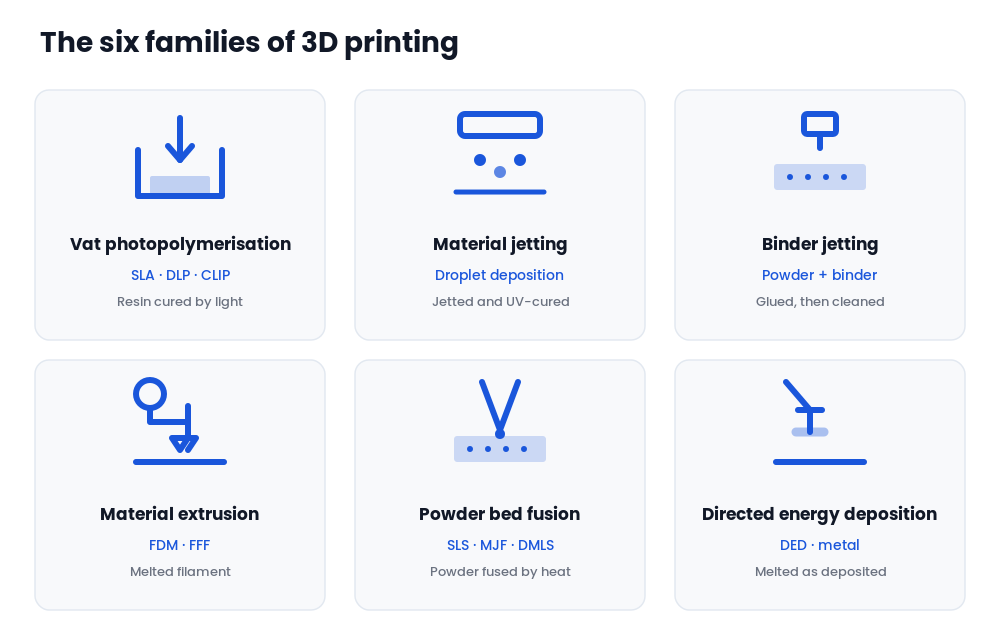
Overview of the main families of 3D printing technology, grouped by filament, resin, powder, and metal

Jump to a section

Comparison table
FDM / FFF (filament)
SLA & DLP (resin)
SLS & MJF (powder)
Metal (DMLS / SLM)
Which is right for you

3D printing technologies compared

The table below is the fast version. Each technology name links to its full section further down the page.

Technology
Material
How it works
Strengths
Best for
FDM / FFF
Plastic filament
Melts and extrudes filament through a nozzle
Affordable, accessible, easy
Beginners, prototypes, everyday prints
SLA
Liquid resin
UV laser cures resin point by point
Very high detail, smooth surfaces
Miniatures, jewelry, dental
DLP
Liquid resin
UV projector cures a whole layer at once
Fast, high detail
Detailed parts at speed
SLS
Nylon powder
Laser fuses powder layer by layer
Strong parts, no supports needed
Functional parts, small production
MJF
Nylon powder
Fusing agent plus heat fuse powder
Fast, consistent, smooth finish
Production-grade nylon parts
DMLS / SLM
Metal powder
Laser fuses metal powder
Real metal parts
Aerospace, engineering, industrial

FDM / FFF (filament)

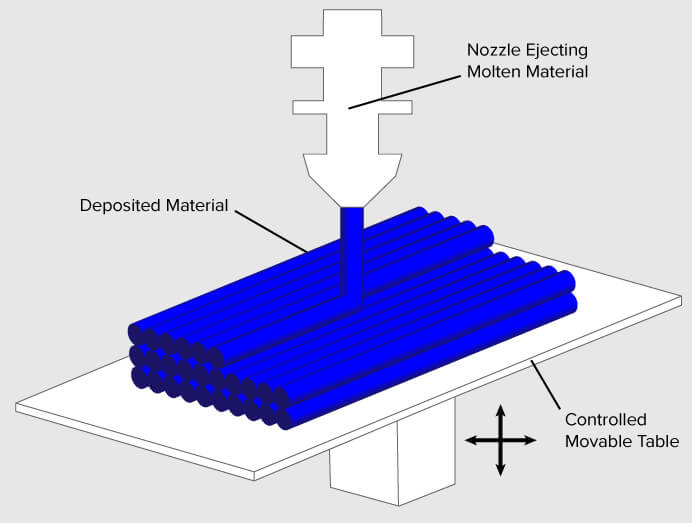
Fused deposition modeling FDM process diagram: filament is fed through a heated nozzle and extruded onto a build plate layer by layer

Fused Deposition Modeling (also called Fused Filament Fabrication) is the most widely used type of 3D printing, and almost certainly what you picture when you think of a desktop 3D printer. It works by melting a plastic filament and extruding it through a heated nozzle, depositing it layer by layer onto the build plate.

FDM is cost-effective, widely available, and beginner-friendly. The trade-off is visible layer lines and lower fine detail than resin. It is the right tool for prototypes, functional parts, and everyday printing, and the sensible first technology for almost everyone. Material choice does a lot of the work here; our 3D printer filament guide explains which plastic suits which job.

SLA & DLP (resin)
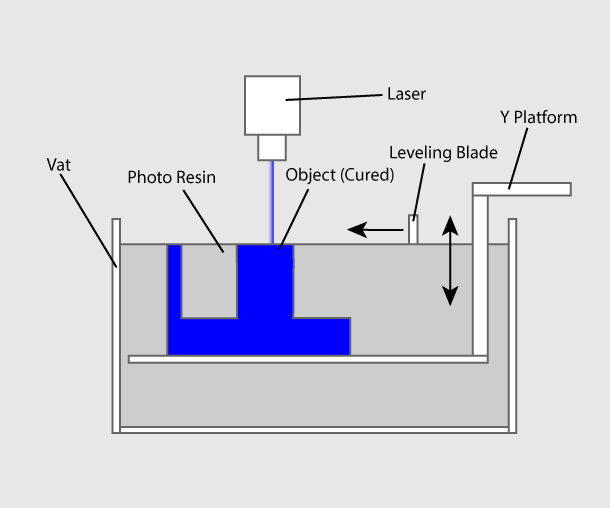
Vat photopolymerisation process diagram: a UV light source cures liquid resin onto a build platform layer by layer

Stereolithography (SLA) and Digital Light Processing (DLP) both build parts by curing liquid photopolymer resin with ultraviolet light. The difference is how. SLA uses a focused UV laser that traces each layer point by point, while DLP uses a projector that flashes an entire layer at once, which makes DLP faster.

Both deliver extremely fine detail and smooth surfaces, making them the go-to for miniatures, jewelry, and dental models. The trade-offs: resin parts can be more brittle, and post-processing (washing and curing) is messier than anything in the filament world. For a deeper head-to-head with filament printing, see FDM vs resin 3D printing.

SLS & MJF (powder)
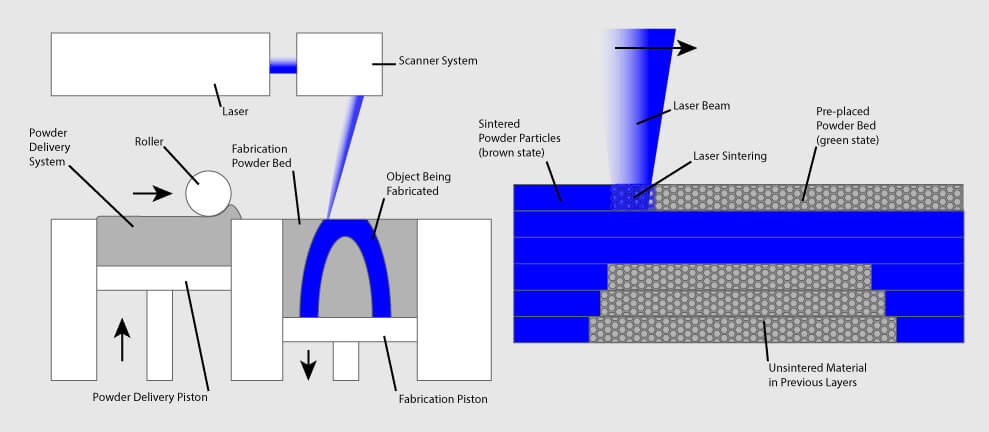
Powder bed fusion process diagram: a laser fuses powder in a bed, then a roller spreads a fresh layer

SLS (Selective Laser Sintering)

Selective Laser Sintering uses a laser to fuse fine nylon powder into solid parts. Because the surrounding loose powder supports the part as it builds, SLS needs no support structures, which frees up complex geometries that other technologies struggle with. The result is strong, durable, accurate parts, well suited to functional prototyping and small-scale production. The surface comes out slightly grainy, and the machines sit mostly in the professional and industrial tier rather than on desktops.

MJF (Multi Jet Fusion)

Multi Jet Fusion, developed by HP, also builds with nylon powder, but instead of a laser it uses an inkjet array to apply a fusing agent, then a heating element passes over to fuse each layer. Compared with SLS, MJF tends to deliver more consistent mechanical properties, a smoother finish, and faster build times, which lowers per-part cost at volume. It is a popular choice for production-grade nylon parts. If you searched for an “MJF printer”, this is the technology behind it.

Metal 3D printing (DMLS / SLM)

Metal 3D printing fuses metal powder layer by layer using a high-powered laser. Direct Metal Laser Sintering (DMLS) and Selective Laser Melting (SLM) are the main methods, and they produce real, functional metal parts for aerospace, automotive, medical, and engineering applications. This is an industrial-tier technology with higher costs and specialized equipment, and it is where 3D printing stops being a workshop tool and becomes a production process.

There is more to metal printing than DMLS and SLM, including binder jetting and directed energy deposition. Our dedicated guide to the types of metal 3D printing covers the full metal landscape.

Which type of 3D printing is right for you?

It comes down to what you value most:

  • Lowest cost and easiest start: FDM/FFF. Best for beginners and general use.
  • Maximum detail and smooth finish: resin (SLA/DLP). Best for miniatures and fine models.
  • Strong, functional parts without supports: SLS or MJF (powder). Best for engineering and production.
  • Real metal parts: DMLS/SLM. Industrial applications.

For most people starting out, FDM is the sensible first machine, and everything you learn on it transfers if you later add a resin printer for detail work. New to the machines themselves? Start with what a 3D printer is.

Frequently asked questions

Which type of 3D printing is best for beginners?

FDM (filament) is the best starting point. It is the most affordable, the easiest to learn, and has the widest range of printers and materials.

What is the difference between FDM and resin printing?

FDM melts and extrudes plastic filament and is cheaper and more forgiving; resin (SLA/DLP) cures liquid resin with UV light for much finer detail but with messier handling. See FDM vs resin 3D printing for the full comparison.

How many types of 3D printing are there?

The most common technologies fall into five core families, FDM/FFF, SLA/DLP, SLS, MJF, and metal (DMLS/SLM), grouped by whether they use filament, resin, powder, or metal.

Ready to pick a machine?

Most popular guide

Best 3D Printers of 2026 ↗

Our flagship buyer’s guide: the best picks at every price and skill level, from your first machine to a prosumer workhorse.

For fine-detail work

Best Resin 3D Printers ↗

The SLA and DLP machines worth buying for miniatures, models, and dental-grade detail, plus the safety kit to run them properly.

About this guide

3DPrinting.com has covered additive manufacturing since 2012. This overview is updated as the technology and the consumer market evolve. Last reviewed: July 6, 2026.

About the author

Robert is co-founder of 3DPrinting.com and has worked in the industry since the site launched in 2012. LinkedIn ↗

Join our newsletter

Our newsletter is free & you can unsubscribe any time.

Social

  • Facebook Facebook 3D Printing
  • Linkedin Linkedin 3D Printing
Join our newsletter

Our newsletter is free & you can unsubscribe any time.

Featured Industries

  • Automotive
  • Aerospace
  • Construction
  • Dental
  • Environmental
  • Electronics
  • Fashion
  • Medical
  • Military
  • Flashforge AD5X

    • - Print size: 220 x 220 x 220 mm
    • - dual extrusion system
    More details »
    $399.00 Flashforge
    Buy Now
  • Creality Hi Combo

    • - Print size: 260 x 260 x 300 mm
    • - up to 16-color printing
    More details »
    $399.00 Creality
    Buy Now
  • Creality K2 Plus

    • - Print size: 350 x 350 x 350 mm
    • - multi-color printing
    More details »
    $1,199.00 Creality
    Buy Now
  • Qidi Q2

    • - Print size: 270 x 270 x 256 mm
    • - enclosed heated chamber up to 65°C
    More details »
    $580.00 Qidi
    Buy Now
  • Snapmaker U1

    • - Print size: 270 x 270 x 270 mm
    • - multi-color printing with SnapSwap
    More details »
    $849.00 Snapmaker
    Buy Now
  • Flashforge Adventurer 5M

    • - Print size: 220 x 220 x 220 mm
    • - 600mm/s travel speed
    More details »
    $299.00 Flashforge
    Buy Now
  • Qidi Max 4

    • - Print size: 390 x 390 x 340 mm
    • - active cooling air control
    More details »
    $1,219.00 Qidi
    Buy Now
  • Anycubic Kobra S1 Combo

    • - Print size: 250 x 250 x 250 mm
    • - budget multicolor printing
    More details »
    $429.00 Anycubic
    Buy Now
  • Flashforge Guider 3 Ultra

    • - Print size: 330 x 330 x 600 mm
    • - dual extruder system
    More details »
    $2,999.00 Flashforge
    Buy Now
  • Anycubic Photon Mono M7

    • - Print size: 223 x 126 x 230 mm
    • - 10.1 inch 14K screen
    More details »
    $279.00 Anycubic
    Buy Now

Company Information

  • What is 3D Printing?
  • Contact us
  • Join our mailing list
  • Advertise with us
  • Media Kit
  • Nederland 3D Printing

Blog

  • Latest News
  • Use Cases
  • Reviews
  • 3D Printers
  • 3D Printing Metal

Featured Reviews

  • Anycubic Photon Mono M5s
  • Creality Ender 5 S1
  • The Mole 3D Scanner
  • Flashforge Creator 3 Pro

Featured Industries

  • Automotive
  • Aerospace
  • Construction
  • Dental
  • Environmental
  • Electronics
  • Medical
  • Military
  • Fashion
  • Art
2026 — Strikwerda en Dehue
  • Home
  • Join our mailing list
  • Contact us
Blog
  • Latest News
  • Use Cases
  • Reviews
  • 3D Printers
  • 3D Printing Metal
Featured Industries
  • Automotive
  • Aerospace
  • Construction
  • Dental
  • Environmental
  • Electronics
  • Medical
  • Military
  • Fashion
  • Art
Company Information
  • What is 3D Printing?
  • Contact us
  • Join our mailing list
  • Advertise with us
  • Media Kit
  • Nederland 3D Printing