
Researchers at the Hong Kong University of Science and Technology (HKUST) have 3D printed a titanium alloy that keeps hardening as it deforms.
That tackles a long-standing limit of the metal. Titanium alloys go into aerospace, automotive and biomedical parts because they combine high specific strength, corrosion resistance and biocompatibility. Yet conventional grades have limited strain-hardening capability. Once these alloys start to deform permanently, strain tends to pile up in one spot. This has kept them out of many safety-critical structures.
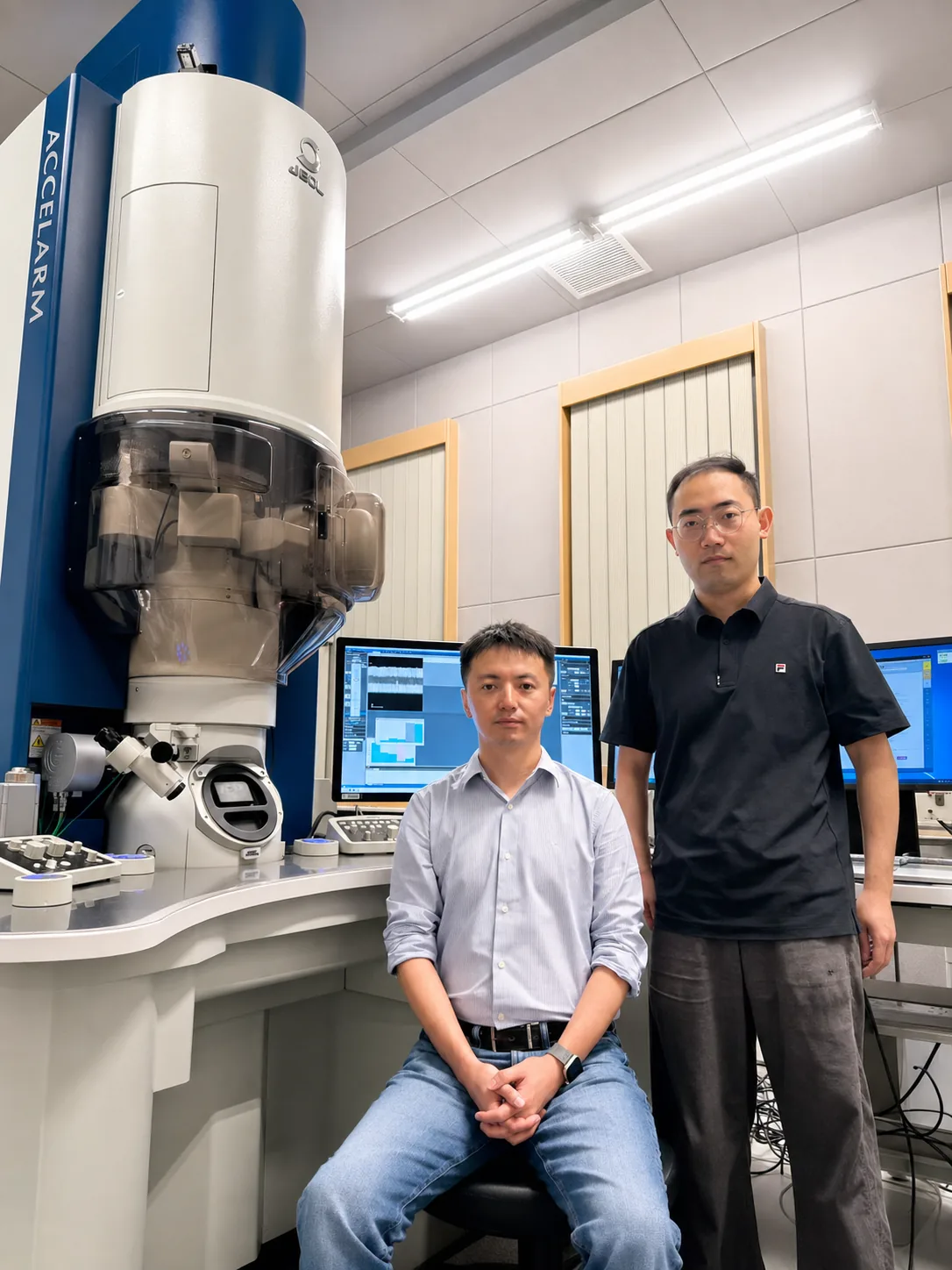
Led by Zhang Tianlong, an assistant professor in the HKUST Department of Mechanical and Aerospace Engineering, the team broke with alloy design that aims for one uniform chemistry. Instead, it used in situ alloying during laser powder bed fusion to run interconnected, microscale waves of molybdenum through Ti-6Al-4V. These 3D compositional waves split the alloy into regions with different phase stabilities, and each region deforms in its own way.
Where molybdenum is low, the microstructure holds α’ martensite formed during cooling, which deforms by detwinning and retwinning. Medium-molybdenum zones carry a metastable β phase that gradually transforms to martensite under stress. By contrast, the high-molybdenum regions consist of stable β, which deforms mainly through dislocation slip.
What makes the design work is that these mechanisms do not act alone. Because the regions push against one another, their interactions create heterogeneous-deformation-induced (HDI) stresses, so each mechanism switches on in turn as the applied stress climbs. That sequential, cooperative process keeps the alloy hardening and delays strain localization.
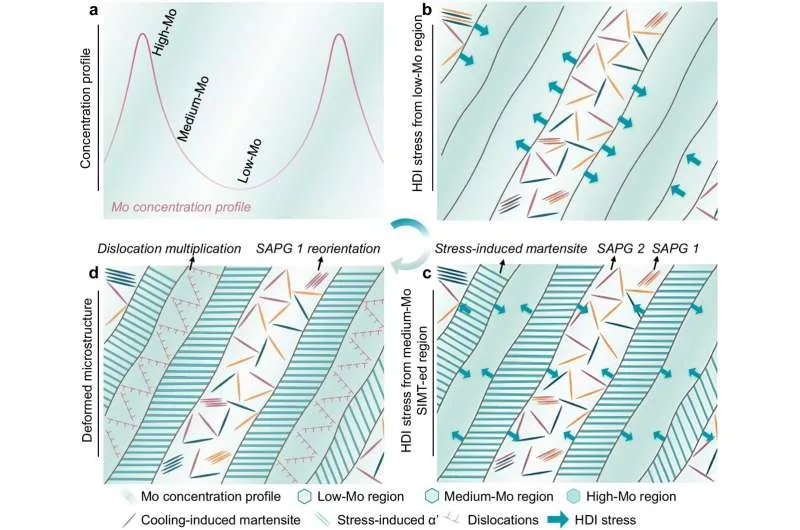
The numbers show how far that goes. The resulting Ti64-6Mo alloy reaches a strain-hardening increment of about 557 MPa, more than double the typical upper limit for conventional titanium alloys. It does so while also reaching a tensile strength of 1,236 MPa and a uniform elongation of 11.5 percent.
The study also turns a familiar trait of metal printing into a design tool. Rather than fighting the compositional heterogeneity that forms during additive manufacturing, the team put it to work. That unevenness now sets phase stability region by region and coordinates several deformation mechanisms inside one material.
Zhang sees that as a fresh lever for alloy designers, because composition no longer has to be uniform. “This study shows that alloy design does not have to focus solely on the overall uniform chemical composition. By controlling how alloying elements are distributed in three-dimensional space, we can coordinate multiple deformation mechanisms within a single material,” he said. “Compositional architecting opens up an extra degree of freedom for designing the next generation of high-performance structural alloys.”
The group presents compositional architecting as a new design paradigm for highly strain-hardenable titanium alloys, one that may extend to other advanced structural materials. The paper, with Yaorui Ma as first author, appears in Nature Communications under the title “Compositional architecting by additive manufacturing enables hardenable titanium alloys.”
Source: HKUST