
Nikon SLM Solutions and Bosch Industry Consulting have produced a complete V8 engine block as a single printed part, using the NXG XII 600 laser powder bed fusion system at the Bosch Additive Solution Center in Nuremberg, Germany. The block was printed in AlSi10Mg aluminum, with no casting and no tooling required.
Conventional cylinder block production requires tooling that takes weeks or months to develop before a single production part can be made. Design changes mean tooling modifications, adding time and cost to every iteration. With the NXG XII 600, the block was produced directly from a digital file, bypassing those constraints entirely and opening up geometries, including integrated cooling channels and topology-optimized structures, that casting can’t reliably achieve.
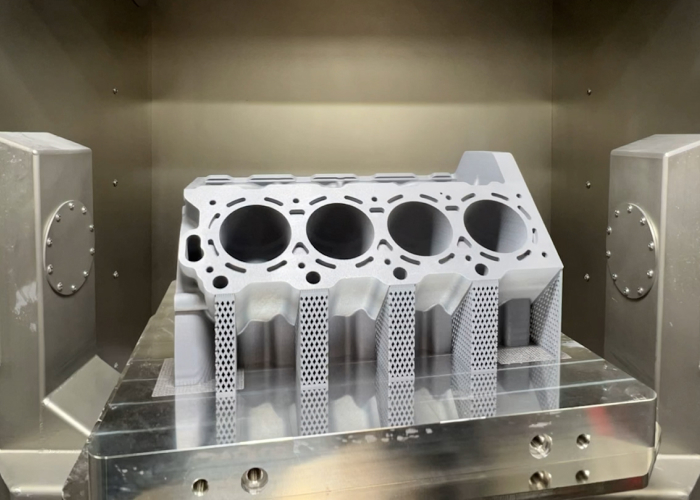
Weight reduction is among the most immediate payoffs. By placing material only where structural analysis shows it’s needed, additive manufacturing produces components lighter than their cast equivalents without sacrificing performance. In motorsport and high-performance automotive applications, that kind of mass savings translates directly into competitive advantage.
The project also reflects a broader strategic point about where AM needs to take root. An estimated 60 to 80 percent of components in a finished vehicle aren’t made by the OEM, but by tier 1 and tier 2 suppliers. Bosch is one of the world’s largest tier 1 automotive suppliers, and the collaboration brings Bosch’s manufacturing expertise together with Nikon SLM Solutions’ process parameters, materials qualification, software, and application engineering. That’s a different proposition than simply selling a machine.
Nikon SLM Solutions says its role in projects like this spans the full workflow: materials development, process parameter optimization, data preparation software, quality assurance, and ongoing application support. For a geometrically complex single-piece aluminum component of this scale, those aren’t peripheral services. They’re what makes the build possible.
The V8 block isn’t entering production, but it’s pointing at what is. Additive manufacturing is taking on automotive applications combining geometric complexity, performance requirements, and production volumes that weren’t considered realistic for AM just a few years ago. The technology, the partnerships, and the production systems are already in place.
Source: nikon-slm-solutions.com