
3D Printing
News Videos Newsletter Contact us
Home / News / MIT’s 3D-Printed Concrete Bridge Shows Printer Hardware, Not Concrete, Is the Limiting Factor

MIT’s 3D-Printed Concrete Bridge Shows Printer Hardware, Not Concrete, Is the Limiting Factor

July 16, 2026

MIT researchers have 3D-printed and load-tested a 2.3-meter concrete bridge using a computational framework that bakes a printer’s physical limitations directly into the design process, and the results revealed a surprise: today’s printing hardware, not the strength of concrete, determines how efficient a structure can be.

The team, from MIT’s Department of Civil and Environmental Engineering, developed the framework to close a stubborn gap in the field. Engineers use topology optimization to find the strongest structure that uses the least material, but those mathematically ideal designs don’t account for what large-scale concrete printers can actually do — their thick nozzles, limited turning radius, and requirement to print in a single continuous motion. The new approach folds all three constraints directly into the math, generating fully printable designs in about two minutes on a laptop. When the team needed to slightly reduce the bridge’s size on the day of printing, they reran the optimization and had an updated design five to 10 minutes later.
MIT's 3D-Printed Concrete Bridge Shows Printer Hardware, Not Concrete, Is the Limiting Factor
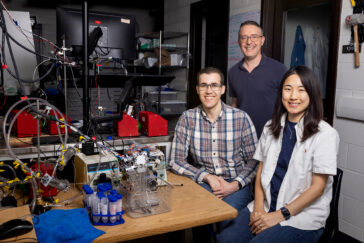
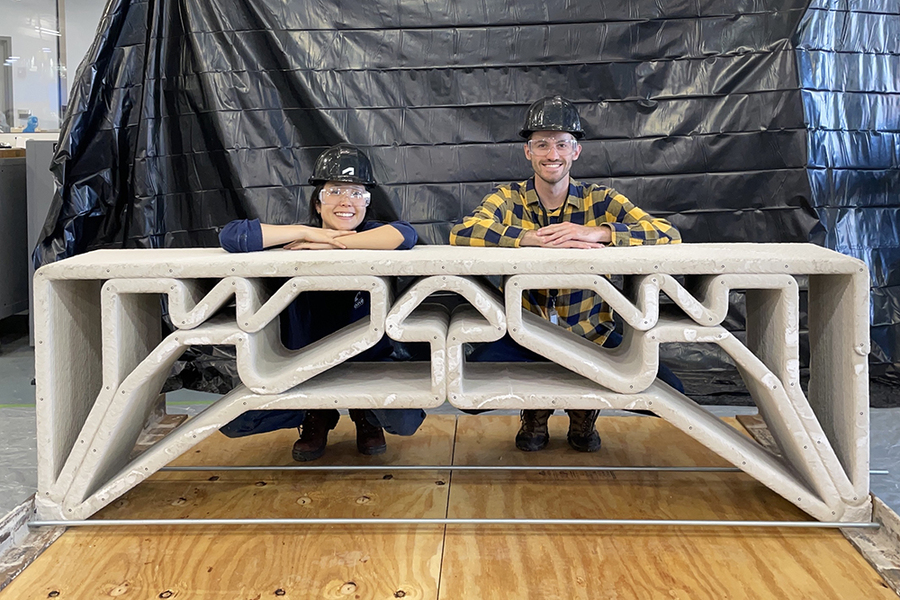
MIT Department of Civil and Environmental Engineering postdoc Hajin Kim-Tackowiak (left) and graduate student Zane Schemmer pose with the 3D-printed concrete bridge they designed and load-tested. (Credit: Photo courtesy of the researchers.)<br />

The bridge itself took about 30 minutes to print using off-the-shelf mortar. During testing, the roughly 900-pound structure held more than 2,000 pounds of concrete blocks spread across its top without measurably bending, closely matching the team’s simulations. But the test exposed how over-engineered the result was. “From zero to 200,000 pounds, your design is entirely driven by these ‘can I build it or not’ constraints. And then, after 200,000 pounds, you can start to think about the physics,” said co-first author Hajin Kim-Tackowiak, a postdoc in MIT’s CEE department.

The framework uses mixed-integer optimization, a mathematical approach long considered too computationally expensive to be practical. “You go back five, 10 years ago, the solver we used, even three years ago, could not solve these problems,” said co-first author Zane Schemmer, a PhD student in CEE. Because the method finds a global optimum rather than just a good solution, the researchers could also quantify precisely what each hardware constraint costs in material. The single biggest factor was bead width. The bridge used a 4-centimeter bead; a machine capable of laying a 1-centimeter bead could cut material use by as much as 76 percent, according to senior author Josephine Carstensen, the Gilbert W. Winslow (1937) Career Development Professor in Civil Engineering. “I thought the continuous path would be the problem, the one that had the highest effect,” Carstensen said. “But it wasn’t. It was the bead width.”

The bridge is built entirely in compression, which is concrete’s strength. Every element is being pushed rather than pulled. That design principle revealed itself dramatically after testing: the structure had held more than 2,000 pounds without budging, but when a worker lifted one corner a few inches to sweep beneath it, it broke immediately. “It’s optimal in one way, but it’s definitely not optimal in every way,” Kim-Tackowiak said.

The team’s next step is reinforced concrete. “We know a pure concrete structure is not necessarily going to be the most optimal thing, so we’re moving it more into the world we live in today, which is reinforced concrete,” Kim-Tackowiak said, though she added that working out how to feed rebar into a printed concrete structure “is proving its own challenge.” The work was funded by the National Science Foundation and supported by the MIT Center for Advanced Production Technologies, with co-authors Pittipat Wongsittikan, a PhD student in MIT’s Building Technology Architecture program, and Jackson Jewett MEng ’18, PhD ’25.

Source: news.mit.edu

Share:
WhatsApp Twitter Facebook LinkedIn Buffer Reddit E-mail
Join our newsletter

Our newsletter is free & you can unsubscribe any time.

Latest posts

Manchester Researchers Link Temperature Swings to Defects in Aluminium 3D Printing

Scientists at The University of Manchester have found that small temperature changes during molten metal deposition can substantially alter the quality of 3D-printed... read more »

3D Printing Metal
Manchester Researchers Link Temperature Swings to Defects in Aluminium 3D Printing

University of Illinois Engineers Build First 3D Thermal Cloak Using 3D-Printed Aluminum

Engineers at the University of Illinois Urbana-Champaign have built the first physical device that can hide objects from heat in any direction, a... read more »

News
University of Illinois Engineers Build First 3D Thermal Cloak Using 3D-Printed Aluminum

Best Large Format 3D Printers 2026: Big Builds Compared

Large format stopped being exotic. A 256 mm cube is the consumer standard now, and the interesting machines start where it ends: 330,... read more »

3D Printers

EPFL’s 3D Printable Elastomer Is 15 Times Tougher Than Comparable Materials

Researchers at EPFL have found that a soft material built for 3D printing also solves one of materials science's stubborn problems: making elastomers... read more »

Materials
EPFL's 3D Printable Elastomer Is 15 Times Tougher Than Comparable Materials

Best Multicolor 3D Printers 2026: Every System Compared

Multicolor went from party trick to default in about two years. Color systems now ship in $299 bundles, toolchangers and multi-nozzle machines have... read more »

3D Printers

University of Utah Develops Holographic 3D Printer That Completes Prints in 20 Seconds

University of Utah engineers have built a holographic 3D printer that produces complete shapes in a single exposure rather than building them layer... read more »

News

Inside Vietnam’s First Connected Surgical Ecosystem, and the Role 3D Printing Plays Within It

When Vinmec switched on a nationwide robotic surgery network, the real advance was the connective tissue around it: preoperative 3D reconstruction, surgical simulation,... read more »

Medical

Best Castable Resin 2026: Clean-Burnout Picks for Jewelry Casting

Castable resin exists for one moment: the burnout. A printed pattern goes into investment plaster, the kiln takes it to several hundred degrees,... read more »

Resin

Best Water-Washable Resin 2026: Easy Cleanup Without the IPA

The messiest part of resin printing has never been the printing; it is the tub of isopropyl alcohol waiting afterwards. Water-washable resin removes... read more »

Resin

Best Flexible Resin 2026: Rubber-Like Picks by Shore Hardness

Flexible resin is the category where the material is the function. Nobody prints a gasket for its looks: the part exists to bend,... read more »

Resin

Social

  • Facebook Facebook 3D Printing
  • Linkedin Linkedin 3D Printing
Join our newsletter

Our newsletter is free & you can unsubscribe any time.

Featured Industries

  • Automotive
  • Aerospace
  • Construction
  • Dental
  • Environmental
  • Electronics
  • Fashion
  • Medical
  • Military
  • Creality Hi Combo

    • - Print size: 260 x 260 x 300 mm
    • - up to 16-color printing
    More details »
    $399.00 Creality
    Buy Now
  • Qidi Max 4

    • - Print size: 390 x 390 x 340 mm
    • - active cooling air control
    More details »
    $1,219.00 Qidi
    Buy Now
  • Flashforge Guider 3 Ultra

    • - Print size: 330 x 330 x 600 mm
    • - dual extruder system
    More details »
    $2,999.00 Flashforge
    Buy Now
  • Flashforge AD5X

    • - Print size: 220 x 220 x 220 mm
    • - dual extrusion system
    More details »
    $399.00 Flashforge
    Buy Now
  • Anycubic Photon Mono M7

    • - Print size: 223 x 126 x 230 mm
    • - 10.1 inch 14K screen
    More details »
    $279.00 Anycubic
    Buy Now
  • Snapmaker U1

    • - Print size: 270 x 270 x 270 mm
    • - multi-color printing with SnapSwap
    More details »
    $849.00 Snapmaker
    Buy Now
  • Qidi Q2

    • - Print size: 270 x 270 x 256 mm
    • - enclosed heated chamber up to 65°C
    More details »
    $580.00 Qidi
    Buy Now
  • Anycubic Kobra S1 Combo

    • - Print size: 250 x 250 x 250 mm
    • - budget multicolor printing
    More details »
    $429.00 Anycubic
    Buy Now
  • Creality K2 Plus

    • - Print size: 350 x 350 x 350 mm
    • - multi-color printing
    More details »
    $1,199.00 Creality
    Buy Now
  • Flashforge Adventurer 5M

    • - Print size: 220 x 220 x 220 mm
    • - 600mm/s travel speed
    More details »
    $299.00 Flashforge
    Buy Now

Company Information

  • What is 3D Printing?
  • Contact us
  • Join our mailing list
  • Advertise with us
  • Media Kit
  • Nederland 3D Printing

Blog

  • Latest News
  • Use Cases
  • Reviews
  • 3D Printers
  • 3D Printing Metal

Featured Reviews

  • Anycubic Photon Mono M5s
  • Creality Ender 5 S1
  • The Mole 3D Scanner
  • Flashforge Creator 3 Pro

Featured Industries

  • Automotive
  • Aerospace
  • Construction
  • Dental
  • Environmental
  • Electronics
  • Medical
  • Military
  • Fashion
  • Art
2026 — Strikwerda en Dehue
  • Home
  • Join our mailing list
  • Contact us
Blog
  • Latest News
  • Use Cases
  • Reviews
  • 3D Printers
  • 3D Printing Metal
Featured Industries
  • Automotive
  • Aerospace
  • Construction
  • Dental
  • Environmental
  • Electronics
  • Medical
  • Military
  • Fashion
  • Art
Company Information
  • What is 3D Printing?
  • Contact us
  • Join our mailing list
  • Advertise with us
  • Media Kit
  • Nederland 3D Printing