
Researchers at EPFL have found that a soft material built for 3D printing also solves one of materials science’s stubborn problems: making elastomers that resist both fracture and fatigue at the same time. The study, published July 13 in Science Advances, shows that double network granular elastomers (DNGEs) achieve fracture toughness values up to 15 times higher than comparable elastomers, and fatigue resistance values up to three times higher.
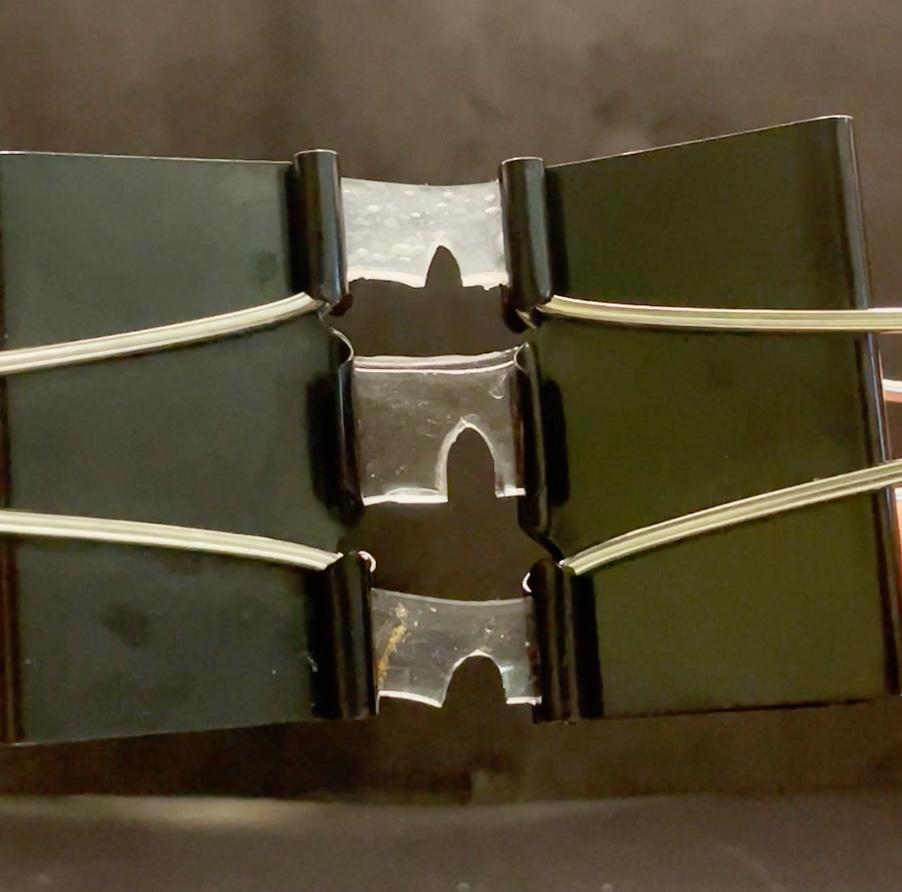
DNGEs were first introduced in 2024 by EPFL’s Soft Materials Laboratory (SMaL). They’re rubber-like materials made of microscopic elastomer particles connected by a softer elastomer network, originally designed as 3D printing inks for structures with finely tuned mechanical properties. The toughness came as a surprise.
“Originally, our focus was on improving processibility, but once we had the granular structure, we discovered that these materials are also very tough,” said SMaL head Esther Amstad. “Then, we realized that a lot of this toughness came from repetitive energy dissipation mechanisms — the material could absorb energy over and over without irreversibly breaking.”
The two-network structure is key. When stretched, the material redistributes mechanical stress from the stiff microparticles into the softer regions between them. There, strain energy dissipates through the sliding and rearrangement of polymer chains rather than through permanent bond breakage. Cracks don’t travel in straight lines, either. They’re forced through the softer regions between microparticles, following a winding path that slows their growth. That’s the architecture that lets DNGEs beat the usual trade-off, where fracture-resistant elastomers tend to accumulate damage under repeated stress, and fatigue-resistant ones tend to snap under sharp loads.
Amstad describes it plainly: “Essentially, the two different networks — one made of granular elastomer particles and one of soft elastomer — share mechanical strain between them, making the material stronger overall.”
The team sees applications in soft robotics, flexible electronics and biomedical devices, where components face repeated stress over long periods. They’re already working on sustainability improvements, including biodegradable elastomers and those derived from recycled materials. “Our aim is to implement more sustainable materials without compromising on mechanics,” Amstad said. “By increasing the scope of materials we can use, we can not only reduce the DNGEs’ environmental footprint, but also make them even more widely accessible to any lab with a commercial 3D printer.”
Source: actu.epfl.ch