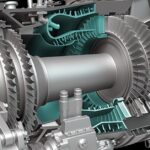
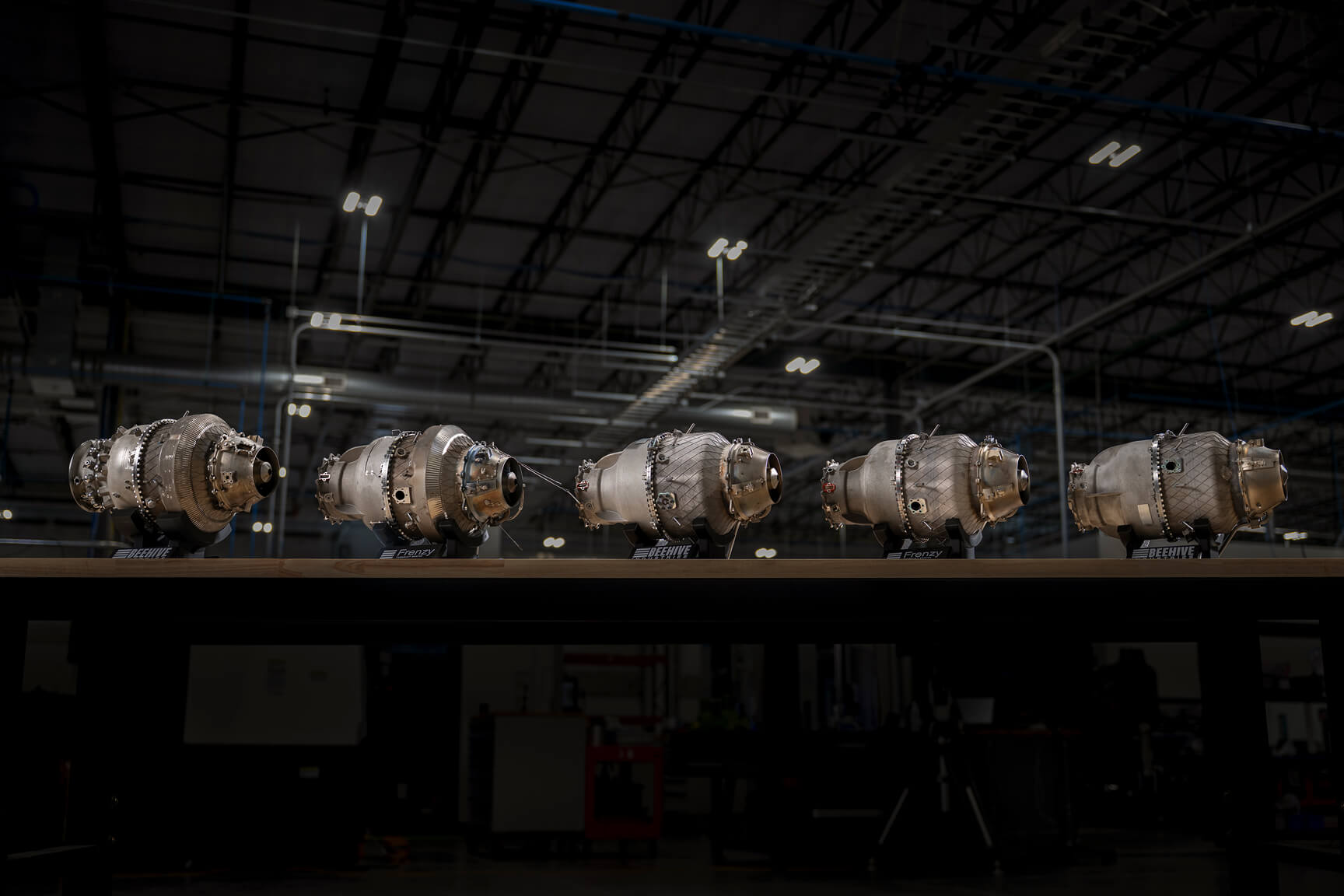
Colorado-based propulsion startup Beehive Industries has secured a nearly $30 million contract from the US Air Force to advance testing and development of its Frenzy line of low-cost, 3D-printed turbojets, the company announced April 9.
The deal funds vehicle integration, flight testing, and qualification of the Frenzy 8, a 200lb-thrust engine that’s Beehive’s lead product. It also covers prototype fabrication of the smaller Frenzy 6, which falls into the 100lb-thrust category. Options for further Frenzy 6 work, including vehicle integration and a flight demonstration, are built into the contract.
Funding comes from the Air Force’s Small Expendable Turbine program, which is designed to qualify low-cost, disposable jet engines for uncrewed aircraft and stand-off weapons that can be produced at scale. Magazine depth has become a pressing military concern in recent years. The Center for Strategic and International Studies estimates that during the first week of combat in Iran, US forces fired nearly 1,700 long-range strike and air defense missiles, roughly a year’s worth of industrial output at current production rates.
Beehive isn’t alone in chasing that market. The six-year-old Denver company is competing against GE Aerospace, Pratt & Whitney, and Honeywell Aerospace for small engine contracts. “By harnessing additive manufacturing to collapse complex supply chains into scalable, 3D-printed propulsion, we are providing the affordable mass essential to modern deterrence,” said Gordie Follin, Beehive’s chief product officer. “This collaboration ensures our warfighters will have the high-volume, mission-ready capabilities they need to maintain a competitive edge in any theater.”
Beehive completed high-altitude lab testing on the Frenzy 8 in December and had planned to begin flight testing in the first quarter of 2026, a target it didn’t meet. The new contract means a flight campaign will move forward in the coming months. Two prototype Frenzy engines were already delivered to the Air Force in 2025 for early evaluation. Engine deliveries to prime manufacturers are also underway, though Beehive wouldn’t identify which primes it’s working with, saying only that each will conduct separate Frenzy trials with their own platforms.
If testing goes well, Beehive says it’s prepared to launch low-rate production at facilities in Denver, Cincinnati, and Knoxville. A company official confirmed it’s already ramping up production to fulfill early contract orders secured alongside the ongoing test effort.