
Researchers at Leiden University have created 3D-printed microrobots just tens of micrometres long that can swim, sense their surroundings, and steer around obstacles without any sensors, software, or external control. The findings were published March 27, 2026 in PNAS.
Professor Daniela Kraft and researcher Mengshi Wei designed the robots as flexible, chain-like structures made up of connected segments, each element measuring just 5 micrometres across, with bar-joints as thin as 0.5 micrometres. To put that in context, a human hair runs 70 to 100 micrometres thick. The structures were printed on a Nanoscribe 3D microprinter, which the team notes is printing at the very edge of what’s technically possible.
The robots’ behavior emerges entirely from their shape. When an electric field is switched on, the chains start moving at roughly 7 micrometres per second. Kraft said that what surprised the team was the constant feedback loop between shape and motion: ‘the shape influences how it moves, and its movements in turn alters its shape.’ That means no microscopic electronics are needed to give the device what she calls smart abilities.
The team’s tests revealed behavior that looks strikingly animal-like. When a robot gets slowed or stopped, Wei says, ‘it starts to wave its tail as if it wants to break free,’ because the rear segments keep trying to propel forward. When it hits an obstacle, it automatically searches for another route. Two robots that encounter each other steer away without any coordination. They can also push objects blocking their path out of the way.
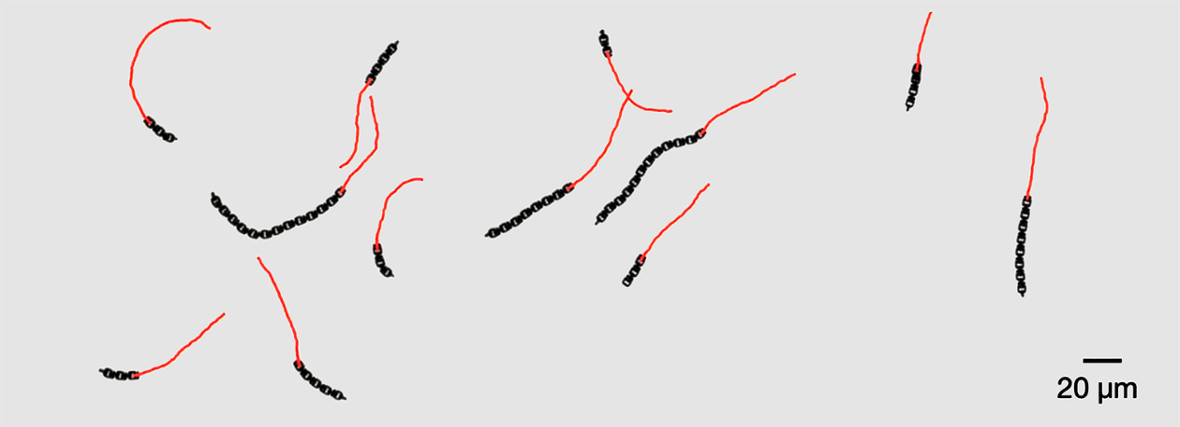
The inspiration for the design came from worms and snakes, which continuously reshape their bodies to move through their environments. Until now, Kraft explains, microrobots were ‘either small and rigid, or large and flexible.’ Getting both small and flexible in the same device had been the missing piece.
Kraft said the next step is understanding exactly how the dynamic behavior emerges: ‘This knowledge will help us develop more advanced microrobots and devices, but also to better understand the physics of biological microswimmers and organisms.’ The team sees potential applications in targeted drug delivery, minimally invasive medical procedures, and diagnostics.
Source: universiteitleiden.nl