
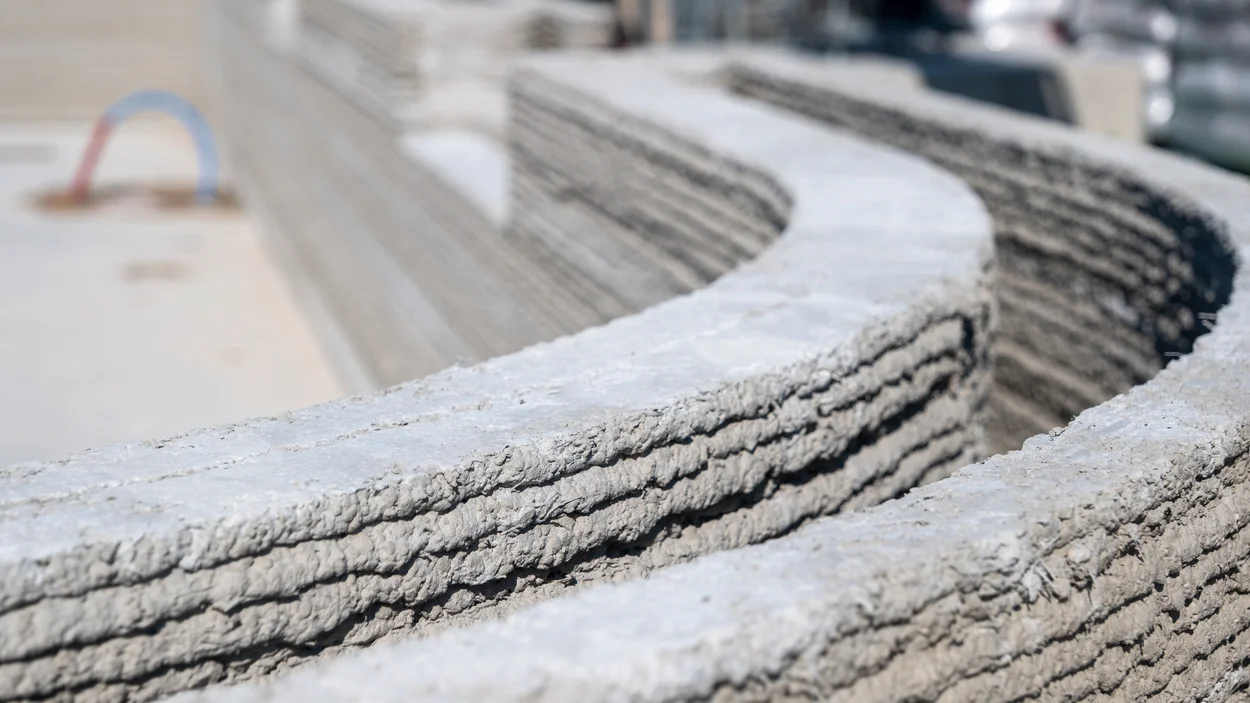
A 12-unit social housing building in Bezannes, France has become Europe’s largest 3D-printed residential project, completed in just 12 months using Holcim’s TectorPrint concrete printing material. The three-storey, 800-square-meter structure, called ViliaSprint², was developed by social housing provider Plurial Novilia and printed on-site using a COBOD robotic gantry that deposited superimposed concrete layers to form fully load-bearing walls.
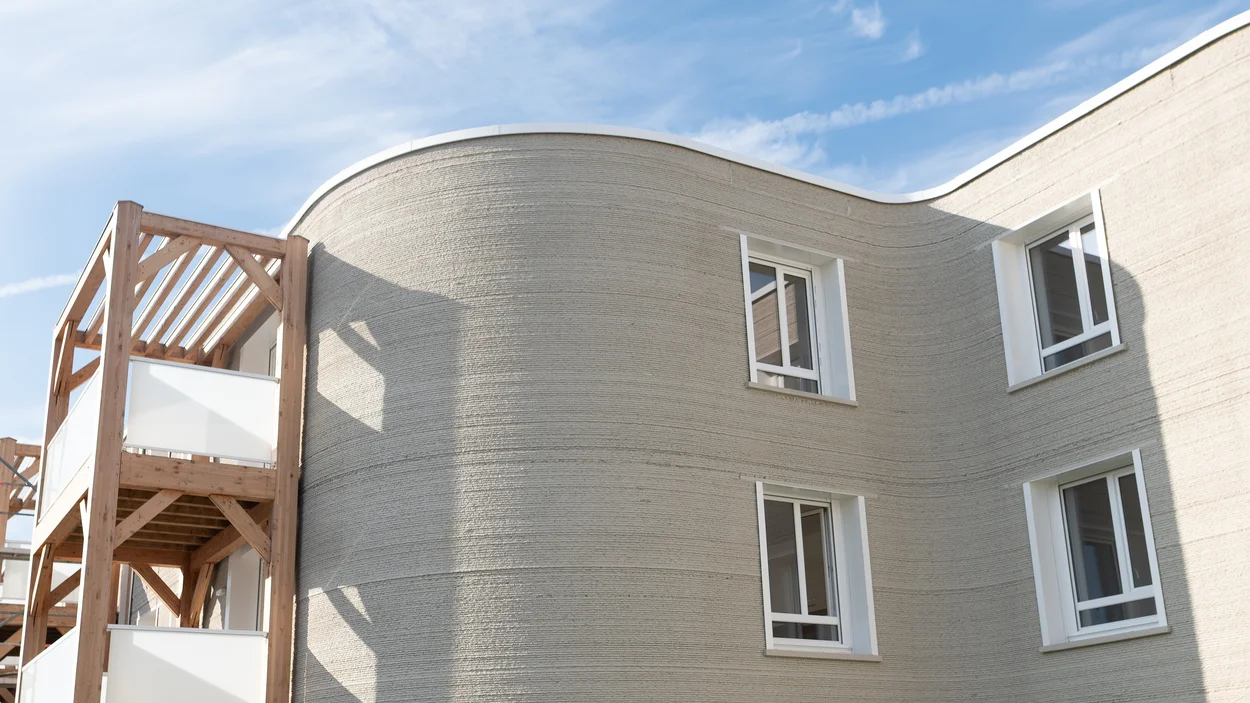
Unlike most on-site 3D printing projects, which have been limited to single-storey structures, ViliaSprint² pushed the technology to a new scale. The walls alone were finished in three months, twice as fast as the walls of a nearly identical building Plurial Novilia constructed on the same plot using traditional methods.
The concrete mix was developed at Holcim’s Innovation Center in Lyon and replaced traditional reinforced concrete with high-performance synthetic macro-fibers. The optimized formula achieved a 30% CO2 reduction compared to standard concrete of equivalent resistance, meeting the 2025 threshold update of France’s RE2020 environmental regulation. The building’s rounded shape, designed by HOBO Architecture, wasn’t purely aesthetic either. Those curves cut total concrete usage by 10% compared to a standard rectangular structure.
“The project has made it possible to concretely assess the contributions of 3D printing to produce housing more quickly and sustainably,” said Johnny Huat, Managing Director of Plurial Novilia, part of the Action Logement Group, France’s largest social housing provider.
On the job site in Bezannes, three operators managed the robotic printing process using digital tablets, replacing the six-person crew that would typically be needed for heavy manual work. Hélène Lombois-Burger, Head of Concrete and Aggregates R&D at the Holcim Innovation Center, described the approach as a shift in how construction itself is defined. “By combining the precision of TectorPrint with our mix design expertise, we are proving that high-performance housing can be both low-carbon and fast to build. We are effectively moving from construction to advanced manufacturing on the job site.”
Productivity on the project rose 35% by the end of the build compared to the start. Holcim’s team says it’s already planning a 40-unit residential development as the next step, aiming to reduce costs further and move 3D-printed construction from experimental projects toward commercial scale.
Source: holcim.com