
Miami University engineer Muhammad Jahan has a $200,000 NSF grant to study greener ways to finish 3D printed carbon fiber composite parts for aircraft, cars and other demanding uses.
The problem sits at the very end of the process chain. Additive manufacturing can build carbon fiber reinforced polymer (CFRP) parts close to their final shape, but close is rarely enough for a component expected to perform under stress in a harsh operating environment. Those parts usually still need machining to bring surface finish and dimensional accuracy where they need to be, and that step must not erode the strength and performance that made CFRP worth printing in the first place.
Jahan, an associate professor of Mechanical and Manufacturing Engineering, is putting that finishing step under the microscope. In his project, sustainable machining means methods that use less energy, fewer resources and less cutting fluid than traditional approaches. The team will look at three of them, dry machining, minimum quantity lubrication and cryogenic coolant machining, and measure how each one affects the quality and performance of printed CFRP parts.
The material choice explains why the work matters. CFRP is strong and light, widely used in commercial aircraft and defense applications, and it also turns up in automotive and construction. If the project succeeds, it could help push more sustainable approaches to making strong, lightweight components for those high-performance industries, where precision and material integrity are not optional.
The grant, awarded in June 2026, is also expected to fund research positions for both graduate and undergraduate engineering students. Those students will train in advanced manufacturing, materials characterization, experiments and computer simulation. Along the way they gain direct experience solving manufacturing engineering challenges tied to the future of those same industries, which gives the project a second payoff beyond the machining data itself.
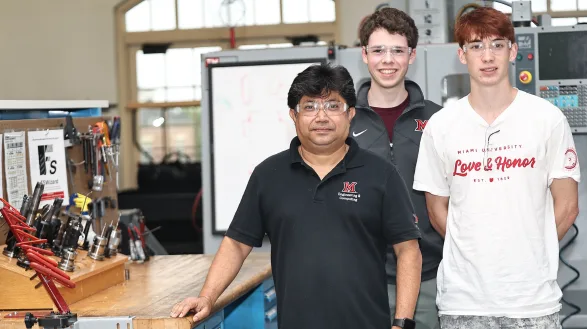
Jahan sees a distinct role for the undergraduates on the team. They arrive with recent hands-on experience in design, CAD, CNC machines and project-based learning, while graduate students can guide them through the research process. “Undergraduate students can really work very closely with graduate students to form teams and share some of the responsibilities,” Jahan said.
That mix of fresh shop-floor skills and research experience is the point. For the students, the project is a chance to help solve one of the emerging challenges in advanced manufacturing, finishing printed composite parts with the precision and reliability that real-world applications demand.
Source: Miami University