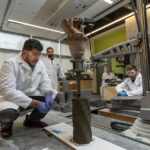

Jan Vítek of Brno University of Technology will teach ceramic clay extrusion at Maker Faire Brno on 17–18 October.
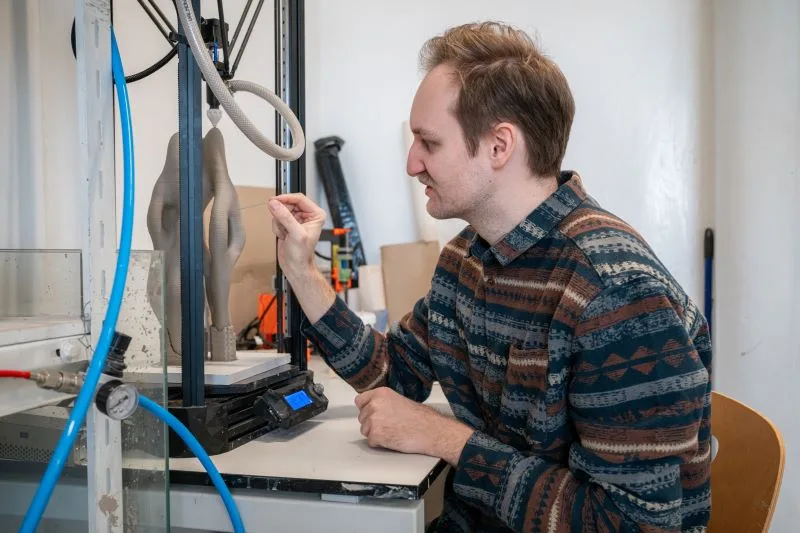
The designer and lecturer at the Faculty of Mechanical Engineering treats the process as computer-assisted coil building. A nozzle lays soft clay along toolpaths the way a potter stacks coils, so the print stays pliable until it dries. That softness is the point. Walls can collapse, overhangs need help, and the operator often stays with the machine, drying with warm air or briefly supporting a feature with a finger or a scrap of clay. Because the material is not hot, those interventions are practical, and once the object has dried they can be touched up fairly easily.
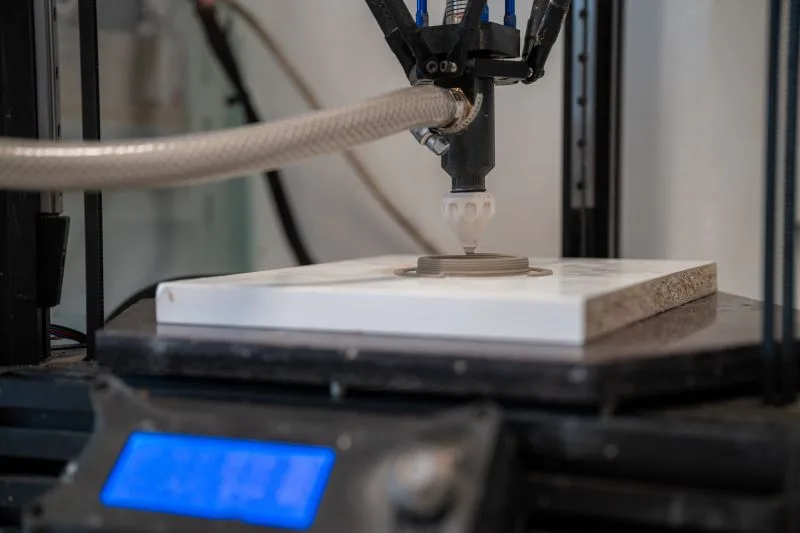
Vítek first met porcelain printing during his bachelor’s thesis, chasing parametric and generative design with a Brno porcelain studio. Pottery classes and handmade bonsai pots had already pulled him toward ceramics, but the studio collaboration locked him onto the subject. A small cup collection followed, then deeper doctoral work at BUT’s Faculty of Fine Arts. He also built his own ceramic printer over about two years because commercial clay systems were expensive. Starting from a reservoir that feeds a screw extruder and nozzle, he spent a long fine-tuning stretch until the results felt comparable to some commercial machines.
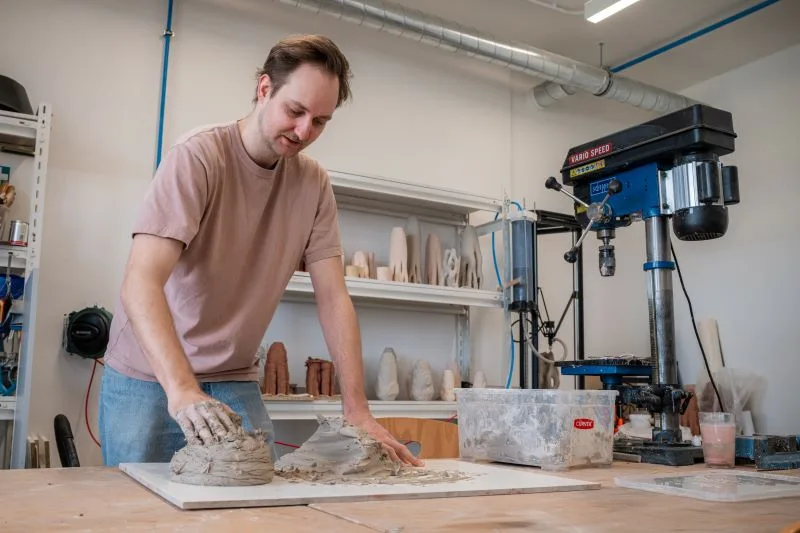
Ordinary pottery clay works once the water content is tuned for the extruder. Grog can stiffen the print and cut deformation if the particles stay fine enough not to wear the hardware. The payoff for designers is one-off and small-batch work without plaster moulds. Changing a digital design and reprinting is far cheaper than cutting a new mould, and forms with awkward undercuts or internal recesses that moulds cannot release become printable. What surprised him most is how thin the walls can go and how much detail clay will hold when the approach is right, opening forms that conventional ceramic production struggles to make.
He still sees extrusion as less precise than powder-based ceramic routes for high-temperature technical parts, but large-format and architectural work look promising, especially when clay can be sourced locally. Moisture resistance, drying cracks and structural failures remain open problems for bigger builds.
Interest has already spilled past the lab. At the international FabX gathering his workshop drew more than thirty people instead of the planned ten, with later contacts from as far as New Zealand and colleagues at the University of Porto. The Maker Faire Brno session sits in that same maker track. It runs Saturday morning at the Brno Exhibition Centre on 17-18 October, as part of the DiSTT project funded by Interreg Central Europe.