
3D Printing
News Deals Contact us
Home / News / Rowan Engineers Monitor 3D-Printed Concrete by Analyzing Images in Reverse
qidi

Rowan Engineers Monitor 3D-Printed Concrete by Analyzing Images in Reverse

October 14, 2026

Rowan University engineers have found a way to measure how 3D-printed concrete deforms while it is still being printed and cured, by starting with images of the finished structure and analyzing the build in reverse. The method shows how lower layers respond to the weight of fresh material, which is where a printed wall can fail before it is finished.

Digital image correlation normally tracks deformation against a reference image taken before loading, and a structure that is still being printed has no such image. Led by Islam Mantawy and Behrad Koohbor of the Henry M. Rowan College of Engineering, the team took thousands of images during printing and curing, then worked backward from the cured structure, using the concrete’s natural surface roughness as the pattern to track. They also built a mathematical approach to validate the reverse-time method and explain how the concrete deforms, shrinks, and cures, even in the first moments after a layer is laid down. The work is published in Experimental Mechanics.
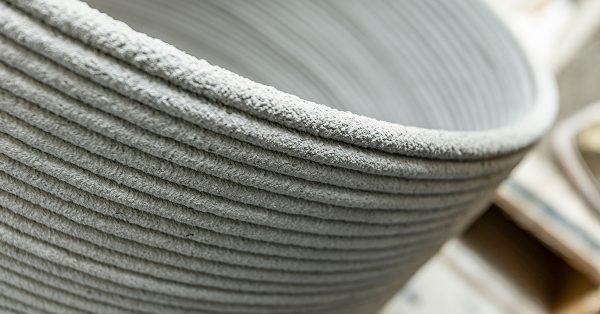
Close view of the ridged, rough surface of a 3D-printed concrete form
The rough surface of printed concrete serves as the tracking pattern. (Credit: Rowan University)

“If you’re building an 8-foot-tall wall and the bottom layer starts to crack and collapse, the entire structure can fail before you reach the final layer,” said Mantawy, an assistant professor of civil and environmental engineering who heads Rowan’s Additive and Robotic Construction Laboratory. “What was supposed to be a faster, more efficient construction method becomes slower and less efficient because you have to start over from scratch.”

Temperature, humidity, and the mix’s chemistry all change how a print behaves as it cures, and the researchers say measuring those effects could help engineers spot problems earlier. Koohbor, an associate professor of mechanical engineering affiliated with Rowan’s Advanced Materials & Manufacturing Institute, said the reverse-time approach could also serve other additive manufacturing processes where conventional quality checks fall short because the part does not exist when production begins.

Mantawy sees it as a step toward printers that run themselves. “Without knowing what’s happening inside the structure, you won’t be able to achieve self-operating 3D printing,” he said. “It’s a way to have an eye on the structure as it evolves.”

Rowan engineering students Nicholas Pagliocca, Anthony Mackin, Aly Ahmed, and Jenna Migliorino contributed. The research was supported in part by a U.S. Department of Education Graduate Assistance in Areas of National Need (GAANN) grant through Rowan’s Center for Research & Education in Advanced Transportation Engineering Systems.

Source: Rowan Today

Share:
WhatsApp Twitter Facebook LinkedIn Buffer Reddit E-mail
Join our newsletter

Our newsletter is free & you can unsubscribe any time.

Latest posts

Protecting Long 3D Prints From Power Failures: Do You Need a UPS or Voltage Stabilizer?

A two-second outage can end a 40-hour print. Built-in power-loss recovery, a UPS and a voltage stabilizer each deal with a different part... read more »

News

Flashforge CJ270: Desktop Full-Color Material Jetting, Explained

The Flashforge CJ270 is a desktop full-color 3D printer that uses MJP, or MultiJet Printing, the inkjet-and-UV process behind the PolyJet and ProJet... read more »

3D Printers

ugee Launches a Moderated 3D-Model Library for Kids and Beginners

ugee has opened ugee maker, a moderated library of printable models and a drawing-to-file tool for parents and children new to desktop 3D... read more »

News

Plane Support Wins Approval to 3D-Print Cabin Ducts for Bushfire Helicopters

Plane Support can 3D-print the cabin air-conditioning ducts for McDermott Aviation's Bell 214B bushfire helicopters, after Australia's aviation regulator approved the parts.

Aerospace

The Invisible Gas Risks Around Metal 3D Printing: Why Oxygen Monitoring Matters

Metal additive manufacturing relies on argon and nitrogen to keep oxygen away from hot, reactive metal. Those same gases can quietly lower the... read more »

3D Printing Metal

ETH Zurich Will 3D-Print Sandstone to Study Why Historic Stone Shells Off

ETH Zurich will 3D-print artificial molasse sandstone, with weak layers placed on purpose, to study why historic Swiss stone shells off.

Construction

FAMU-FSU Engineers 3D-Print Wave-Shaped Walls That Cut Peak Wind Loads

FAMU-FSU engineers 3D printed wind-tunnel models of wave-shaped walls and roofs that cut peak wind pressure by 40% to 60%.

Construction

Meshy Ranks No. 31 on a16z’s First Consumer AI Revenue List, the Only 3D Company

Meshy is the only AI 3D company on Andreessen Horowitz's (a16z) new Top 50 Consumer AI Apps by Monthly Revenue, the first time... read more »

News

Umeå Researcher 3D-Prints Custom Lab Instruments on a Desktop Printer

Daniel Nilsson at Umeå University showed that a desktop 3D printer can make custom laboratory instruments for biological research.

News

Hands-On Review: Creality Falcon A1C Enclosed Laser Engraver

Our first laser engraver review. Creality's entry-level enclosed Falcon A1C is sold as safe for the home, beginner-proof, and clever enough that a... read more »

Laser Engravers

Social

  • Facebook Facebook 3D Printing
  • Linkedin Linkedin 3D Printing
Join our newsletter

Our newsletter is free & you can unsubscribe any time.

banner
  • Flashforge Adventurer 5M

    • - Print size: 220 x 220 x 220 mm
    • - 600mm/s travel speed
    More details »
    $299.00 Flashforge
    Buy Now
  • Anycubic Photon Mono M7

    • - Print size: 223 x 126 x 230 mm
    • - 10.1 inch 14K screen
    More details »
    $279.00 Anycubic
    Buy Now
  • Qidi Q2

    • - Print size: 270 x 270 x 256 mm
    • - enclosed heated chamber up to 65°C
    More details »
    $580.00 Qidi
    Buy Now
  • Snapmaker U1

    • - Print size: 270 x 270 x 270 mm
    • - multi-color printing with SnapSwap
    More details »
    $849.00 Snapmaker
    Buy Now
  • Flashforge AD5X

    • - Print size: 220 x 220 x 220 mm
    • - dual extrusion system
    More details »
    $399.00 Flashforge
    Buy Now
  • Qidi Max 4

    • - Print size: 390 x 390 x 340 mm
    • - active cooling air control
    More details »
    $1,219.00 Qidi
    Buy Now
  • Creality Hi Combo

    • - Print size: 260 x 260 x 300 mm
    • - up to 16-color printing
    More details »
    $399.00 Creality
    Buy Now
  • Flashforge Guider 3 Ultra

    • - Print size: 330 x 330 x 600 mm
    • - dual extruder system
    More details »
    $2,999.00 Flashforge
    Buy Now
  • Creality K2 Plus

    • - Print size: 350 x 350 x 350 mm
    • - multi-color printing
    More details »
    $1,199.00 Creality
    Buy Now
  • Anycubic Kobra S1 Combo

    • - Print size: 250 x 250 x 250 mm
    • - budget multicolor printing
    More details »
    $429.00 Anycubic
    Buy Now

Company Information

  • What is 3D Printing?
  • Contact us
  • Join our mailing list
  • Advertise with us
  • Media Kit
  • Nederland 3D Printing

Blog

  • Latest News
  • Use Cases
  • Reviews
  • 3D Printers
  • 3D Printing Metal

Featured Reviews

  • Anycubic Photon Mono M5s
  • Creality Ender 5 S1
  • The Mole 3D Scanner
  • Flashforge Creator 3 Pro

Featured Industries

  • Automotive
  • Aerospace
  • Construction
  • Dental
  • Environmental
  • Electronics
  • Medical
  • Military
  • Fashion
  • Art
2026 — Strikwerda en Dehue
  • Home
  • Join our mailing list
  • Contact us
Blog
  • Latest News
  • Use Cases
  • Reviews
  • 3D Printers
  • 3D Printing Metal
Featured Industries
  • Automotive
  • Aerospace
  • Construction
  • Dental
  • Environmental
  • Electronics
  • Medical
  • Military
  • Fashion
  • Art
Company Information
  • What is 3D Printing?
  • Contact us
  • Join our mailing list
  • Advertise with us
  • Media Kit
  • Nederland 3D Printing