
The Flashforge CJ270 is a desktop full-color 3D printer that uses MJP, or MultiJet Printing, the inkjet-and-UV process behind the PolyJet and ProJet machines that service bureaus run for color prototypes. It prints blended skin tones, gradients, surface patterns and clear sections in a single job at 7 micron layers, and it is the first machine of that type to reach a price under $5,000. The US launch price is $3,999 against a $4,499 list price, and Flashforge has issued the code BOOSTCJ270 to 3DPrinting.com readers for a further $100 off at checkout, with equivalent codes in Canada, the UK, the EU and Australia.
Nothing on this page is based on our own test prints. The first units ship from 15 October 2026, and every figure comes from Flashforge’s published specifications, store pages and launch materials; where a number is our own estimate, it says so.
Launch pricing and reader code
Flashforge CJ270: $3,999 launch price, and code BOOSTCJ270 takes $100 off at checkout
List price $4,499. The code is entered at checkout on the Flashforge store and is worth C$140 in Canada, £80 in the UK, €90 in the EU and A$140 in Australia; see the regional price table.
Jump to menu
What the CJ270 is, and what it is not
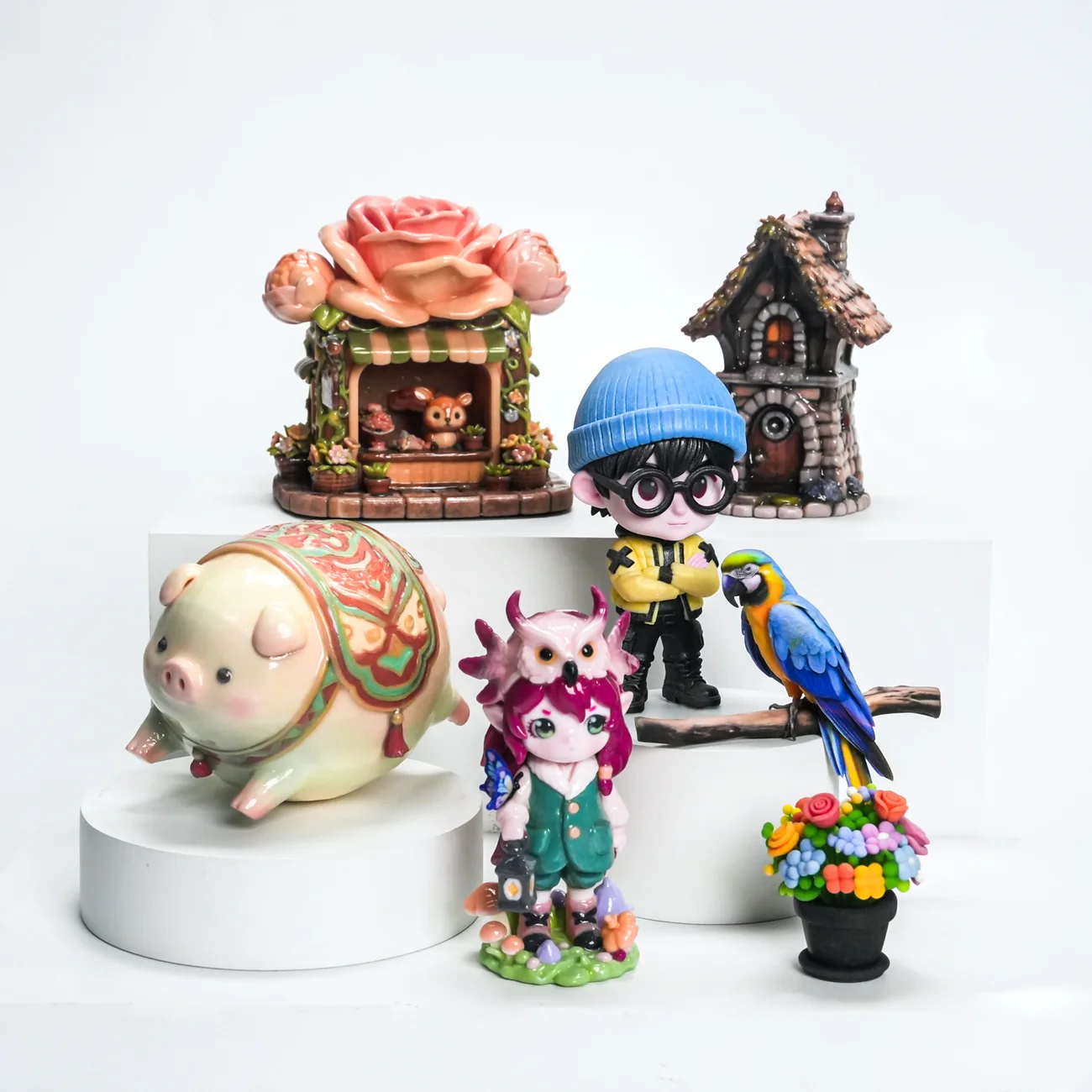
Most desktop printers sold as multicolor are FDM machines with a filament changer. They swap between a handful of spools, purge the nozzle between colors, and produce flat, separate zones of color with visible layer lines. The CJ270 uses a different process. Seven industrial inkjet printheads deposit droplets of cyan, magenta, yellow, black, white, clear and a water-soluble support resin in each pass, a planarizer levels the layer, and a UV lamp cures it. Because the colors are mixed at the droplet level, the output is continuous tone: blended skin, gradients, printed text and patterns, and clear windows or shells within the same part. Flashforge quotes more than 10 million color combinations from the six build materials; as with any CMYK process, the usable gamut is narrower than that number suggests, and no independent color measurements have been published yet.
That process is material jetting in the ISO/ASTM 52900 vocabulary, the family Stratasys sells as PolyJet and 3D Systems as MultiJet. New machines in that class cost from several tens of thousands of dollars upward, with service contracts on top, which is why color prototypes and painted-look figurines have mostly been bureau work. The CJ270 is a 697 x 410 x 405 mm, 33.5 kg unit with active carbon filtration, a noise rating under 55 dB and automatic leveling, priced at the level of a well-equipped desktop FDM or resin setup.
Flashforge calls the CJ270 the world’s first desktop full-color 3D printer. That needs qualifying. XYZprinting’s da Vinci Color (2017, around $3,000) was sold under the same claim and used inkjet heads to tint PLA filament as it was extruded; the results were coarse and the line was discontinued. Mcor’s ARKe (2016) built full-color models from inkjet-printed paper. Mimaki’s 3DUJ-2207 (2021) is a compact material jetting printer that Mimaki describes as desktop-sized, listed at tens of thousands of dollars. The CJ270 is the first desktop material jetting printer priced under $5,000, and the first to bring the PolyJet-style process within reach of a small studio.
It is not a general-purpose printer. The resins are formulated for visual models rather than functional parts, and Flashforge says so on the product page. Its intended work is small objects where color is part of the product: a scanned portrait, a tabletop army with the paint scheme printed in, an appearance prototype in production colors, a teaching model of a heart with the vessels in red and blue.
Flashforge's launch video, showing the printhead array, the planarizer pass and support removal in water.
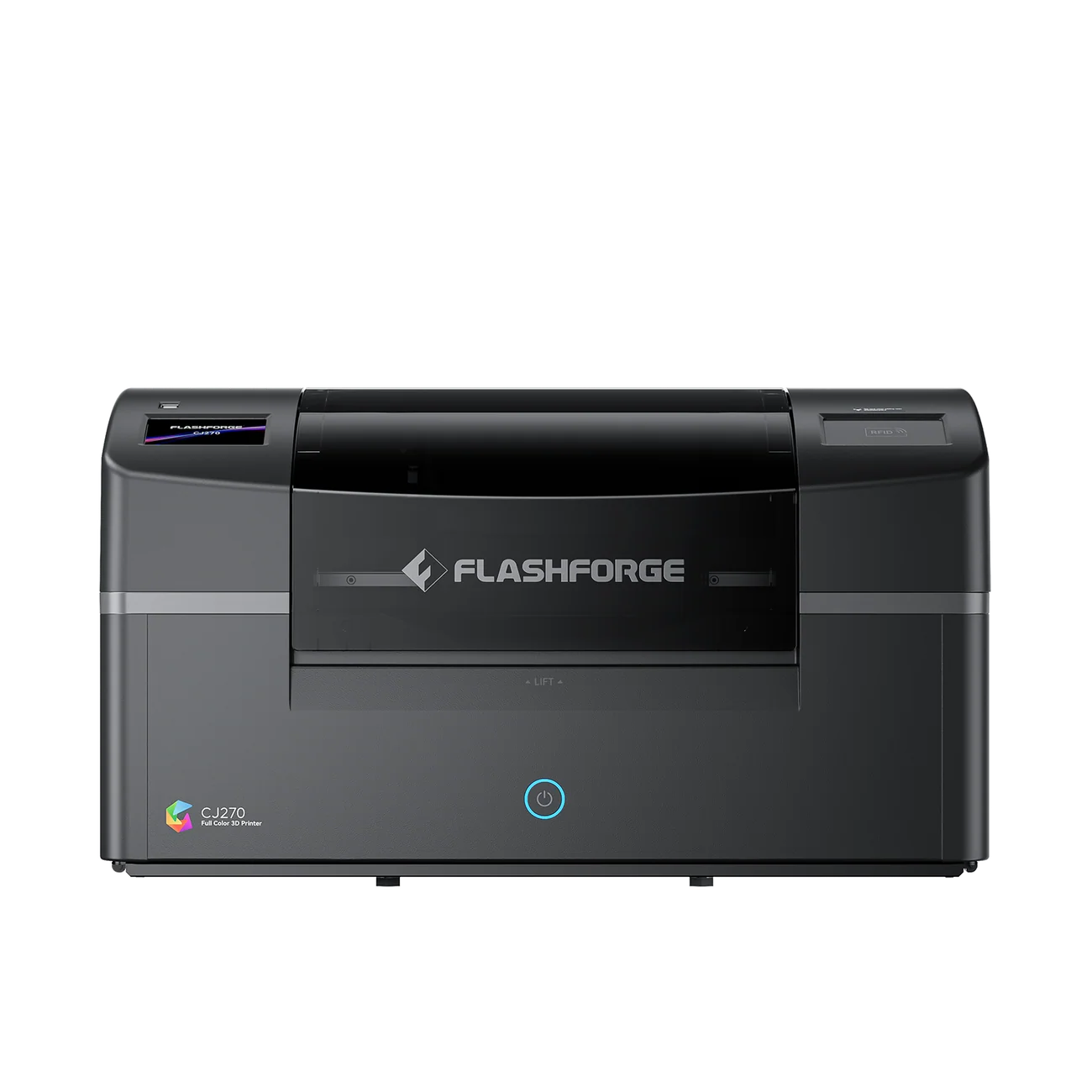
Flashforge CJ270 at a glance
- MJP material jetting with UV curing, 7 printheads, 7 µm layers
- CMYK plus white and clear build resins, 10 million+ colors, water-soluble support
- 180 x 120 x 100 mm build volume; 697 x 410 x 405 mm footprint, 33.5 kg
- ColorPrint slicer for Windows and macOS with automatic color separation
- USB and LAN at launch, Wi-Fi promised in a later update
Price: $3,999 launch price, code BOOSTCJ270 for $100 off (pre-order pricing; varies by region and sale period, click through for current pricing)
Flashforge CJ270 specifications
Flashforge has published the figures below on its US and EU product pages. There is no official speed rating. The print-time guidance is Flashforge’s own and scales with model height, since a jetting machine spends much the same time on each layer regardless of how much of the plate is in use.
| Technology | MJP (MultiJet Printing) material jetting with UV curing |
| Printheads | 7 industrial inkjet printheads, individually replaceable; rated life up to 2,000 hours; 3-month printhead warranty |
| Layer thickness | 7 µm |
| Build volume | 180 x 120 x 100 mm (7.1 x 4.7 x 3.9 in) |
| Colors | 10 million+ combinations from cyan, magenta, yellow, black, white and clear |
| Materials | 7 Flashforge-only photopolymer resins: C, M, Y, K, White, Clear, Support (water-soluble). Supplied in 100 g cartridges with a one-time activation card; 18 months shelf life unopened, use within 2 months once opened |
| Support removal | Soak in water (around 10 hours) or ultrasonic cleaner (1 to 2 hours, sold separately) |
| Print time guide | Under 10 hours for models under 10 cm tall; 15+ hours at 10 cm; 25+ hours at 15 cm (Flashforge figures) |
| Software | ColorPrint (Windows, macOS): slicing, color separation, printer management, AI image-to-3D tool. Reads CJP, CJM, STL, OBJ, 3MF, STEP, PLY, FBX, GLB, GLTF, WRL |
| Connectivity | USB drive and LAN from a connected computer; Wi-Fi not available at launch, planned for a later update |
| Leveling | Automatic |
| Noise | ≤ 55 dB |
| Filtration | Active carbon filter |
| Machine size and weight | 697 x 410 x 405 mm; 33.5 kg |
| Warranty | 1 year limited on the printer; 3 months on printheads; 30-day returns after delivery |
Who the CJ270 is for
The build volume and the resin economics point at a specific kind of user: someone who makes small objects where color is part of the product, and who today either hand-paints them, outsources them, or does not make them at all. Flashforge’s own list of target users comes down to four groups, and they match what the specifications support.
Figurines and collectibles
Pet portraits from a phone scan, custom bobbleheads, art toys, anime and game characters, designer collectibles in short runs. The 7 micron layers are fine enough for faces and fabric folds on figures viewed up close, and the color is printed rather than painted.
Tabletop and miniatures
Pre-colored miniatures, terrain details, tokens and game pieces. A 28 mm miniature is well inside the build envelope, and water-soluble support avoids cutting around swords, tails and cloaks. For painted-by-hand grey resin, see our miniature printers guide.
Design studios and product teams
Appearance prototypes in approximate production colors, with logos, labels and clear lenses printed in: the job bureaus have sold for years, brought in-house for parts that fit a 180 x 120 x 100 mm box or can be split.
Education and visualization
Anatomical models with color-coded structures, architectural massing with materials shown, geological and molecular models, museum replicas. Sub-55 dB operation and carbon filtration are aimed at classroom and office use rather than a workshop.
For functional parts, large props, or anything you would print in PLA or PETG today, the CJ270 is the wrong tool; a conventional FDM printer or a single-color resin printer does that work for a fraction of the price. The case for the CJ270 rests on replacing hours of painting or a bureau invoice.
What to know before you order
Flashforge lists most of the following on its own product page. Together they decide whether the CJ270 fits a given workflow.
The build volume is small. 180 x 120 x 100 mm is a little less than the footprint of a sheet of A5 paper and the height of a smartphone lying on its side. A 15 cm figure fits; a 20 cm one has to be printed in sections and bonded. Flashforge gives 25 or more hours for a 15 cm print, so a full-height print runs for more than a day.
Material supply is closed. Each of the seven materials ships in 100 g cartridges that are activated once by scanning a material card, after which the balance lives on the printer. Flashforge states that third-party resin may damage the machine, and no third-party supply exists. Opened cartridges should be used within two months, which matters for colors you use rarely. The printheads are a consumable too: rated at up to 2,000 hours each and covered for three months, with no published replacement price yet.
The parts are display parts, and Flashforge has published no mechanical data for the resins; treat the output as you would a painted resin figure. Flashforge recommends a light sand or polish followed by a thin UV-cured gloss coat for the best finish, and sells an optional ultrasonic cleaner that cuts support removal from around 10 hours of soaking to one or two.
Connectivity is USB and wired LAN for now; Wi-Fi is promised in a software update later in 2026. The slicer, ColorPrint, runs on Windows and macOS, handles color separation automatically and accepts textured formats alongside plain STL. Color quality follows the source model: a scan with a good texture map or a model generated with one of the AI 3D model generators that export textures will print in color, a plain STL will not, because there is no color in the file to begin with.
This is a pre-order. The first 100 units ship by air on 15 October 2026 and later orders follow in sequence, with delivery to Europe quoted at around two weeks after shipment. Printers can be returned within 30 days of delivery and unshipped orders can be cancelled through customer service. No independent reviews have been published; every sample print shown so far comes from Flashforge. We have requested a review unit and will link a hands-on review from this page when it is done.
What the CJ270 costs to run
Resin is sold on the Flashforge US store at $69.90 for a 1 kg pack of ten 100 g cartridges, split as three support, two white, one each of cyan, magenta, yellow, black and clear. A 10 kg bulk pack is $499, or $49.90 per kilogram. Flashforge has not published a cost per print, and the mix you actually consume depends on the model: a pale figure uses white heavily and almost no black, while supports can account for a third of the material on anything with overhangs. Our rough estimate for a 10 cm figurine is 100 to 200 g of material including support, which puts resin at $7 to $14 per print at single-pack prices, before printhead wear and electricity. Independent testing will refine that.
The $49 Early Bird Package, offered with pre-orders and capped at 1,000 participants on the EU store, bundles one full-color sample print of the buyer’s own model with 24 kg of resin delivered as 2 kg a month for 12 months. At single-pack pricing that resin would cost $1,677.60, which makes the package the main financial reason to order during the pre-order window rather than later; deliveries start around November. A $999 Application Support Package for onboarding is also listed on the store.
Launch price by region and the BOOSTCJ270 code
Flashforge sells the CJ270 through its own regional stores in the United States, Canada, the United Kingdom, the European Union and Australia. The launch price is the pre-order price and is time limited; the list price is what Flashforge says the printer returns to afterward. The code BOOSTCJ270 was issued by Flashforge for 3DPrinting.com readers and is entered at checkout. Our link opens the US store; if you are elsewhere, use the store’s own region or country switcher at the top of the page, and the code applies in that region’s currency.
Launch and list prices from Flashforge’s regional stores and affiliate pack, October 2026; the code amounts are fixed per region. Pricing varies by bundle, sale period and region, so click through for the current figure.
How the CJ270 compares
Against multicolor FDM, the question is what kind of color is needed. A Bambu Lab, Anycubic or Creality printer with a multi-material unit costs $400 to $1,500, prints parts you can use, and gives you up to 16 discrete filament colors per job, with purge waste and a visible seam where colors meet. It cannot blend, cannot print a photograph onto a surface, and cannot do clear sections inside an opaque part. For two-tone signs, logos on a phone stand and parts that need to be used, multicolor FDM is cheaper and more useful; our best 3D printers guide covers those machines. For a face, a photograph on a surface, or a gradient, the CJ270 is currently the only desktop machine in production that can print it.
Against industrial material jetting, the CJ270 gives up build volume, material range and throughput. A Stratasys J35 Pro or J55 Prime offers larger rotating build trays, rigid, clear and flexible materials, and validated color management, at prices several times higher plus service contracts. Mimaki’s 3DUJ-2207 is the closest existing compact full-color machine and is listed at tens of thousands of dollars. Whether the printheads, resin and color consistency hold up over years of use is a question only independent testing will settle.
Against a service bureau, the comparison comes down to volume and turnaround. Bureau pricing for full-color jetted parts varies widely with size and finish, and a bureau still makes sense for occasional pieces or anything larger than the CJ270 can print. For a studio producing color figures every week, the in-house case depends on resin consumption per part and on printhead life, which is why the running-cost figures above matter more than the launch discount.
FAQ: Flashforge CJ270
How much does the Flashforge CJ270 cost?
The US launch price is $3,999, down from a $4,499 list price, and the code BOOSTCJ270 takes $100 off at checkout. Launch prices in other regions are C$5,699, £3,499, €3,999 and A$5,799, with code discounts of C$140, £80, €90 and A$140. Resin is $69.90 per 1 kg pack or $499 for 10 kg.
How does the CJ270 print in full color?
It is a material jetting (MJP) printer. Seven inkjet printheads deposit droplets of cyan, magenta, yellow, black, white, clear and support resin in each 7 micron layer, a planarizer levels the layer and a UV lamp cures it. Colors are mixed at the droplet level, so the printer produces continuous-tone gradients and printed textures rather than the separate color zones of a multicolor FDM printer.
What is the build volume of the CJ270?
180 x 120 x 100 mm, or 7.1 x 4.7 x 3.9 inches. That is enough for figurines up to about 15 cm tall, tabletop miniatures, hand-sized prototypes and teaching models. Larger pieces have to be split and bonded after printing.
Can I use third-party resin in the CJ270?
No. The CJ270 uses seven dedicated Flashforge photopolymer resins supplied in 100 g cartridges with one-time activation cards, and Flashforge warns that other materials may damage the printer. Unopened resin keeps for 18 months; opened cartridges should be used within two months.
Are CJ270 prints strong enough for functional parts?
They are not meant to be. Flashforge describes the resins as designed for high-quality full-color visual models rather than functional applications. Use the CJ270 for figurines, collectibles, appearance prototypes and display models, and an FDM or engineering-resin printer for parts that take load, heat or impact.
When does the Flashforge CJ270 ship?
Pre-orders opened on 9 September 2026. The first 100 units ship by air on 15 October 2026 and later pre-orders follow in order of purchase, with Flashforge quoting delivery by mid-November for most early orders and around two weeks after shipment for Europe. Unshipped orders can be cancelled, and delivered printers can be returned within 30 days.
Does the CJ270 have Wi-Fi?
Not at launch. Files are sent from a computer running ColorPrint over a wired LAN connection or carried over on a USB drive. Flashforge says Wi-Fi will be added in a software update later in 2026.
What file formats does the CJ270 accept?
ColorPrint opens CJP and CJM project files plus STL, OBJ, 3MF, STEP, STP, PLY, FBX, GLB, GLTF and WRL. For a color print the file needs color information, meaning a texture map or vertex colors; a plain STL contains geometry only and will print in a single color.