
Apollo Automobil’s upcoming Evo supercar will feature what the company describes as the largest one-piece 3D-printed titanium exhaust system ever produced, with each unit requiring 123 hours to print. The system, called “Dragon Skin,” is covered in scale-like texturing that ties into Apollo’s dragon-themed naming convention for individual cars.
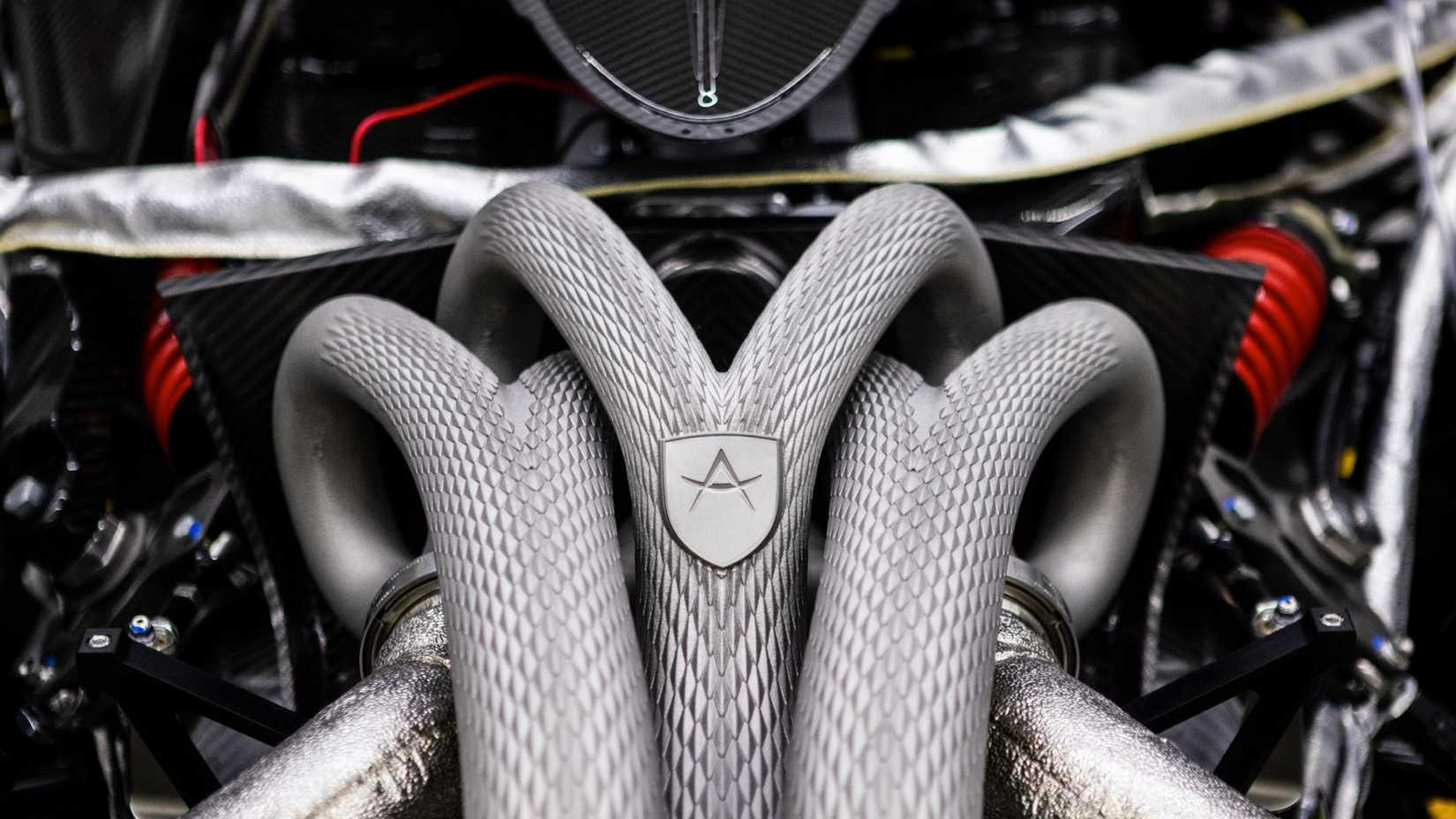
The exhaust is made from aerospace-grade titanium alloy and finished with a ceramic coating rated to withstand temperatures up to 1,000°C. Apollo says the scale pattern isn’t purely decorative — it’s engineered to improve heat distribution across the system, which matters on a car running a Ferrari F140 V12 making over 800 horsepower and revving to 9,000 rpm. The system is available in multiple colors to match each car’s individual dragon theme.
“Apollo’s Dragon Skin exhaust embodies the brand’s core design DNA, serving as another extraordinary piece of Rebellious German Engineering. It seamlessly merges art, storytelling and extreme engineering into a single functional component. Sculpted to evoke awe, it represents the next stage of design evolution from Apollo Automobil,” the company said in a statement.
The Apollo Evo is a direct follow-up to the Intensa Emozione, which sold 10 units at $2.5 million each. The Evo carries the same Ferrari V12 and six-speed sequential transmission sending power to the rear wheels, but adds 20 hp, a new carbon fiber monocoque chassis, and Le Mans hypercar-inspired aerodynamics. The price reflects those upgrades — the Evo starts at over $4 million.
“Following the success of the Apollo Intensa Emozione, it was obvious for us to push the envelope even further,” said Niko Konta, Apollo CEO. “To extract the fullest potential from the platform, we have fine-tuned an already exceptional design while applying the latest in cutting-edge technologies and processes to truly take the Evo to another level.”
Apollo is limiting production to 10 track-only units. None have been delivered yet, with the company saying the first car will reach its owner in the first half of 2026.
Source: carbuzz.com