
MIT engineers have developed a method for 3D printing soft, microscopic structures infused with iron-oxide nanoparticles that can be remotely controlled by an ordinary magnet — including a lollipop-shaped gripper smaller than a grain of sand that snaps shut like a Venus flytrap on command. The research, published April 28 in the journal Matter, was conducted with collaborators at the École Polytechnique Fédérale de Lausanne (EPFL) in Switzerland and the University of Cincinnati.
The key challenge the team had to solve is a longstanding problem in magnetic microprinting: magnetic particles scatter and absorb laser light, weakening or preventing the printing of any structure they’re mixed into. The MIT team’s solution is a two-step process. They first print a standard polymer gel microstructure using two-photon lithography, a high-resolution 3D printing technique that traces patterns with laser flashes into resin. Then they dip the finished gel into a solution of iron ions, which the gel absorbs, followed by a second bath of hydroxide ions. The two react inside the gel to form iron-oxide nanoparticles that are inherently magnetic — no particles in the resin required.
There’s an added layer of control in the process. By tuning the laser’s power during printing, the researchers can set how tightly cross-linked, or “tight,” the gel is in any given feature. The tighter the gel, the fewer magnetic particles it can absorb. That means the team can assign different degrees of magnetism to individual parts of a single microscopic structure with micron-scale precision.
“Directly 3D printing deformable micron-scale structures with a high fraction of magnetic particles is extremely difficult, often involving a tradeoff between magnetic functionality and structural integrity,” said graduate student Rachel Sun, a co-lead author on the paper.
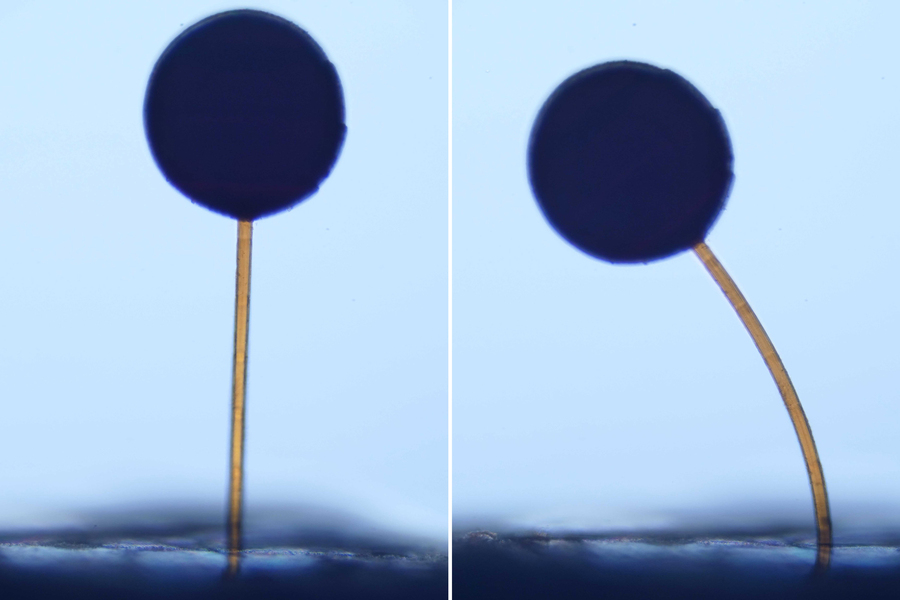
To demonstrate the technique, the team printed ball-and-stick structures resembling tiny lollipops, each less than a millimeter tall with balls smaller than a grain of sand. Each ball was infused with a different amount of magnetic particles. When a refrigerator magnet was passed over the petri dish, the lollipops bent toward it by varying degrees, mimicking a gripping hand. The team also built a millimeter-long bistable switch with four oar-like magnetic arms measuring about 8 microns thick — roughly the size of a red blood cell — on each side. Applying a magnet to either end flips the oars and locks the rectangle in place like a toggle.
“With a magnetically responsive material, we have control at a distance and the response is instantaneous,” said co-lead author Andrew Chen, a graduate student at MIT. “We don’t have to wait for a slow chemical reaction or physical process, and we can manipulate the material without touching it.”
Carlos Portela, the Robert N. Noyce Career Development Associate Professor of Mechanical Engineering at MIT, said the bistable switch could function as a magnetic valve in a microfluidic device, while the gripper geometry points toward potential medical applications. “You could imagine a magnetic architecture like this could act as a small robot that you could guide through the body with an external magnet, and it could latch onto something, for instance to take a biopsy,” Portela said. The research was supported in part by the National Science Foundation and the MathWorks seed grant program, and was performed in part at MIT.nano.
Source: news.mit.edu