
A team from Oak Ridge National Laboratory has won the 2026 SME Aubin Additive Manufacturing Case Study Award for using large-format 3D printing to produce molds for advanced nuclear reactor construction, a method the lab says could shave weeks off build schedules while cutting costs.
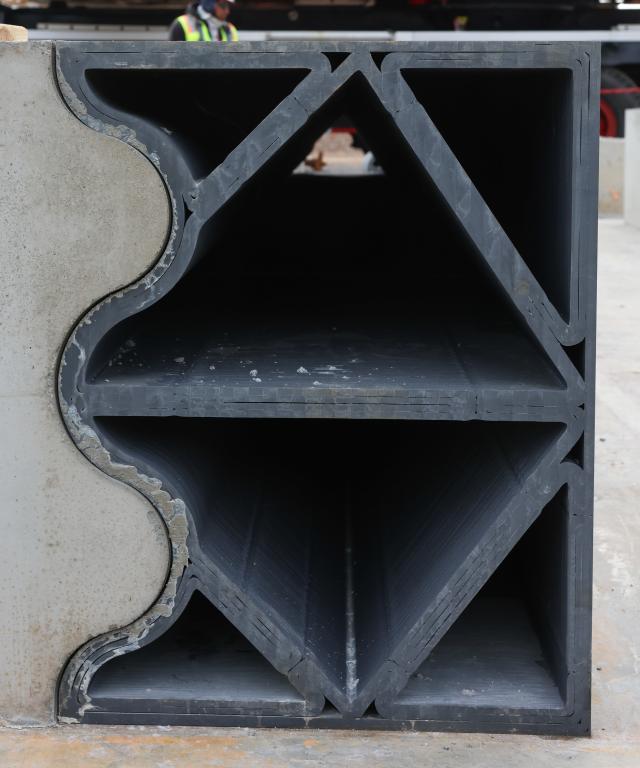
DOE’s Manufacturing Demonstration Facility led the project, working with the University of Maine, Kairos Power, and other industry partners to print composite molds for concrete radiation shielding structures used in Kairos Power’s modular reactor program. The molds shaped bio-shield strongback columns measuring roughly 8 feet by 8 feet by 20 feet, and shielding wall panels up to 27 feet long with complex interlocking joints that reduced or eliminated the need for grout between pieces.
Construction has long been one of the steepest cost hurdles for new nuclear plants. Nuclear concrete structures alone can account for up to 60 percent of schedule risk. “Construction has been a major bottleneck for advanced reactors,” said Ahmed Hassen, group leader for composites innovation and ORNL’s project lead. “We showed that digital manufacturing can cut weeks off the schedule while meeting strict nuclear standards.”
The team designed, printed, and delivered reusable molds in about two weeks. Traditional steel molds take six to eight weeks to build and don’t accommodate design changes easily. Engineers printed the composite molds in sections, then machined and sealed them to achieve surface precision of one-sixteenth of an inch. The molds held their shape under wet concrete poured at heights of up to 12 feet. The team completed four casting cycles for the bio-shield columns and three cycles for shielding wall panels without measurable quality loss.
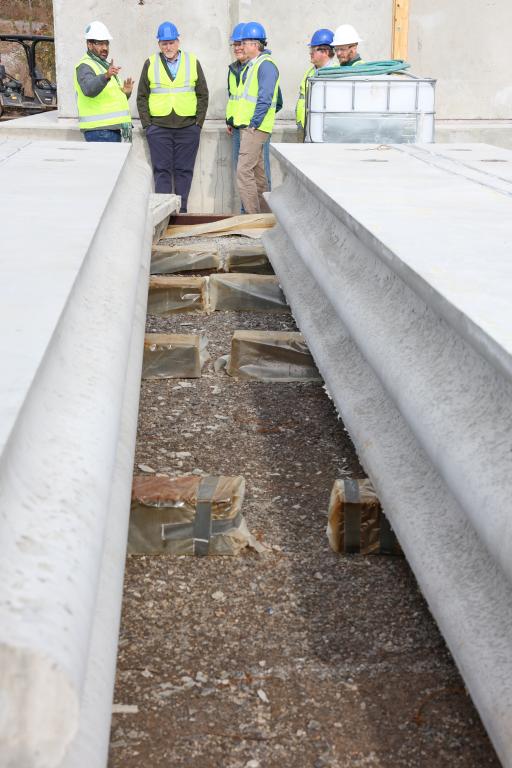
The printed molds were also lighter than steel, making them easier for crews to handle on-site. ORNL is now in discussions with a major U.S. precast manufacturer to scale up the approach. “This project shows that additive manufacturing is not just for prototypes,” Hassen said. “It can be a reliable, repeatable system for building safety-critical nuclear infrastructure to strengthen the country’s energy security.”
The award was presented at the SME AM Awards and TCT Awards Gala on April 14, 2026, in Boston. The project was funded by DOE’s Advanced Materials and Manufacturing Technologies Office as part of the SM²ART Program with the University of Maine.
Source: ornl.gov