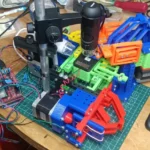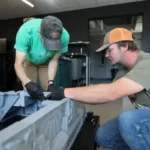

Engineering student Caleb Jelf and Steel Developments have run two stainless steel propellers 3D printed with direct metal laser sintering (DMLS) at the powerboat UIM F2 World Championship, which they call a first for metal printed props.

The five-bladed props, made at Dave Harwood’s Steel Developments, ran in free practice at the Peso da Régua round in September, fitted to the boats of Jelf’s father Owen, a veteran circuit racer, and Ian Blacker. Between them they completed more than 60 laps.
Jelf, who studies Mechanical Engineering at Imperial College London and took a year out to work in Brackley for the Mercedes-AMG PETRONAS F1 Team, first raised the idea with Harwood in 2024. Metal printing was then still largely a research subject with little industrial use, so the pair began by asking whether a printed race propeller was feasible at all and what it would gain or give up.
Over the following two years he used FDM-printed plastic models to settle on the blade profile he wanted. In parallel he studied the elastic, strength and fatigue properties of DMLS parts, while the process matured to the point where it is now used for structural components. That groundwork is the real story, because the catch with any printed propeller is proving it is strong enough to live with salt water and constant flexing.
“These first two propellers were about testing strength not speed however after the initial testing we were able to achieve a lap time within five tenths of the fastest propeller that session,” Jelf told Powerboat News.
The next stage varies pitch, aspect ratio and diameter, using a mathematical model that assesses each parameter from first principles. “We have a large dataset of competitive propellers on the OptiMax 200XS engine so we will be focusing on producing propellers for the new APX250 engine, aiming to correlate these models with reality,” he added.
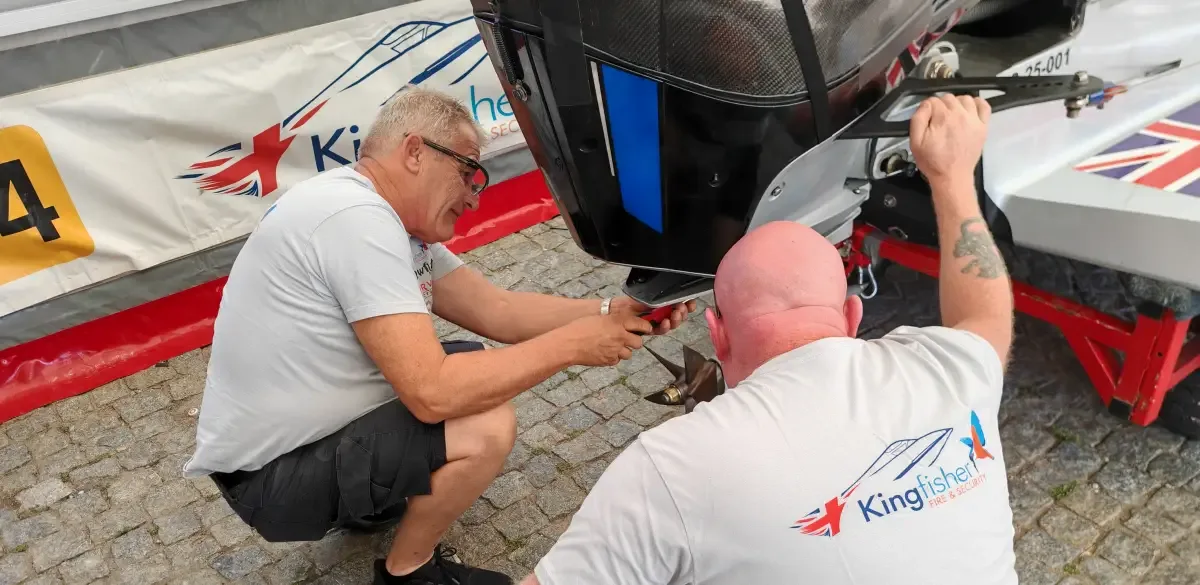
For a propeller maker the attraction is geometry, since DMLS can produce complex metal parts that would be uneconomic or impossible to cast or machine. Getting a race-ready blade still takes work after the build. Each part is heat treated while still on its base plate to relieve process stresses, cut free of its supports and polished, and that finishing counts on a blade under repeated load because a rough as-built surface can act as a starting point for cracks.
Marine use has moved more slowly than aviation. The first class-approved printed ship’s propeller, the WAAMpeller, was produced in Rotterdam in 2017 by a consortium that included Damen Shipyards and Bureau Veritas, but it was a nickel aluminium bronze tug propeller made by wire arc additive manufacturing rather than a laser-printed racing part.
Source: Powerboat News