
Snapmaker has opened the beta of Snapmaker Space, a model platform built around its U1 toolchanger. It launches with more than 2,500 models that ship with ready-made U1 print profiles and a Community Rewards program that rewards creators for print time instead of downloads. It follows the September launch of a calibrated filament bundle for Full Spectrum, a workflow that produces colors beyond the four spools loaded on the printer. 3DPrinting.com has a U1 in the workshop but has not yet used either; the details below are Snapmaker’s own.
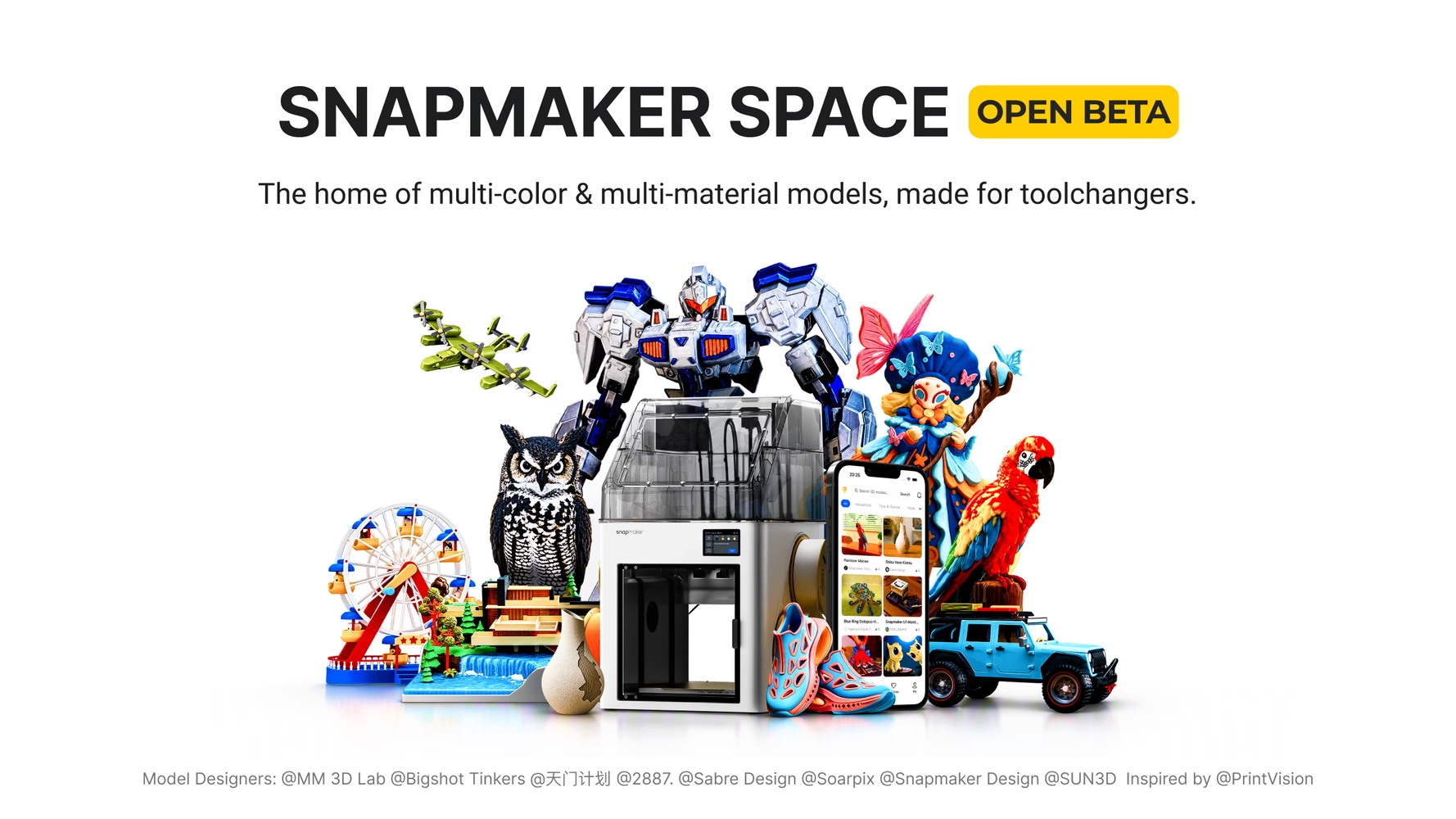
Snapmaker Space, now in open beta. Image: Snapmaker.
Multi-color and multi-material printing has moved from a niche into the mainstream of desktop FDM in recent years, and toolchangers such as the Snapmaker U1 promise to make it faster and less wasteful. Content has lagged behind. A four-color model that looks good on a product page still needs the right color assignments, sensible purge settings and a print profile that was tested on the machine it will run on. Snapmaker’s two September announcements come at that problem from different sides. Snapmaker Space supplies models that come with prepared U1 print profiles, and Full Spectrum changes how many colors four spools can produce.
Snapmaker Space: 2,500+ models with U1 print profiles
Snapmaker Space is a platform for discovering, sharing and printing multi-color and multi-material 3D models. Snapmaker announced the open beta on September 21, 2026. According to the company, the library opened with more than 2,500 models that come with U1 print profiles, from established designers, newer creators and Snapmaker’s in-house modeling team. The public site shows a featured feed, a Contests section and author listings.
Snapmaker’s argument is that as printers gain multi-color capability, the quality of the model and its profile decides whether that capability turns into a good print. The platform is built to surface tested content and to give creators a reason to produce it.
Snapmaker Space extends our work from building machines and materials to supporting the content ecosystem that gives that hardware its purpose. Our objective is to make high-quality models easier to discover and to create clearer incentives for the people who design, test, and improve them.
Jade Wu
Director of Community Operations, Snapmaker
Creator rewards based on cumulative print time
How creators earn points is the most distinctive part of Snapmaker Space. Points are awarded on cumulative qualifying print time, which Snapmaker defines as a model’s print duration multiplied by the number of times it is printed, with prorated credit for prints that do not finish. The company’s reasoning is that rewarding print time instead of upload counts or downloads reduces the incentive to mass-upload simple files. A small model that many people print earns through repetition, and a large model earns through its long print duration. In Snapmaker’s framing, the reward follows what was printed.
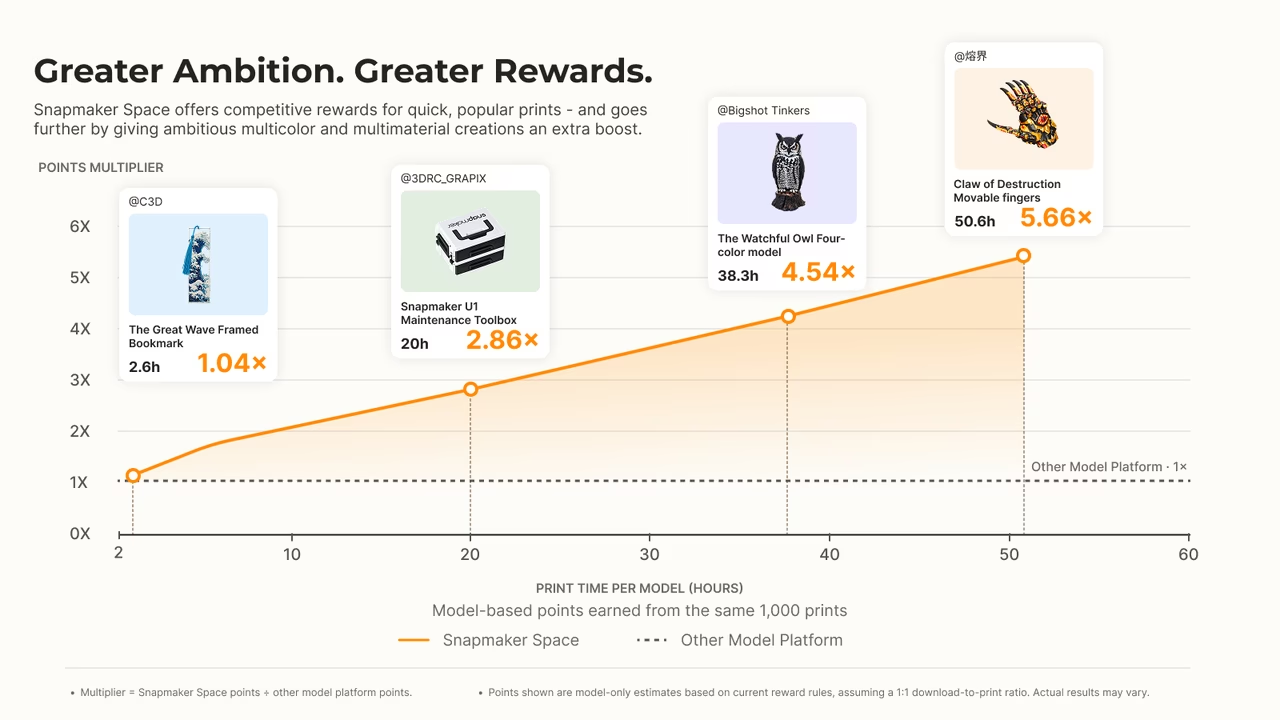
Snapmaker’s estimate of how model points scale with print time on Snapmaker Space, compared with a platform that counts downloads only. Chart and data: Snapmaker.
Snapmaker has illustrated the effect with four models from the platform. In its estimate, which assumes 1,000 prints per model and one print per download, a 2.6 hour bookmark earns about the same points as it would on a download-counting platform, a 20 hour toolbox earns 2.86 times as many, and a 50.6 hour articulated claw earns 5.66 times as many. These are Snapmaker’s own model-only estimates under the current rules, and the company notes that actual results may vary.
The Community Rewards program also awards points for preparing print profiles and for rating models. Points can be redeemed for Snapmaker Store gift cards that cover eligible printers, materials and accessories. Points do not expire, and a redeemed gift card is valid for one year. The announcement does not give the conversion rate between print hours and points; Snapmaker refers creators to the program terms for eligibility, so those are worth reading before relying on a figure.
Explore Snapmaker Space
Browse the featured models, check the Contests section and read the Community Rewards program terms. The platform is in open beta and Snapmaker is collecting feedback on discovery and submission.
Full Spectrum: more colors from four filaments
Full Spectrum is Snapmaker’s answer to getting more colors out of a four-toolhead machine. It was first introduced as a feature of Snapmaker Orca, and on September 4 the company added a dedicated PLA Full Spectrum Filament Bundle to go with it. According to Snapmaker, the method produces colors beyond the four spools loaded on the printer by stacking thin alternating layers of partially light-transmitting filament. The filaments are never melted together into a new pigment; light passes through the layers, the colors interact optically, and the viewer perceives colors beyond the four loaded.
The bundle contains four 1 kg spools of 1.75 mm PLA in cyan, magenta, yellow and gray, which Snapmaker abbreviates to CMYG. Each is formulated for controlled light transmission, expressed as a Transmission Distance (TD) value; Snapmaker lists TD 6.5 for the gray, 9.5 for the yellow and 5.5 for both the magenta and the cyan. Snapmaker says that before the bundle users had to measure the TD of each spool, enter the values in the slicer and tune from there, and that the bundled profiles in Snapmaker Orca remove that step. The company adds that the published TD values are reference figures and may vary between batches and testing conditions.
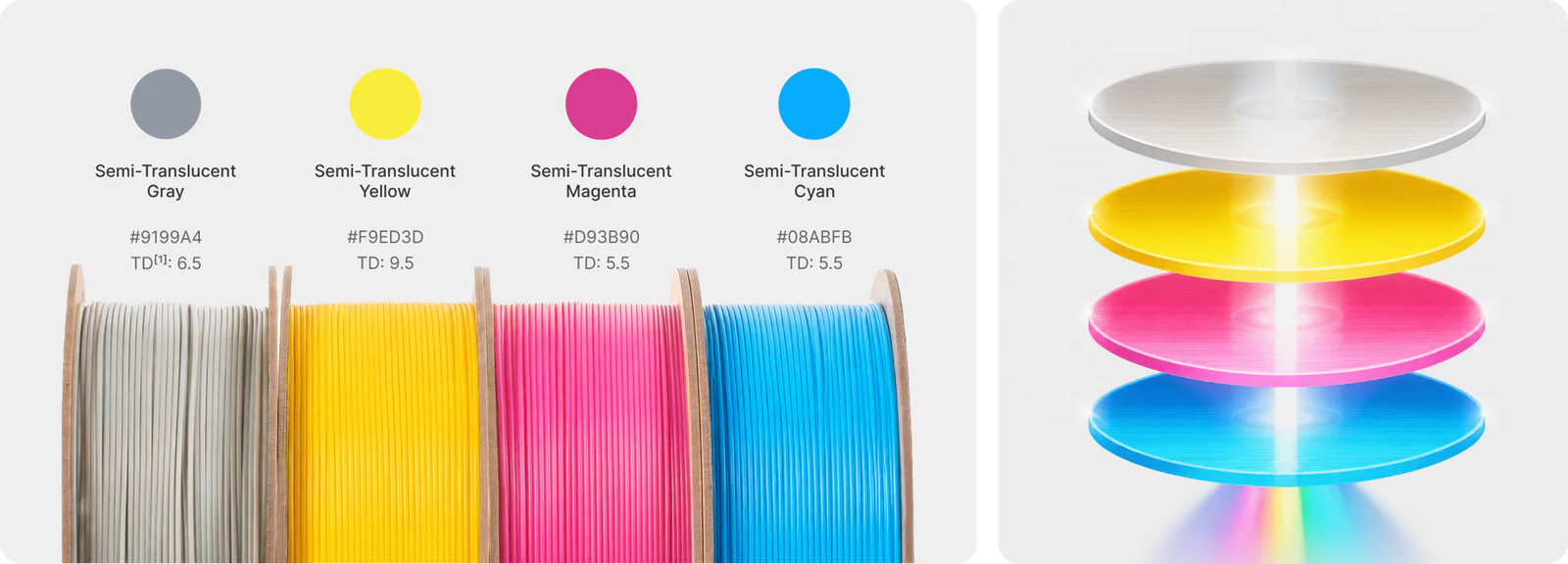
The PLA Full Spectrum Filament Bundle is designed for layered color mixing with the Full Spectrum feature in Snapmaker Orca: four semi-translucent CMYG filaments with their TD values, and the stacked layers light passes through. Image: Snapmaker.
Snapmaker Orca 2.3.6 or later handles the color selection, blending, slicing and the calibrated filament profiles. In Snapmaker’s explanation, the U1’s four toolheads are what make the frequent filament changes practical, without constant loading, unloading and purging. Snapmaker’s own sample plate below shows well over a hundred distinct swatches from the four spools, but the blog post gives no figure for how many colors the method reaches or for the print-time cost of the extra layer changes, and we have not measured either. The Snapmaker wiki documents the process in more detail.
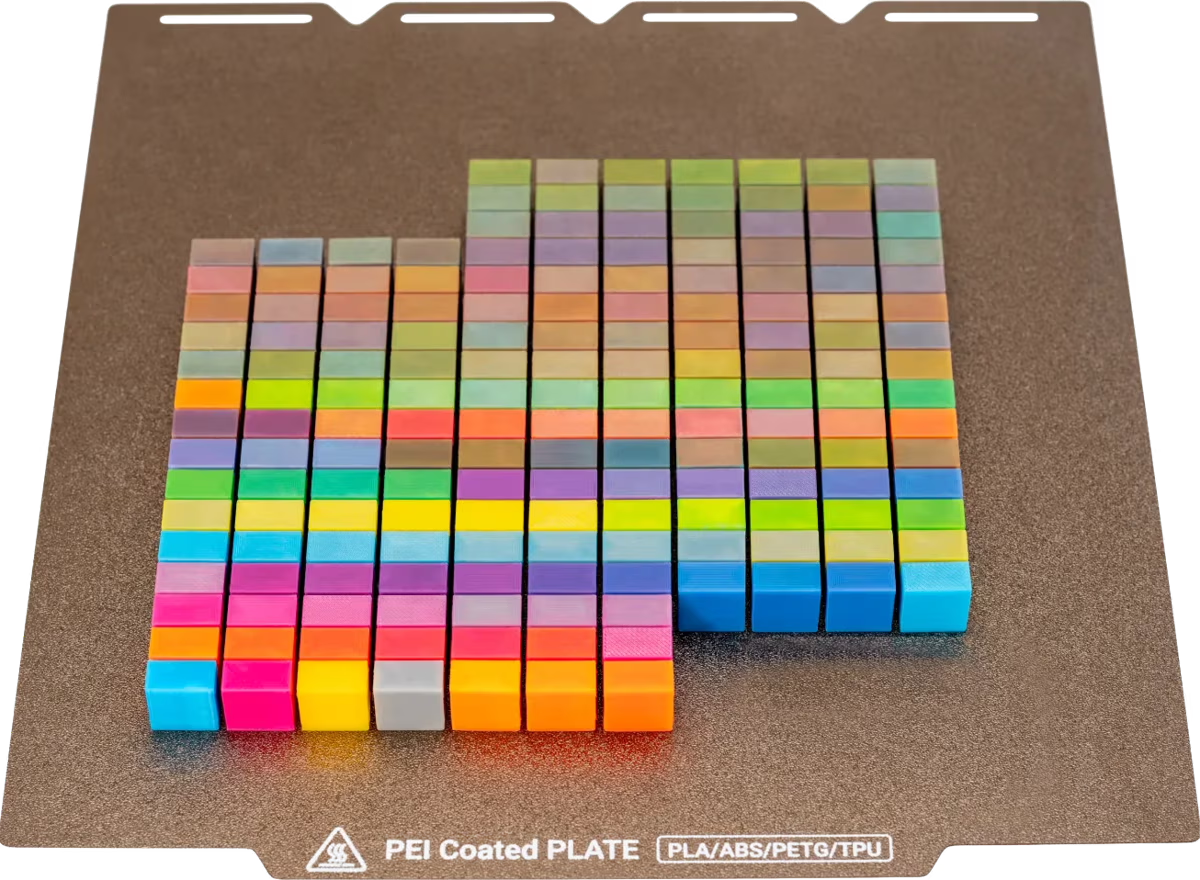
A selection of blended colors printed from the four base filaments, which sit in the front row. Image: Snapmaker.
Full Spectrum began as an independent community project by Radu, known online as Ratdoux. Snapmaker says it noticed the work, supported it and brought it into Orca, after which Radu joined the company as Full Spectrum Lead to continue development across the slicer, the U1 and the filament bundle. Snapmaker cites its Innovation Fund as another example of how it supports community-developed technology.
Instead of adding more and more individual filament colors, we can use a small set of calibrated materials together with software and multi-toolhead hardware to generate a much broader spectrum. Our goal is to make that process simple enough that users can focus on what they want to create rather than how to engineer the color.
Radu (Ratdoux)
Full Spectrum Lead, Snapmaker
Pricing and availability
Snapmaker Space is in open beta and its models are listed as free downloads; the announcement does not mention any fee for using the platform. The PLA Full Spectrum Filament Bundle sells for $89 on the Snapmaker Official Store, a little over $22 per kilogram. Full Spectrum ships as part of Snapmaker Orca 2.3.6 and later, and Snapmaker says the slicer still accepts user-measured TD values for anyone who wants to run it with other filaments. Pricing may vary by region.
PLA Full Spectrum Filament Bundle, $89
Four 1 kg spools of calibrated cyan, magenta, yellow and gray PLA with matching Snapmaker Orca profiles, for Full Spectrum printing on the Snapmaker U1.
View the bundle on the Snapmaker Store
Affiliate link: 3DPrinting.com may earn a commission on purchases made through it, at no extra cost to you.
What comes next
During the beta Snapmaker says it will work on model discovery and the submission flow, grow the library and recruit more creators and communities. Snapmaker says it will evaluate the rewards framework against operational data and community feedback, so the print-time formula described above is the opening version and may change.
The U1 that ran our multi-color review of Meshy 7.1 is still in the workshop, and a full hands-on review of the printer is in preparation. We plan to print Snapmaker Space models with their stock profiles as part of that review, and to try the Full Spectrum bundle if one is available in time, which will give an independent read on the prepared profiles and the four-filament palette.
Snapmaker paid for this article to appear on 3DPrinting.com. The Snapmaker U1 in our workshop was supplied by Snapmaker. 3DPrinting.com has not yet used Snapmaker Space or the Full Spectrum filament bundle; the platform figures, rewards mechanics, color-mixing description and images are Snapmaker’s own. The link to the filament bundle on the Snapmaker store is an affiliate link. Last reviewed October 19, 2026.