
3D Printing
News Back to school deals Contact us
Home / News / New 3D Printing Technique Creates Glass Objects at Low Temperatures
qidi

New 3D Printing Technique Creates Glass Objects at Low Temperatures

June 18, 2025

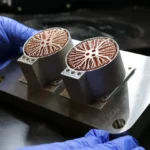
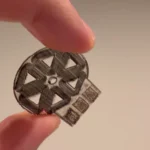
Researchers at MIT Lincoln Laboratory have developed a new low-temperature process for 3D printing glass objects. This method creates complex glass structures without requiring the high-temperature processing typically associated with glass manufacturing. The technique uses direct ink writing to build objects layer by layer at room temperature, followed by curing at just 250°C—significantly lower than the 1,000°C+ temperatures traditionally needed for glass processing.
New 3D Printing Technique Creates Glass Objects at Low Temperatures
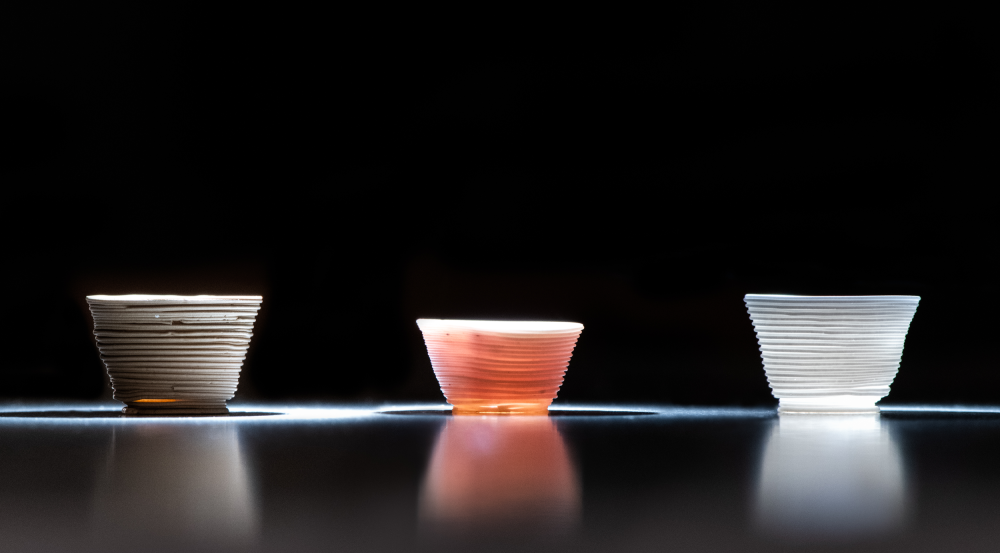
Researchers used the low-temperature additive manufacturing process to build the glass cups above. The optical behavior of the printed cups can be tailored by altering the chemical components of the inks. (Image Credit: MIT Lincoln Laboratory)

The process employs custom inks made from inorganic materials combined with a silicate solution. These components allow engineers to tailor the optical, chemical, and electrical properties of the resulting glass composite. After printing, the structures are cured in a mineral oil bath and then rinsed with an organic solvent to remove residual material.

Testing has demonstrated that the printed glass items maintain high resolution, good thermal stability, and experience minimal shrinkage during production. The method overcomes key limitations of conventional 3D printing materials like plastics and metals, which can suffer from mechanical, chemical, and thermal instabilities. Using inorganic composite glasses addresses many of these issues.

The technique could enable more widespread adoption of glass in additive manufacturing applications. Potential uses include microfluidic systems, free-form optical lenses or fiber, and high-temperature electronic components. The approach is particularly valuable for components that would be difficult or impossible to produce using traditional glass manufacturing methods.

Current research efforts are focused on improving the optical clarity of the printed glass. Scientists are also developing new ink formulations to expand the range of chemical and electrical properties available in the printed objects. The accessible nature of the ink ingredients and the geometric freedom offered by direct ink writing provide significant versatility for creating specialized glass structures.

Source: ll.mit.edu

Share:
WhatsApp Twitter Facebook LinkedIn Buffer Reddit E-mail
Join our newsletter

Our newsletter is free & you can unsubscribe any time.

Latest posts

MIT Researchers Let Users Repair AI-Generated 3D Models Before Printing

MIT CSAIL, with Google and Northeastern, built software that generates 3D models from prompts and lets users fix printability defects with language and... read more »

News
MIT Researchers Let Users Repair AI-Generated 3D Models Before Printing

Elegoo Day Sale 2026: The Four Best Prices, And How The Rest Compare

Elegoo Day runs to September 29 with up to 54% off. Four prices are the lowest we have on record, the material tiers... read more »

News

FibreSeek Opens Pre-Sale of FibreSeeker 3 Continuous Carbon Fibre Printer

FibreSeek has opened a limited global pre-sale of 500 FibreSeeker 3 printers, a desktop machine that lays continuous carbon fibre into plastic parts.

3D Printers
FibreSeek Opens Pre-Sale of FibreSeeker 3 Continuous Carbon Fibre Printer

Reverse Engineering Without CAD Data: How the MetroY Ultra Turns Physical Parts into Digital Designs

A custom seat tray for a 1984 Honda CB400, a hard-to-find grille for a VW Golf Mk1 Convertible, and a black throttle body... read more »

News

University of Amsterdam 3D Prints Ice Structures Without Supports

University of Amsterdam physicists have developed a way to 3D print structures out of ice that need no extra supports and melt back... read more »

News
University of Amsterdam 3D Prints Ice Structures Without Supports

RMIT 3D Prints Titanium That Floats

RMIT engineers have created a 3D-printed titanium material that floats in water even after severe damage, a candidate for jetties, buoys and marine... read more »

3D Printing Metal
RMIT 3D Prints Titanium That Floats

University of Waterloo 3D Prints Diamond-Shaped Electrodes for Flow Batteries

University of Waterloo researchers 3D printed a diamond-geometry electrode that improved redox flow battery performance by 52 percent in lab tests.

News

University of Maine Launches 30-Foot 3D-Printed Offshore Boat

The University of Maine launched a 30-foot 3D-printed boat designed for offshore speeds near 40 knots, skipping a new mold for every hull.

News
University of Maine Launches 30-Foot 3D-Printed Offshore Boat

SUNLU FilaDC i10: 10-spool filament dehumidifying cabinet

A co-branded storage cabinet that SUNLU rates to hold up to ten 1 kg spools at 10 to 55 percent RH without heating... read more »

News

ORNL Combines 3D Printing and Electroforming for Leak-Free Nuclear Parts

Oak Ridge National Laboratory and A.J. Tuck combined 3D printing and electroforming to make leak-free HIP cans for nuclear and energy components.

News
ORNL Combines 3D Printing and Electroforming for Leak-Free Nuclear Parts

Social

  • Facebook Facebook 3D Printing
  • Linkedin Linkedin 3D Printing
Join our newsletter

Our newsletter is free & you can unsubscribe any time.

banner
  • Flashforge AD5X

    • - Print size: 220 x 220 x 220 mm
    • - dual extrusion system
    More details »
    $399.00 Flashforge
    Buy Now
  • Anycubic Photon Mono M7

    • - Print size: 223 x 126 x 230 mm
    • - 10.1 inch 14K screen
    More details »
    $279.00 Anycubic
    Buy Now
  • Flashforge Guider 3 Ultra

    • - Print size: 330 x 330 x 600 mm
    • - dual extruder system
    More details »
    $2,999.00 Flashforge
    Buy Now
  • Snapmaker U1

    • - Print size: 270 x 270 x 270 mm
    • - multi-color printing with SnapSwap
    More details »
    $849.00 Snapmaker
    Buy Now
  • Qidi Q2

    • - Print size: 270 x 270 x 256 mm
    • - enclosed heated chamber up to 65°C
    More details »
    $580.00 Qidi
    Buy Now
  • Creality K2 Plus

    • - Print size: 350 x 350 x 350 mm
    • - multi-color printing
    More details »
    $1,199.00 Creality
    Buy Now
  • Anycubic Kobra S1 Combo

    • - Print size: 250 x 250 x 250 mm
    • - budget multicolor printing
    More details »
    $429.00 Anycubic
    Buy Now
  • Flashforge Adventurer 5M

    • - Print size: 220 x 220 x 220 mm
    • - 600mm/s travel speed
    More details »
    $299.00 Flashforge
    Buy Now
  • Creality Hi Combo

    • - Print size: 260 x 260 x 300 mm
    • - up to 16-color printing
    More details »
    $399.00 Creality
    Buy Now
  • Qidi Max 4

    • - Print size: 390 x 390 x 340 mm
    • - active cooling air control
    More details »
    $1,219.00 Qidi
    Buy Now

Company Information

  • What is 3D Printing?
  • Contact us
  • Join our mailing list
  • Advertise with us
  • Media Kit
  • Nederland 3D Printing

Blog

  • Latest News
  • Use Cases
  • Reviews
  • 3D Printers
  • 3D Printing Metal

Featured Reviews

  • Anycubic Photon Mono M5s
  • Creality Ender 5 S1
  • The Mole 3D Scanner
  • Flashforge Creator 3 Pro

Featured Industries

  • Automotive
  • Aerospace
  • Construction
  • Dental
  • Environmental
  • Electronics
  • Medical
  • Military
  • Fashion
  • Art
2026 — Strikwerda en Dehue
  • Home
  • Join our mailing list
  • Contact us
Blog
  • Latest News
  • Use Cases
  • Reviews
  • 3D Printers
  • 3D Printing Metal
Featured Industries
  • Automotive
  • Aerospace
  • Construction
  • Dental
  • Environmental
  • Electronics
  • Medical
  • Military
  • Fashion
  • Art
Company Information
  • What is 3D Printing?
  • Contact us
  • Join our mailing list
  • Advertise with us
  • Media Kit
  • Nederland 3D Printing