
3D Printing
News Videos Newsletter Contact us
Home / News / New 3D Printing Technique Offers Faster Production and Reduced Waste Innovating Multimaterial 3D Printing Efficiency
qidi

New 3D Printing Technique Offers Faster Production and Reduced Waste Innovating Multimaterial 3D Printing Efficiency

October 14, 2024

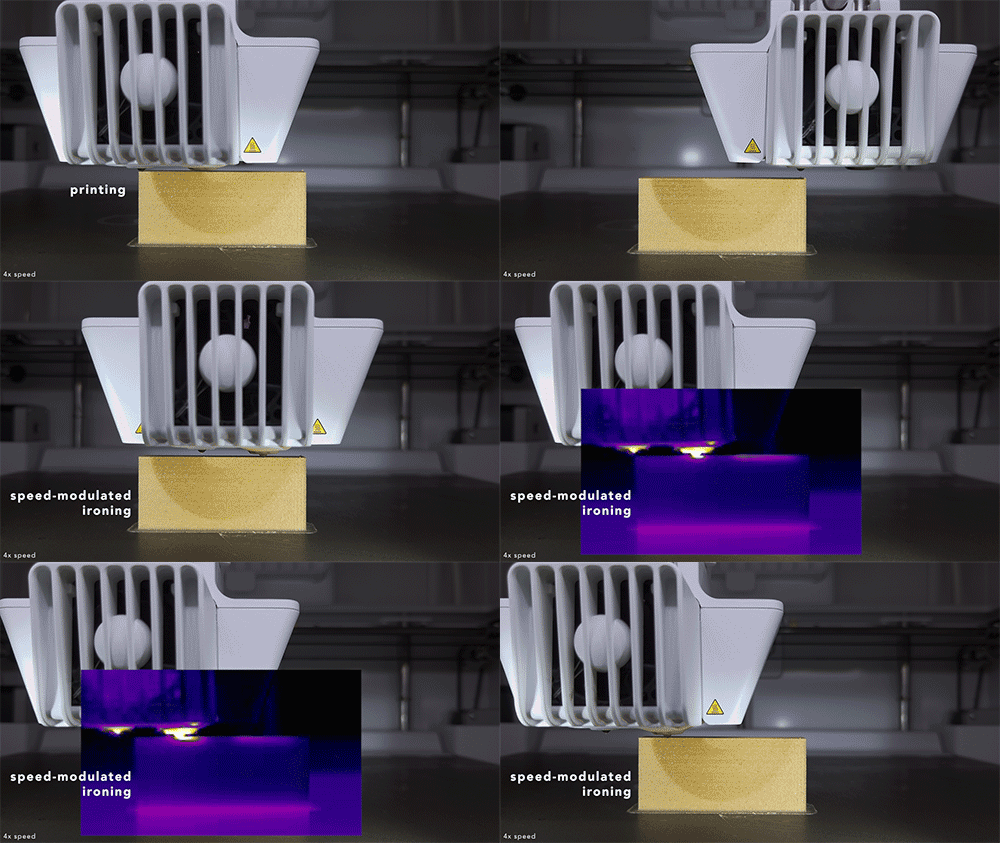
Researchers from MIT and Delft University of Technology have introduced a new technique in 3D printing called speed-modulated ironing. This method enables the creation of complex, multi-colored, and textured objects more quickly and with less waste compared to traditional multimaterial 3D printing methods. Current 3D printers often require multiple nozzles to deposit various materials, resulting in time-consuming processes and material waste. Speed-modulated ironing solves this by utilizing a dual-nozzle system that allows a more efficient approach to producing detailed objects.

How It Works: Heat-Responsive Filaments and Dual Nozzles

The new method involves the first nozzle depositing a heat-responsive filament, while the second nozzle “irons” the material by reheating it at controlled speeds, triggering specific responses such as changes in color, texture, or opacity. The innovative process doesn’t require any hardware modifications and operates more efficiently by adjusting the speed of the second nozzle instead of the temperature, allowing precise control over the printed object’s characteristics.
This approach not only increases the speed of production but also significantly reduces waste by using a single material to produce varied outcomes. As Mustafa Doğa Doğan PhD ’24, co-author of the study, explains, “We want to use a limited set of materials to create a much more diverse set of characteristics for 3D-printed objects.”

Applications and Benefits: Real-World Solutions

The speed-modulated ironing method opens doors to various real-world applications. For instance, the team successfully created translucent water bottles with gradients of opacity and bike handles with enhanced grip textures using the same material. Traditional methods of multimaterial 3D printing are not only slower but also lack the fine detail and precision offered by this new technique. With speed-modulated ironing, the researchers were able to achieve smoother transitions between colors and textures, all while reducing production time and energy consumption.
By testing their method with a variety of heat-responsive filaments like foaming polymers, wood fibers, and cork fibers, the researchers demonstrated how varying the speed of the second nozzle produced a range of unique textures and visual effects. This approach allows for more personalized and detailed fabrications while conserving material and energy.

Potential for Future Exploration

Looking ahead, the team aims to expand the range of materials that can be used with speed-modulated ironing. In particular, they are interested in thermally responsive plastics and other materials that could benefit from mechanical and acoustic property adjustments. The method’s adaptability to various materials could push the boundaries of 3D printing across multiple industries, from product design to healthcare.
As the technology evolves, the potential to create objects faster, with more precision, and less waste marks a critical step forward in the development of sustainable manufacturing. Speed-modulated ironing presents a powerful solution for industries seeking efficient, environmentally-friendly methods to produce complex, high-quality 3D-printed objects.
New 3D Printing Technique Offers Faster Production and Reduced Waste Innovating Multimaterial 3D Printing Efficiency

Collaboration and Research Impact

This project was a joint effort between MIT’s Computer Science and Artificial Intelligence Laboratory (CSAIL) and Delft University of Technology, reflecting a strong partnership focused on pushing the limits of 3D printing technology. The research team, led by Stefanie Mueller and Zjenja Doubrovski, continues to refine their technique, aiming to provide users with an easy-to-use interface that generates printing instructions based on material specifications.
Their work in speed-modulated ironing showcases the future of 3D printing, where customization and efficiency are at the forefront, and sustainable manufacturing becomes increasingly accessible.

Source: news.mit.edu
Share:
WhatsApp Twitter Facebook LinkedIn Buffer Reddit E-mail
Join our newsletter

Our newsletter is free & you can unsubscribe any time.

Latest posts

SonicMax Slice 10 Takes Aim at the Biggest Problem in Cordless Ultrasonic Cutting: Heat

A wireless ultrasonic cutter built for longer, cooler cutting sessions, now live on Kickstarter. Now live on Kickstarter Super Early Bird pricing from... read more »

News

Pusan National University team creates 3D-printable ink that lets soft actuators both stretch and contract

Researchers at Pusan National University in South Korea have developed the first 3D-printable smectic liquid crystal elastomer ink capable of switching molecular alignment... read more »

News
Pusan National University team creates 3D-printable ink that lets soft actuators both stretch and contract

Florida Firm 3D Prints Military Drone Boat Using Robotic Arms

A St. Petersburg, Florida manufacturing company has used large-format robotic 3D printing to produce a military drone boat, marking the latest expansion of... read more »

Military
Florida Firm 3D Prints Military Drone Boat Using Robotic Arms

FAU Lands $800,475 EPA Grant to Fight Algal Blooms With 3D-Printed Sargassum and AI

Florida Atlantic University has received an $800,475 grant from the U.S. Environmental Protection Agency to develop AI-guided, 3D-printed structures that pull excess phosphorus... read more »

Environmental
FAU Lands $800,475 EPA Grant to Fight Algal Blooms With 3D-Printed Sargassum and AI

QIDI Launches the QIDI Plus5: More Build Volume, a Hotter Chamber, and Cleaner Air for Under $750

QIDI's new large format machine adds 18 percent more build volume in the same footprint, a hotter chamber, and cleaner air, and it... read more »

News

MIT’s ShiftLens lets 3D-printed objects change appearance without electronics

MIT researchers have built a 3D-printing system that produces objects capable of changing their surface appearance in response to physical interaction, no electronics... read more »

News
MIT's ShiftLens lets 3D-printed objects change appearance without electronics

Almaty Designer’s Glue Free Sneaker Uses 3D-Printed TPU Sole

Almaty-based designer Daniyar Uderbekov has released an updated version of UDRB, a modular sneaker system built entirely without adhesives, combining a 3D-printed thermoplastic... read more »

Fashion

TU Graz’s 3D-Printed Ceramic Cubes Drop Nearby Air Temperature by 7 Degrees

Researchers at Graz University of Technology have built a ceramic cooling wall from 3D-printed porous cubes that lowered air temperature by nearly seven... read more »

Construction
TU Graz's 3D-Printed Ceramic Cubes Drop Nearby Air Temperature by 7 Degrees

3D Printed TPMS Foot Pads Cut Quadruped Robot Energy Use by Up to 6.2%

Researchers at Seoul National University of Science and Technology have developed 3D-printed porous foot pads for walking robots that reduce battery power consumption... read more »

News
3D-Printed TPMS Foot Pads Cut Quadruped Robot Energy Use by Up to 6.2%

Social

  • Facebook Facebook 3D Printing
  • Linkedin Linkedin 3D Printing
Join our newsletter

Our newsletter is free & you can unsubscribe any time.

Featured Industries

  • Automotive
  • Aerospace
  • Construction
  • Dental
  • Environmental
  • Electronics
  • Fashion
  • Medical
  • Military
  • Anycubic Kobra S1 Combo

    • - Print size: 250 x 250 x 250 mm
    • - budget multicolor printing
    More details »
    $429.00 Anycubic
    Buy Now
  • Creality Hi Combo

    • - Print size: 260 x 260 x 300 mm
    • - up to 16-color printing
    More details »
    $399.00 Creality
    Buy Now
  • Flashforge AD5X

    • - Print size: 220 x 220 x 220 mm
    • - dual extrusion system
    More details »
    $399.00 Flashforge
    Buy Now
  • Qidi Max 4

    • - Print size: 390 x 390 x 340 mm
    • - active cooling air control
    More details »
    $1,219.00 Qidi
    Buy Now
  • Flashforge Adventurer 5M

    • - Print size: 220 x 220 x 220 mm
    • - 600mm/s travel speed
    More details »
    $299.00 Flashforge
    Buy Now
  • Flashforge Guider 3 Ultra

    • - Print size: 330 x 330 x 600 mm
    • - dual extruder system
    More details »
    $2,999.00 Flashforge
    Buy Now
  • Qidi Q2

    • - Print size: 270 x 270 x 256 mm
    • - enclosed heated chamber up to 65°C
    More details »
    $580.00 Qidi
    Buy Now
  • Creality K2 Plus

    • - Print size: 350 x 350 x 350 mm
    • - multi-color printing
    More details »
    $1,199.00 Creality
    Buy Now
  • Anycubic Photon Mono M7

    • - Print size: 223 x 126 x 230 mm
    • - 10.1 inch 14K screen
    More details »
    $279.00 Anycubic
    Buy Now
  • Snapmaker U1

    • - Print size: 270 x 270 x 270 mm
    • - multi-color printing with SnapSwap
    More details »
    $849.00 Snapmaker
    Buy Now

Company Information

  • What is 3D Printing?
  • Contact us
  • Join our mailing list
  • Advertise with us
  • Media Kit
  • Nederland 3D Printing

Blog

  • Latest News
  • Use Cases
  • Reviews
  • 3D Printers
  • 3D Printing Metal

Featured Reviews

  • Anycubic Photon Mono M5s
  • Creality Ender 5 S1
  • The Mole 3D Scanner
  • Flashforge Creator 3 Pro

Featured Industries

  • Automotive
  • Aerospace
  • Construction
  • Dental
  • Environmental
  • Electronics
  • Medical
  • Military
  • Fashion
  • Art
2026 — Strikwerda en Dehue
  • Home
  • Join our mailing list
  • Contact us
Blog
  • Latest News
  • Use Cases
  • Reviews
  • 3D Printers
  • 3D Printing Metal
Featured Industries
  • Automotive
  • Aerospace
  • Construction
  • Dental
  • Environmental
  • Electronics
  • Medical
  • Military
  • Fashion
  • Art
Company Information
  • What is 3D Printing?
  • Contact us
  • Join our mailing list
  • Advertise with us
  • Media Kit
  • Nederland 3D Printing